 Digital Vikingz
 / Content not converting
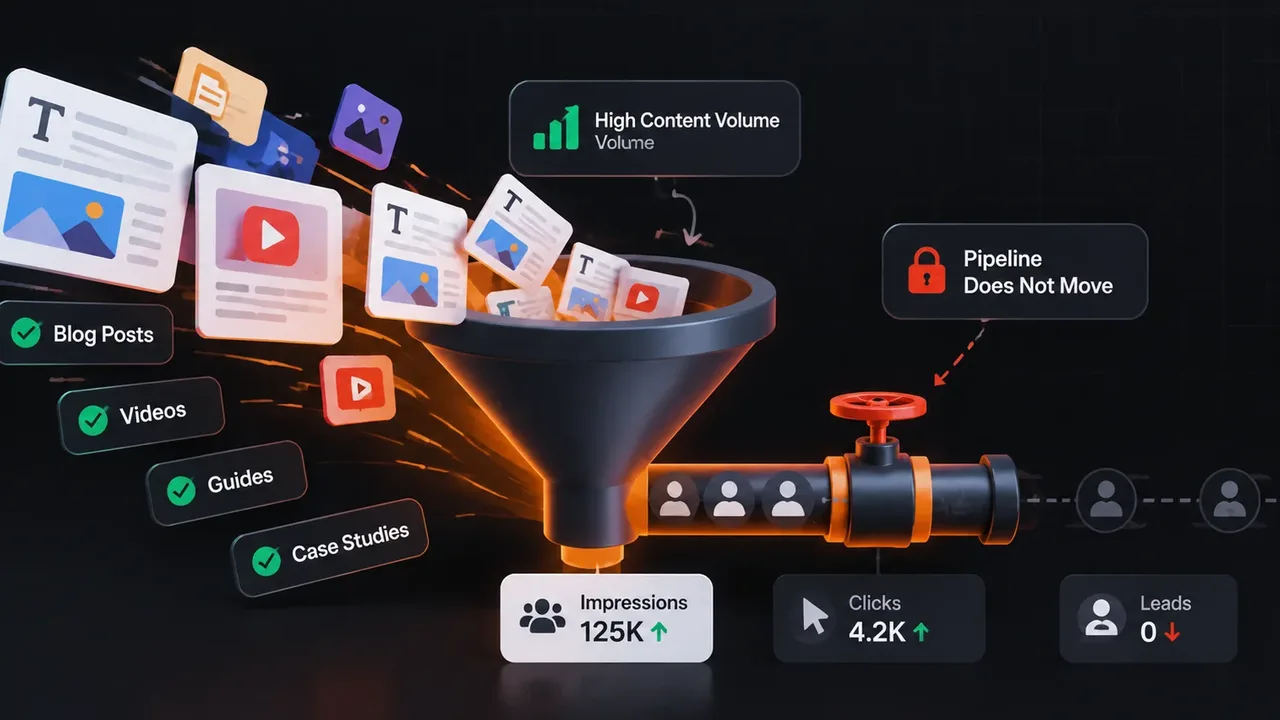
Content Ships Every Month and Pipeline Does Not Move
Content that earns traffic but no leads is usually missing the bottom of the buyer's path: the comparison, vendor and decision pages. SEO Reporting and Attribution maps the buyer's query path, builds the missing stages and reports leads by cluster.
Why does content earn traffic and no leads?
Content earns traffic and no leads when the site covers the first two stages of the buyer's path and none of the last three.
A buyer moves through five stages: problem, category, comparison, vendor and decision. Problem guides and category lists bring sessions. Comparison, pricing and demo pages bring leads. Many sites publish the first two stages every week and never build the last three, because nobody mapped the path.
Two other faults produce the same symptom. In the first, blog posts compete with service pages for the same query, so the reader lands on an article and never reaches the offer. In the second, converting pages exist but no outer page links to them, so the reader who finishes a guide has nowhere to go.
How is the fault found?
The fault is found by sorting your Search Console queries into the buyer's path and checking each stage for the right page.
Search Console queries are sorted into the five stages, and sales call notes supply the questions buyers ask before they sign. Each stage needs a page of the right type with the right main component: a diagnosis block, a ranked list with visible criteria, a typed comparison table, a pricing page with a working estimator, a demo page with the form first.
Three gaps show up: an empty stage, a stage whose page has the wrong component, and a stage whose page nobody links to.
What gets built?
Comparison, vendor and decision pages get built first, in roadmap order.
Comparison pages name the competitors and state the differentiating attributes as typed values. Vendor pages carry pricing as visible text and a working estimator. Decision pages carry the form or booking above the fold as the main component, rendered without JavaScript.
Attribution is wired at the same time: every form submission records its source page, CRM stage fields match the path stages, and analytics and Search Console group pages by cluster.
What does the report show?
The report shows sessions, leads, opportunities and closed revenue per cluster, monthly, with rankings in the appendix.
The four numbers sit on page one. The report names the cluster that produced each qualified lead and the cluster that produced only sessions, so the next month's production goes where the pipeline is.
Who is this page for?
The page serves B2B companies whose content earns traffic but no leads.
A pipeline exists to attribute to, and most SEO reports never touch it.
Pipeline by cluster belongs in a board deck, and rankings do not.
A site without lead capture or a CRM has nothing to attribute. Add lead capture first, then start with the Semantic SEO Strategy.
Questions about content that does not convert
Do we stop publishing blog posts?
Do you need access to our CRM?
Our sales cycle is nine months. How do you report?
Do comparison pages have to name competitors?
Who approves claims about competitors?
Can you attribute AI-referred traffic?
What happens to our existing pricing and comparison pages?
Does this replace the architecture?
Services that fix it
The audit names the cause. The services below carry out the fix.
See which page was meant to produce the lead
On a 30-minute call we sort your top queries into the five stages and show you the stage with no page.