 Digital Vikingz
 / Not appearing in AI search
Not Appearing in AI Search: Why the Answer Names Your Competitor and Not You
A site is not appearing in AI search when ChatGPT, Perplexity, Claude, Gemini and AI Overviews find no passage on it they can quote. AI engines cite standalone sentences that state one fact about a named entity, under a named author. AI Search Visibility fixes the structural layer those systems read, so your pages become citation candidates.
Why is your site missing from AI answers?
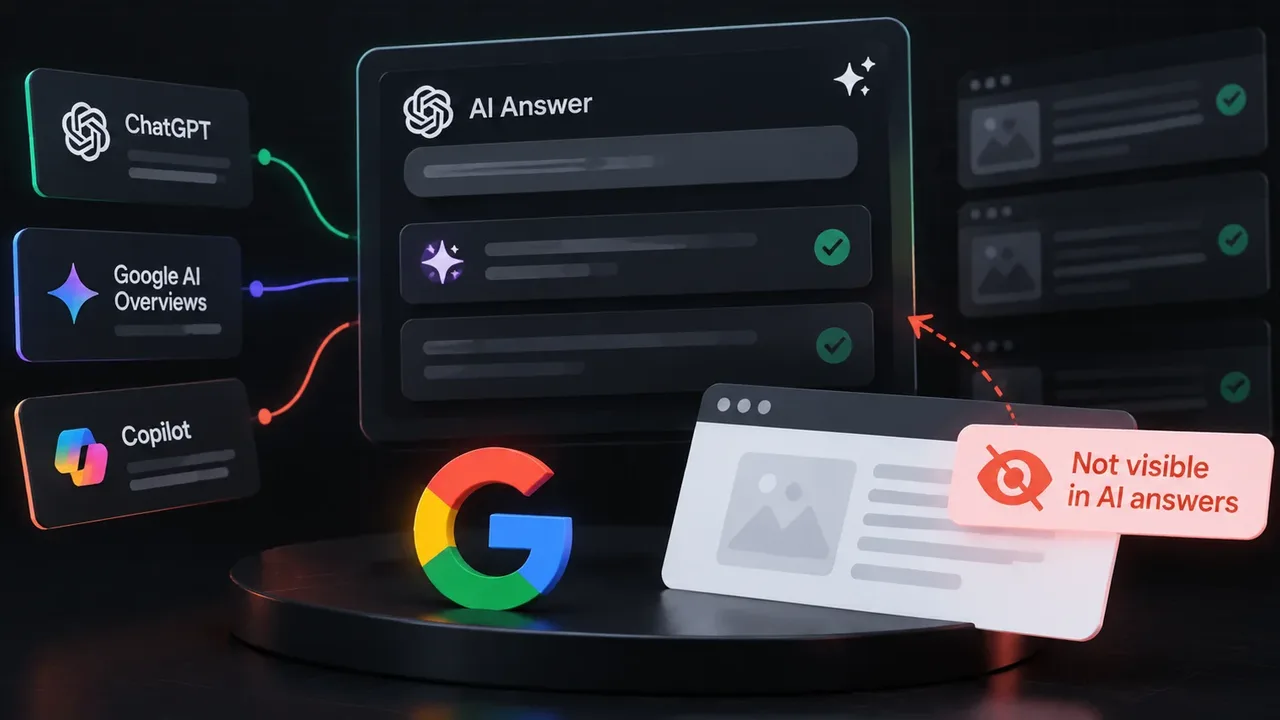
A site is missing from AI answers for one of four reasons, and ranking well in Google is not one of them.
Google's filing on generative search describes selecting a handful of documents per query, splitting them into passages and linking each summary sentence to a passage that verifies it. Confidence rises as more trustworthy documents agree. Four faults keep a site out of that process:
- No sentence states a fact about the entity on its own. The claims are adjectives such as leading, trusted or innovative.
- The page has no named author and the site has no identity block, so the trust inputs are empty.
- The site words its facts differently from every other source, so nothing corroborates them.
- The page answers the head query and none of its rewrites, so it never enters the document set.
The structure that earns an AI citation is the same structure that ranks in Google Search.
How does the engagement find the gap?
The engagement finds the gap by running a fixed prompt set and recording a baseline before anything changes.
We run twenty to fifty buyer prompts on each system and record, sentence by sentence, which sources are cited. Every later month is compared against that baseline.
Each core page is then read against six requirements: passage independence, one fact per sentence, corroborated wording, author and organization identity, image text agreement and next-step coverage. Each requirement has a test that runs before and after the change.
What changes on the site?
Four structural changes make a page citable.
Every H2 block opens with a declarative sentence that answers on its own. Every verifiable claim gets its own sentence with the entity, the attribute and the value. Consensus facts take the wording the field uses, and claims only your site makes carry their evidence in the same block. Every page names its author, links to a profile and sits one click from an identity block.
Stable ids go on every heading so a citation can link to the passage, and captions go under every image. The three to five follow-up questions a system generates for each query get a block on the page or a page in the cluster.
What does progress look like?
Progress is a sentence-level record, re-run monthly on the same prompt set.
The first citations usually appear on the outer pages, the definitions and guides, before the commercial pages. ChatGPT can cite a new source before AI Overviews does, because its selection is less tied to Google rankings. The record names each cited sentence and its system, so the next month's work targets the pages still absent.
No one controls which candidate a system cites, so the work makes every page a candidate that passes the published checks.
Who is this page for?
The page serves brands whose buyers ask an AI assistant first and hear a competitor's name.
The answer names three vendors, and the work is to be one of them.
Generative answers in these fields draw from sources with visible authorship and corroborated claims.
A site with no pages to cite yet starts with the Semantic SEO Strategy, because AI search visibility is a layer on pages that exist.
Questions about AI search visibility
Do we need to rank on page one first?
Is this GEO or AEO?
Does schema markup fix this?
Does this change our Google rankings?
Which systems do you check?
Can you guarantee citations?
Who writes the author profiles?
Does this work in German or Spanish?
Services that fix it
The audit names the cause. The services below carry out the fix.
See which of your sentences an AI can quote
On a 30-minute call we run three prompts live, show who is cited, and read the page that was meant to be cited.