 Digital Vikingz
 / Traffic dropped after a core update
Traffic Dropped After a Core Update: What Changed and How It Comes Back
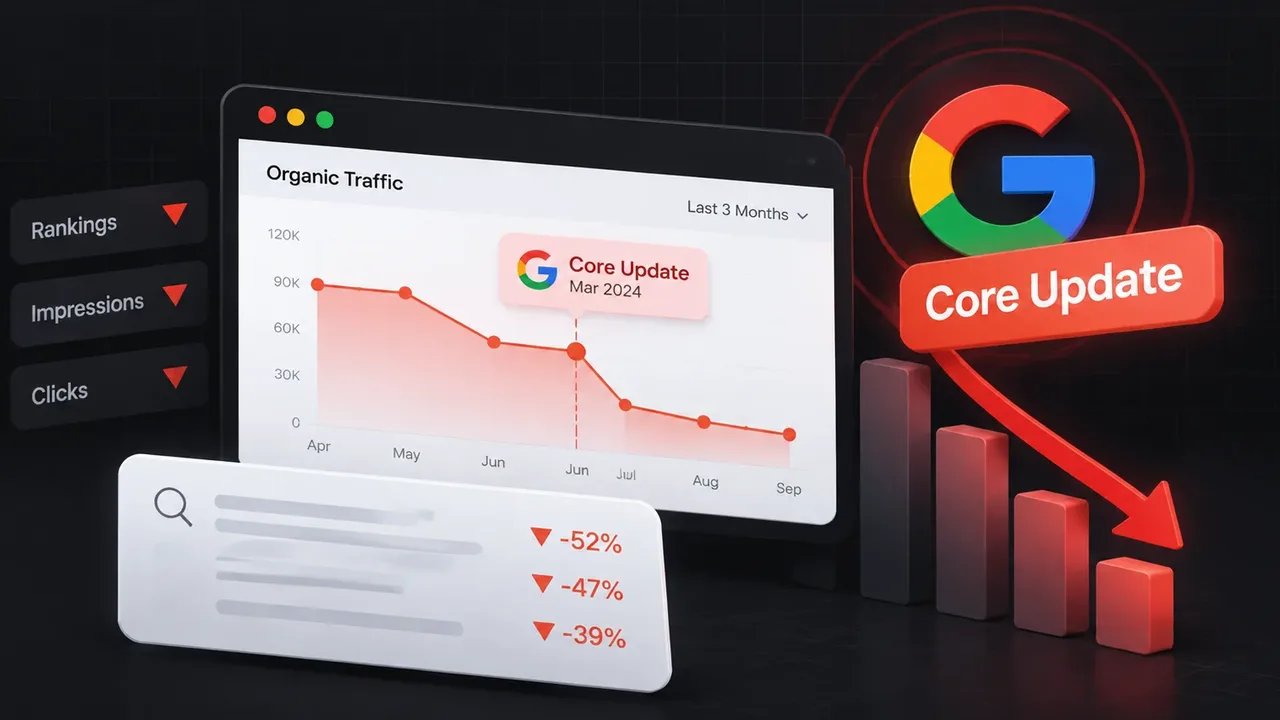
A traffic drop after a Google core update is a relevance recalculation, not a penalty. The update re-reads every page for entity, intent and layout, so a page built on keyword matching loses the position it was renting. The Semantic SEO Audit reads your site the way the update did, names the pages that lost queries and ranks the fixes by cost.
Why does traffic drop after a core update?
Traffic drops after a core update when the site reads as a collection of pages instead of one source.
Google's ranking systems guide describes core updates as broad changes to how content is assessed, not actions against a site. Every page is re-scored on the same signals: what the page is about, which pages on the site compete for the same query, and where the main content sits.
Three patterns account for most drops we audit:
- Two or more pages target one query, so the update picks one and the others lose.
- The vocabulary drifts: one service carries three names, so the site reads as three weak sources.
- The main content sits below a carousel, share bar or author widget, so the first 400 characters say nothing about the entity.
Each pattern is a structural fault the update found, not a penalty.
How does the Semantic SEO Audit read a core update drop?
The Semantic SEO Audit compares the queries each page held before and after the update, then reads the page for the fault that explains the gap.
We export Search Console for the 28 days before and after the update date and list every page that lost impressions, with the queries it lost. Each lost query is grouped by the page that now holds it. A sibling page on your own site means cannibalization, and a competitor means a coverage or layout fault.
Every flagged page then passes six checks: entity coverage, predicate consistency, semantic dilution, centerpiece and block order, AI citation readiness and competitive entity gaps. The output is a written issue map, ranked by the cost of each fix.
What changes after the audit?
The fix list runs in a fixed order: merge, vocabulary, layout, then coverage.
Pages competing for one query merge into one URL, and the others redirect to it. The vocabulary is fixed in a source term vector before any rewrite. Templates move the main component to the top of the page. Coverage gaps are filled last, in roadmap order, because new pages on a broken structure repeat the fault.
Sites with more than one fault type usually move on to the Semantic SEO Strategy, and the issue map becomes its first phase, so nothing is paid for twice.
What does recovery look like in Search Console?
Recovery shows as query count rising per template before clicks rise.
Merged pages show their combined queries on one URL within a crawl cycle. Impressions rise first on the re-anchored pages, and clicks follow once position settles. The next core update is the test: a site that holds through it has stopped renting positions.
The results page shows this curve on client properties consolidated before expansion: a flat or falling period, then the bend upward.
Who is this page for?
The page serves site owners whose Google traffic fell at a core update and has not come back.
The audit names the fault and the order of fixes.
The partial recovery was a content fix on a structural fault.
A site with fewer than ten indexable pages holds too little to audit and starts with the strategy call.
Questions about core update drops
Was my site penalised?
Can I recover before the next update?
Do I delete the pages that lost traffic?
Do I publish more content to recover?
What does the audit include?
Does the audit cover technical SEO?
What do you need from me?
What if the audit says the drop is not structural?
Services that fix it
The audit names the cause. The services below carry out the fix.
Find out what the update found
On a 30-minute call we open your Search Console, compare the before and after, and tell you which fault explains the drop.