Topical authority architecture for the diabetes patient education vertical — entity-driven content clusters, condition guides, and information-gain content engineered for high-stakes healthcare buyer queries.
Digital Vikingz builds the entity infrastructure that ranks in Google and gets cited by ChatGPT, Perplexity, Claude, and AI Overviews. We engineer structural authority — using Koray Tuğberk Gübür's semantic SEO methodology proven across 200+ projects in 40+ industries.
Google rewrote the rules with Helpful Content updates and AI Overviews. ChatGPT, Perplexity, and Claude opened a second search layer entirely — one where rankings don't matter, but citations do. The businesses winning this shift aren't producing more content. They're producing structurally authoritative content that AI systems quote and Google recognizes as the source.
Sites engineered around entity architecture survive algorithm updates and grow stronger over time. Sites built on isolated keyword optimization reset with every update — and clients wonder why a year of work didn't move the line.
LLMs cite entities with predicate consistency and structural credibility. Generic content gets ignored regardless of word count. Sites with clean Source Term Vectors and defined entity hierarchies become the source AI quotes.
Trying to rank for everything signals semantic dilution. Owning a topic deeply — with predicate-clean content, comprehensive query path coverage, and reinforced entity signals — produces the authority that converts clicks into pipeline.
The businesses that win the next decade aren't producing more content. They're claiming fewer topics, deeper, with structural integrity that compounds.
Digital Vikingz isn't a content factory or a link broker. We're a semantic SEO architecture firm — and the businesses we work with experience six structural shifts inside their search and pipeline operations. These aren't promises. They're the outcomes the methodology produces when it's applied correctly.
Every asset we publish reinforces the Central Entity. No more articles that rank briefly, drop, and need to be rewritten in 12 months.
Sites built on entity architecture are structurally aligned with what Google's helpful content systems reward. Updates stop being existential events.
ChatGPT, Perplexity, Claude, and Google's AI Overviews start quoting your site as a primary source — capturing the high-intent traffic competitors are losing.
You don't compete for keywords anymore. You own the topic. New competitors entering your space have to climb past architectural authority — not just outrank a few pages.
We engineer bottom-funnel content clusters tied to qualified pipeline — not vanity traffic. Every quarter, the work justifies itself in pipeline numbers, not impression charts.
We deliver the architecture, the briefs, the system. Your in-house team executes against a structured blueprint instead of trying to invent strategy from scratch every month.
Three operating principles. Three service tiers. One outcome — businesses that own their topic, defend that ownership against AI dilution and competitive pressure, and convert authority into measurable pipeline.
We map your Central Entity, design the topical hierarchy, and build the semantic foundation that lets your site rank for the topics that matter. Architecture is engineered before a single article is written.
We optimize for citation in LLMs and AI search, reinforce entity signals across the open web, and ensure topical authority compounds — instead of eroding with every algorithm shift or competitor entry.
We engineer query path coverage from awareness to conversion, attribute SEO output to pipeline impact, and expand topical clusters strategically — based on entity logic, not content calendars.
Digital Vikingz runs methodology, not process. Every engagement is grounded in semantic SEO principles developed by Koray Tuğberk Gübür and proven across 200+ projects in our hands. These four principles separate authority-building work from generic SEO.
Search systems index entities and the relationships between them. Digital Vikingz builds sites around the Central Entity and its supporting concepts, then attaches query coverage to that structure. Keywords become outputs of the architecture — not inputs to it. This is why the work survives core updates that reset other sites.
Every site has a vocabulary it speaks. When that vocabulary drifts across pages, search engines and AI systems lose confidence in the entity. We define Source Term Vectors at the architectural layer and enforce them across content, internal linking, and external signals — eliminating the semantic dilution that flatlines most sites.
Getting cited by ChatGPT, Perplexity, Claude, and Google's AI Overviews is not an afterthought optimization. It's a function of how cleanly your entity is defined, how consistent your predicates are, and how much information gain each page contributes. We engineer for AI citation at the architecture layer.
Every page Digital Vikingz publishes earns its place in your topical map by adding something that doesn't already exist on the SERP. We don't summarize. We extend the topic, fill agreement-area gaps, and contribute new attribute coverage — which is exactly what helpful content systems and AI retrieval models reward.
Every service maps to a tier in the Claim · Shield · Scale framework. Each one is fully scoped — you know exactly what's inside the deliverable before you commit. Most clients begin with an audit or architecture engagement and expand outward as the system matures.
Semantic SEO works differently in every industry. Buyer query paths, entity hierarchies, predicate vocabularies, and conversion patterns shift dramatically across verticals. Digital Vikingz has refined the methodology across these primary industries — and we map your specific page architecture to the buyer behavior of your category.
Plus deep work in local services, professional services, education, legal, automotive, manufacturing, hospitality, and content publishing — across copywriting, blog production, conversion content, and full topical authority programs.
Five stages. Sequenced so each one earns the next. Digital Vikingz doesn't sell month-to-month tactical work — we engineer outcomes across cycles. Most engagements run 6 to 18 months, with attribution layered in from week one.
Diagnose entity coverage, predicate consistency, semantic dilution, AI visibility gaps. Output: prioritized issue map.
Design topical map, Source Term Vector, entity infrastructure, and content sequence. Output: 12-month blueprint.
Execute briefs, content, configuration, internal linking, and authority link reinforcement against the architecture.
Amplify across AI search, LLMs, and the open authority network. Engineer entity recognition at the citation layer.
Measure impact on qualified pipeline — not vanity metrics. Tie rankings, citations, and traffic to revenue outcomes.
This isn't a comparison to other agencies. It's a description of how the operational reality of your search and content function shifts when Digital Vikingz architects the system. The transformation is observable inside the business — usually within the first two quarters.
Authority is claimed through evidence — not adjectives. The work below represents semantic SEO programs Digital Vikingz has delivered for businesses across SaaS, e-commerce, professional services, healthcare, local services, and content publishing.
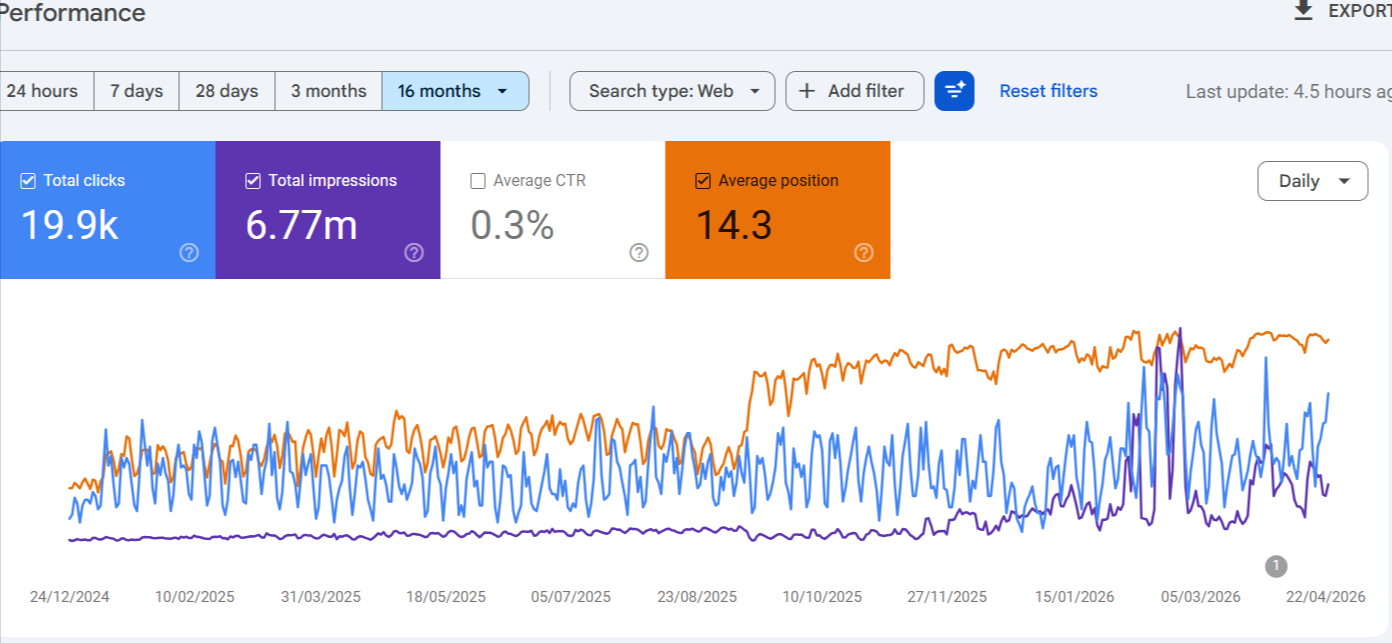
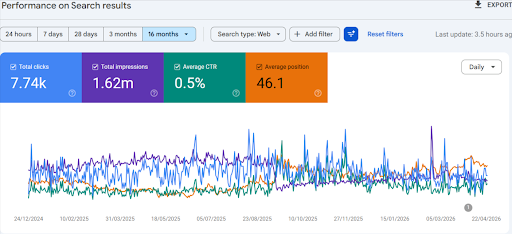
Topical authority architecture for the diabetes patient education vertical — entity-driven content clusters, condition guides, and information-gain content engineered for high-stakes healthcare buyer queries.
Semantic content engineering for international calling vertical — Source Term Vector definition, comparison cluster architecture, and predicate-clean writing across high-conversion buyer queries.
Topical authority program for the aviation training simulator category — entity-driven feature pages, comparison architecture, and bottom-funnel content engineered for high-intent commercial pilot queries.
Bottom-funnel content architecture for BCG CCA and consulting platform comparison clusters. Founder-aligned semantic content engineered for sophisticated B2B buyer queries and AI consultation citation.
Author-led content platform for an entrepreneurial thought leader — semantic content production, technical SEO diagnostics, and CMS migration governance to support compounding personal-brand authority across a high-velocity publishing schedule.
Topical authority program for the Florida boating safety and education vertical — semantic content clusters built around licensing, safety, and seasonal boating queries with state-specific entity infrastructure.
Semantic SEO program for a destination wellness and hot springs venue — entity architecture spanning experience, location, and hospitality query paths to capture high-intent travel research traffic.
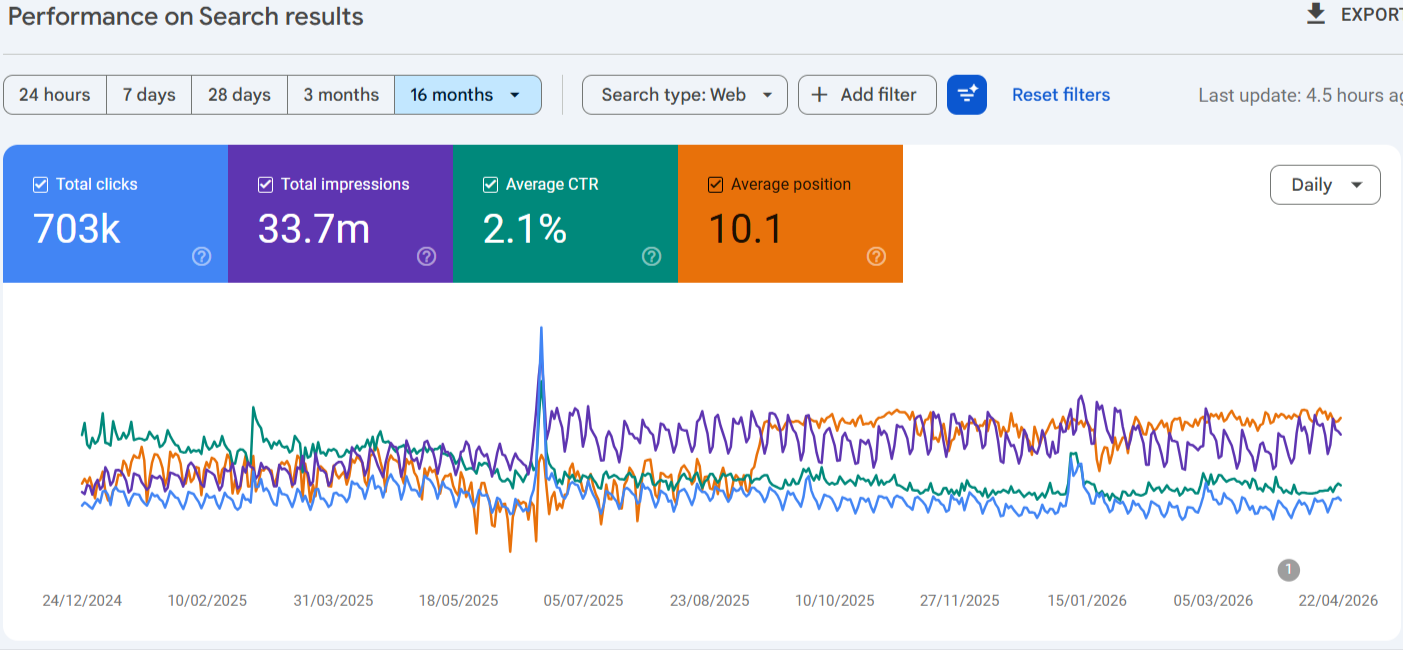
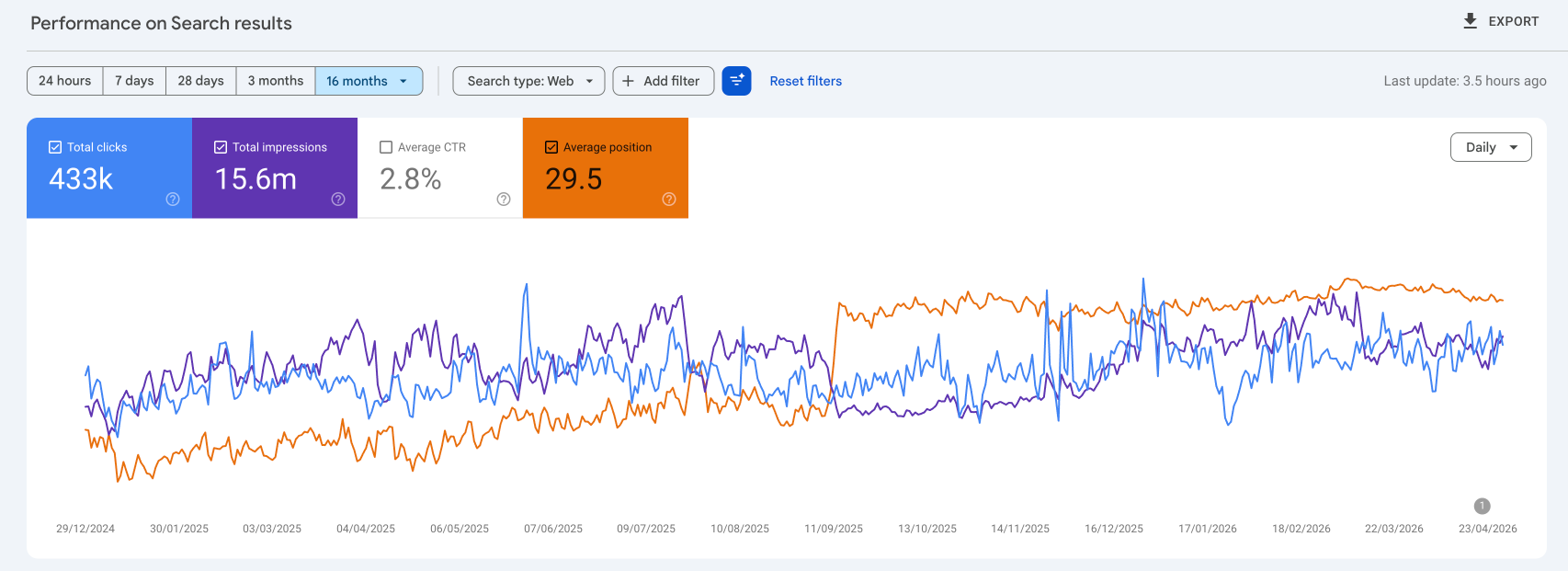
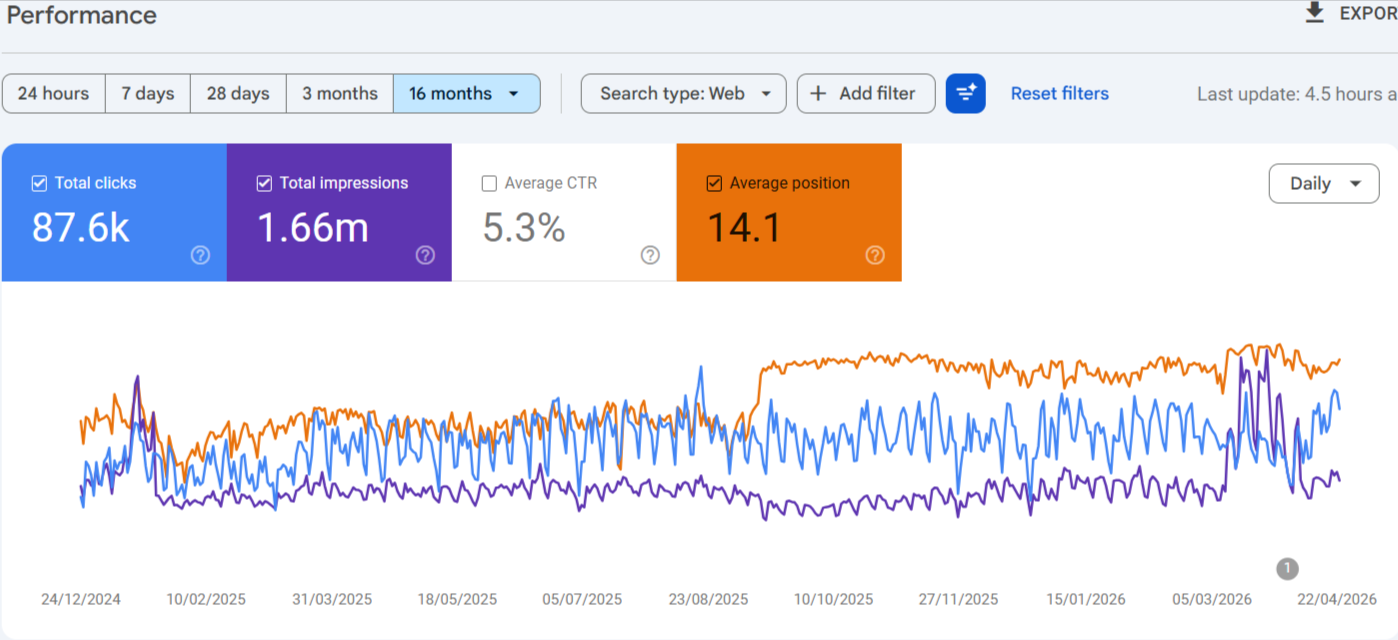
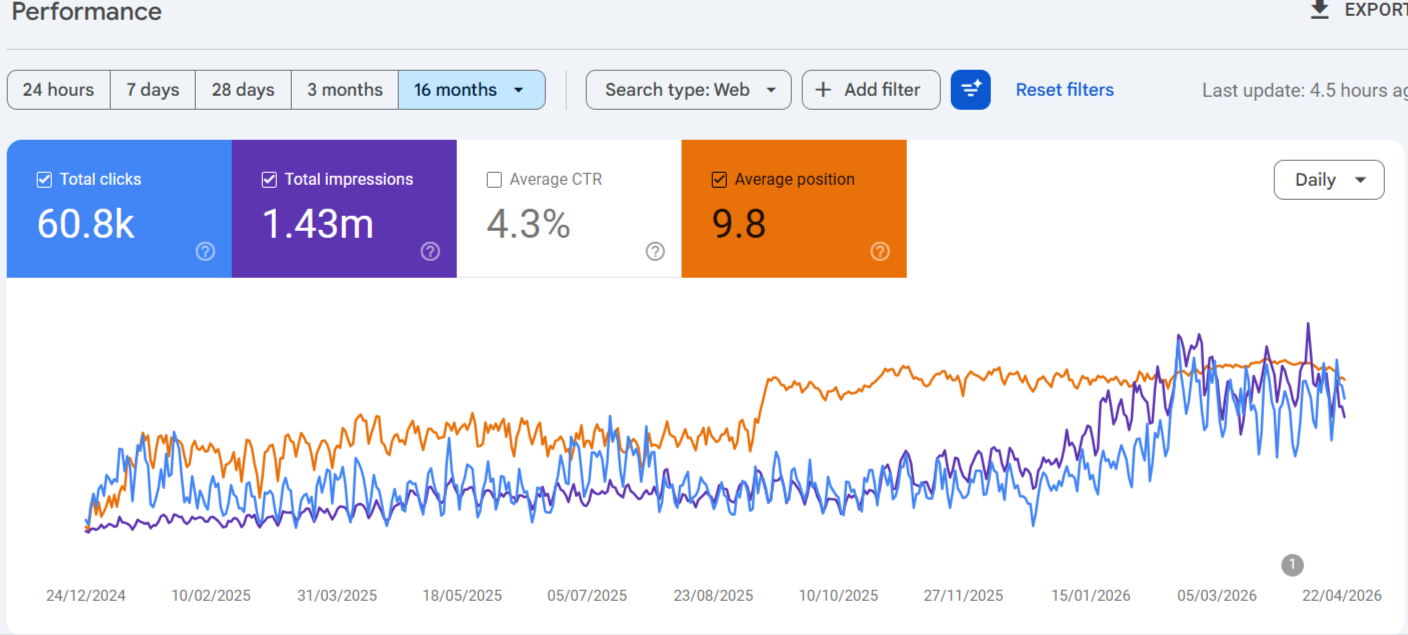
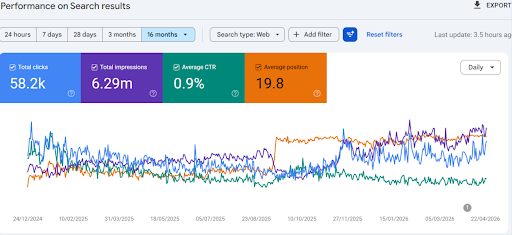
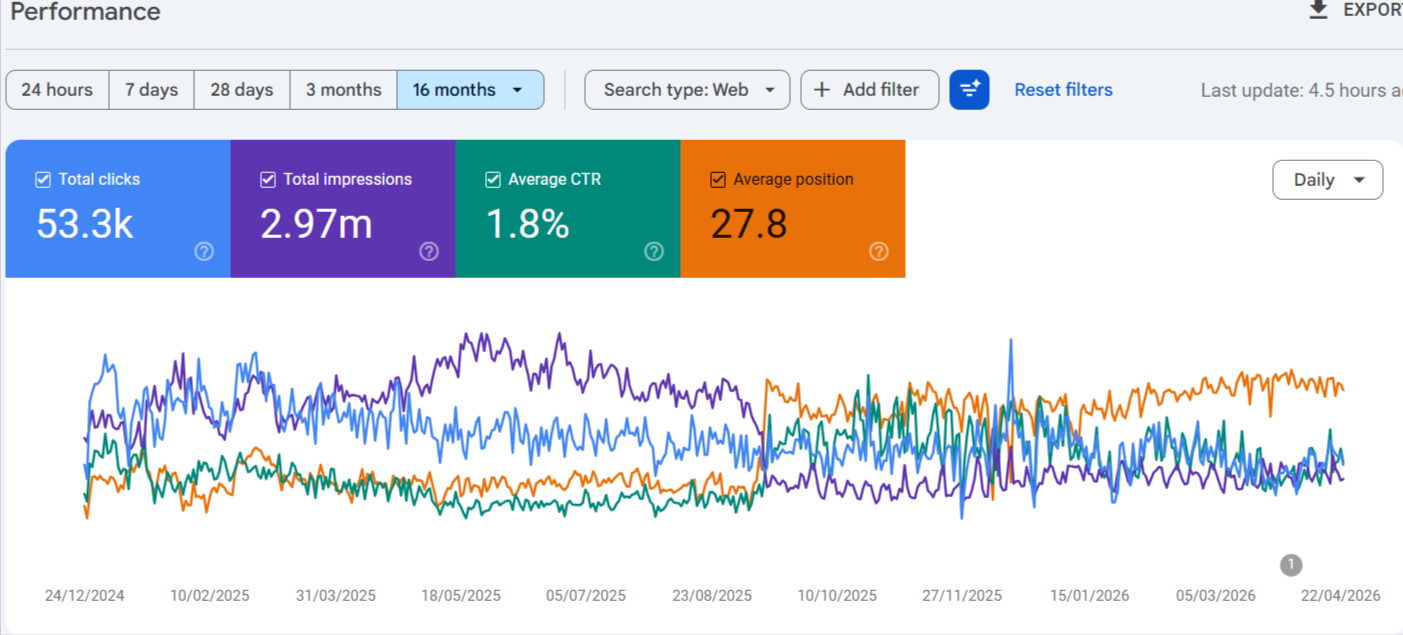
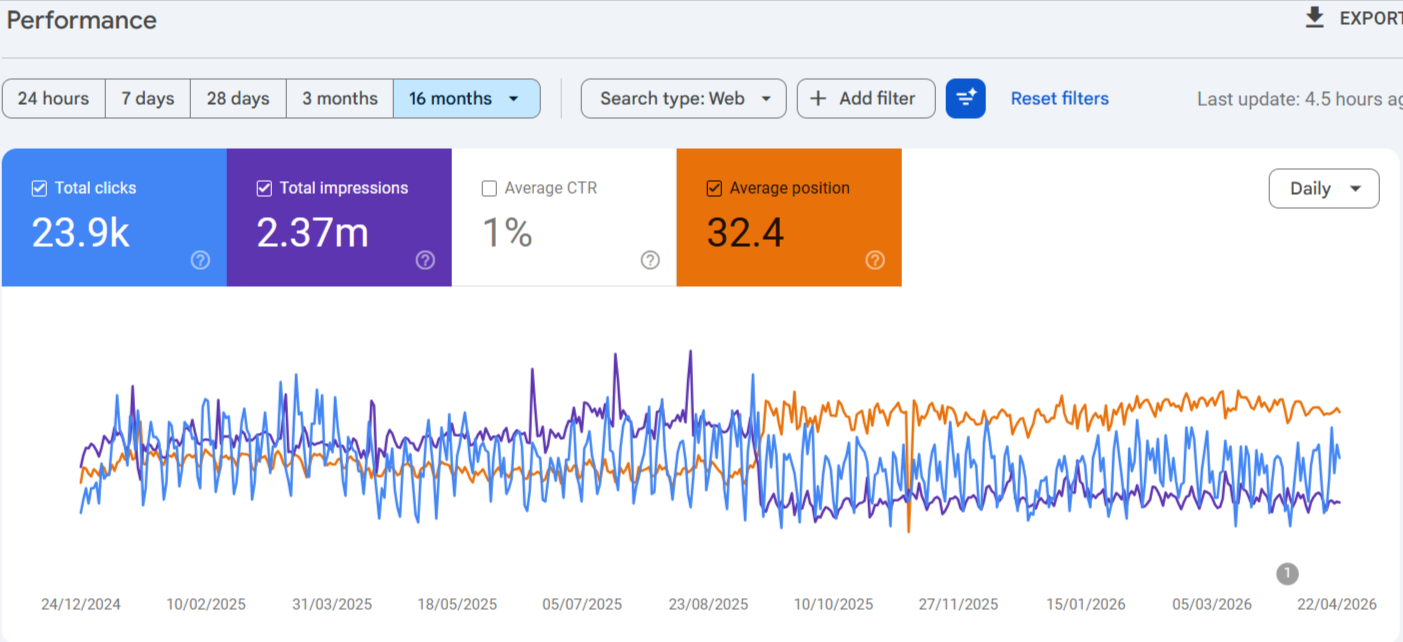
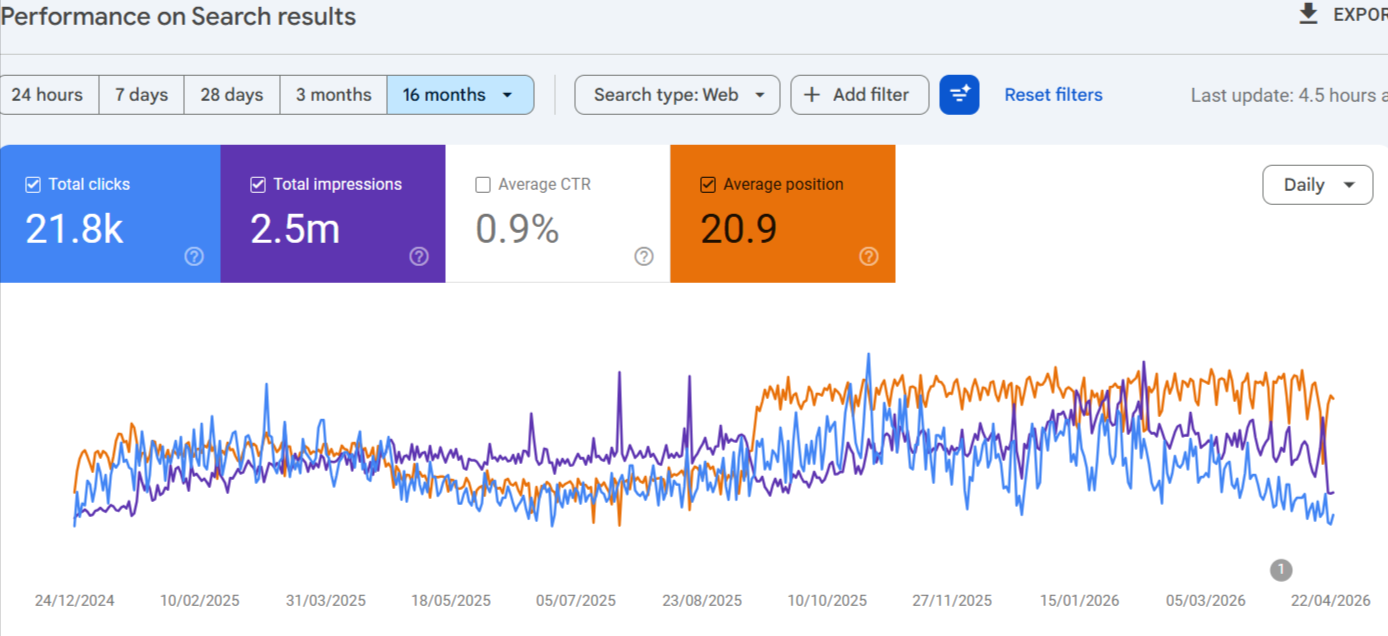
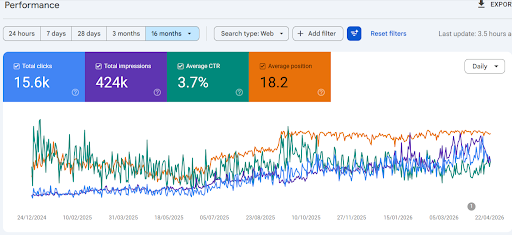
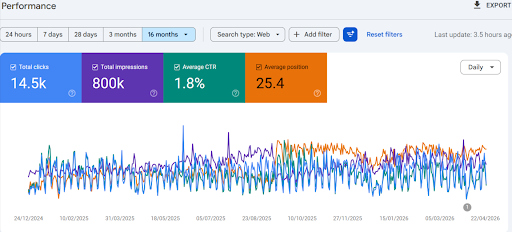
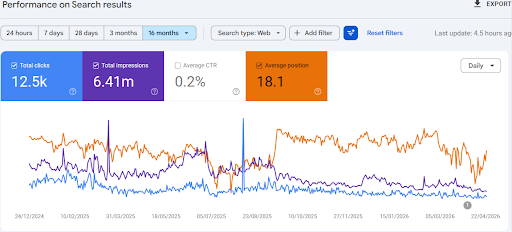
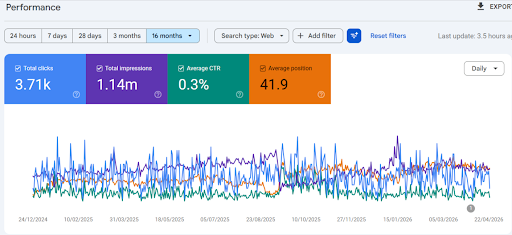
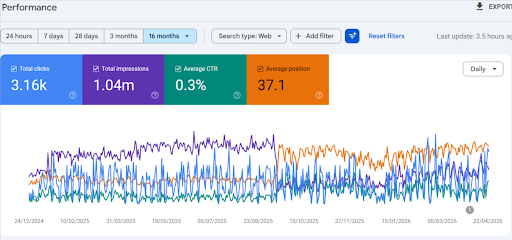
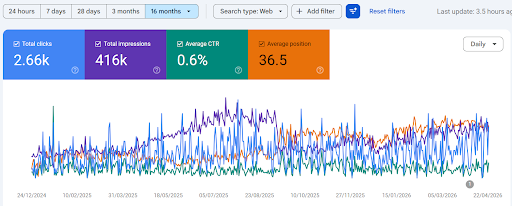
Most agencies show case study graphics. Digital Vikingz shows the actual Google Search Console panels — clicks, impressions, position, and the full 16-month curve. The screenshots below are pulled from real client properties spanning SaaS, healthcare, e-commerce, local services, IT, B2B, and content publishing. Different industries. Same methodology. Same compounding pattern.
Screenshots are anonymized for client confidentiality. Full case context, traffic-to-pipeline attribution, and methodology details are shared on the strategy call.
Digital Vikingz is a 15-person specialist team. Every operator on staff is trained on the Koray methodology, the agency's internal Semantic SEO Master Instruction, and the operating standards that govern entity-clean content production. We hire for depth — not for headcount.
Architect of every engagement. Six years applying the Koray methodology across 200+ projects in 80+ industries. Owns strategic direction, methodology governance, and senior client engagement.
Owns delivery operations across the agency. Manages the workflow systems, team coordination, and quality governance that ensure semantic SEO programs ship on architecture, on time, on standard.
Heads content production governance. Owns brief integrity, editorial standards, banned-phrase enforcement, and the publishing workflow that turns architecture into entity-reinforcing assets.
Trained writers, semantic SEO analysts, link acquisition operators, technical SEO engineers, and AI visibility specialists working across active client architectures every day.
For clients running active semantic SEO programs with us, Digital Vikingz offers in-house implementation support — built so structural integrity carries through from architecture to publish without handoff loss. These services are not sold standalone. They exist only to protect the integrity of the SEO work.
These are the questions that come up consistently on first calls. Every answer is the version Digital Vikingz would give in a real sales conversation — direct, specific, and aligned with how engagements actually run.
The math is straightforward when you separate activity from asset. A traditional retainer pays for monthly tactics — content volume, link counts, status reports — that reset value to zero every quarter. The work is rented, not owned.
Semantic SEO architecture pays for an asset. The topical map, the entity infrastructure, and the authority that compounds across cycles belong to your business permanently. Most engagements break even on pipeline impact within the first 6–9 months and produce returning gains for years afterward — including across algorithm updates that reset competitor sites entirely. We share the unit economics on the discovery call once we understand the topic and current baseline.
Google penalizes thin, generic, low-information-gain content — regardless of whether a human or an AI produced it. The 2024 helpful content updates clarified this directly: the discriminator is structural quality and information gain, not authorship.
We use AI as a research and acceleration layer inside a human-governed methodology. Briefs, entity definitions, predicate consistency, fact integrity, and editorial standards are owned by trained operators. AI assists with research synthesis and draft generation; it never determines what gets published. Every asset goes through a Koray-aligned brief and editorial QA before it ships. That's the difference between AI-assisted authority content and the AI slop Google penalizes.
Most of our clients have internal teams. The architecture engagement is designed to empower in-house operators, not replace them. We deliver the topical map, the entity blueprint, the briefs, and the publishing standards — your team executes against the system instead of inventing strategy from scratch every quarter.
Clients typically choose one of three models. We handle architecture, your team handles production. We handle architecture and briefs, your team handles writing. Or we handle everything, and your team focuses on distribution and conversion. All three work — the right fit depends on your team's capacity and where you want internal time to focus.
Specialized industries are where semantic SEO produces the strongest leverage. The deeper and more technical the topic, the more clearly entity architecture separates authoritative sites from generic content factories — because the buyer queries are precise, the predicates are specific, and the agreement areas are well-defined.
We've architected programs in aviation training simulators (Crewsim), consulting platform technology (Prepmatter), telecom infrastructure (Mytello), healthcare patient education (Diabetics Trust, ADHD Dude), and dozens of other technical verticals. The methodology adapts to the topic — the architecture changes; the principles don't. If your category has a defined entity, semantic SEO works.
Digital Vikingz has executed 200+ projects across 40+ industries over six years on the Koray methodology. The reference work spans healthcare patient-education (Diabetics Trust, ADHD Dude), B2B SaaS (Prepmatter, Crewsim, Mytello), professional services (AJ Kumar, AdvancedSE), hospitality and destination travel (World Springs, CFL Boating), e-commerce (Pepthrive), and content publishing (EarnEdits, Articlegen).
On the discovery call, we walk through a case study from a vertical adjacent to yours — including the architecture decisions, the publishing sequence, and the measurable outcomes that resulted. We don't make blanket promises; we show the specific work and let the structure speak for itself.
You're never locked in. The architecture engagement is project-priced and stands on its own — you receive the complete blueprint, topical map, entity infrastructure spec, and 12-month publishing roadmap as a permanent deliverable your business owns.
From there, ongoing engagement is a choice. Many clients continue with Digital Vikingz for production, AI visibility, link building, and attribution work because the methodology is easier to execute through us than to operationalize internally. Others take the architecture and execute it with their internal team. Both paths are intended outcomes — the architecture is built to be ownable, not held hostage.
Yes — but only for active semantic SEO clients. Digital Vikingz offers SEO-architected WordPress development and authority distribution support as implementation extensions of the core SEO work. Neither is sold standalone, because both only produce real outcomes when built on the same entity architecture as the SEO program.
If you need a standalone website build or a generalist social media manager, we'll point you to a partner. It's the right answer for both of us.
Two stages. First, a 30-minute fit call — we understand the business, the topic, and the goal; you understand the methodology, the team, and how engagements run. No pitch decks, no canned slides.
If there's mutual fit, we move to the Semantic Audit as the structured entry point: a paid, fixed-scope diagnostic with a written deliverable. The audit either becomes the foundation of an architecture engagement, or it becomes a roadmap your internal team executes. Both outcomes are intended.
The audit is the structured entry point. Fixed scope, written deliverable, zero commitment to longer engagement. If the methodology fits your business, we move forward. If it doesn't, you leave with a roadmap your team can execute.