 Digital Vikingz

Schema markup affects AI visibility indirectly in three places: entity disambiguation for the brand and the author, product data for shopping answers, and the dates and authorship a system reads alongside the passage. The work that moves citation rate is the passage: one standalone sentence under each heading, consensus wording, a named author and an index entry on each system. Schema belongs to mention rate, not citation rate.
Entity card
Field | Value |
Term | Schema markup and AI citations |
Also called | Structured data for AI search, JSON-LD for LLM visibility, schema for GEO |
Part of | AI Search Visibility, entity layer |
Depends on | Organization, Person, Article and Product markup that matches the visible page |
Produces | Entity clarity for the brand and author; eligibility for rich results; no citation on its own |
Measured by | Mention rate on the prompt set, not citation rate |
Not the same as | A citation-ready passage |
What does schema markup do?
Schema markup states the entities, attributes and values on a page in a machine-readable form, so a search engine reads them without parsing the prose.
The markup is a block of JSON-LD in the page that names the organisation, the author, the article, the product or the local business, with the properties each one has. Google uses the markup for two purposes: eligibility for rich results in Search, and entity data that feeds its understanding of who published the page and what the page is about.
Schema markup describes. The markup does not rank, and the markup does not answer a question. A searcher's question is answered by a sentence on the page, and the markup tells the engine which organisation wrote that sentence.
Does schema markup produce AI citations?
Schema markup does not produce AI citations, because a citation links to a passage of text that answered the prompt, and markup holds no such passage.
What does Google say about markup and AI features?
Google states that no special markup, structured data or configuration is required for content to appear in AI Overviews or AI Mode.
Google's documentation on AI features says the same requirements apply as for appearing in Search: the page is indexable, follows the quality guidelines and serves the user. The documentation names no schema type as a condition for citation. A page with no markup and a strong passage is cited. A page with complete markup and a dependent passage is not.
What do AI systems retrieve, and what does schema hold?
AI systems retrieve text passages and select the one that answers the prompt on its own, and schema markup holds property values rather than answering sentences.
An answer to "how long does a configuration pass take" comes from a sentence that states the duration. A JSON-LD block states the author, the date and the headline. The block never states the duration. The system quotes the sentence and links the page; the block played no part in that selection.
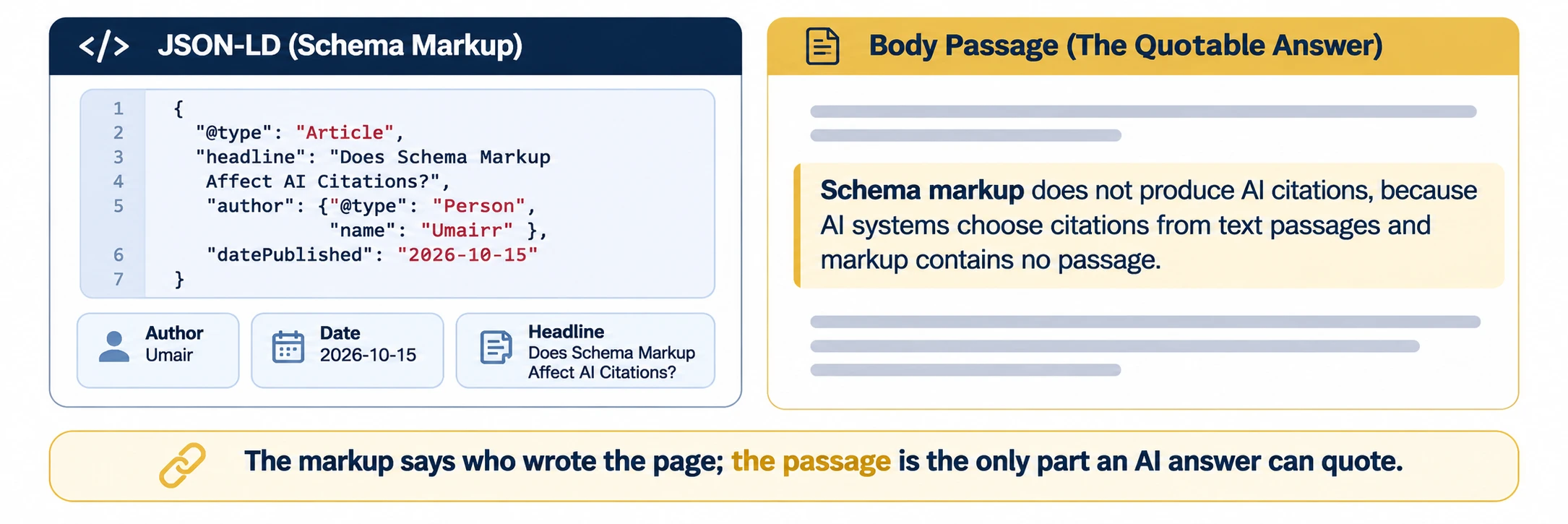
The image above shows the two side by side. The block on the left tells the engine who wrote the page and when. The passage on the right is the only part an AI answer can quote.
Does FAQ schema help a page appear in AI Overviews?
FAQ schema does not help a page appear in AI Overviews, and Google limited FAQ rich results in 2023 to authoritative government and health sites.
The questions and answers themselves still matter, as text under headings. The markup around them earns nothing in AI features and, outside the two site types Google named, nothing in rich results either.
Where does schema markup help AI visibility indirectly?
Schema markup helps AI visibility indirectly through entity disambiguation, product data, and the authorship and dates a system reads beside the passage.
The indirect effects of schema markup on AI visibility are listed below:
Markup | What the markup settles | Which metric moves |
Organization with sameAs | One brand, one set of profiles, one definition across the web | Mention rate |
Person with jobTitle and sameAs | The author as a distinct entity tied to the topic | Mention rate, attribution in citations |
Article with author and dates | Who wrote the page and when the facts were current | Freshness reading on citations |
Product with Offer | Name, price, availability and identifiers for shopping answers | Product citations in shopping systems |
LocalBusiness with address and hours | The business as a place, matched to the business profile | Local recommendations |
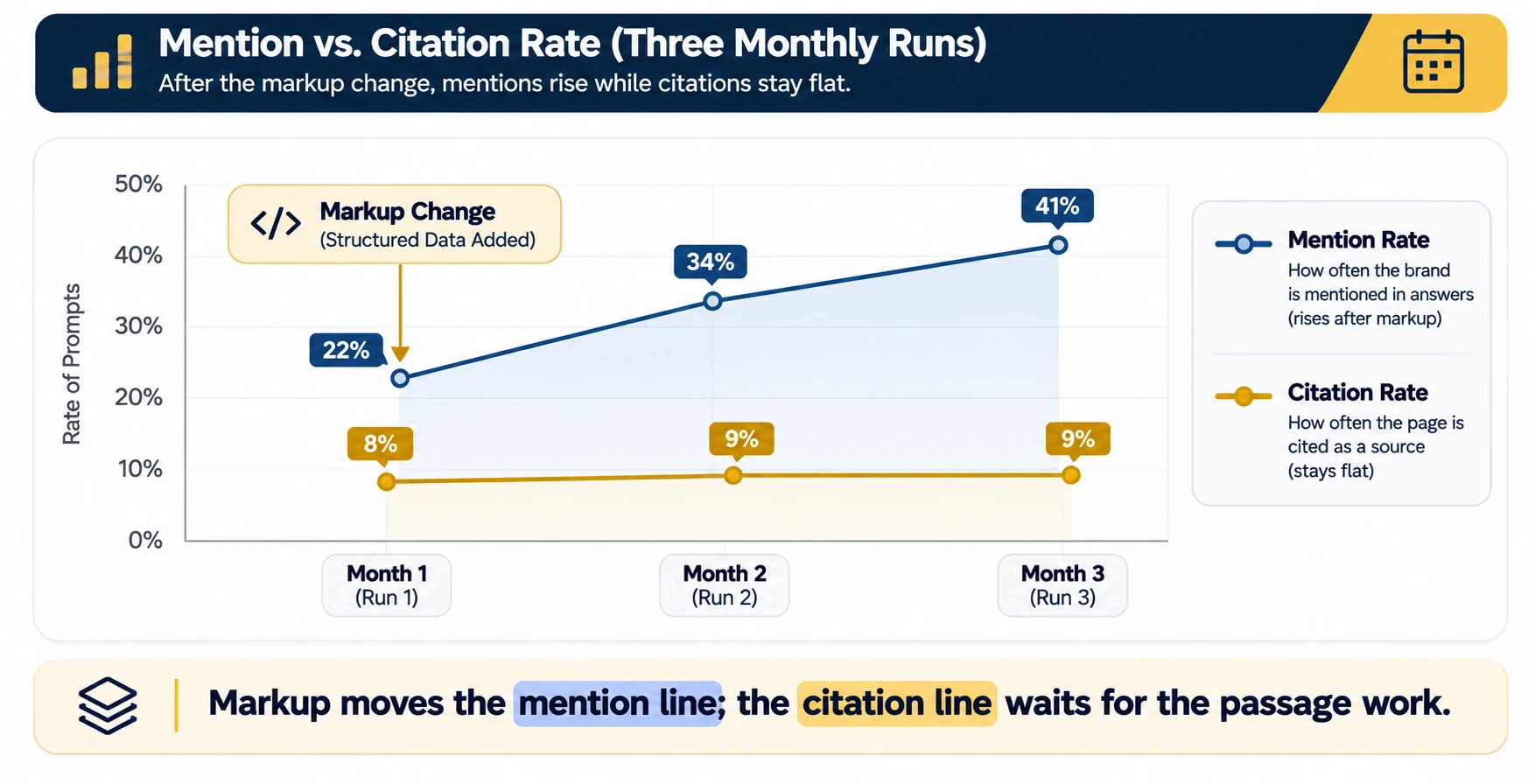
The image above shows what a markup change does on a prompt set: the mention line rises after month one and the citation line stays flat until the passages change.
How does Organization markup affect mention rate?
Organization markup affects mention rate by fixing one brand entity with one name, one definition and one set of profiles, so an AI system associates the brand with the topic instead of splitting the association across variants.
A brand written three ways across the web is three weak entities. Organization markup with a canonical name, an alternateName for the known variant and sameAs links to each profile tells the engine the three are one. The association between brand and topic accumulates on one entity, and the brand is named in answers more often.
How does Product markup affect shopping answers?
Product markup affects shopping answers by supplying the name, price, availability and identifiers that shopping systems read, where those systems draw on page data or merchant feeds.
Product answers in AI systems can draw on structured product data and merchant feeds, according to the shopping documentation each system publishes. A product page with complete Offer data is a candidate for those answers. The product's description passage still decides whether the page is quoted for a question about the product.
How do you test whether schema markup changed AI visibility?
Schema markup is tested by running the prompt set before and after the markup is added, and reading mention rate and citation rate on separate lines.
The steps to test the effect of schema markup on AI visibility are listed below:
Run the fixed prompt set on each system and record, per answer, the brands named and the URLs linked. That record is the baseline.
Add or correct the markup: Organization, Person, Article, and Product where products exist. Validate the markup against the visible page.
Change nothing else on the pages in the set for the test window. A passage rewrite in the same window hides the result.
Re-run the prompt set one month later and again at two months.
Read mention rate per system. A rise with no passage change is the markup's effect on the entity.
Read citation rate per system. No change is the expected result, and a change points to re-indexing or a competitor's move rather than the markup.
We run the test on every site where the client expects schema to lift citations. The result is the same each time: mention rate moves when the entity was inconsistent before, and citation rate waits for the passage work.
What moves AI citations instead of schema markup?
AI citations are moved by the passage: a standalone answering sentence under each heading, consensus wording, a named author, dated facts, coverage of follow-up questions and an index entry on each system.
The page requirements behind citation rate are defined in AI citation readiness, with the test for each. The diagnosis of a page that ranks and is still not cited runs through the seven causes of ranking without citation.
Schema markup supports two of those requirements, authorship and dates, by stating in markup what the page already states in text. The markup confirms; the text qualifies.
How does structured data fit an AI Search Visibility engagement?
Structured data fits an AI Search Visibility engagement as entity work in the first month, done once and validated, while the passage work runs across the cluster.
The engagement writes Organization and Person markup to match the brand definition used on every surface, adds Article markup with true dates to every content page, and validates the lot against the visible text. The markup is then left alone. The monthly prompt-set run reads mention rate for the markup's effect and citation rate for the passage work's effect, on separate lines.
AI Search Visibility sets out the six requirements the engagement tests. The markup itself is implemented through Website Development, where the template carries one Organization block site-wide and one Article block per page.
Which schema mistakes hurt AI visibility?
Schema mistakes hurt AI visibility when the markup describes something the visible page does not show, names the brand differently from the page, or declares several Organization entities on one site.
The schema mistakes that hurt AI visibility are listed below:
Markup not matching the page. An author in the markup who is not named on the page, or a rating in the markup with no reviews shown. Google's structured data policies require the markup to reflect visible content, and a mismatch removes rich result eligibility.
Brand name variants. The Organization name spelled one way in markup and another in the footer. The entity splits.
Several Organization entities. A theme, a plugin and a manual block each declaring an Organization with different details. The engine reads three organisations.
FAQ and HowTo markup as a tactic. Markup added for a rich result that no longer exists, cluttering the page with no gain.
Dates that are not true. A dateModified updated on every deploy. The freshness signal becomes noise.
Author and organization entities covers how the person and the organisation are declared once and kept consistent.
See what your markup settles and what your passages win
On a 30-minute call we read your Organization and Person markup against your pages, run three buyer prompts live, and show you which answers name the brand and which link the page. You leave with the two lists, with or without an engagement.
Book a strategy call · Request the audit
Questions about schema markup and AI citations
Does ChatGPT read schema markup?
ChatGPT search reads the page text through Bing's index and OpenAI's crawler. Organization and Product markup contribute to the entity and product data those indexes hold. The citation is still chosen from the text passage.
Does Article markup with an author raise citations?
Article markup confirms the author the page already names. The visible author block with a role and a profile is what the system reads beside the passage. Markup without a visible author adds nothing.
Should a business remove schema markup that earns nothing?
No, when the markup is accurate. Accurate Organization, Person and Article markup costs nothing and settles the entity. Markup for retired rich results, such as FAQ on most sites, is removed to keep the page clean.
Does schema markup help a page appear in Perplexity?
Not for citation. Perplexity cites passages from its own index. Consistent entity data helps the brand be named in Perplexity's answers, which is mention rate.
Is JSON-LD better than microdata for AI systems?
Google recommends JSON-LD for structured data. AI systems read the page's text for citation either way, so the format question concerns rich results and entity parsing, not citation.
Does speakable markup matter for AI answers?
Speakable markup was defined for voice assistants reading news. Google lists speakable as a limited feature, and AI answer systems do not depend on it.
Can markup fix a brand that AI systems describe wrongly?
Markup is one of the sources that settle the entity, alongside the About page, the business profile and third-party pages. A wrong description is corrected across all of those, and markup alone does not overturn the others.
Does LocalBusiness markup help a business get recommended by AI?
LocalBusiness markup matched to the business profile settles the place entity. Recommendations draw on reviews, the business profile and third-party mentions as well, so the markup is one input of several.
How is schema markup validated?
Google's Rich Results Test checks eligibility for rich results. The Schema Markup Validator checks syntax against the vocabulary. Both are run after any template change, and the visible page is compared with the markup by eye.
Does adding more schema types raise the chance of citation?
No. Citation rate is a passage outcome. More types add more properties to validate and more places for a mismatch, with no effect on which sentence a system quotes.
Which comes first on a new site: markup or passages?
Both in the first month, because the markup is written once and the passages are written into every page from the start. On an existing site the markup is fixed first because the fix is one template change, and the passage work follows across the cluster.