Digital Vikingz
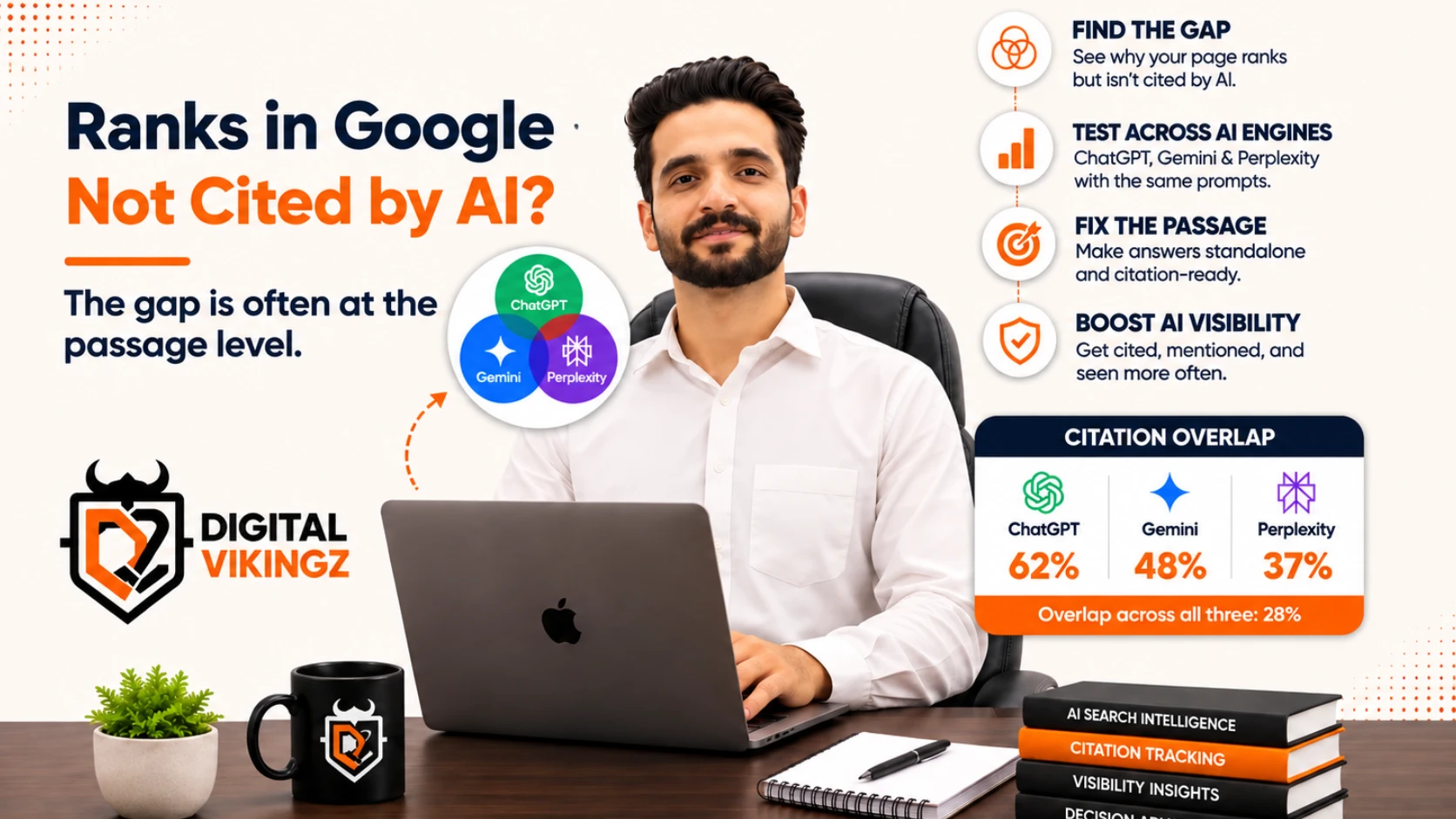
Seven causes open the gap: a passage that depends on its context, an answer buried in the page, wording that departs from consensus, a page missing from the system's index, no entity attached to the passage, follow-up questions left uncovered, and no date on the facts. Each cause has a test that takes minutes and a fix that stays on the page. A page that ranks has already cleared the hard part; the gap is closed at the passage level.
Entity card
Field | Value |
Term | Ranking without AI citation |
Also called | Ranks but not cited, organic ranking without AI Overview citation, citation gap |
Part of | AI Search Visibility diagnosis |
Depends on | A prompt-set record of cited sources, the page's passages, and the index each AI system reads |
Produces | One cause per prompt and one passage fix per cause |
Measured by | Citation rate per system on the same prompt set after the fix |
Not the same as | A page that ranks nowhere, or a page cited without a brand mention |
What is the difference between ranking in Google and being cited by AI?
Ranking in Google is a decision about a document, and being cited by AI is a decision about a passage inside that document.
Google scores the document: relevance of the whole page to the query, links pointing at the page, the site's history on the topic, and the page's quality signals. The top result is the best document.
An AI system builds an answer from passages. The system retrieves candidate pages from an index, splits them into passages, selects the passages that answer the prompt and its sub-questions, and writes the answer with links to the passages used. The cited source is the best passage, not the best document.
The two decisions use different indexes as well. Google AI Overviews and AI Mode retrieve from Google's index. ChatGPT search retrieves from Bing's index and OpenAI's own crawl. Perplexity retrieves from an index of its own. A page can lead Google's results and be absent from the index another system reads.
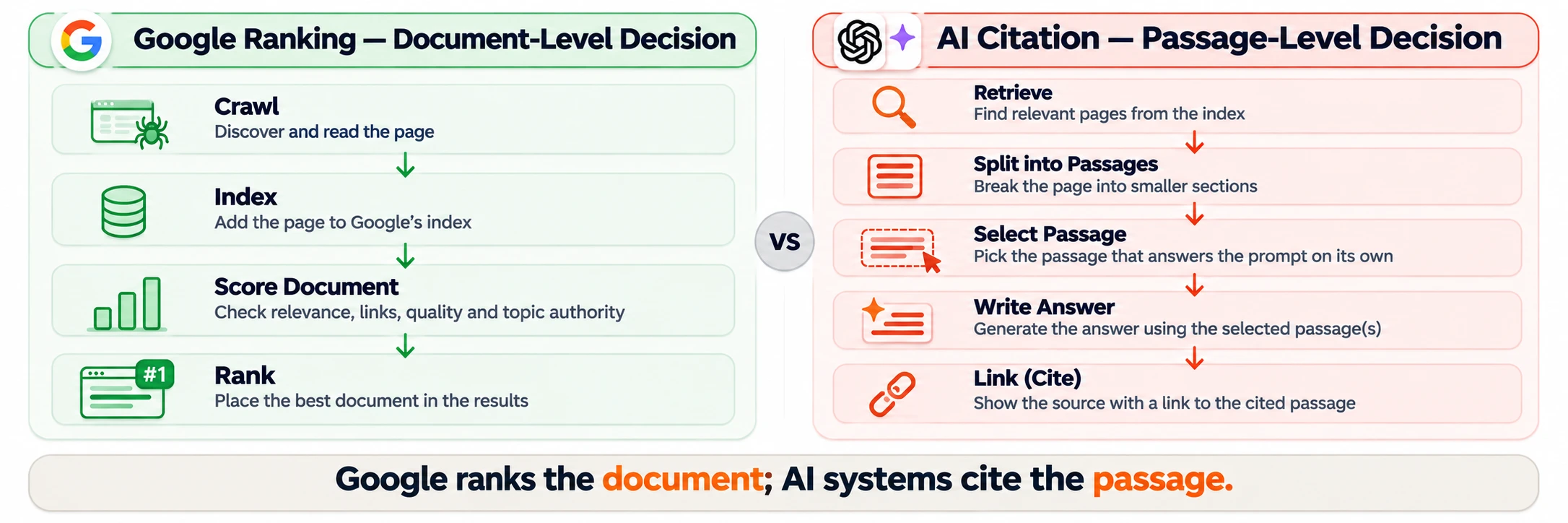
The image above sets the two pipelines side by side. The left column ends at a ranked document. The right column ends at a quoted passage with a link. Seven faults sit between the two.
Why does a ranking page fail to be cited?
A ranking page fails to be cited for seven causes: a dependent passage, a buried answer, non-consensus wording, a missing index entry, an unattributed passage, uncovered follow-ups and undated facts.
The seven causes, the test for each and the fix each one takes are listed below:
Cause | Test | Fix |
Dependent passage | Lift the answering sentence out of the page; a reader without the page does not understand the sentence | Rewrite the sentence with the entity, attribute and value inside the sentence |
Buried answer | The answer sits after three paragraphs, inside an image or inside a table with no text version | Move the answer to the first sentence under its heading and state table figures in text |
Non-consensus wording | The fact is stated with a different figure, unit or definition from authoritative sources | State the consensus version first, the site's own angle after |
Missing index entry | The page is absent from Bing, or a crawler the system uses is blocked in robots.txt | Submit to Bing, allow the crawlers the business wants, confirm indexing |
Unattributed passage | No author, no brand and no credential near the passage | Name the author with role, name the brand in the passage |
Uncovered follow-ups | The system cites a competitor for the sub-questions the prompt fans out into | Add the follow-up questions as headings with their own standalone answers |
Undated facts | Figures and claims carry no date, and the system prefers a dated competitor | Date the figures and the page, and keep the dates true |
Why does a dependent passage fail citation?
A dependent passage fails citation because the AI system reads the sentence alone, and a sentence that needs the preceding paragraph carries no answer alone.
A page that ranks often answers the query across a paragraph: the entity in sentence one, the attribute in sentence two, the value in sentence three. Google reads the paragraph. The AI system lifts sentence three, finds a pronoun and a number, and moves on to a competitor whose sentence carries all three parts.
The lift test takes one minute to run. Copy the sentence the heading is meant to answer. Read the sentence with nothing around it. A person who has never seen the page must know the entity, the attribute and the value from that one sentence.
Why does non-consensus wording fail citation?
Non-consensus wording fails citation because AI systems weight agreement across sources, and a passage that states a fact differently from the authoritative sources reads as an outlier.
The page can be right and still lose the citation. A figure in a different unit, a definition with the terms in a different order, or a claim stated with more certainty than the sources carry marks the passage as the odd one out.
The fix keeps the site's angle and changes the order. The consensus version of the fact is stated first, in the wording authoritative sources use. The site's depth, measurement or disagreement follows in the next sentence, labelled as the site's own.
Why does a missing index entry fail citation?
A missing index entry fails citation because a system never cites a page absent from the index the system retrieves from.
ChatGPT search retrieves through Bing and OpenAI's own crawler. A page that Bing has not indexed, or that blocks the OpenAI crawler in robots.txt, is invisible to ChatGPT whatever the page's Google position. Perplexity has its own crawler with the same rule. Google AI Overviews retrieve with Googlebot, so a Google-ranked page is already in that index.
The test is a site search on Bing and a read of robots.txt for the crawler names each system publishes. Google states that the Google-Extended control affects Gemini training and not AI Overviews, so blocking Google-Extended does not remove a page from overviews.
Why do uncovered follow-ups fail citation?
Uncovered follow-ups fail citation because the AI system expands one prompt into several sub-questions and cites the pages that answer those, not the page that answers only the head question.
Google describes the expansion in AI Mode as query fan-out: one question becomes several searches, and the answer is assembled from the results of all of them. A page that answers the head question in one passage and leaves the follow-ups to other pages is cited for the head and the competitor is cited for the rest, or the competitor is cited for the whole answer.
The fix is coverage of the next questions, each under its own heading with its own standalone sentence, on the same page where the page test allows and on a linked page where the page test says so.
Does a page need to rank in Google to be cited by ChatGPT?
A page does not need to rank in Google to be cited by ChatGPT, because ChatGPT retrieves through Bing and its own crawler rather than through Google's results.
A page indexed by Bing with a standalone passage is a candidate whatever Google shows. The reverse holds for Google AI Overviews, where cited pages overlap with the organic results in part and not in full. AI Overview citation overlap measures that overlap.
How do you test which cause applies to a page?
The cause is found by running the prompt on each system, opening the cited competitor passage beside the page's own passage, and checking the seven causes in order.
The steps to test why a ranking page is not cited are listed below:
Write the prompt as a buyer asks it, without the brand name. Run the prompt on ChatGPT, Perplexity, Gemini and Google AI Mode or AI Overviews.
Record every cited URL per system and the sentence in which each citation appears.
Open the cited competitor page. Copy the passage the citation points to. Copy the page's own passage for the same question.
Run the lift test on both passages. Record which one stands alone.
Compare the two passages for position on the page, consensus wording, named author and date.
Search Bing for the page's URL. Read robots.txt for GPTBot, OAI-SearchBot, PerplexityBot and ClaudeBot. Record the index and crawler state per system.
List the sub-questions the answer covered and check which ones the page answers under a heading of its own.
Assign one cause per prompt per system. A page often has one cause on ChatGPT and another on AI Overviews.
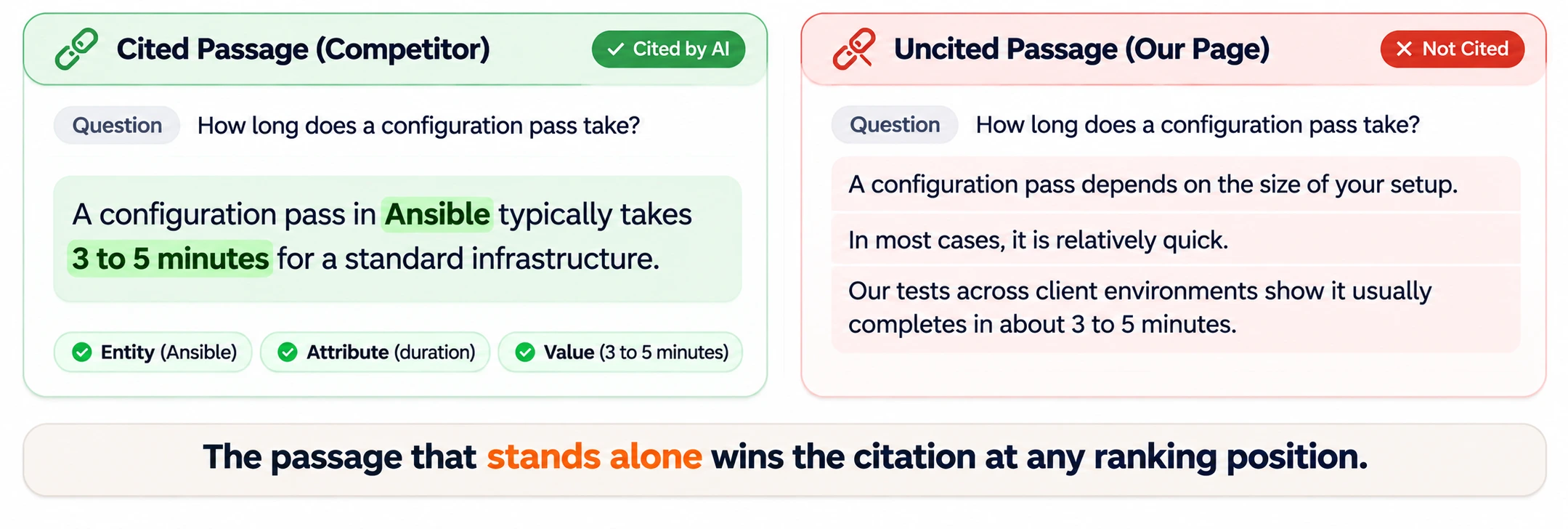
The image above shows step 3 and step 4 on one question. The left passage carries the whole answer in one sentence. The right passage spreads the answer over three sentences and loses the citation.
We run the eight steps on the prompt set before any page is edited. The record is the baseline, and every later run is a difference against the baseline.
How do you fix a page that ranks and is not cited?
A page that ranks and is not cited is fixed at the passage level: one standalone sentence under each heading, consensus wording first, a named author, dated figures, follow-up headings, and an index entry on every system the business wants.
How do you rewrite the answering passage?
The answering passage is rewritten so the first sentence under the heading carries the entity, the attribute and the value, and passes the lift test on its own.
The heading asks the question the prompt asks. The first sentence answers in full. The second sentence adds the condition or the source. A list follows when the question asks for types or steps, introduced by a sentence that defines the list.
Nothing else on the page changes. The page keeps the text that earned the ranking, and the opener under each heading is replaced.
How do you attach the entity to the passage?
The entity is attached to the passage by naming the brand or the author inside the answering block, not only in the byline.
A passage that reads "our measurement across client properties shows" carries the brand into the citation. A passage that reads "measurements show" carries nothing. The author's name and role sit in a visible block near the top of the page, with a profile page the author's other work links to.
How do you get the page into the index each system reads?
The page enters each system's index when the crawler the system uses is allowed in robots.txt and the page is indexed by the search engine the system retrieves from.
The business decides per system whether the visit is wanted. The decision is recorded with the date, and the citation rate for that system is read a month later. Bing Webmaster Tools confirms Bing indexing, which ChatGPT depends on.
How does an AI Search Visibility engagement close the gap?
An AI Search Visibility engagement closes the gap by running the prompt-set baseline, assigning one of the seven causes per prompt, and rewriting the answering passages across the cluster in one batch.
The seven causes above map onto the six page requirements the engagement tests, and the prompt set is re-run monthly so the fix is read per system. AI Search Visibility sets out the six requirements and the test for each. The requirements are defined in AI citation readiness.
The engagement reads citation rate and mention rate separately, because a page fixed for citation can still be cited without the brand named, and that is an entity problem with a different fix.
When is the citation gap not worth closing?
The citation gap is not worth closing on prompts whose answer is a commodity fact every source states identically, because the citation goes to the largest source and the brand gains nothing from a link.
A definition every encyclopedia holds, a conversion figure every reference states, or a date every record agrees on is cited from the most authoritative source. The brand's page ranks for the query and earns the click from the people who read past the overview. The passage is left unchanged.
The gap is worth closing on prompts where the answer depends on method, measurement or experience, because the citation carries the brand into the answer as the source of that method. Mention rate vs citation rate sets out how the two outcomes are read on the same prompt set.
Test your top page against the sources AI cites
On a 30-minute call we run five of your buyer prompts live, open the cited passage beside yours, and name the cause for each. You leave with the passage fix order, with or without an engagement.
Book a strategy call · Request the audit
Questions about ranking without AI citation
Does a featured snippet guarantee an AI Overview citation?
No. A featured snippet is a Google ranking decision for one passage. An AI Overview assembles several passages for the fan-out of the query, and the snippet page is one candidate among them.
Does page authority matter for AI citation at all?
Yes, as a filter. Systems retrieve from pages the index already trusts, so a page with no ranking history is rarely a candidate. Authority gets the page into the candidate set; the passage wins the citation.
Can a page be cited by Perplexity and not by ChatGPT?
Yes, and often. The two systems use different indexes and different crawlers. The cause is tested per system, and a blocked crawler on one system is the usual reason.
How many sub-questions does a prompt fan out into?
The number depends on the prompt and the system and is not published per query. The practical test is the answer itself: the headings the answer covers are the sub-questions the page must cover.
Does rewriting the passage risk the Google ranking?
No, when the rewrite changes the opener sentence under each heading and leaves the rest of the page intact. The document that earned the ranking is unchanged in substance.
Should the fix be applied to every page on the site?
No. The fix is applied to the pages in the prompt set first, read for a month, and then applied across the cluster when the citation rate moves.
Do AI systems cite PDFs and documents?
Yes, when the document is indexed and the text is extractable. A PDF with the answer in an image is not cited.
Does a table count as a standalone passage?
A table counts when a sentence directly above the table states what the table shows and the key figure is also stated in text. A table with no text version is skipped by systems that read text first.
How long after a passage rewrite does a citation appear?
Within weeks on systems that re-crawl often, once the page is re-indexed. The monthly prompt-set run is the reading that confirms the change.
Is a brand mention without a link a failure of the passage fix?
No. A mention without a link is an entity outcome, read as mention rate. The passage fix addresses citation rate. The two are reported on separate lines.