Digital Vikingz

The two rates measure two different assets: mention rate measures the brand entity, and citation rate measures the pages. Both rates are measured on a fixed prompt set, run on each AI system on a fixed schedule, with a sentence-level record of who is named and who is linked. A business reports both, because a brand named without a link earns recognition and no visit, and a page linked without the brand named earns a visit and no recognition.
Entity card
Field | Value |
Term | Mention rate and citation rate |
Also called | Brand mention rate, AI citation rate, LLM visibility metrics, GEO metrics |
Part of | AI Search Visibility measurement |
Depends on | A fixed prompt set, the AI systems in scope, and a sentence-level answer record |
Produces | Two percentages per system per month, with the pages and competitors behind each |
Measured by | Named or linked answers divided by total answers in the prompt set |
Not the same as | Share of voice from a rank tracker, or organic click share |
What does mention rate measure in GEO?
Mention rate measures how often an AI system names a brand in the text of its answers, across a fixed set of prompts.
The unit is the answer, not the prompt. One prompt run on ChatGPT, Perplexity, Gemini and Google AI Overviews produces four answers. Each answer either names the brand or does not. Mention rate for one system is the answers that name the brand divided by all answers that system produced for the set.
Mention rate reads the brand as an entity. An AI system names a brand when the brand co-occurs with the topic often enough, in enough places, for the model to associate the two. The association comes from the whole web: the site, reviews, directories, press, social profiles and third-party articles. One good page does not create a mention. A consistent entity across many surfaces does.
Mention rate rises and falls without any change to the site. A competitor's press coverage, a new review platform, or a model update moves the rate. That is why mention rate is read as a trend over months and never as a single reading.
A brand named in an answer earns recognition. A brand linked in an answer earns a visit. The second outcome is measured by citation rate.
What does citation rate measure in GEO?
Citation rate measures how often an AI system links to a page on the brand's domain as a source for its answer, across the same fixed set of prompts.
The unit is again the answer. An answer either carries at least one link to the domain or does not. Citation rate for one system is the answers that link the domain divided by all answers for the set. A second version counts per page: the answers that link one specific URL divided by all answers, which shows which pages the systems trust.
Citation rate reads the pages. An AI system links a page when the page holds a passage the system retrieved and used while building the answer. Retrieval depends on the page being crawlable and indexable, on the passage standing on its own, and on the passage stating the fact the prompt asked for in the wording the model expected. Google states that no special markup is required for AI features and that the same crawl, index and quality signals apply as for Search.
Citation rate moves when pages change. A rewritten passage, a new page on a question the set asks, or a blocked crawler changes the rate within weeks. That makes citation rate the operational metric: the one the content team moves on purpose.
The two rates are often confused because both are reported as a percentage of answers. The difference sits in what each one counts.
How do mention rate and citation rate differ?
Mention rate counts the brand name in the answer text, and citation rate counts a link to the brand's domain in the answer sources.
The differences between the two rates are listed below:
Dimension | Mention rate | Citation rate |
What is counted | The brand name in the answer text | A link to a URL on the domain |
What is measured | The brand entity | The pages |
What moves the rate | Co-occurrence of brand and topic across the web | Retrievable passages on indexable pages |
Where the signal lives | Reviews, directories, press, profiles, third-party articles, the site | The site |
Speed of change | Months | Weeks |
Outcome for the business | Recognition | A visit |
Who moves the rate | Authority and entity work | Content and technical work |
False positive to watch | A different brand with a similar name | A link to a scraped or syndicated copy of the page |
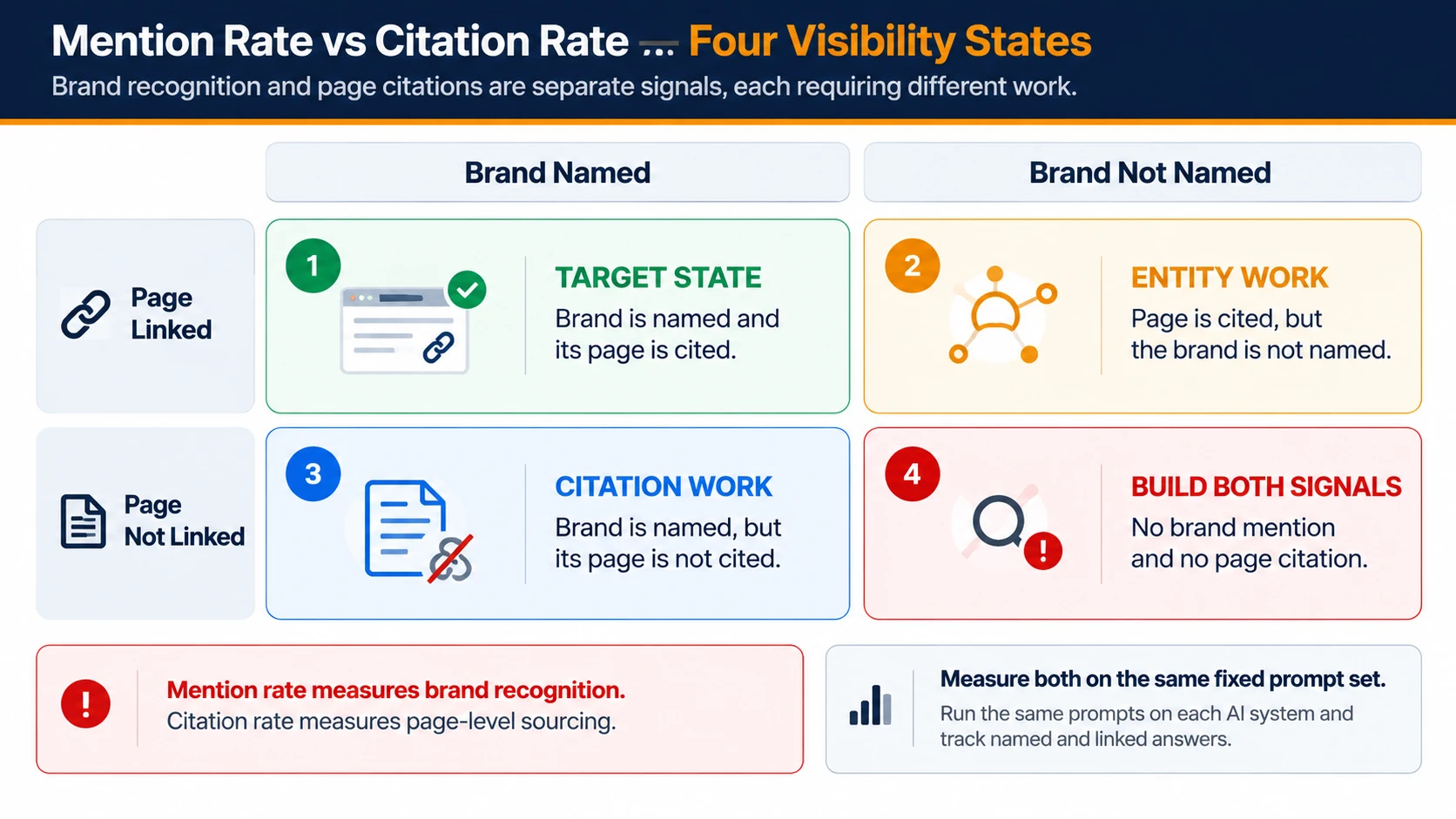
The four combinations of the two rates and what each one means are listed below:
Named and linked. The system knows the brand and trusts the page. The target state.
Named and not linked. The system knows the brand and used another source for the fact. The pages lack a retrievable passage on that question.
Linked and not named. The system used the page and treated the brand as a generic source. The entity is weak: the page states the fact without the brand attached to the expertise.
Neither. The system has no association between brand and topic and no page to retrieve. Both tracks start from zero.
Each combination points to different work. The combination is only visible when both rates are measured on the same prompt set.
How do you measure mention rate and citation rate?
Mention rate and citation rate are measured by running a fixed prompt set on each AI system on a fixed schedule and recording, per answer, every brand named and every URL linked.
The steps to measure mention rate and citation rate are listed below:
Write the prompt set from real buyer questions. Take the questions from sales calls, Search Console queries, People Also Ask and the closing questions on the site's own pages. Hold the set fixed for at least two quarters, so the trend is real.
Name the systems in scope. ChatGPT, Perplexity, Gemini and Google AI Overviews are the usual four. Each system is scored on its own row, because each one retrieves differently.
Run every prompt on every system on the same day each month, from a clean session with no account history, and store the full answer text with its sources.
Record per answer: each brand named, each URL linked, and the sentence in which each appears. The sentence matters, because a brand named in a list of ten reads differently from a brand named as the recommended option.
Compute the two rates per system: answers naming the brand divided by total answers, and answers linking the domain divided by total answers. Add the per-page citation rate for the top linked URLs.
Record the competitors named and linked in the same answers. Share of mentions against named competitors is read from the same record without a second run.
We run the set once before any page changes, so the first reading is a baseline and every later reading is a difference. A reading with no baseline is a number with no meaning.
Two controls keep the numbers honest. Prompts are phrased as a buyer phrases them, never as the brand wishes to be asked. Runs are repeated on a second day when a system's answers vary widely, and the two runs are averaged.
The method produces two percentages per system per month. The next question is which one goes in front of the business owner.
Which rate should a business report?
A business reports both rates, with citation rate as the operational number and mention rate as the brand number, on separate lines.
Citation rate is reported first, because the content team controls the pages that move the rate. A citation rate that rises after a passage rewrite is evidence the rewrite worked. A citation rate that stays flat after the rewrite says the passage still fails retrieval, or the page is not being crawled.
Mention rate is reported second, as a trend, next to the competitors named in the same answers. A mention rate that rises while citation rate stays flat says the brand is becoming known for the topic while the pages are still not the source. That gap is the signal to build the pages the prompts are asking for.
Neither rate replaces the visit and the lead. The citation record names the pages the systems link, and those pages are then read in the analytics property for referral sessions from each system. A citation that produces no visits is still a citation, and the report says so.
Both rates are moved by work, and the work differs by rate.
What moves citation rate and what moves mention rate?
Citation rate is moved by page-level work, and mention rate is moved by entity-level work.
The page-level factors that move citation rate are listed below:
Crawl and index access. The page is crawlable by the system's crawler and indexed by the search engine behind the system. A blocked crawler is a citation rate of zero.
Passage independence. The sentence that answers the prompt stands on its own, with the entity named in it, so the passage survives being lifted out of the page.
One fact per sentence. A sentence that carries one claim with its value is quoted. A sentence that carries three claims is paraphrased without a link.
Consensus wording. The fact is stated the way authoritative sources state it, with the unique angle added after, so the system does not treat the passage as an outlier.
Next-question coverage. The page answers the question the prompt leads to, so the system stays on the page for the follow-up.
A named author. The page carries an author with a verifiable role, which the systems weight on advice and comparison prompts.
The entity-level factors that move mention rate are listed below:
One brand definition everywhere. The sentence after "is" stays the same on the site, the business profile, the social profiles and the directories.
Co-occurrence with the topic. The brand appears next to the topic terms on third-party pages: reviews, interviews, podcasts, directories, industry lists.
Reviews on platforms the systems read. Google reviews and industry review platforms are retrieved for recommendation prompts.
Consistent author entities. The people behind the brand are tied to the topic on their own profiles, with the brand named.
Page-level work is content and technical work. Entity-level work is authority work. Most GEO reports only measure the first and only act on the first, which is why mention rate stays flat for them.
How does an AI search visibility agency use the two rates?
An AI search visibility agency uses the two rates as the baseline before any change and as the evidence after each change, on the same prompt set.
The agency runs the baseline, names the gap in each of the four combinations, and assigns the work: passage rewrites and new pages for citation rate, entity and authority work for mention rate. Each month the set is re-run and the difference is reported per system.
AI Search Visibility sets out the six page requirements behind citation rate and the test for each one. The prompt-set baseline is the first deliverable of that service, and the baseline record stays with the business whatever happens afterwards.
What mistakes distort mention rate and citation rate?
Mention rate and citation rate are distorted by a tool's share-of-voice number used alone, a single run, prompts the buyer never types, and systems merged into one figure.
The common mistakes and the fix for each are listed below:
Share of voice as the only number. A tool's share-of-voice figure is a blend of mentions and citations across prompts the tool chose. Fix: keep the two rates separate and own the prompt set.
One run. Generative answers vary between runs. Fix: a fixed day each month, repeated when answers vary, with the raw answers stored.
Brand-flattering prompts. A prompt that includes the brand name produces a mention every time. Fix: non-brand prompts only, written from buyer language.
Systems merged. An average across ChatGPT and AI Overviews hides a zero on one of them. Fix: one row per system.
Syndicated copies counted as citations. A link to a scraped copy of the page is not a citation of the domain. Fix: match the linked host to the domain before counting.
Each mistake inflates the number and hides the work. The clean record is slower to build and is the only one a decision can rest on.
Why does a page rank in Google and still earn no citation?
A page ranks in Google and earns no citation when the page holds no passage the AI system can lift as a complete answer.
Ranking is decided for the page. Citation is decided for the passage. A page that ranks on breadth and backlinks still fails citation when the answering sentence depends on the sentence before it, or when the fact is spread across a paragraph. The overlap between organic ranking and AI citation is measured in its own right in AI Overview citation overlap, and the fix for a site that is absent across systems is set out in Not appearing in AI search.
Questions about mention rate and citation rate
Is mention rate the same as share of voice?
No. Share of voice compares the brand's mentions with named competitors' mentions in the same answers. Mention rate compares the brand's mentions with all answers in the set. Share of voice is derived from the mention record.
How many prompts does the set need?
Enough to cover each buying stage the business sells into, with several phrasings per stage. The set is sized by the topic, not by a round number, and the set stays fixed once written.
Does citation rate count a link in AI Overviews the same as a link in ChatGPT?
Each system is counted on its own row. A link in AI Overviews sits inside Google Search and is measured against Search Console impressions as well. A link in ChatGPT is measured against referral sessions from that system.
Is a brand mention without a link worth anything?
Yes. A mention is the system recommending the brand by name, which a buyer then searches for directly. The branded query count in Search Console is where that value appears.
Can a page be cited without the brand being mentioned?
Yes, and the case is common. The system uses the page as a source for a fact and names no brand. The fix is entity work on the page: the brand and author attached to the expertise in the passage itself.
How often do the two rates change?
Citation rate changes within weeks of a page change or a crawl change. Mention rate changes over months, with model updates and third-party coverage.
Does schema markup raise citation rate?
Google states that no special markup is required for AI features. Schema supports entity identity and consistency, which belongs to mention rate, and schema does not create a retrievable passage.
Which tools measure mention rate and citation rate?
Several subscription tools run prompt sets and report both. The record they produce is useful when the prompt set is the business's own and the raw answers are exportable. A tool-chosen prompt set measures the tool's topic, not the business's.
Does blocking AI crawlers protect content and keep citations?
No. A blocked crawler ends citation on that system. A business decides per system whether the visit is wanted, and the decision shows in the citation rate for that system within the month.
Which rate matters more for a service business?
Mention rate on recommendation prompts, because a buyer asking "which agency" or "which clinic" acts on the name. Citation rate on informational prompts, because the visit comes from the link. Both are read, per prompt type.
How is a false mention handled?
A mention of a different brand with a similar name is excluded at the sentence level. The record keeps the sentence, so the exclusion is auditable.
See your two rates on your own prompts
On a 30-minute call we run ten of your buyer prompts live on two systems, show you where the brand is named and where the page is linked, and name the first gap to close. You leave with that reading with or without an engagement.
Book a strategy call · Request the audit