Sticker prices differ by acquisition model, so the honest comparison is effective cost per durable link. A neutralized cheap link has no effective price, because it delivers nothing. Budgets should size from the referring domain gap, not from a round number. This is the pricing layer behind our earned link building program, published with the market data.
What Does One Authority Link Cost in 2026?
One genuinely earned authority link costs $200 to $800 in 2026, and the market average sits at $508.95. That benchmark comes from Editorial.link survey of 518 SEO professionals: the average price they consider acceptable for one high-quality link.
The trajectory matters as much as the number. The same benchmark sat near $350 in 2022. That is roughly a 45% rise in four years, and 80.9% of surveyed SEOs expect link building to get more expensive over the next 2 to 3 years.
Cross checks land in the same zone. Ahrefs measured niche edits at $361.44 on average. Field data across all placement types averaged $280 in 2025, with quality editorial placements running $180 to $380 and up. Published agency rate cards start near $350 per link at entry tiers.
One number sits far below all of these: the $83 average paid link. We covered why paid links price low already. Low price reflects low expected value, not a bargain.
What Actually Drives the Price of a Link?
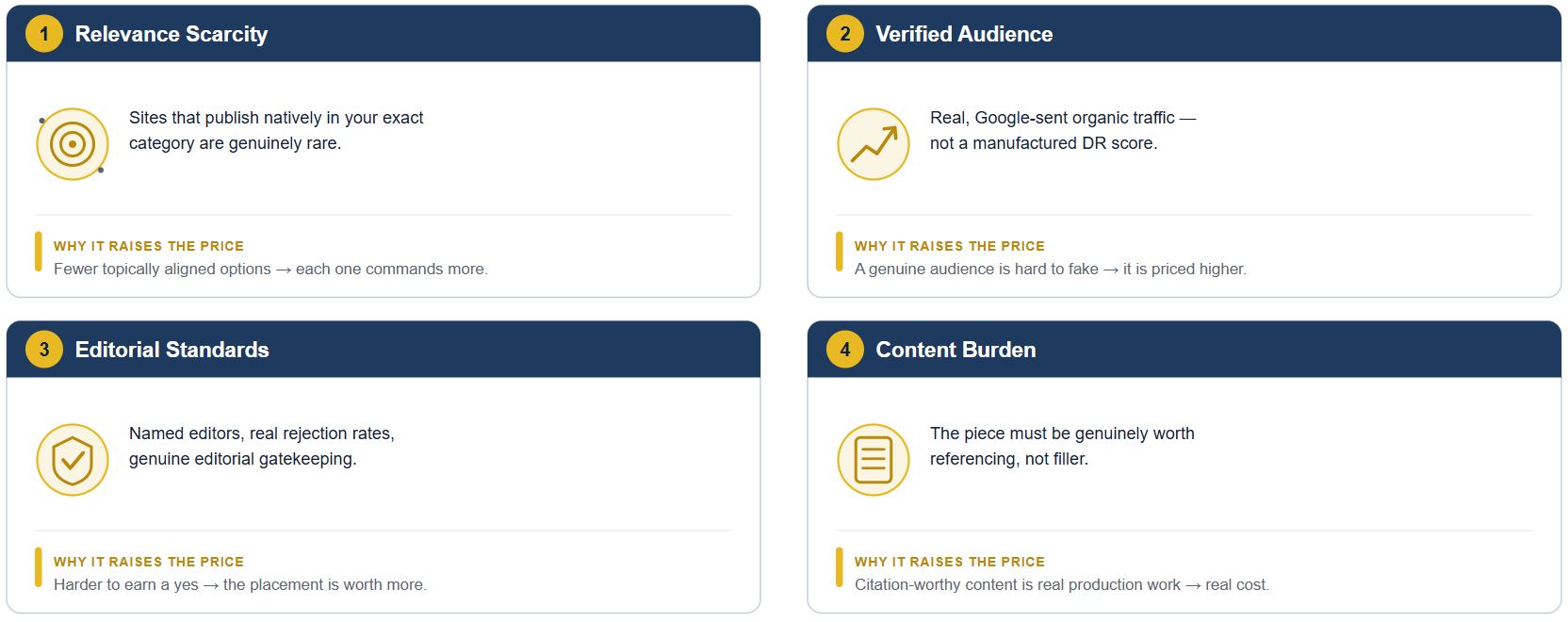
Four drivers set the price: relevance, scarcity, verified audience, editorial standards, and content burden. Everything else is noise around these.
Relevance Scarcity
Scarce categories price high. When only a few dozen publications genuinely cover your category, each placement carries scarcity value. Ahrefs' outreach data showed some niches barely sell or accept placements at all, which pushes earned coverage prices up further.
Verified Audience
Real traffic costs more than manufactured metrics. DR can be faked for roughly $100. Google sent traffic cannot. Every prospect we price passes the five vetting gates first, and gated inventory is smaller inventory.
Editorial Standards
Rejection is expensive, and it is the point. Authority Hacker measured 3.1 months on average to secure one real link. Publications that reject pitches produce links that survive. The cycle time is priced into every quote.
Content Burden
New content adds real cost. When a placement requires an original article, expect $200 to $800 in content production on top of the placement itself. Editorial grade writing is part of the link's price, not an extra.
Pricing by Acquisition Model: The Effective Cost Table
Sticker prices differ by model. Normalize everything to effective cost per durable link.
Acquisition model | Typical spend | Typical output | Effective cost per durable link |
Marketplace paid links | $83 average per link | Neutralization risk, no editorial gate | Unpriceable, value trends to zero |
Agency retainer | $1,500 to $10,000 and up monthly | Roughly 4 to 12 vetted links monthly | $350 to $800 |
Digital PR campaign | $6,000 to $20,000 per campaign | 10 to 40 editorial mentions | $150 to $2,000 blended |
In-house team | $3,000 to $8,000 monthly plus placements | 8 to 15 links monthly when experienced | $300 to $1,000 fully loaded |
The spend reality matches the table. uSERP found 46.5% of teams spend $5,000 to $10,000 monthly on link building, and 18% spend more than $10,000. Experience changes output more than budget does: experienced builders ship 25 links monthly against 7 for beginners, and 73.5% of all builders ship fewer than 10.
The Cost per Durable Link Reframe
Price the survival, not the placement. A link that gets neutralized delivers nothing, so its effective cost is the entire spend. A link that compounds for three years amortizes to almost nothing per month.
The payback window is measurable. Authority Hacker found 89.2% of link builders see ranking impact within 1 to 6 months of placement. One documented campaign puts concrete numbers on it: $4,520 for 14 podcast earned links, or $332.82 each, all editorial, all durable.
Durable links also pay on a second surface. The same earned coverage that passes PageRank builds the brand mention pattern AI systems cite. One asset, two returns.
How to Size a Link Building Budget
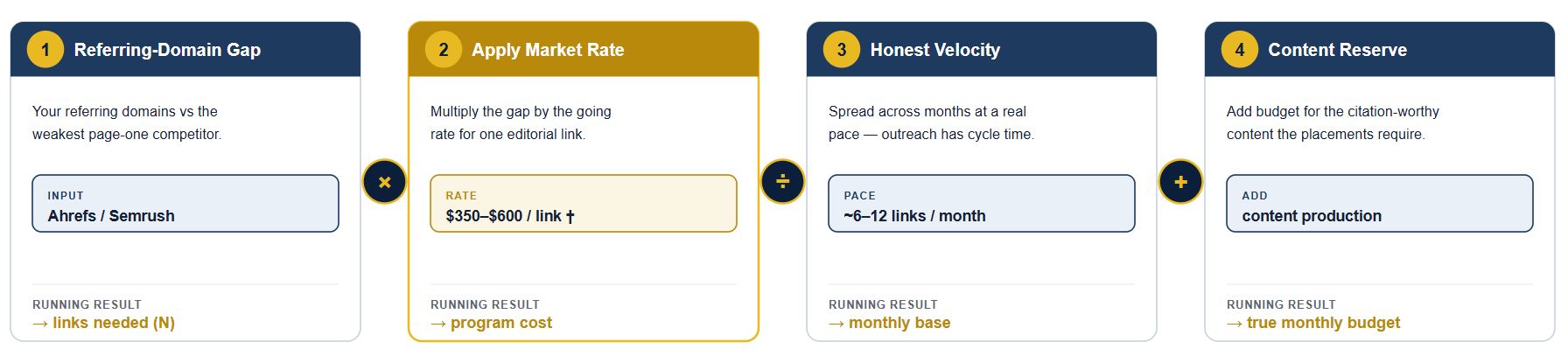
Budget from the referring domain gap, not from a round number. Four steps produce a defensible figure.
Pull the referring domains of the weakest page one competitor for your target queries.
Multiply your gap by the relevant placement market rate of $350 to $600 per link. That is the campaign floor.
Spread the floor across months at honest velocity. Most builders ship under 10 links monthly.
Reserve for content burden where placements require original articles.
Our own model stays simple. Engagements run as continuous retainers delivering 6 to 12 earned links monthly at steady state. We publish the vet, we decline categories with no earnable placements, and every anchor obeys Source Term Vector governance. The gap math above tells you whether the investment is worth starting.
Authority Link Pricing: Pay for Survival, Not Placement
The market already priced the difference for you. $83 buys a placement that Google likely zeroes. $508.95 buys a link the market believes survives. The gap is not margin. It is a probability estimate.
Digital Vikingz prices the earned side only: vetted publications, editorial acceptance, predicate clean anchors, links that still count in three years. Run the gap math on your own queries, then book a scoping call and we will tell you honestly whether your category has enough earnable placements to justify the spend.
FAQs About Link Building Pricing
How much does link building cost per month?
Managed programs run $1,500 to $10,000 and up monthly. Nearly half of surveyed teams spend $5,000 to $10,000, and 18% spend more. Steady-state output is commonly 5 to 12 quality links per month.
Why do some backlinks cost $50 and others $1,000?
The $50 link buys marketplace inventory with neutralization risk and no editorial gate. The $1,000 link buys a scarce, relevant, editorially gated placement with a real audience. Price tracks scarcity and survival odds.
Is link building getting more expensive?
Yes. The quality benchmark rose from about $350 in 2022 to $508.95 in 2026, and 80.9% of SEOs expect further increases within 2 to 3 years. Publisher consolidation and the AI era demand for earned mentions both push in the same direction.