
Some signals fail a prospect instantly, whatever the metrics say. This rubric is the vetting layer inside our authority link acquisition work, published in full.
Why DR Alone Fails as a Link Vetting Metric
Domain Rating measures a site's backlink profile. It says nothing about readers, rankings, or relevance. And it can be manufactured.
Google's John Mueller confirmed the search engine does not use domain authority at all. DR and DA are third-party estimates. Useful for sorting a prospect list. Useless as proof of value.
The manufacturing problem makes it worse. Practitioners report DR can be pushed past 50 for roughly $100 in fabricated links. A metric that costs $100 to fake cannot be your gate.
The DR Inflation Pattern Sellers Run
The scam follows one shape. A seller inflates a domain's DR with manufactured links, then sells placements on a site with near zero organic traffic. The metric survives the trick. The value never existed.
The sanity check is simple: DR against traffic. A DR 70 domain pulling 200 monthly organic visits is a manufactured profile. BuzzStream's 2025 synthesis puts the average DR of a real-world backlink near 41. When every prospect on a seller's list shows DR 60 and up, treat the list as a red flag, not a catalog.
The Five Vetting Gates We Run
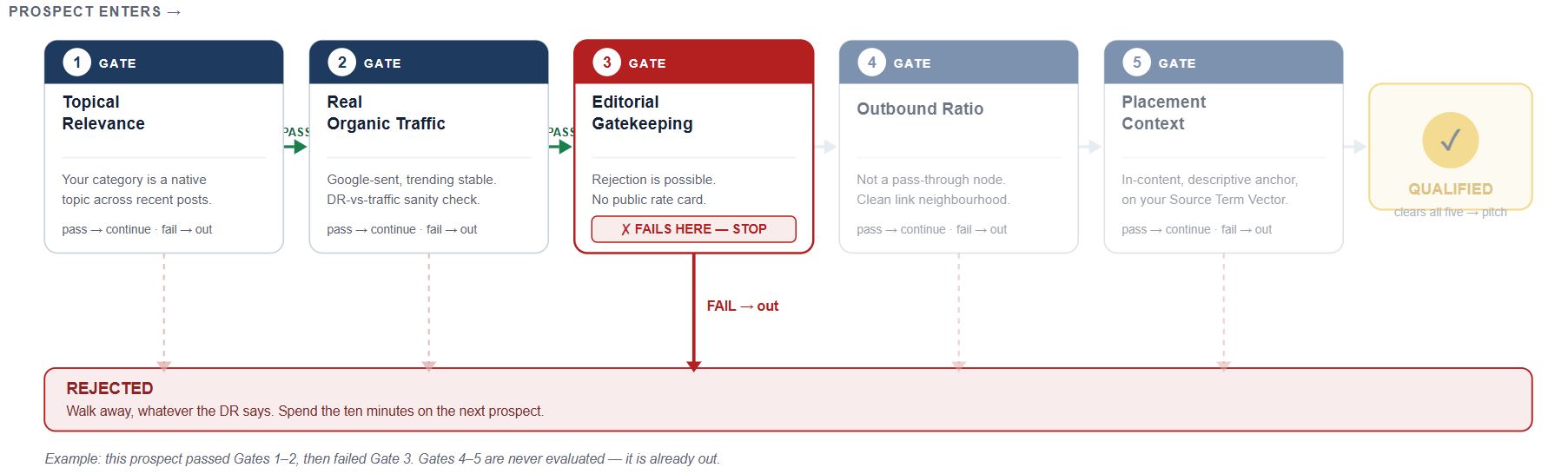
We vet every prospect on five gates before a pitch leaves the building. A prospect must pass all five. There is no averaging.
A perfect score on four gates does not rescue a failure on one. That rule is what separates a vetting system from a checklist.
Gate 1: Topical Relevance to Your Central Entity
Relevance is the first gate because PageRank flows with topical similarity. Koray Tuğberk Gübür's Source Context principle sets the rule: a relevant DR 40 link outperforms an irrelevant DR 90 one. Our full definition of authority link building builds on that principle.
The check: read the site's last 20 posts. Your category must appear as a native topic, not a one-off. We map 100 to 300 category-aligned publications per engagement and score each for relevance before any outreach begins.
Gate 2: Real Organic Traffic, Trending Stable
Traffic is the signal sellers cannot buy convincingly. Authority scores can be manufactured. Google sent traffic is hard to fake.
Two checks in Ahrefs Site Explorer. First, current organic traffic. Second, the performance graph over three years. Ahrefs documented the pattern to watch: a site still showing thousands of monthly visits after losing roughly 95% of its traffic overnight in an update. The residual number looks alive. The graph shows a corpse.
There is no universal traffic minimum. A niche trade journal at 800 monthly visits can outweigh a general blog at 80,000. Judge traffic against the category, and judge the trend before the total.
Gate 3: Editorial Gatekeeping
A link is earned only where rejection is possible. Real publications reject pitches. Sellers accept everything with a rate card attached.
The signals: named editors, contributor guidelines, authors with verifiable bios, and no pricing page for placements. Ahrefs' outreach study found 12.6% of approached sites agreed to sell niche edit links. Sellers are a minority, and they self-identify. A "write for us" page listing prices ends the conversation.
Watch author bios too. A byline that reads as a first name with no history is the classic network tell.
Gate 4: Outbound Link Ratio and Neighborhood
A site that exists to pass links passes almost nothing. Millions of outbound links against few inbound ones mark a pass-through node.
Check the neighborhood on three recent posts. Casino, pharma, and crypto anchors sitting beside legitimate content poison the profile. Google's December 2022 link spam update targets both sides: SpamBrain detects sites buying links and sites used for passing outgoing links. Linking from a flagged seller buys you proximity to the flag.
Gate 5: Placement Context and Anchor
Where the link sits and what it says carry the semantic weight. The placement belongs inside relevant main content with a descriptive anchor. Footer, sidebar, and author bio placements pass a fraction of the value.
Anchor mix matters at portfolio scale. Editorial.link found 41.7% of SEOs prefer partial match anchors, 25.1% exact match, and 20.5% branded. We enforce every anchor against the client's Source Term Vector, and the rules live in our anchor text governance layer. One entity, one consistent predicate, across every placement.
How to Run the Vet in Ten Minutes
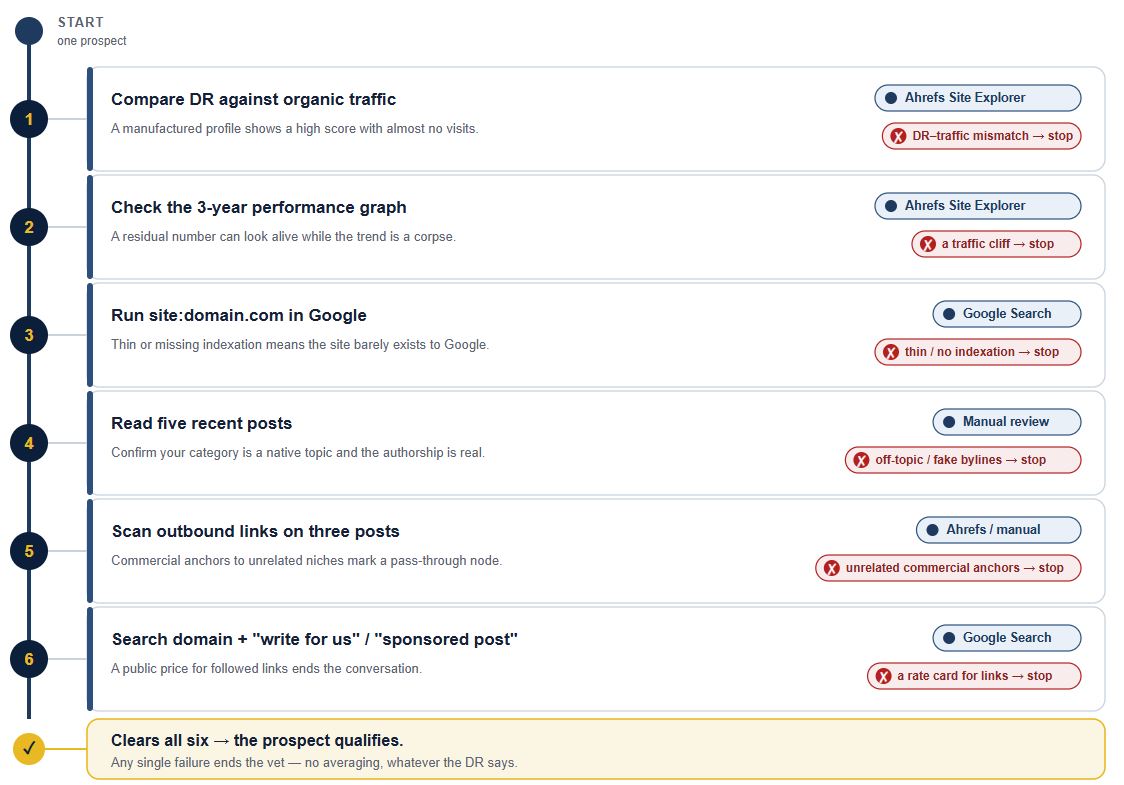
The full check takes ten minutes per prospect with two tools. Run the steps in order and stop at the first failure.
Open Ahrefs Site Explorer. Compare DR against organic traffic. A mismatch fails the prospect.
Check the performance graph across three years. A cliff fails the prospect.
Run site: domain.com in Google. Thin or missing indexation fails the prospect.
Read five recent posts. Confirm topic fit and real authorship.
Scan outbound links on three posts. Commercial anchors to unrelated niches fail the prospect.
Search the domain plus "write for us" and "sponsored post." A rate card for followed links fails the prospect.
Gatekeeping has a cost, and the cost is time. Authority Hacker measured 3.1 months on average to secure a real link. That cycle time is exactly why earned placements hold through updates while authority links versus paid links keep ending the same way.
Red Flags That End the Vet Instantly
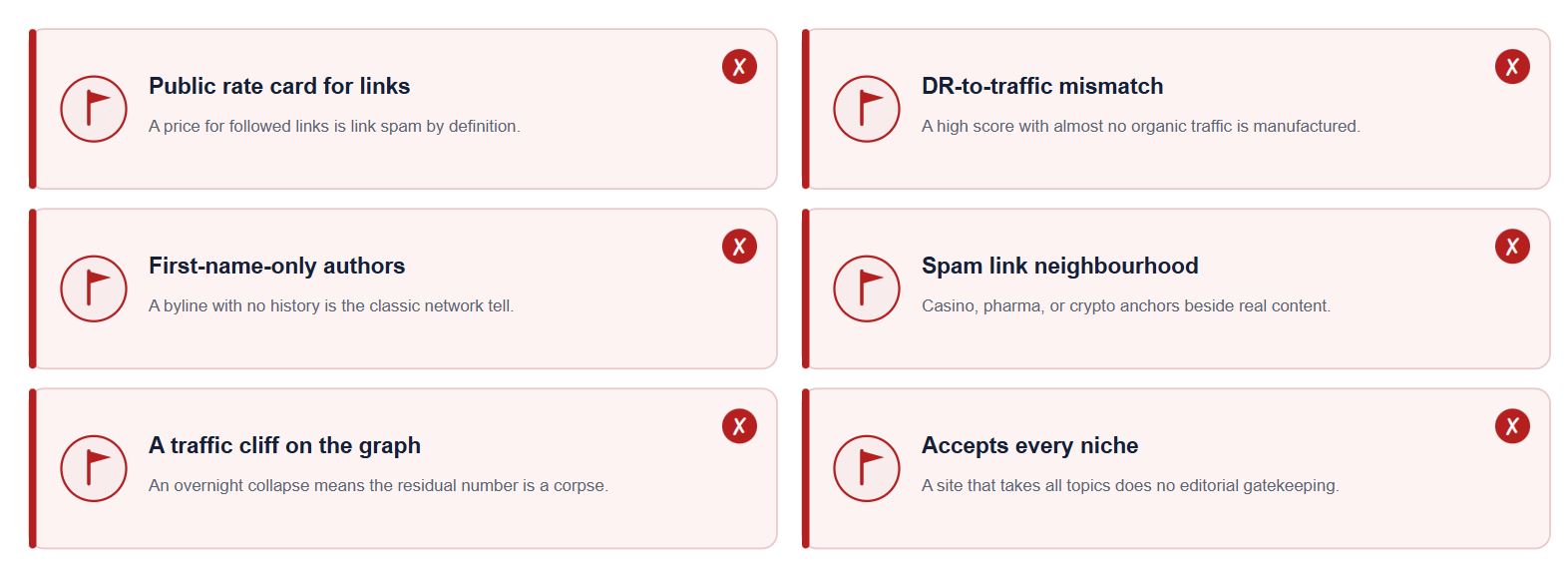
Some signals fail a prospect at first sight. A public rate card for followed links. A DR to traffic mismatch. First name only authors. A spam link neighborhood. A traffic cliff on the graph. A site that accepts all niches.
No metric rescues these. Walk away and spend the ten minutes on the next prospect.
Vetting Backlinks the Methodology Grade Way
Five gates. No averaging. Ten minutes per prospect. That discipline is why every placement we deliver carries real relevance, real audience, and real editorial standards, and why we decline categories where no earnable placements exist.
Most vendors sell you their inventory. We publish our vet so you can run it on anyone, including us. When you want the gates run at portfolio scale, that is our link building engagement.
FAQs About Vetting Backlink Quality
What is a good DR for a backlink?
There is no good DR in isolation. The average real-world backlink sits near DR 41 per BuzzStream's synthesis. Judge DR against traffic and relevance, because a manufactured DR 70 with no audience fails the vet.
How much organic traffic should a linking site have?
No universal floor exists. Judge traffic against the category: a specialist journal at 800 monthly visits can outweigh a generalist blog at 80,000. The three-year trend matters more than the current total.
Do DR and DA affect Google rankings?
No. John Mueller confirmed Google does not use domain authority in its algorithms. Both metrics are third-party estimates, useful as a first sorting filter and nothing more.