Digital Vikingz

Pages are grouped into clusters by buying stage, so a ranking gain on one cluster is read against the leads that cluster produced in the following window. The report to a finance owner lists clicks, leads, opportunities and closed revenue per cluster, with the lag between first visit and deal. Positions and traffic totals do not appear in that report, because neither one is a pipeline number.
Entity card
Field | Value |
Term | SEO pipeline attribution |
Also called | SEO revenue attribution, organic attribution, organic-to-pipeline reporting |
Part of | Pipeline Attribution SEO |
Depends on | Google Search Console, an analytics property, a CRM, and a cluster map of the site |
Produces | Clicks, leads, opportunities and closed revenue per cluster, with median lag |
Measured by | Share of CRM leads that carry a landing page and a cluster |
Not the same as | Rank tracking or an organic traffic report |
What does SEO pipeline attribution measure?
SEO pipeline attribution measures how many leads, opportunities and closed deals began with an organic search visit, and from which page.
The chain has six links. A query produces an impression. A click produces a session. A form produces a lead. Sales qualifies the lead into an opportunity. The opportunity closes as revenue or is lost. Attribution keeps the page name attached through all six links.
Most SEO reports stop at link two. Search Console ends at the click. Analytics ends at the form. The CRM starts at the lead, with no page attached. Three systems, three endings, and no chain between them.
SEO pipeline attribution is the work of making one chain out of those three records. The chain is built from three data sources, and each one has a different ending point.
Which data sources does SEO pipeline attribution join?
SEO pipeline attribution joins three data sources: Google Search Console, a web analytics property, and the CRM.
The three sources and what each one holds are listed below:
Source | What the source holds | Where the record ends | Join key |
Google Search Console | Query, page, clicks, impressions, average position, for the last 16 months | The click | Page URL |
Analytics property (GA4 or equivalent) | Session, landing page, referrer, form submission event | The form | Landing page URL |
CRM (HubSpot, Salesforce, Pipedrive or equivalent) | Contact, source, opportunity, amount, stage, close date | Closed revenue | Landing page field on the contact |
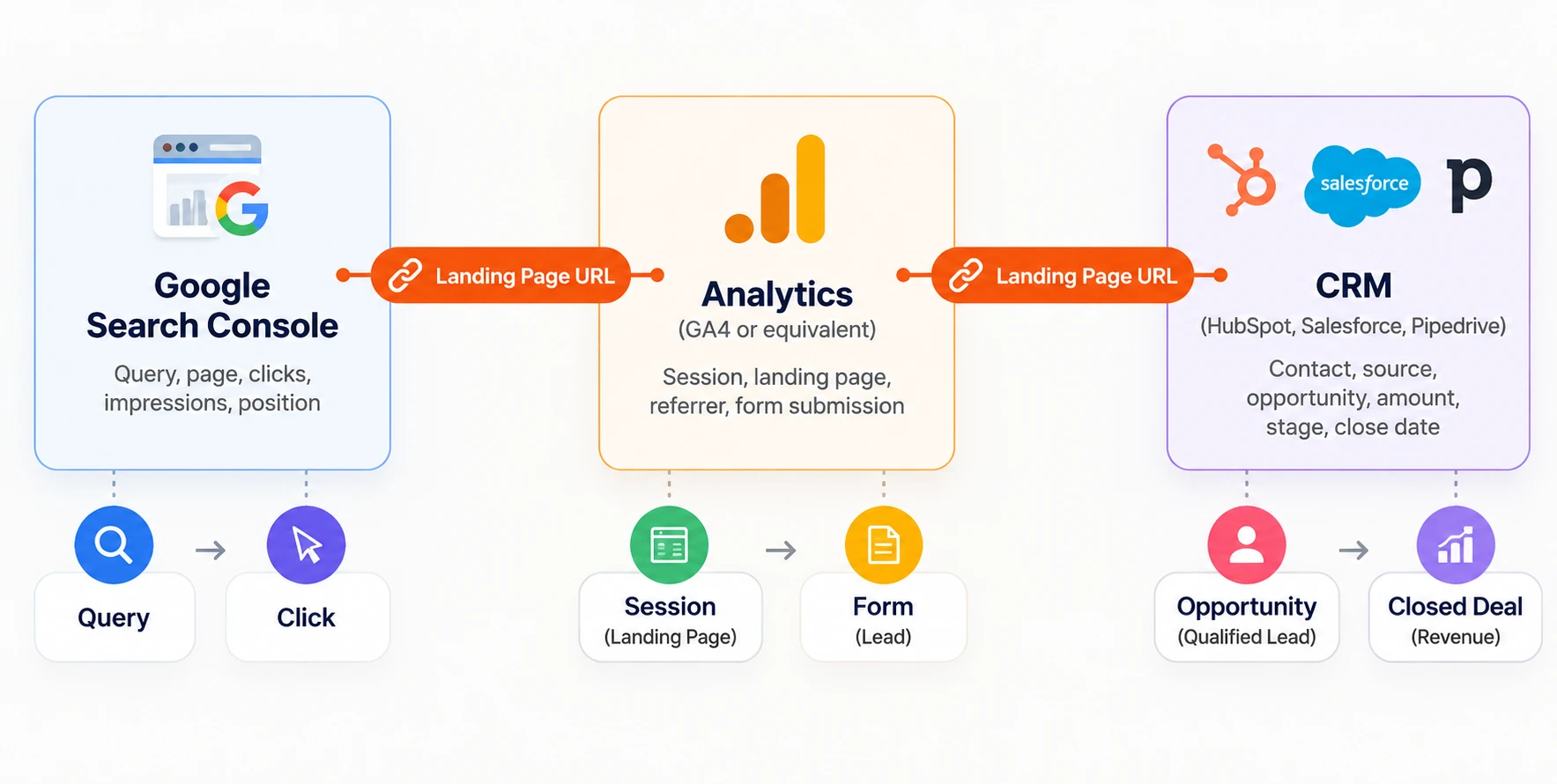
The join key is the landing page URL, not the query. Google does not pass the search query to the landing page. The page is the finest unit of SEO pipeline attribution, and Search Console then shows which queries that page earned clicks for in the window.
Retention limits shape the window. Search Console keeps 16 months of performance data. GA4 retains event-level data for 2 months by default and for 14 months at most on a standard property. The CRM keeps the lead for as long as the account exists, which is why the CRM is the system of record for revenue.
The landing page reaches the CRM only when the form carries the landing page with the lead. That is the tagging step.
How do you tag a lead with its SEO source?
A lead is tagged with its SEO source by writing the first landing page, the first referrer and the first visit date into hidden form fields at submission.
The steps to tag a lead with its SEO source are listed below:
Store the landing page URL, the document referrer and a timestamp in a first-party cookie on the first page view of the first session.
Add three hidden fields to every lead form: first landing page, first referrer, first visit date.
Fill the three hidden fields from the cookie when the form loads, so the values survive a visit that ends on a different page.
Map the three fields to contact properties in the CRM. HubSpot records organic search at channel level in the Original source property; the landing page field adds the page beneath that channel.
Classify the referrer into a channel with one rule: a search engine domain is organic search; a blank referrer with a non-brand landing page is direct, reported separately.
We fit the three fields before any content work starts on an engagement. A lead that arrives without a landing page is never attributed later, because the visit that produced the lead is gone.
Phone, chat and WhatsApp leads need a manual version of the same rule. The person taking the call asks which page the caller read and records the slug on the contact. A WhatsApp link with a pre-filled message carries the page slug inside the message text.
Tagged leads are counted per cluster, not per page, because a single page rarely produces enough leads to read.
How do you tie ranking improvements to pipeline?
Ranking improvements are tied to pipeline by grouping pages into clusters by buying stage, then reading clicks and leads per cluster across the same window.
Clusters are the unit for three reasons. One page produces too few leads to separate signal from noise. Pages on one topic move together in a core update, so a per-page read double counts the same event. A cluster is also the unit of the topical map, so the SEO plan and the revenue report share one row structure.
The five buying stages used to group pages are listed below:
Problem pages answer a symptom the buyer has noticed, such as a traffic drop after a core update.
Category pages define the discipline, such as what semantic SEO is and how a topical map is built.
Comparison pages weigh two approaches or two options, such as semantic SEO against traditional SEO.
Vendor pages help the buyer choose a provider, such as how to vet a semantic SEO agency.
Decision pages state the service, the scope and the price.
The steps to tie a ranking improvement to pipeline are listed below:
Assign every indexable URL to one cluster and one stage. The column sits next to the URL in the topical map, so every new page inherits a cluster on the day the page is planned. What is a topical map describes that document.
Export Search Console performance by page for the window. Use 28 days at minimum and three months by preference. Sum clicks and count distinct queries per cluster.
Export CRM contacts created in the same window with the first landing page field. Map each landing page to its cluster. Count leads, opportunities and closed amount per cluster.
Measure the lag. Take the median days from first visit date to close date across closed deals. Read the pipeline window offset by that lag, so a ranking gain in March is read against deals that close after the median lag has passed.
Compare each cluster period over period and read the pattern.
The patterns and their readings are listed below:
Clicks up, leads flat: a conversion fault on the cluster's pages, not an SEO fault.
Clicks up, leads up, opportunities up: the ranking gain reached pipeline.
Clicks flat, leads up: a page change or a sales change, not a ranking change.
Clicks down, leads flat: lost clicks were low-intent, often brand or navigational.
A ranking improvement is read as a rise in query count and clicks for the cluster. Average position is left out, because position averages across queries hide the queries that matter. The output of the five steps is a one-page report.
What does an SEO revenue report contain?
An SEO revenue report contains one row per cluster, with clicks, query count, leads, opportunities, closed revenue and median lag, for a named window.
The columns of the report and the source of each are listed below:
Column | Source | Why the column is there |
Cluster and stage | Topical map | Names the group of pages being read |
Clicks | Search Console | The volume of organic visits the cluster earned |
Distinct queries | Search Console | The breadth of demand the cluster captured |
Leads | CRM, first landing page field | Visits that became a contact |
Opportunities | CRM, stage field | Leads that sales qualified |
Closed revenue | CRM, amount and close date | The pipeline number |
Median lag | CRM, first visit date to close date | The delay the reader applies to the next window |
Three numbers stay out of the report. Average position is a rank, not a result. Total organic sessions mix brand with non-brand and problem pages with decision pages. Share of voice from a rank tracker is the vendor's tool reporting the vendor's keywords.
The window and the lag are named in the first line of the report, before any number. A finance owner reads the leads and revenue columns first and the clicks column last. We publish the Search Console half of that report for client properties on Results, measured in Google Search Console, with the window named on each panel.
The report is only as clean as the tagging behind the leads. Five faults break the chain between a click and a deal.
What breaks SEO pipeline attribution?
SEO pipeline attribution breaks at five points: forms without hidden fields, cookies cleared before the form, leads created by sales without a source, clusters that change mid-window, and reports that mix organic with paid.
The five faults and the fix for each are listed below:
Forms without hidden fields. Every lead arrives sourceless. Fix: add the three fields to every form, including the chat widget and the demo request.
Cookies cleared before the form. The first landing page is lost on the return visit. Fix: store the first visit server-side against the client ID where consent allows, and report the share of leads with a blank landing page every month.
Leads created by sales without a source. A rep adds a contact after a call and the SEO origin is never recorded. Fix: make the source field required on manual contact creation, with a value for organic search.
Clusters that change mid-window. A page moves between clusters and the period comparison breaks. Fix: version the cluster map, and read the window with the version that was live at the start.
Reports that mix organic with paid. A paid landing page shares a URL with an organic one. Fix: classify by referrer and by the presence of a click identifier, and report the two channels on separate rows.
Each fault shows up in the same place: the share of leads with a complete landing page, referrer and date. When that share falls, the report is paused until the tagging is repaired.
When does an agency build SEO pipeline attribution for you?
An agency builds SEO pipeline attribution when no one inside the company owns the CRM fields, the cluster map and the Search Console read together.
A revenue operations owner who holds all three builds the model in-house from the steps above. Most businesses under a few hundred employees have a marketing owner and a sales owner and no one in between. The fields drift, the cluster map is never written, and the Search Console read happens once a year.
Pipeline Attribution SEO builds the three parts and reads the report after each core update, so the ranking state and the pipeline state are read on the same date. The service returns the cluster map, the field specification for the forms and CRM, and the report format, all of which stay with the business when the engagement ends.
What should you check when clicks rise and leads do not?
Clicks that rise without leads point to a page fault, not an attribution fault, once the hidden fields are confirmed complete.
Check the tagging first. A cluster with rising clicks and a falling share of tagged leads has a form problem. A cluster with rising clicks and a complete tag share has a page problem: the page ranks for queries the page does not answer, or the page answers them and offers no next step.
The second case is covered on Content not converting, which separates a query-match fault from a next-step fault and names the fix for each.
Questions about SEO pipeline attribution
Does Google Analytics attribute organic leads on its own?
Partly. GA4 reports conversions by channel group with its own attribution model, and the record ends at the form event. Revenue after the form sits in the CRM, so GA4 alone never shows pipeline.
Why not use UTM parameters for organic traffic?
Organic search results carry no UTM parameters. The landing page and the referrer are the only two fields available, and both are enough when stored at the first visit.
Does SEO pipeline attribution need a CRM?
Yes, for revenue. Without a CRM the model ends at the lead, read from form submissions grouped by landing page and cluster.
First touch or last touch?
First touch for SEO. Organic search opens most considered purchases and is then overwritten by a direct or email visit at the last step. Record both dates and report first touch.
How long is the lag between a ranking gain and revenue?
As long as the sales cycle. The median days from first visit to close date, measured on closed deals in the CRM, is the figure to use, and the figure differs per cluster.
Can attribution show which keyword produced a deal?
No. Google does not pass the query to the website. The page is the finest unit, and Search Console lists the queries the page earned clicks for in the same window.
How are brand searches handled?
Brand queries are reported as a separate cluster. The homepage and the brand query share in Search Console define the cluster, so non-brand SEO is read clean.
How many leads are needed before the numbers mean something?
Enough that one deal does not move the cluster total. Small sites read quarters rather than weeks, and report the lead count next to the revenue figure.
Does the model work for ecommerce?
Yes, with order value in place of CRM revenue. The landing page per session joins to the order in analytics, and the lag is measured from first visit to purchase.
Who owns the attribution model inside the company?
One person who owns the CRM fields. A field nobody owns is removed in the next form redesign, and the chain breaks without anyone noticing.
How often is the report read?
The report is read after each Google core update and at each quarter close. The ranking state and the pipeline state are read on the same date, so a change in one is matched to the other.
See your pipeline per cluster
On a 30-minute call we open your Search Console and your CRM, check whether leads carry a landing page, and name the first cluster to read. You leave with that answer with or without an engagement.
Book a strategy call · Request the audit