
AI systems learn trust from text distribution, not from link graphs alone. Google debated this signal for a decade without settling it. AI search settled it with data. The finding reprices authority link building rather than replacing it.
What the 3 to 1 Gap Actually Measures
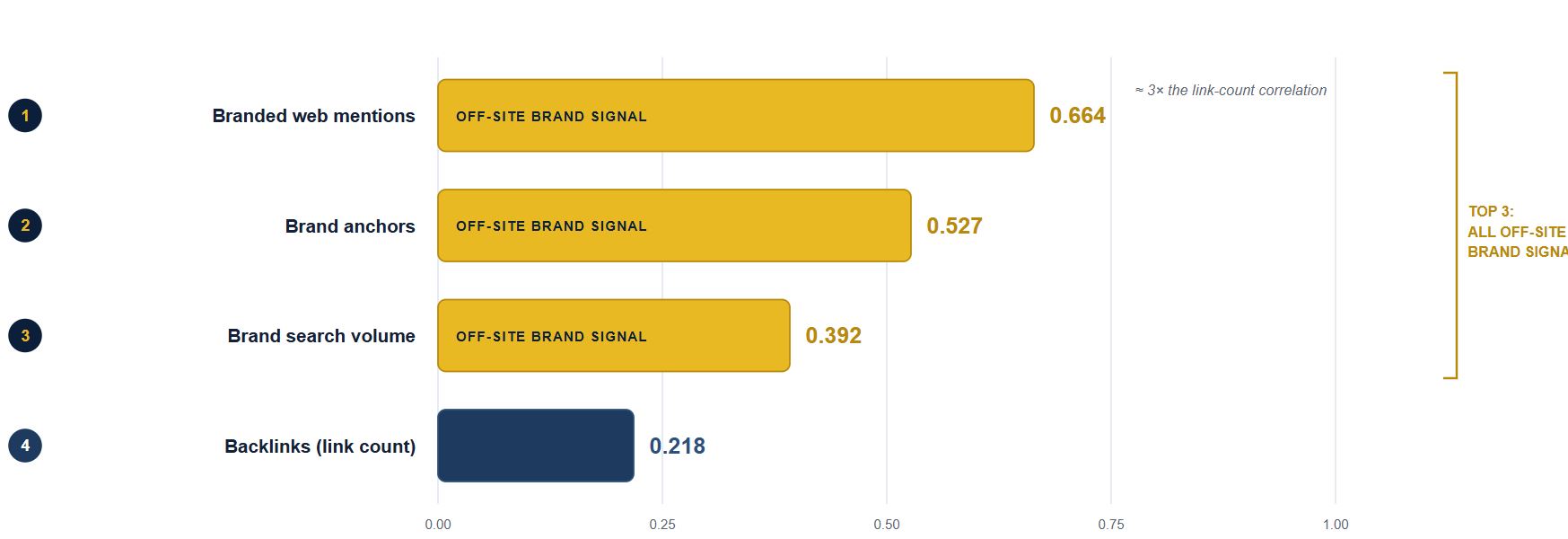
Ahrefs analyzed 75,000 brands to find what correlates with visibility in Google's AI Overviews. Branded web mentions scored 0.664. Backlinks scored 0.218. The gap is roughly 3 to 1.
The full factor stack matters more than the headline. The top three correlates were all off site: branded mentions at 0.664, brand anchors at 0.527, and brand search volume at 0.392. Link counts sat below all three.
One caveat, stated plainly because Ahrefs states it too. Correlation is not causation. Ahrefs' own head of content drew the practical conclusion anyway: chasing link volume does not move the needle on AI citation.
Why AI Systems Weight Mentions Over Links
LLMs learn trust from text, not from link graphs. A language model ingests distribution: your brand appearing next to your category terms, repeatedly, across independent sources. We mapped the retrieval side in the AI citation pipeline.
A backlink is one signal on one page. A mention pattern is a statistical association the model carries into every answer it writes.
How Co-Occurrence Builds Entity Trust
Co-occurrence is the mechanism. When independent sources mention your brand alongside your category, the association hardens. When mentions scatter across unrelated contexts, no association forms.
Koray Tuğberk Gübür made this point before the AI wave. Authority references help only inside an aligned Source Context, and he counts linkless mentions alongside links. The full argument sits in our post on links in semantics. Relevance was always the gate. AI search just made the gate measurable.
Where Brand Mentions Live Matters
Not all mention surfaces carry equal weight. Muck Rack analyzed more than 25 million AI citation links. Earned media accounted for 84% of citations. Paid and advertorial content accounted for 0.3%.
Platform patterns compound the effect. Reddit is among the most cited external platforms in ChatGPT answers, and Wikipedia presence feeds multiple engines. A mention in earned editorial or on a trusted community surface works. A mention on a paid placement network does not.
Did Google Ever Count Unlinked Mentions?
The debate predates AI search by a decade, and Google never settled it. The evidence sits in one patent and a handful of public statements. Both deserve an honest reading.
What the Implied Links Patent Actually Says
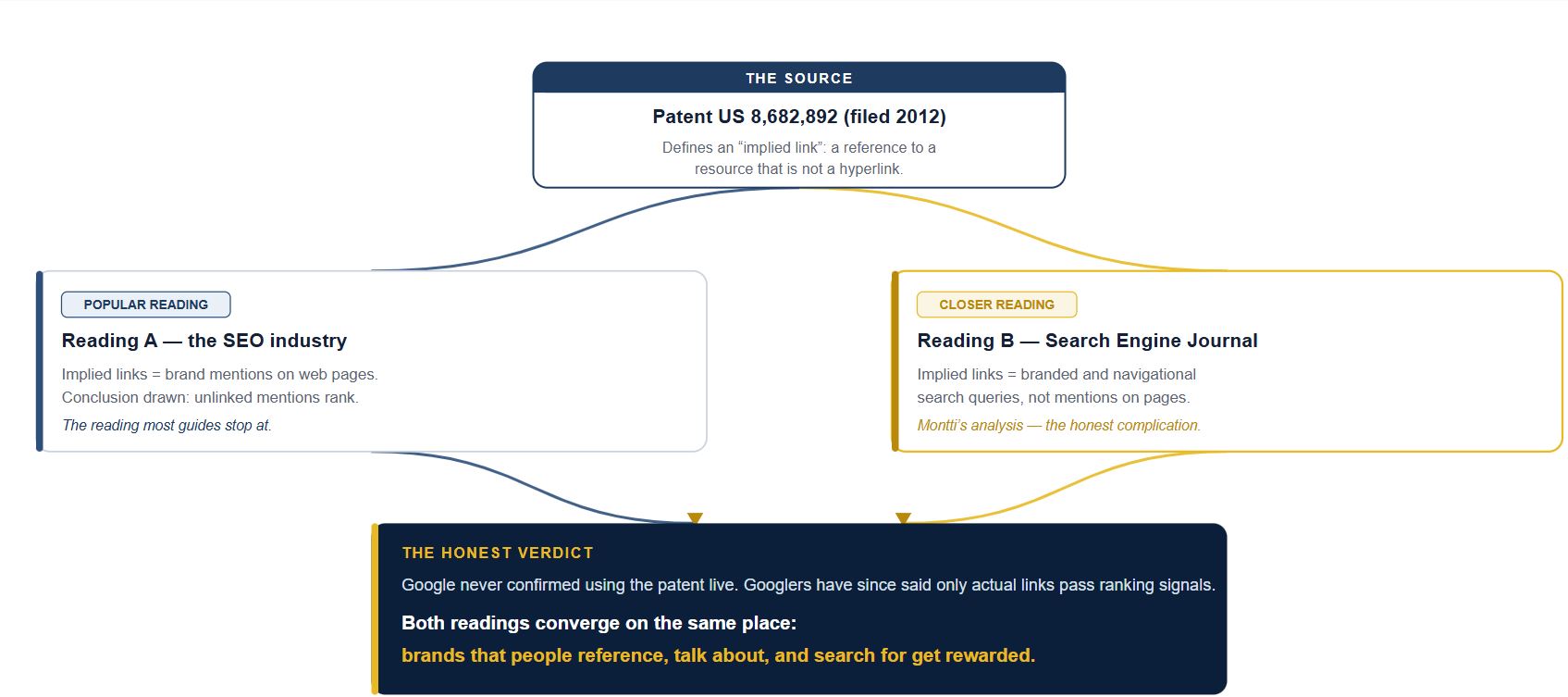
Google's 2012 patent US 8,682,892 distinguishes express links from implied links. The text defines an implied link as a reference to a target resource that is not a hyperlink. The SEO industry read that as proof that brand mentions rank.
A closer reading complicates the story. Search Engine Journal's analysis argues the patent's implied links are branded and navigational search queries, not mentions on web pages. Google never confirmed using the patent at all, and Googlers have since said only actual links pass ranking signals.
Either reading lands in the same place. Brands that people reference, talk about, and search for get rewarded. Brand search volume was the third factor in the Ahrefs study at 0.392.
What Google and Bing Said Out Loud
The public statements point one direction. Gary Illyes told a Brighton SEO audience in 2017 that highly cited content wins, and he was explicit that he meant mentions and brand talk, not only links. Bing went further a year earlier. Duane Forrester said Bing had learned to associate mentions without a link and reward them with rankings.
Illyes added a coda in April 2024: Google needs very few links to rank pages. Practitioners already voted. Editorial.link found 80.9% of surveyed SEOs believe unlinked brand mentions influence organic rankings.
What the 3 to 1 Gap Means for Link Building Budgets
Mentions do not replace links. They replace them. Backlinks still correlate with Google rankings, and the #1 result still averages 3.8x more of them. The change is what a placement must now produce to justify its cost.
The market is already moving. BuzzStream found 87.3% of digital PR practitioners never pay for placements. Paid inventory scored 0.3% of AI citations in the paid link teardown. Earned coverage produces the mention pattern paid links never will.
The Two Surface Test for Every Placement
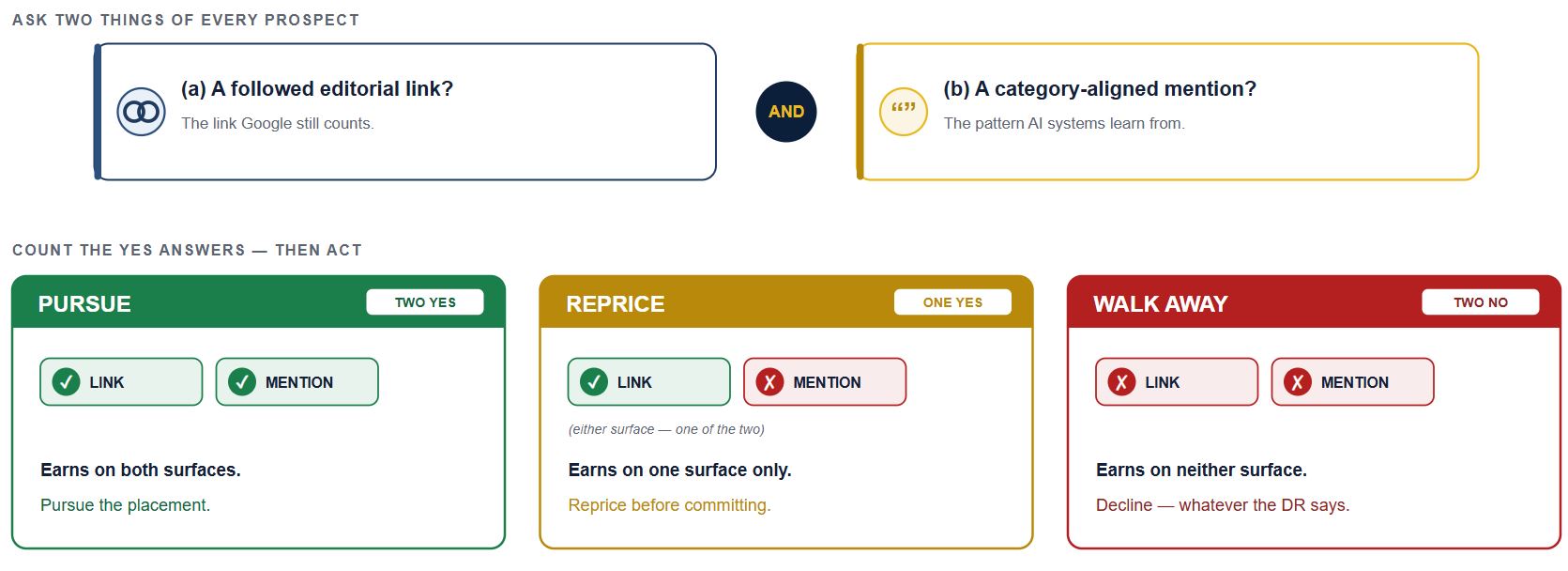
Run every prospect through one question. Does this placement produce a followed editorial link and a category-aligned brand mention that AI systems will ingest?
Two yes answers make the placement worth pursuing. One yes means reprice it. Two no answers mean walk away, whatever the DR says.
Brand Mentions vs Backlinks: What to Build Now
Build the engine that produces both. Earned editorial coverage generates the link Google counts and the mention pattern AI systems learn from. Seer Interactive measured the payoff: brands cited inside AI Overviews saw 35% more organic clicks than uncited competitors on the same queries.
Digital Vikingz builds that engine with predicate clean anchors, consistent entity naming, and category-aligned placements only. One earned asset, two search surfaces. If your link budget still buys link counts, redirect it into methodology grade link building.
FAQs About Brand Mentions and Backlinks
Do unlinked brand mentions help SEO?
On AI surfaces, measurably yes: mentions correlate at 0.664 with AI Overview visibility. In classic Google rankings, the signal remains unconfirmed, though the implied links patent exists and 80.9% of SEOs believe mentions matter.
Are brand mentions a Google ranking factor?
Google has never confirmed it. The 2012 patent describes implied links, but its operative reading may be branded search queries, and Googlers say only real links pass ranking signals. Treat mentions as an entity trust signal, not a confirmed factor.
How do you earn more brand mentions?
Publish original data, offer expert commentary, and keep entity naming consistent everywhere. Digital PR built on data assets produces linked and unlinked mentions together, which is the only model that pays on both surfaces.