
AEO predates the LLM wave and originally meant winning answer boxes and voice assistants. The retrieval mechanics stay identical under every label. Semantic architecture is the discipline underneath all four. We deliver it through our LLM and AI search visibility service.
What Do GEO, AEO, LLM SEO, and AI SEO Mean?
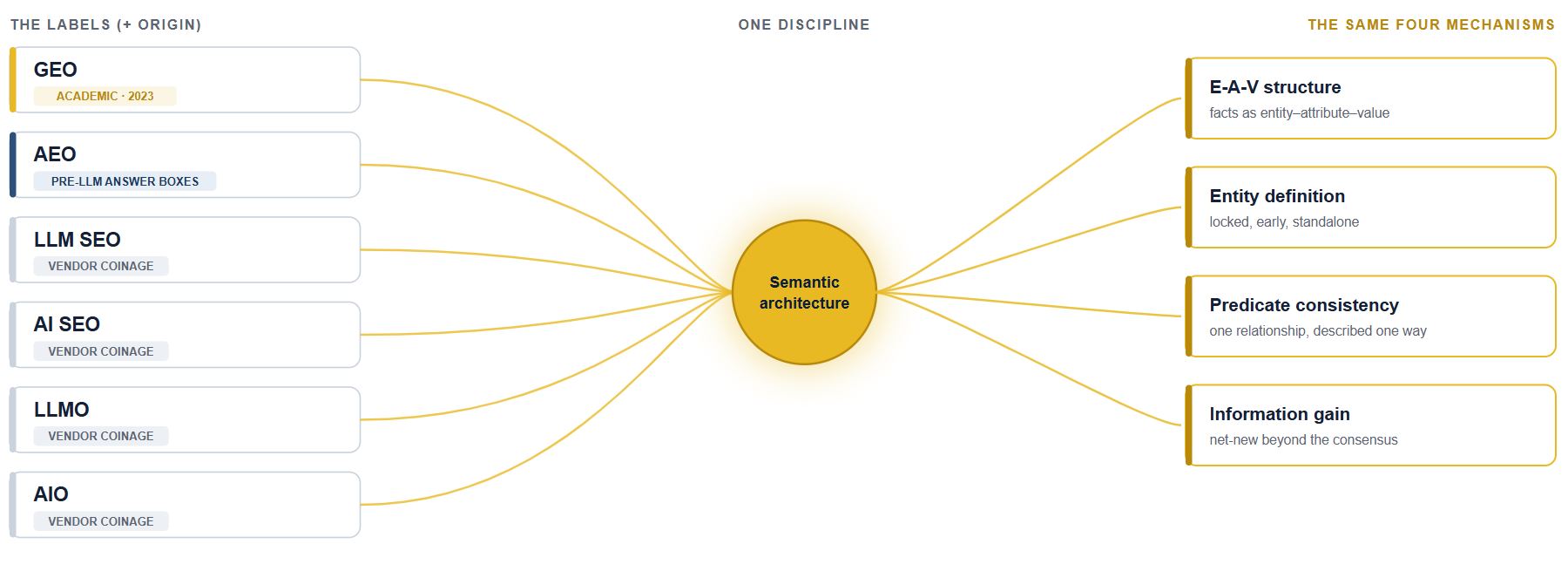
All four labels name one practice: engineering content so AI systems retrieve it, extract it, and cite it. The vocabulary split is a marketing artifact, not a technical one. No consensus academic definition has settled, and the variants keep multiplying.
Where the Term GEO Comes From
GEO has a documented academic origin. The paper "GEO: Generative Engine Optimization" appeared on arXiv in November 2023 and was presented at KDD 2024. Aggarwal, Murahari, and co-authors from Princeton and IIT Delhi coined the term and built GEO-bench, a benchmark of 10,000 queries.
Their measured result: optimization methods lifted visibility in generative engine responses by up to 40%. The strongest methods were citing sources, adding quotations, and adding statistics. Keyword stuffing scored roughly 10% below an unoptimized baseline.
Read that last line twice. The founding study of GEO found that the oldest keyword tactic makes AI visibility worse. Semantic substance won the benchmark.
What AEO Meant Before AI Chatbots
AEO predates the LLM wave. Answer Engine Optimization originally described winning featured snippets, answer boxes, and voice assistant responses. The answer layer belonged to Google snippets and Alexa style devices.
Chat interfaces became the new answer layer. The label got rebranded rather than retired. Same job, new engines.
Why LLM SEO and AI SEO Are Vendor Labels
LLM SEO and AI SEO carry no academic anchor. Tool vendors and agencies coined them to name the same retrieval problem. LLMO and AIO circulate as well.
Six names now describe one practice. Every vendor wants to own a category. None of the names changes what the work is.
Why Four Labels Describe One Discipline
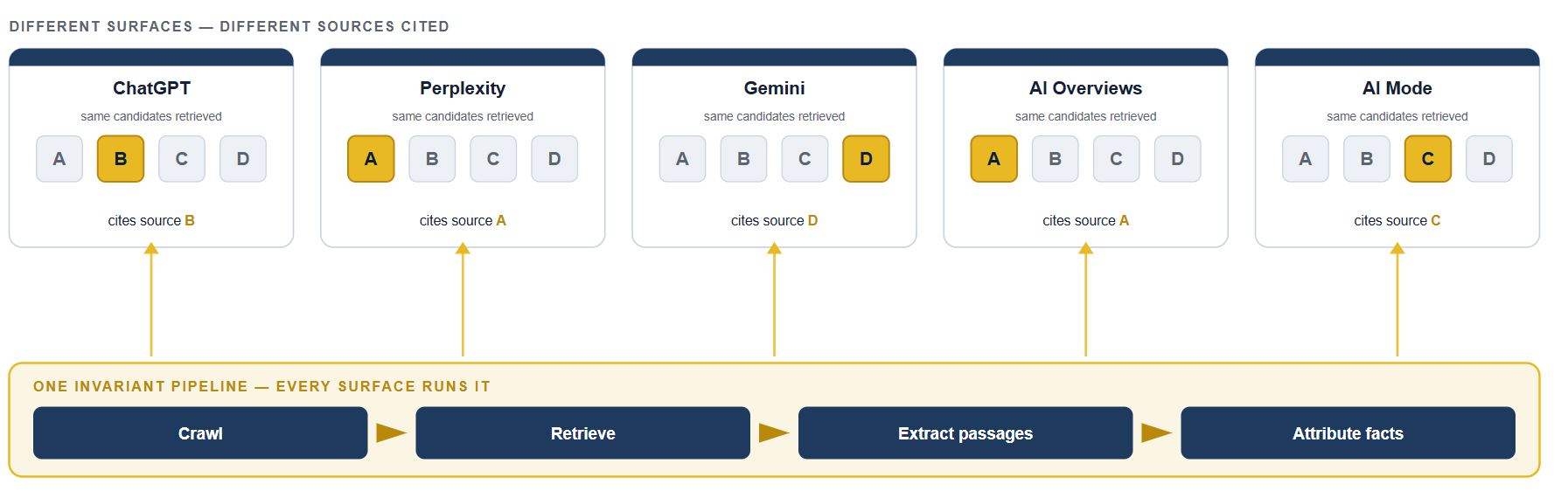
The retrieval pipeline does not change with the label. Every AI surface crawls, retrieves, extracts passages, and attributes facts. We mapped that pipeline stage by stage in how AI search engines decide who to cite.
Koray Tuğberk Gübür states the invariance directly. Information retrieval, cost of retrieval, and representative source selection govern every surface. A new interface does not rewrite retrieval mathematics.
Google's own products prove the point in reverse. AI Overviews and AI Mode cite the same URLs only 13.7% of the time. The surfaces differ. The discipline that wins both is identical.
The Same Four Mechanisms Under Every Label
Every label resolves to the same four page properties. Clean E-A-V structure. Entity definition strength. Predicate consistency. Information gain.
The Princeton findings map onto them directly. Statistics and citations are E-A-V density by another name. The full specifications live in our 21-layer methodology, and they predate every label on this page.
Where Did the Label Explosion Come From?
The labels multiplied because the demand did. AI Overviews appeared in over 50% of Google searches by August 2025, up from 18% in March of the same year. Gartner predicted in 2024 that traditional search volume falls 25% by 2026. Profound found 58% of American shoppers already use AI at least weekly to browse or buy.
New demand created a tool market. The tool market needed shelf labels. GEO, AEO, LLM SEO, and AI SEO are those labels.
The GEO Tool Hype Cycle
Measurement tools are real. The separate practice framing is the sale. Dashboards track citations. Dashboards do not create them.
The 2025 C-SEO Bench study tested popular conversational SEO tactics systematically. Most did not help. Several hurt. Plain source relevance kept working.
One concrete myth deserves naming: llms.txt. SE Ranking's 2025 study found no significant correlation between an llms.txt file and ChatGPT citation frequency. Structural work beats magic files.
How to Evaluate GEO and AEO Services Without the Hype
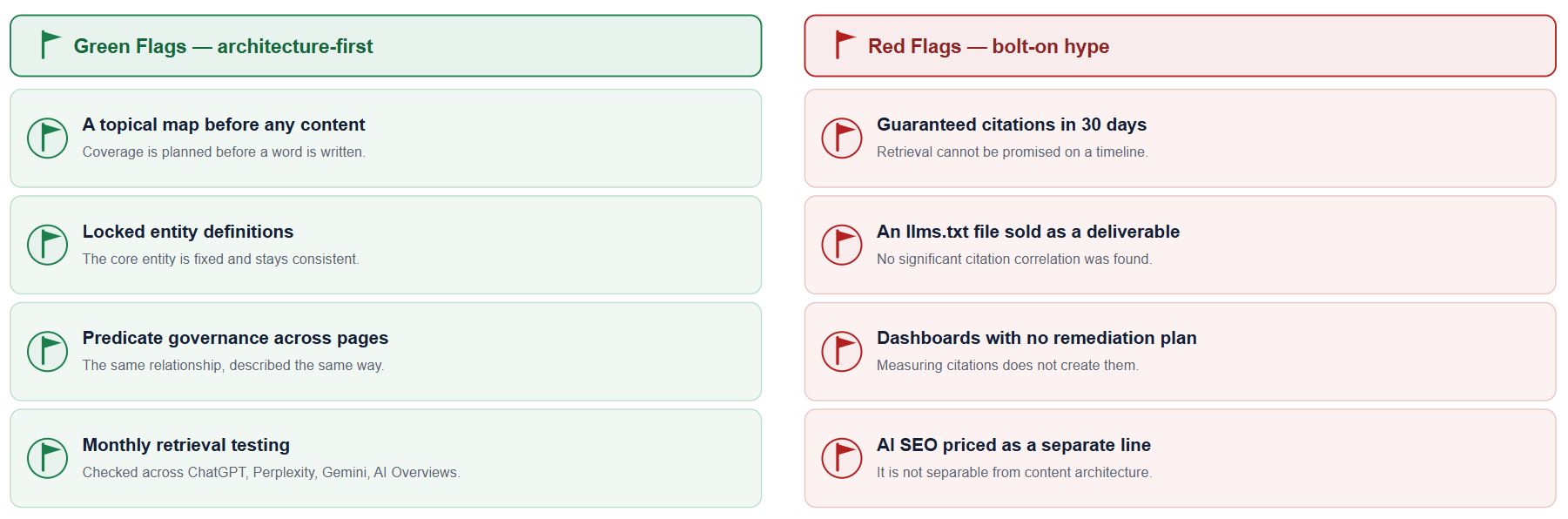
Ask one question first: does the work start at the architecture layer? A vendor selling AI optimization as a bolt on is selling a symptom, not a fix.
Green flags look like this. A topical map before any content. Locked entity definitions. Predicate governance across pages. Monthly retrieval testing across ChatGPT, Perplexity, Gemini, and AI Overviews.
Red flags look like this. Guaranteed citations in 30 days. An llms.txt file sold as a deliverable. Dashboards with no remediation plan. AI SEO priced as a separate line from the content architecture.
We run a citation readiness assessment inside the semantic audit before any engagement. It shows which clusters retrieve, which fail, and why.
GEO, AEO, or AI SEO: The Discipline Behind Every Label
Pick whichever label your buyers type into a search bar. Build the discipline underneath it. The label on the invoice never changed the retrieval math.
Digital Vikingz runs one practice: entity-first semantic architecture, tested against four AI surfaces every month. Call it GEO, call it AEO, call it AI search. If you want the discipline rather than the buzzword, start with our LLM and AI search visibility service.
FAQs About GEO, AEO, and LLM SEO
Is GEO different from SEO?
GEO extends SEO into AI answer surfaces. The founding benchmark found semantic methods lift AI visibility by up to 40% while keyword stuffing scores below baseline. Correct semantic SEO already is GEO.
What does AEO stand for?
Answer Engine Optimization. The label originally covered featured snippets and voice assistants. Today it describes the same AI citation work that GEO describes.
Do I need a separate GEO agency?
No. You need an agency whose architecture already produces AI citations. Visibility in ChatGPT, Perplexity, and AI Overviews is a property of correct semantic structure, not a separate service line.