
Once units align, three findings survive: ranking still buys entry, citation slots are escaping the top 10, and your vertical sets your number.
Citations also churn: 45.5% change when AI Overviews update. This tracker reconciles every major study, dates, and updates quarterly. It is the measurement backbone of our AI search visibility service.
Why AI Overview Overlap Studies Disagree
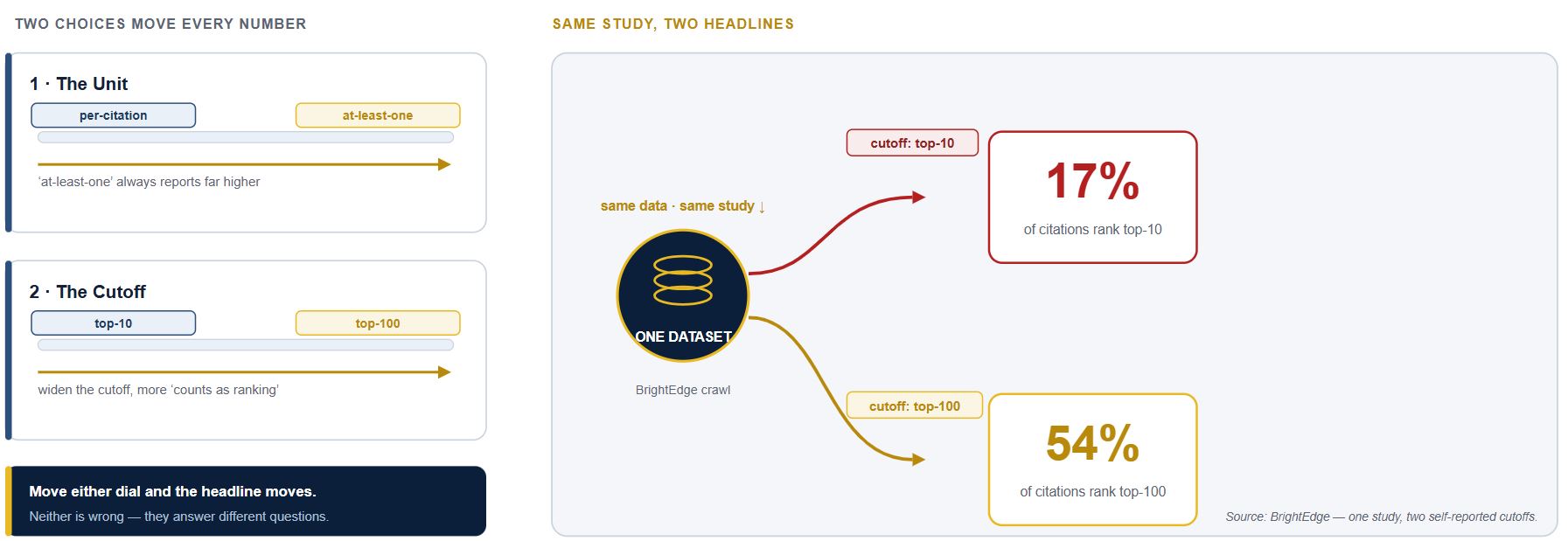
The studies report anywhere from 17% to 94% overlap with organic rankings. They are not contradicting each other. They are measuring different things.
Two distinctions dissolve most of the conflict. First, the unit. Per citation studies ask what share of individual cited URLs rank in the top 10. At least one study asks whether an AI Overview cites any top-ranked URL at all. The second number is always dramatically higher.
Second, the cutoff. Top 10, top 12, top 20, and top 100 all appear across the studies as the definition of "ranking." BrightEdge's famous 54% overlap means top 100. Its top 10 figure is 17%. Same study, same data, two very different headlines.
Add three more sources of noise: some studies count only the top three visible citations, some count SERP feature blocks while others count blue links only, and one tracker counts a page as "ranking" if it ranks for a fan-out sub query rather than the original query. Every one of these choices moves the number.
The Tracker: Every Major Study, Dated and Defined
Eight studies, one table, definitions aligned. Read the last column before comparing any two rows.
Study | Date | Sample | Headline figure | What it actually measured |
SE Ranking | Aug 2024 | Early AIO link analysis | 93.67% of links from top 10 | Early era counting; figures not comparable to later per-citation studies |
Industry study via SEJ | Late 2024 | Retrospective coverage | 75% of citations from top 12 pages | Per citation, top 12 cutoff |
seoClarity | May to Oct 2025 | 362K keywords, 5.1M citations | 94% of AIOs cite at least one top 20 URL; 90% at least one top 10; 32% of individual citations from top 10 | Both units side by side, the definitional Rosetta stone |
Ahrefs | Jul 2025 | 1M AIOs, 1.9M citations | 76% of cited pages ranked top 10; median rank of 3 | Per citation, top 3 visible citations per response only |
BrightEdge | May 2024 to Sep 2025 | 16 months, 9 industries | Top 100 overlap grew from 32.3% to 54.5%; only 16.7% of citations from top 10 | Overlap defined as top 100; huge industry variance |
Nov 2025 | Rank vs citation correlation | 52% of citations in top 10 | Per citation, mid point of the decline | |
BrightEdge | Feb 2026 | Separate dataset | Roughly 17% top 10 overlap | Per citation, different methodology from Ahrefs |
Ahrefs | Early 2026 | 863K keywords, 4M AIO URLs | 37.9% top 10; 31.2% positions 11 to 100; 31% beyond top 100; 28.3% no meaningful visibility | Per citation; improved parsing, so not directly comparable to its own July 2025 edition |
What the Numbers Agree On Once Definitions Align
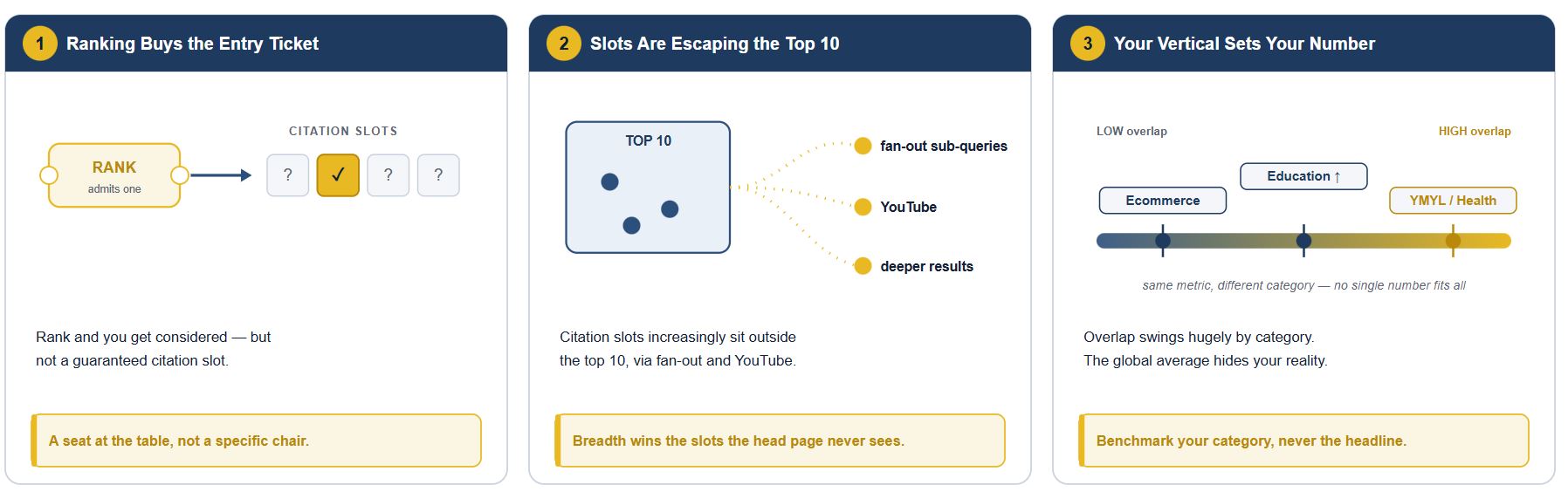
Three findings survive normalization. Everything else is methodology.
Ranking Still Buys the Entry Ticket
More than 90% of AI Overviews cite at least one top-ranked URL. seoClarity measured 94% citing at least one top 20 result and 90% citing at least one top 10 result. Position one pages get cited roughly 43% of the time, falling steadily to 7% by position 20.
Ranking gets you a seat at the table. It has never guaranteed a specific chair.
The Citation Slots Are Escaping the Top 10
The per-citation top 10 share declined all through 2025 into 2026. From 76% in July 2025, to 52% in November, to 38% and 17% in early 2026 across two methodologies.
Ahrefs published the honest caveat itself: its parsing improved between editions, so part of the drop is better detection, not Google changing. Even with that discount, the direction is unambiguous. The drivers are documented: query fan-out pulls sources from subquery results, the Gemini 3 upgrade landed in January 2026, and YouTube keeps expanding.
YouTube made up 18.2% of citations that rank nowhere in the top 100, sits at 5.6% of all AIO citations, and grew 34% in six months as the most cited domain overall.
Your Vertical Sets Your Number
Global averages hide vertical reality. BrightEdge's 16-month tracking found education's overlap surged 53.2 percentage points while ecommerce moved 0.6. YMYL categories like healthcare and insurance run 68% to 75% top 100 overlap, because trust topics lean hardest on already ranked sources.
Benchmark against your category, never against the headline number.
The Volatility Layer: Why Even the Right Number Moves
45.5% of AI Overview citations change when AI Overviews update. The composition of the box churns even when your ranking holds still.
The plurality runs deeper. Google's own two AI surfaces, AI Overviews and AI Mode, cite the same URLs only 13.7% of the time. We covered the citation pipeline breakdown across every engine already. The operational answer is cadence: fixed prompt sets, monthly runs, trends over snapshots, exactly as specified in the LLM measurement framework.
What the Tracker Means for Strategy
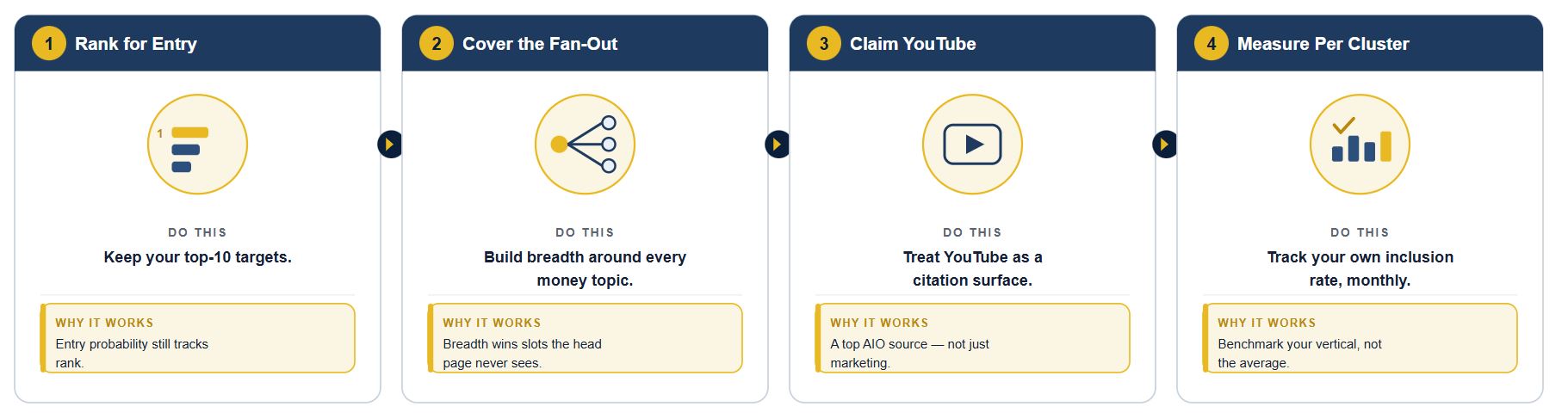
Rank for the entry ticket. Build breadth for the slots. Four moves follow directly from the reconciled data.
Keep your top 10 targets, because entry probability still tracks rank. Cover the fan-out subqueries around every money topic, because breadth wins slot auditions that the head page never sees.
Treat YouTube as a citation surface, not a marketing channel. And measure your own inclusion rate per cluster instead of trusting anyone's global average, starting with the citation baseline diagnostic.
The prize for a slot is measurable. Seer found cited pages earn roughly 2.1% CTR against 0.9% for uncited pages on the same AI Overview queries. Being in the box is worth about double the clicks.
The Overlap Tracker: Updated Quarterly
The studies will keep publishing, and the definitions will keep drifting. This page absorbs both. We refresh the table each quarter, date every edition, and keep the units labeled, because a tracker that goes stale becomes one more conflicting headline.
Rank for entry. Build breadth for slots. Measure your own inclusion monthly. When you want the measurement and the remediation run as one loop, start with our AI search visibility service.
FAQs About AI Overview Citations and Rankings
What percentage of AI Overview citations come from the top 10?
Depends on the unit and the date. Per citation figures ran from 76% in July 2025 down to 38% and 17% in early 2026. At least one figure stays above 90%. Both are true, and they measure different things.
Do you need to rank to appear in AI Overviews?
Ranking strongly helps entry: over 90% of AI Overviews cite at least one top 10 URL, and position one is cited about 43% of the time. But roughly 28% to 31% of cited pages rank nowhere meaningful, entering through fan-out subqueries and YouTube.
How often do AI Overview citations change?
Ahrefs measured 45.5% of citations changing when AI Overviews update. A single snapshot misleads. Measure monthly on a fixed prompt set and report the trend.