 Digital Vikingz
What Is Query Augmentation?
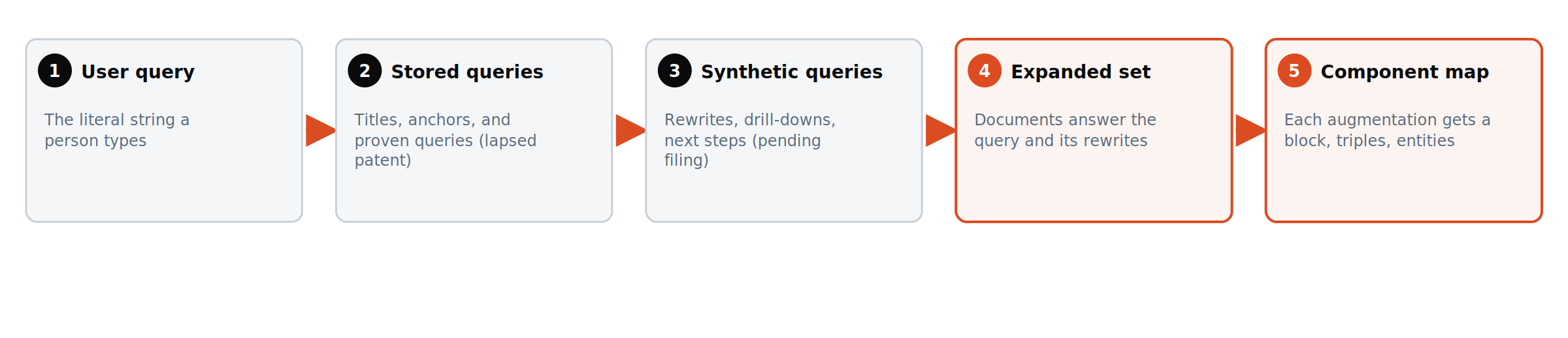
Query augmentation is the expansion of a search query into related phrasings, entity types, attributes, and contexts before retrieval. A page answers the expanded set, not only the literal string. Two Google documents describe the mechanism: a lapsed patent and a pending filing.

What does query augmentation add to a search query before retrieval?
Query augmentation adds synonyms, the entity type, attribute terms, and context terms to the literal query, then retrieves against the expanded set.
A user types a few words. The search system reads them as an entity, an attribute, and a context, then adds phrasings that share the meaning. A query for semantic SEO audit cost is a typical case, with expansions toward audit pricing basis, audit deliverables, and audit versus technical audit. The page that answers only the literal string covers one row of that set.
Google's sources describe two mechanisms. A lapsed patent matches the user query to stored queries that already perform well. A pending filing has a generative model write new queries from the query and its session. Both lead to the same page-side requirement: cover the expanded set.
Augmentation is not a longer keyword list. A keyword list collects strings by volume. An augmented set collects the phrasings that share one meaning and one answer. Strings with a different answer belong to a different page, and Query Deserves a Page makes that call.
How did Google's query augmentation patent turn titles and anchor text into queries?
Google's query augmentation patent stored page titles and widely repeated anchor text as queries a page answers, then matched user queries to them.
The patent is US 9,916,366, granted in 2018 and since expired for non-payment of fees. Its stored queries come from two sources. User queries from logs qualify when they pass performance signals such as long clicks and click-through rate. Synthetic queries are generated from titles, anchor text, tagged sections, and listing fields.
A document title counts as a well-performing query even when no user ever typed it. Submitting the title returns that document, so the title is stored. Anchor text that many pages use for one target is stored as a query for that target. The example threshold is 500 pages. The patent calls anchor text a signal of how users describe the target's subject.
Matching favors nouns. Candidate stored queries share at least two terms with the user query, allowing synonyms and stems. Verbs and adjectives are dropped before nouns. The patent has lapsed, so this is design logic, not a guarantee.
How does Google's stateful chat filing generate synthetic queries?
Google's stateful chat filing has a generative model write synthetic queries: rewrites, simplifications, drill-downs, supplemental queries, and next steps.
The filing is US 2024/0289407, published in August 2024 and still pending. Several synthetic queries run in parallel or in sequence. The model is trained on search logs first, then on sequences of queries issued within a time interval. The second stage teaches it multi-step tasks.
Session state is held as a set of tokens that accumulates attributes. A buyer researching agencies starts with {semantic SEO agency}. After two more queries the set reads {semantic SEO agency, audit, flat fee}. Every later rewrite carries those tokens, so each retrieved document is matched against the attributes as well as the head entity.
Documents are selected for the query and for the rewrites. A page that answers the head query and none of its rewrites competes for one slot in a set built from several. Next-step suggestions follow the categories the results fall into, such as price range or a best-for variant.
Why do drill-down queries change after a user reads a tutorial?
Drill-down queries change because the filing tracks what the user has already read and then seeks more detailed, lower-level information.
The filing describes a familiarity signal drawn from the user's profile and session. Content the user already read is omitted from the summary, or the summary goes deeper. After a high-level tutorial, later synthetic queries seek lower-level detail. The next query is built to go deeper, not to repeat.
The page-side response is depth tiers inside a cluster. A pillar page holds the high-level layer. Each cluster page holds one level down: a specific type, a specific application, or a specific comparison. No two pages in a cluster sit at the same depth on the same entity.
Each cluster page states its depth in the standfirst. A page on query templates says it assumes the reader knows what a topical map is. A system that filters by familiarity needs that depth stated to use it. A restatement of the pillar gives a reader who finished the pillar nothing new.
How does a content brief map augmented queries to page components?
A content brief maps each augmented query to one component, the triples that component states, and the named entities it contains.
The method has five steps. List the augmented variations of the canonical query. Assign one component to each variation. Write the triples each component expresses, then list the named entities it carries as text. Order the components last, and the four-column table becomes the brief.
Order follows function. Augmentations that establish identity and trust sit in macro context, above the fold. Augmentations that expand attributes sit in micro context below it. Augmentations phrased as questions close the page.
Take a dental clinic's service page for dental implants. The augmentation dental implant cost maps to a cost component, with the pricing basis as triples. Implant procedure steps map to an ordered step list. Candidacy questions map to the closing FAQ, and the clinic's dentists appear as named entities in the trust block.
Which page elements carry query augmentation phrasings?
Titles, headings, and internal link anchors carry the phrasings augmentation matches against, so each one is written as a query.
The title is a phrase a user types: entity type, entity, and one constraint. Slogans and brand taglines in a title match nothing a user submits. Pasting the title into search is the test, and a working title returns its own page.
Headings cover the augmented terms, not only the literal keyword, and each one leads with the head noun. Noun-first phrasing survives matching because verbs and adjectives drop first. Each page also has one canonical anchor phrase that every internal link uses. Varying the anchor splits the phrase that a repeated anchor builds.
- US 9,916,366 B1: Query augmentation (Google, expired)
- US 2024/0289407 A1: Search with stateful chat (Google, pending application)
- Koray Tuğberk Gübür, Search Engine Land: Visual semantics, the missing piece of topical authority
- Google Search Central: A guide to Google Search ranking systems
Patents and filings describe systems Google has invented. None is a confirmed ranking factor.
What should you read after query augmentation?
 AI citation readinessAI citation readiness is the degree to which each sentence on a page verifies a sentence in a generative summary.
 Query templatesA query template is a recurring query pattern with fixed wording and one variable entity slot, such as 'semantic SEO for.
 What is a content briefA content brief is the document that turns one node of the topical map into one page.
 Query Deserves a PageQuery Deserves a Page is the test that decides if a query variation gets its own page, a section, or a sentence.
 AI Search VisibilitySix requirements, each tied to a stage in the pipeline. Each one is tested before and after.
 Semantic SEO ArchitectureSeven documents with a fixed structure. Every engagement produces all seven.
 Talk to usMessage the team on WhatsApp
Questions about query augmentation
Is query augmentation the same as query fan-out?
Does query augmentation mean a page targets every synonym?
Where do augmented query lists come from without access to Google's logs?
Do misspellings need their own pages or sections?
Are brand and place names expanded like other terms?
Does the page title still matter now that the patent has lapsed?
Does query augmentation affect local service pages?
Which contextual signals does the stateful chat filing use?
Does a page ever rank for an augmented query it never mentions?
What is the difference between query augmentation and query templates?
Does next-step coverage mean adding more pages?
Does a long click still matter for query augmentation?

See it applied to your site
The Semantic Content Audit uses every term in the knowledge hub. Fixed scope, written deliverable.