 Digital Vikingz
What Is AI Citation Readiness?
AI citation readiness is the degree to which each sentence on a page verifies a sentence in a generative summary. A ready page states one fact per sentence, in the wording the field uses, with evidence beside every claim that is its own.

Also covered on this page: Passage verification, Corroboration confidence
How does Google's generative search choose the pages it summarizes?
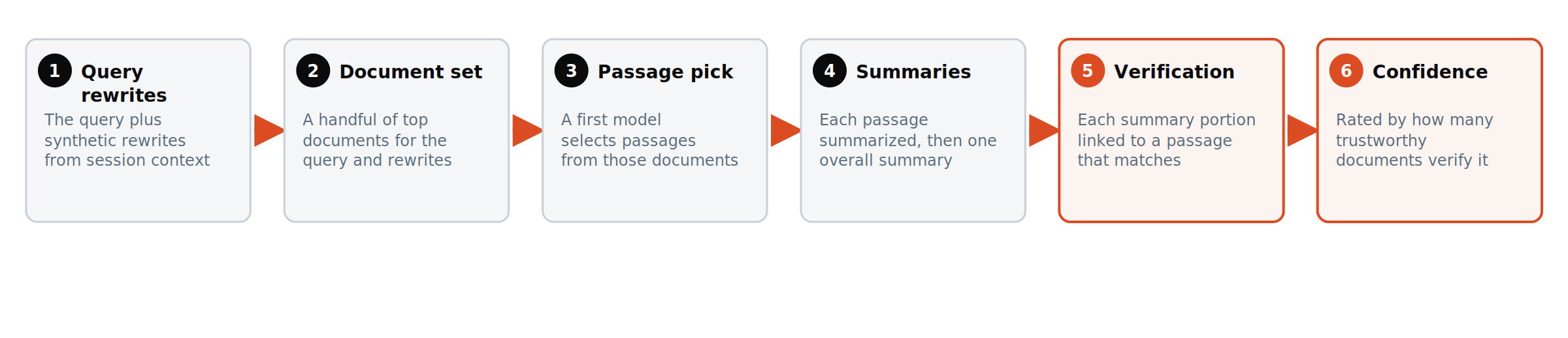
Google's filing on its generative search describes summarizing a handful of documents chosen for the query and its rewrites.
The filing is US 2024/0289407, a pending application titled Search with stateful chat. A generative model first writes synthetic queries from the user's query and session context. The system then selects the top documents for those queries, with two or three given as examples. Query augmentation covers how those rewrites are built.
Selection runs on ordinary search measures. Query-dependent measures include the document's rank position, its selection rate for the query, locality, and language match. Query-independent measures include selection rate across many queries, trustworthiness, popularity, and freshness. Ranking for the query or one of its rewrites is the entry ticket.
Inside the set, the filing describes three models in series. The first model selects passages from the documents. The second summarizes each passage. The third writes the overall summary from those passage summaries, and every later check works on its sentences.
How does passage verification link an AI summary sentence to a page?
Passage verification links a summary portion to a document through a source token or through embedding distance to one of its passages.
The filing marks each document with a source identifier token before summarizing. A summary portion is linked to a document when its token points there. Otherwise the portion is compared with the document's passages, and a distance under a threshold counts as verification. Google's granted patent on generative summaries, US 11,769,017, links summary portions to sources by embedding similarity in the same way.
The link sometimes goes to the specific portion of the page as an anchor link. Stable ids on every heading and standalone passage give that link a target. A page without ids receives a general link at best. The filing also describes running a fresh search on a portion's text to find more verifying documents.
The page-side unit is the sentence inside a passage. A sentence with one entity, one attribute, and one value sits close to a summary sentence that states the same fact. A compound sentence that bundles two claims sits between two summary portions and matches neither cleanly. Preamble before the fact risks a cut at passage selection, before summarization starts.
How does corroboration confidence rate a sentence in an AI summary?
Corroboration confidence rises with the number of documents that verify a summary portion and with how trustworthy those documents are.
The filing scores each portion on three inputs: the model's own confidence, the count of verifying documents, and their trustworthiness. Four verifying documents beat one. Four highly trustworthy documents beat four less trustworthy ones. Trustworthiness comes from author, domain, and inbound links, the subject of the article on author and organization entities.
Agreement-area facts verify best in agreement-area wording. A fact that many sources state is written in the terms those sources use. Rephrasing a consensus fact for originality moves it away from the passages that verify it. A semantic SEO agency describing a topical map uses that term, not a coined synonym such as content universe.
Consensus wording is not copying. The sentence states the shared fact in shared terms, and the page adds its own facts around it. Google's ranking systems guide names original content systems that favor originals over pages that cite them. A ready page carries both the shared vocabulary and the original contribution.
How does a unique claim earn confidence in an AI summary?
A unique claim earns confidence only when its evidence sits in the same block as the claim.
A claim that only one site makes starts with one verifying document against zero others. Under the filing's confidence inputs, that portion has a single document behind it. Evidence on the page changes what the summarizer reads: the measurement, the method, the sample, and the date. The claim then arrives with its basis attached.
Take an audit page that says most sites have cannibalization. The unsupported version stops there. The ready version names how many audits were counted, the date range, and how cannibalization was defined. The claim becomes a reported observation with a method, and a reader or a model checks it against that method.
Information gain explains why unique claims matter for ranking. The question here is narrower: how a unique claim verifies. Without evidence, the claim is one voice with no support. Evidence makes the claim checkable, and a checkable claim is a candidate for citation.
What does an AI-citable sentence look like on a service page?
An AI-citable sentence names the entity as its subject, states one attribute, and gives the value in plain words.
Take a semantic SEO agency's audit page. The weak version reads: our in-depth audits help brands win more from search. The sentence has no entity, no attribute, and no value to verify. The ready version reads: the Semantic Content Audit is a flat-fee engagement.
Each ready sentence matches one summary portion a model writes about audits. Pricing basis, output, and format each get their own sentence. None of them depends on the sentence before it for meaning. Pronouns that point back across sentences break that independence, so the entity name repeats.
Values carry their units and dates. A sentence that says Google retired a system a while ago verifies against nothing. A sentence that says Google folded the Helpful Content System into core ranking in March 2024 matches Google's own ranking systems guide. Vague values fail because no other page states the same vague thing.
What does AI citation readiness not control?
AI citation readiness makes a page a candidate for citation, and the system still decides which candidates it cites.
The filing is a pending application, and its claims are still open to narrowing. Nothing in its claims constrains page content, so every page-side rule here rests on the description. Google does not publish which parts of the filing run in AI Overviews or AI Mode today.
The summary also draws on sources the page never touches. The filing says a summary sometimes adds content from the model's training that appears in no document. A query classified as do not interfere returns a plain results page with no summary at all. Model confidence is one of the three confidence inputs, and no page has a say in it.
- US 2024/0289407 A1: Search with stateful chat (Google, pending application)
- US 11,769,017 B1: Generative summaries for search results (Google)
- US 9,940,367 B1: Scoring candidate answer passages (Google)
- Google Search Central: A guide to Google Search ranking systems
Patents and filings describe systems Google has invented. None is a confirmed ranking factor.
What should you read after ai citation readiness?
 Query augmentationQuery augmentation is the expansion of a search query into related phrasings, entity types, attributes, and contexts bef.
 Author and organization entitiesAuthor and organization entities are the named person and the named business a page declares as responsible for it.
 Information gainInformation gain is the new information a page adds beyond the pages a searcher has already seen.
 MicrosemanticsMicrosemantics is the sentence-level layer of semantic SEO: subject choice, word order, and predicate choice inside each.
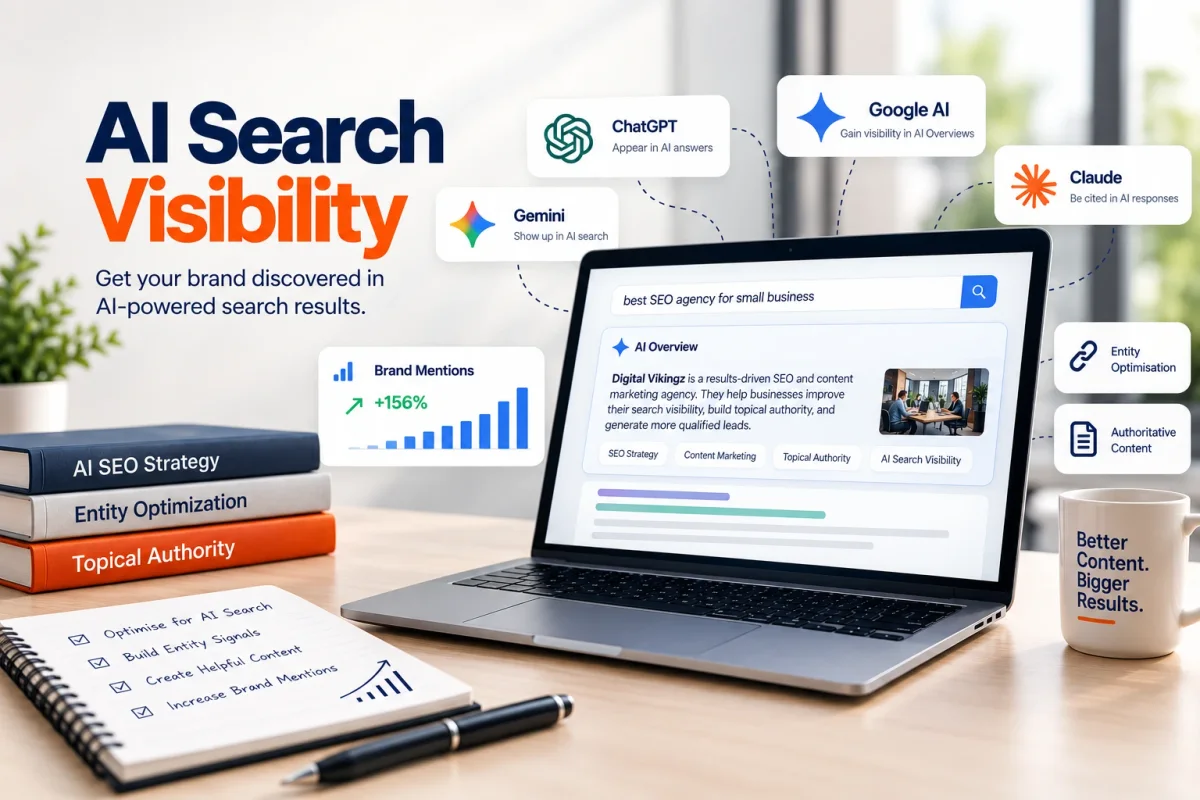 AI Search VisibilitySix requirements, each tied to a stage in the pipeline. Each one is tested before and after.
 Content ProductionEvery page passes all six stages. The check at each stage is a written gate, not a feeling.
 Talk to usMessage the team on WhatsApp
Questions about ai citation readiness
Does a page need to rank on page one to be cited in an AI answer?
Are tables and lists citable in AI summaries?
Do images and video get read by the generative pipeline?
Does page length change AI citation readiness?
Does the meta description matter for AI citation?
Does updating a page's date improve AI citation readiness?
Do ChatGPT, Perplexity, and Gemini verify sentences the same way?
What happens when two pages on one site state different values for the same fact?
Does AI citation readiness apply to product and category pages?
How does the system choose between competing AI summaries?
Do FAQ sections help a page get cited?
Does a claim need an external link to count as evidence?

See it applied to your site
The Semantic Content Audit uses every term in the knowledge hub. Fixed scope, written deliverable.