Website Development for Semantic SEO: WordPress, Shopify, Wix, Squarespace, and Next.js

Website Development builds or migrates the site the architecture needs. The main component renders without JavaScript, and block order matches the map. Every page type gets its template, and migrations move every URL and asset.

Website Development, a Digital Vikingz semantic SEO service

Which platforms does Website Development build on?

Five platforms, chosen by what the architecture needs, not by preference.
WordPress

Best fit
Service businesses, content networks, local sites
Rendering and control
Server-rendered. Full template control.
What to know
Plugin bloat raises DOM size. Themes are replaced, not patched.

Shopify

Best fit
Ecommerce with a product catalog
Rendering and control
Server-rendered Liquid. Theme-limited.
What to know
Product and collection paths are fixed. Filters need theme work.

Wix

Best fit
Small local businesses, single-location services
Rendering and control
Server-rendered. Editor-limited.
What to know
Custom code elements for calculators and estimators.

Squarespace

Best fit
Portfolios, small practices
Rendering and control
Server-rendered. Limited block control.
What to know
Fewer page types. Fine when the map is small.

Next.js

Best fit
SaaS, programmatic pages, headless builds
Rendering and control
Static or server-rendered. Full control.
What to know
Needs a developer on your side or ours for changes.
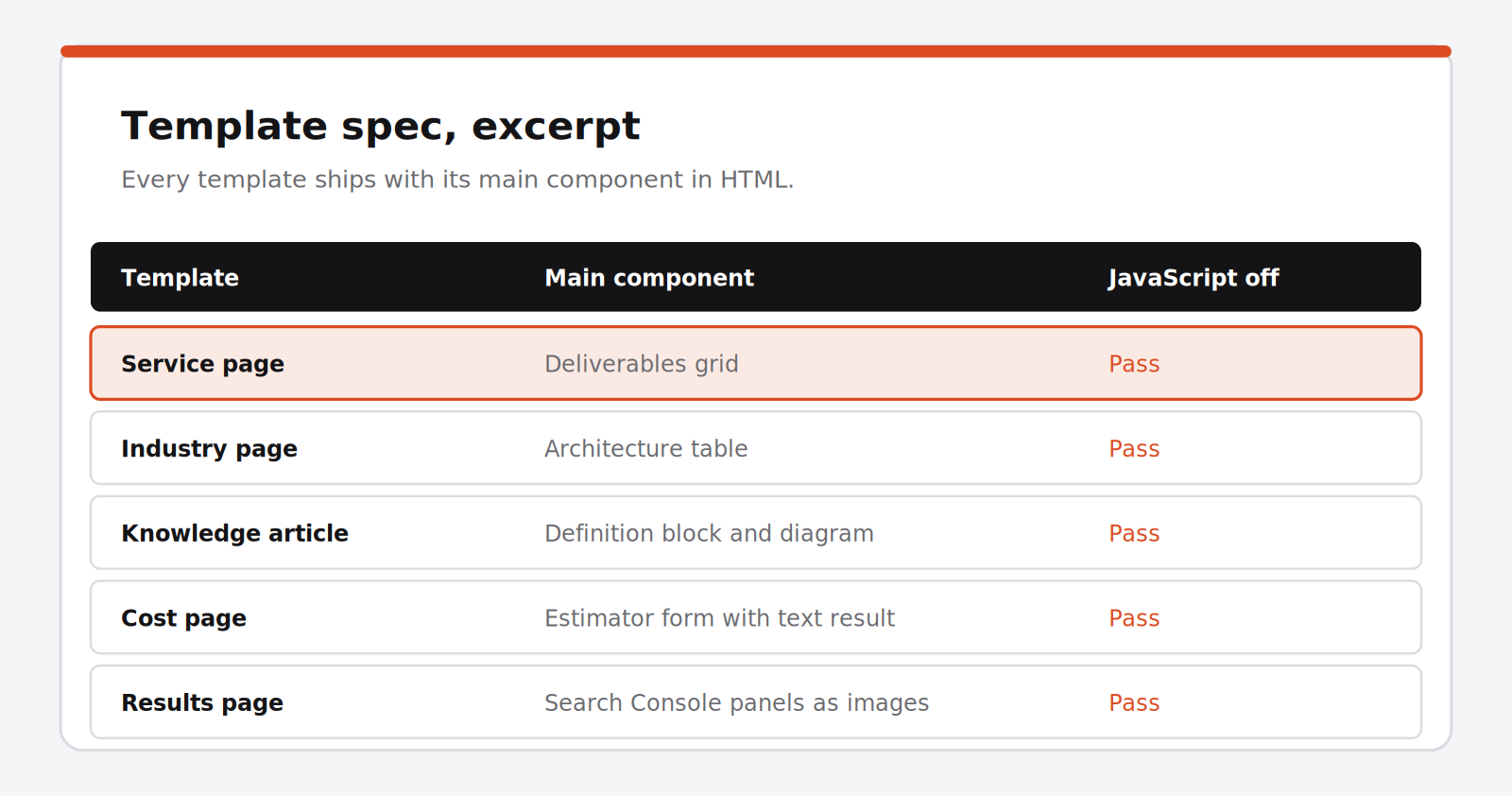
Sample Website Development deliverable, shown as an excerpt table
Sample layout of the deliverable, filled with topics from this site. Client deliverables carry the client's own entities.

How does Website Development work?

A site is letters, pixels, and bytes, and a search engine reads all three.

The architecture decides what each page is and what its main component does. Development is where that decision either survives or dies. A calculator injected by script after load, a share bar under the H1, a category page with no filter: each one undoes the plan. The build rules below are the plan, enforced in code.
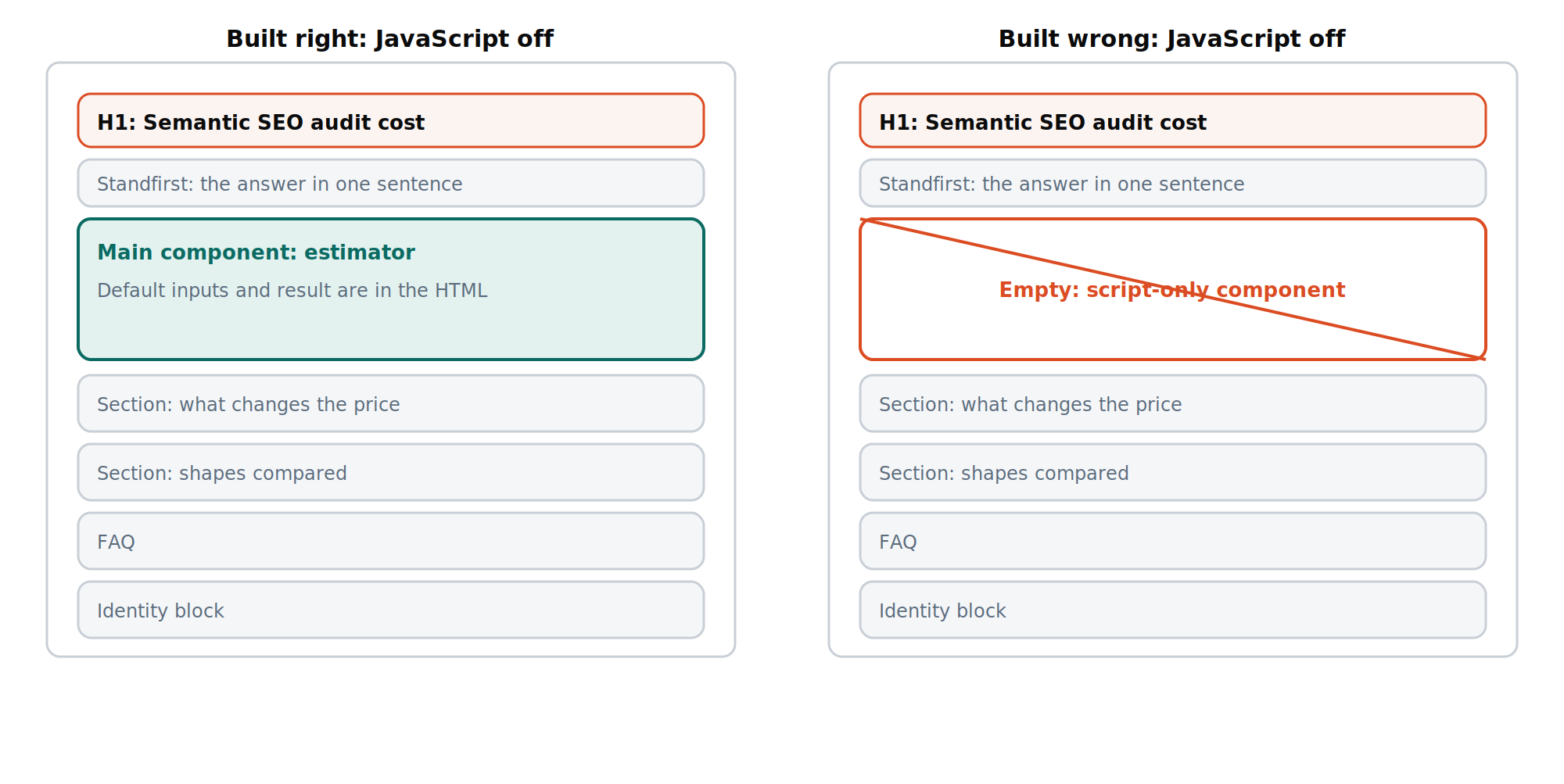
The rendering test: the same page with JavaScript on and off, showing which components survive
The rendering test. The main component and every block still render with JavaScript off. Anything that disappears was never read.

Which build rules does Website Development enforce?

  1. Main component without JavaScriptThe centerpiece is in the HTML. Scripts enhance it. They do not create it.
  2. DOM order equals rendered orderNo CSS reordering of content blocks. One sequence for every system that reads the page.
  3. Typed values as textPrices, dates, addresses, and counts are text on the page, with units. Never icons alone.
  4. Caption block under every imageImage and caption are two adjacent blocks. The caption is a sentence.
  5. Stable id on every headingEvery H2 and H3 carries an id that does not change on republish.
  6. Filter on every listing pageAny page with more than one product or provider carries a working filter on at least two attributes.
  7. No empty containersSpacer divs and empty grid cells are removed. Each one renders as a block with nothing in it.
  8. Identity block one click from every pageOrganization name, address, contact, and author profiles reachable from the footer.

Which Google documents does Website Development build on?

Patents describe systems Google has invented. They are not confirmed ranking factors. The work is built so a page passes the check each document describes.

Who is Website Development for?

Clients whose current site fails to carry the architecture

The theme blocks the calculator from going first, or has no room for a filter. The site is rebuilt to the templates.

Migrations between platforms

WordPress to Next.js, Wix to WordPress, Shopify theme changes. One-to-one URL and asset mapping.

New sites launching on the architecture from day one

No legacy to fix. Every template built to the map before the first page is written.

Not the right fit

A redesign for its own sake. The build follows the architecture. Without page decisions and a template list, the build has no target.

How is Website Development priced and delivered?

Shape
Fixed-scope project
Pricing basis
Priced by template count and migration size
What you receive
The site, the template list, and the migration log

Exact scope is quoted in writing after the strategy call. How semantic SEO is priced.
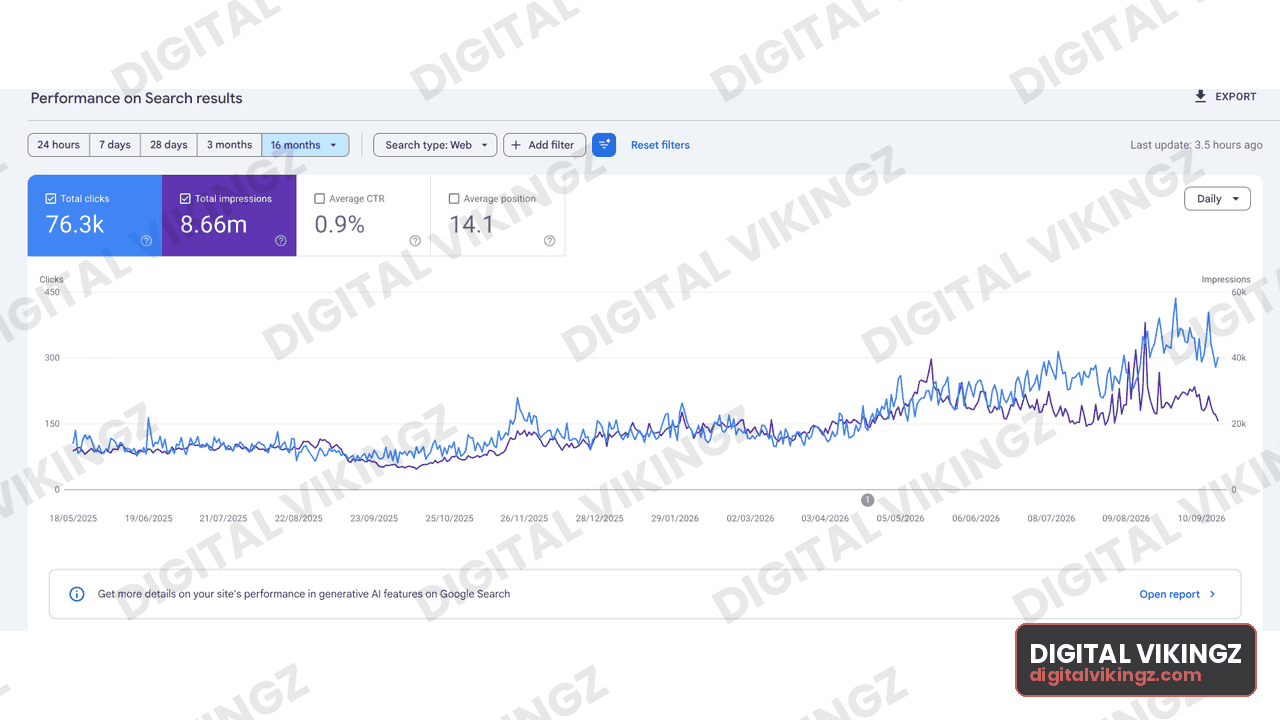
A client property from the results page

Google Search Console performance panel, Real estate · 16 months: 76.3K clicks, 8.66M impressions, 0.9% CTR, average position 14.1
76.3K clicks · 8.66M impressions · 0.9% CTR · position 14.1Real estate · 16 months. Domains stay hidden. Which services each property used is shared on the call.
All nineteen properties

Questions about Website Development

What are the migration rules?
One change at a time. Every URL redirects one to one, including image and file URLs. Nothing is left behind for the crawler to rediscover. Crawl stats are watched for the recrawl before the next change.
Why do image URLs matter in a migration?
Images are indexed separately and re-indexed slowly. A changed image URL without a redirect loses the image's history. The migration log maps every image.
Can we keep our current theme?
Yes, when it renders the main component without JavaScript and allows the block order the map needs. A theme that fails either test is the problem, and it is replaced.
Do you design, or only build?
Both, to the client's brand. The architecture decides the layout. The brand decides the look. The build keeps the two separate.
Where does the site host?
The site hosts on your hosting account. The build specifies response time and rendering requirements. Hosting is chosen to meet them, not resold.
What about a site with thousands of programmatic pages?
Next.js with a headless CMS, templates per page type, and the page test applied before generation. Pages that fail the test are not generated.
How do you hand it over?
Template documentation, the migration log, and a recorded walkthrough. Your developer maintains the site without us.
What access does a build or migration need?
Admin access to the CMS and hosting for the build. A migration also needs the current site, Search Console, and DNS access at cutover.
What happens to existing content during a rebuild?
Content moves to the new templates on the same URLs where the map keeps them. URLs the map merges get one-to-one redirects. Nothing is dropped without a redirect in the migration log.
Do you build multilingual sites?
Yes. Every language version shares one template set and one block sequence. Each version gets its own URLs.
Book a callWhatsApp