 Digital Vikingz
What Is a Query Template?
A query template is a recurring query pattern with fixed wording and one variable entity slot, such as 'semantic SEO for [industry]'. Every entity value that fills the slot produces one query variation. A site covers the template when its pages answer every variation in the same shape.

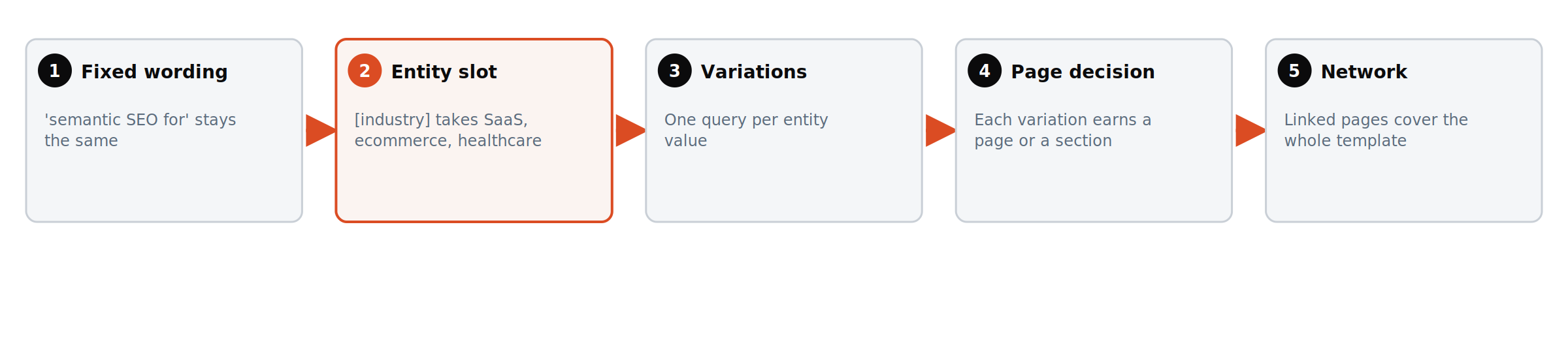
What are the parts of a query template?
A query template has three parts: a contextual noun slot, the central entity, and a tail synonym.
The central entity stays constant across every variation. The central entity of this site is semantic SEO. The contextual noun is the slot that changes: SaaS, ecommerce, healthcare, finance, real estate. The tail synonym closes the query: agency, services, consultant, company.
Each part behaves differently. Contextual noun values carry their own attributes and verbs, so each value is a candidate page. Tail synonyms never become pages. 'Semantic SEO agency for SaaS' and 'semantic SEO consultant for SaaS' ask for the same thing, so one page holds both phrasings.
A template also fixes position. The slot sits at the start, the middle, or the end of the query, and keeps that position across variations. Query Deserves a Page decides, per variation, if a slot value earns a page or a section.
How does Google's query suggestion templates patent build a query template?
A Google patent on query suggestion templates describes grouping past queries by shared wording plus an entity alias, then using a placeholder.
The patent is US 10,635,717, granted in 2020. The system defines an entity category, such as a city or a year, and recognizes the aliases each entity goes by. Past queries that share the same wording around an alias are grouped. The entity is then replaced with a placeholder such as [city], and templates are ranked by how often past queries match them.
The patent describes query suggestions, not page ranking. What transfers is the shape. The patent describes demand stored as templates with slots, with frequency tracked per template. A site that answers the whole template matches the unit the patent uses to group demand.
The harvest follows the same steps. Fix the wording, vary the entity in autocomplete and related searches, and count the entity values that return suggestions. Templates with the most producing values get pages first. Entity aliases the template accepts, such as 'SaaS' and 'software as a service', sit on one page and never get their own.
What makes an answer template-efficient across a query template?
An answer is template-efficient when every variation of the query template gets the same answer pattern, with every slot filled by a real value.
A Google patent on generating query answers, US 10,031,953, describes loading candidate answer templates for an attribute. The system retrieves entity-attribute-value facts and picks the answer template whose constraints are best satisfied. The named constraints include type, time, relationship, singular or plural, and unit.
The page-side rule is one answer pattern per query template. Take 'semantic SEO for [industry]'. The answer pattern opens with the industry as subject. The pattern then states the entity the industry's sites are built around and names the first page type the map needs. Every industry page fills those slots with its own values, and no slot is left as 'contact us'.
The mechanics of the triple belong to entity-attribute-value writing. The query template adds one demand on top: the pattern stays fixed across variations while the values change. Writers do not vary the pattern across a template for naturalness. Variation belongs inside one page.
How does a semantic content network cover a query template?
A semantic content network covers a query template when linked pages answer every variation that earns a page, so history carries across.
Koray Tuğberk Gübür's model describes the sequence. A site satisfies one variation. A sibling variation shares the template. Under the model, the search engine tests the site on the sibling and reads the clicks. Positive tests make the whole template easier to rank.
The build order follows from that model. Seed the template with the variations most likely to earn first clicks. Those are the highest demand, the lowest competition, and the closest match to the site name. Satisfied clicks on those pages open tests on the rest. The network is built as a set, not as isolated pages.
Under the same model, off-topic volume spends the earned trust. Unrelated pages published on the strength of one template reverse the gain, and the site restarts at a lower scale. The template's pages link to one another through their parent and toward the commercial core. The topical map records that link direction.
How do predicates shape the pages of a query template?
Predicates, the verbs users pair with each slot value, decide which sentences and components each variation's page carries.
The contextual domain of a term is the set of contexts produced by adding one or two words to it. Mapping the contextual domain before the topical map shows which verbs travel with which values. A platform value such as Shopify tends to pair with build verbs: migrate, configure, redirect. A regulated industry value such as healthcare tends to pair with trust verbs: review, cite, verify.
Each predicate set becomes sentences and components. Build verbs call for steps, a migration checklist, and a template list. Trust verbs call for authorship, sources, and review dates. A page written with the sibling's verbs matches the sibling's queries better than its own.
The predicate stays fixed for one relationship across one template. Every page in 'semantic SEO for [industry]' uses the same verb for the same relationship in its opening sentence. The source term vector records that verb, so writers on different pages keep one verb.
How is a query template measured in Search Console?
A query template is measured as a group: query count, impressions, and clicks summed across every page and section that answers it.
Search Console lists queries one by one. Grouping them on the fixed wording rebuilds the template. The BigQuery export keeps the row totals of anonymized queries, which the interface drops. The group total then comes closer to real demand.
Query count across the template is the leading indicator. Impressions on new variations rise before clicks do. A template gaining ground shows new variations entering at low positions while the seeded pages climb.
Single-page reports hide the pattern. One variation losing clicks while the template gains queries is a healthy network. The whole template losing queries at once points to a template-level fault, such as a changed layout or a drifted vocabulary.
- Koray Tuğberk Gübür, Search Engine Land: Query templates, expanding the scope of topical authority
- US 10,635,717 B2: Query suggestion templates (Google)
- US 10,031,953 B1: Generating query answers (Google)
- Google Search Central: A guide to Google Search ranking systems
- Google: Search Quality Rater Guidelines (PDF)
Patents and filings describe systems Google has invented. None is a confirmed ranking factor.
What should you read after query templates?
 Query Deserves a PageQuery Deserves a Page is the test that decides if a query variation gets its own page, a section, or a sentence.
 Entity-attribute-valueEntity-attribute-value is the method of stating every fact as an entity, one property of that entity, and the property's.
 What is a topical mapA topical map is the plan of every entity, attribute, and query a site covers.
 MicrosemanticsMicrosemantics is the sentence-level layer of semantic SEO: subject choice, word order, and predicate choice inside each.
 Semantic SEO ArchitectureSeven documents with a fixed structure. Every engagement produces all seven.
 Content ProductionEvery page passes all six stages. The check at each stage is a written gate, not a feeling.
 Talk to usMessage the team on WhatsApp
Questions about query templates
How many variations does a query template need before it is worth building?
Can a query template cross unrelated topics?
What is the difference between a query template and a keyword cluster?
Do query templates differ between languages?
Do programmatic pages count as query template coverage?
How do query templates appear on a topical map?
Can one page answer a whole query template?
Do query templates change over time?
Does every variation page need a distinct opening?
Do local businesses use query templates?
Do B2B service sites have query templates?

See it applied to your site
The Semantic Content Audit uses every term in the knowledge hub. Fixed scope, written deliverable.