 Digital Vikingz
How Much Does Semantic SEO Cost?
Semantic SEO cost is set by the engagement shape and five scope factors: site size, query network size, language count, producer, and platform. The producer is whoever writes the pages, the client's team or the agency. The scope estimator below names the shape that fits before a quote is requested.

Which semantic SEO engagement fits your site?
Five questions. The result names the engagement shapes that fit and the factors that set their price. No number appears, because the number depends on your query network.
- Semantic Content Audit: flat fee.
- Semantic SEO Architecture: fixed scope, priced by site size and query network.
- Semantic Content Production: monthly, sized by the roadmap.
Price moves with: site size, query network size, language count.
Get the written quote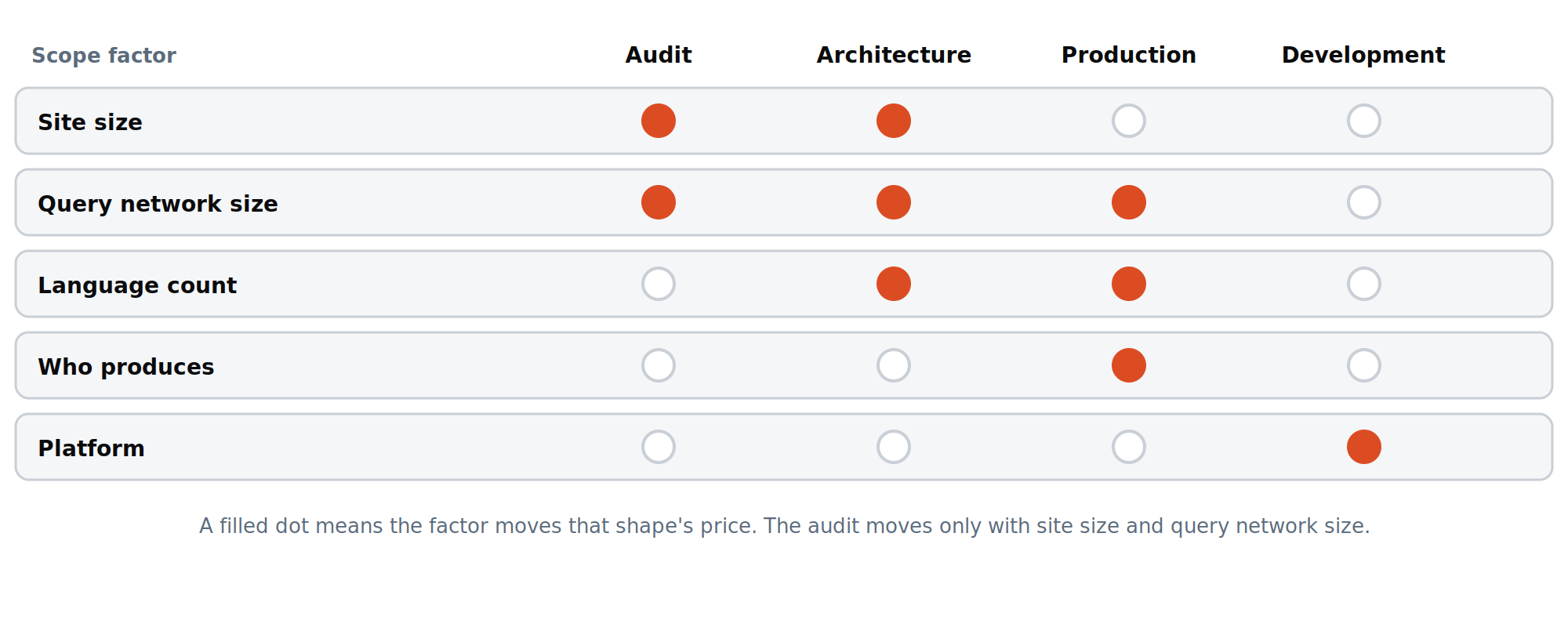
Which engagement shapes does semantic SEO pricing follow?
Semantic SEO pricing follows five engagement shapes, and each shape carries its own pricing basis.
The Semantic Content Audit is a flat fee, quoted before access, covering the document and the review call. The Semantic SEO Architecture is a fixed-scope project priced by site size, query network size, and language count. Content Production runs monthly, sized by the roadmap. AI Search Visibility is a project for the structural pass and monthly for the prompt set. Website Development is a fixed-scope project priced by template count and migration size.
Five engagement shapes, each with its pricing basis, the factors that move it, and what it produces.
| Engagement | Pricing basis | Moves with | Produces |
|---|---|---|---|
| Semantic Content Audit | Flat fee | Site size, query network size | Issue map and review call |
| Semantic SEO Architecture | Fixed-scope project | Site size, query network size, languages | Seven documents and a workshop |
| Content Production and AI visibility | Monthly | Roadmap size, languages, who writes | Pages live in sequence; citation record |
| Website Development | Fixed-scope project | Template count, migration size | The site and the migration log |
| White-Label | Wholesale rate card | Deliverable type | Deliverables in your brand |
White-label work uses a wholesale rate card per deliverable, quoted per agency. Each shape produces a different output, and that output sets the basis. The audit produces a written issue map. The architecture produces seven documents and a handoff workshop. Development produces the site, the template list, and the migration log.
Which five scope factors set the price of semantic SEO?
Site size, query network size, language count, who produces the pages, and platform set the price of semantic SEO.
Site size is the number of indexable pages that need a decision. A site with two hundred pages costs more to audit and map than one with twenty, because every page gets a page test. Query network size is the number of query variations the central entity carries. A local practice carries hundreds, and a software category carries thousands.
Language count is the number of languages the map serves. Production depends on who writes the pages. Execution in-house against the architecture costs the architecture alone, and agency execution adds monthly production. Platform sets the build scope, because a Shopify theme change and a Next.js rebuild are different projects.
Five factors move the price, and nothing else does. Each factor is visible before the quote: page count from the index, query network from the research, languages and platform from the brief. No factor is guessed.
Why does semantic SEO use fixed-scope pricing for the architecture and monthly pricing for production?
The architecture has an end and production does not, so the architecture is priced as a fixed scope and production as a monthly program.
The architecture is a document set of seven parts. The parts are the central entity definition, the source term vector, the topical map, and the entity-attribute matrix. The rest are the internal linking architecture, the publishing roadmap, and the technical entity specification. A document set is finished when the last document is delivered. A retainer for a document set pays for time, not for the documents.
Production runs against the roadmap, one page at a time, in the order the topical map sets. The roadmap has a sequence but no final page, because new query variations keep entering the network. Monthly pricing matches that shape. The size of each month follows the roadmap, not a page count.
The audit sits before both shapes. Its scope is fixed by what it reads: the indexed pages, the queries, and the live results. One price covers that scope, quoted before access is granted.
What does a written semantic SEO quote contain?
A written semantic SEO quote names the engagement shape, the value used for each scope factor, the deliverables, and the pricing basis.
The shape comes first, because it decides the basis. A flat fee, a fixed scope, and a monthly program are three different contracts. The factor values follow: page count, query network size, languages, producer, and platform. A buyer checks each value against the site. A value the buyer disputes is corrected before the quote is signed.
The deliverables are named as documents or pages, not as hours. An architecture quote lists its seven documents and the handoff workshop. A production quote lists the roadmap segment each month covers. An audit quote lists the issue map and the review call.
Every quote starts from the strategy call. The call runs with the site open, and the central entity is named on it. The written quote follows the call.
Why do industry, competition, and ambition not change the price of semantic SEO?
Industry, competition, and ambition change the strategy of a semantic SEO engagement, not the cost of building it.
Industry does not set the price. A healthcare map and a SaaS map are priced by their size, not their sector. The trust layer differs by sector, but it is part of the template, not a surcharge. A legal site and a retail site follow the same rule.
Competition changes the strategy, not the cost of the map. A crowded query network needs sharper page decisions, not more documents. Ambition changes the length of the roadmap. Wanting to rank first changes how long the roadmap runs, not what the map costs.
The trust layer shows how sector differences are absorbed. A healthcare site carries named authors with credentials, reviewed-by lines, and provider profiles in its templates. A SaaS site carries a security and compliance page and author profiles on help content instead. Both are template decisions made inside the architecture, and neither adds a line to the quote.
How should a buyer compare semantic SEO quotes?
A buyer compares semantic SEO quotes with three questions about page decisions, vocabulary, and measurement.
First question: is there a page decision per URL, in writing, with the reason? Second: is the vocabulary fixed in a document before writing starts? Third: is measurement read per template, with pipeline included where a CRM exists?
A quote that answers all three is a semantic SEO quote. A quote that answers none is a content quote with a new name. A quote that answers one or two names the gap to raise before signing.
Price comparisons across shapes mislead. A flat-fee audit and a monthly production program answer different questions. Compare an audit with an audit and a map with a map, on the three questions first and the number second. A low number on a quote that skips page decisions buys pages without a plan.
What should you read after how much does semantic seo cost?
 What is semantic SEOSemantic SEO optimizes a website around entities, their attributes, and the relationships between them instead of isolat.
 What is a topical mapA topical map is the plan of every entity, attribute, and query a site covers.
 Semantic SEO vs traditional SEOSemantic SEO differs from traditional SEO in what an engagement is built from: an entity and a topical map instead of a .
 Query Deserves a PageQuery Deserves a Page is the test that decides if a query variation gets its own page, a section, or a sentence.
 Semantic Content AuditSix checks. Each one has a defined failure and a defined fix.
 Semantic SEO ArchitectureSeven documents with a fixed structure. Every engagement produces all seven.
 Talk to usMessage the team on WhatsApp
Questions about how much does semantic seo cost
Is there a cheaper way to start?
Do you charge by the page or by the word?
Is there a minimum contract?
What is included that other agencies charge extra for?
Does the price change if we already have content?
Does a multi-language site double the price?
How is Authority Signals priced when the placement count varies?
What does Pipeline Attribution SEO add to the cost?
Does white-label pricing differ from direct pricing?
What happens to the audit if we go on to the architecture?
Why is no price shown on this page?

See it applied to your site
The Semantic Content Audit uses every term in the knowledge hub. Fixed scope, written deliverable.