 Digital Vikingz
What Is Semantic SEO?
Semantic SEO optimizes a website around entities, their attributes, and the relationships between them instead of isolated keywords. Search engines and generative systems then read the site as one consistent source.

What does semantic SEO build a website from?
Semantic SEO builds a website from one central entity, the attributes of that entity, and its relationships to other entities.
The method starts from one question: what is this site about, as a thing in the world. The answer is the central entity. Everything the site publishes either describes an attribute of that entity or connects it to another entity. A page exists because the entity has an attribute worth a page, not because a keyword tool returned a number.
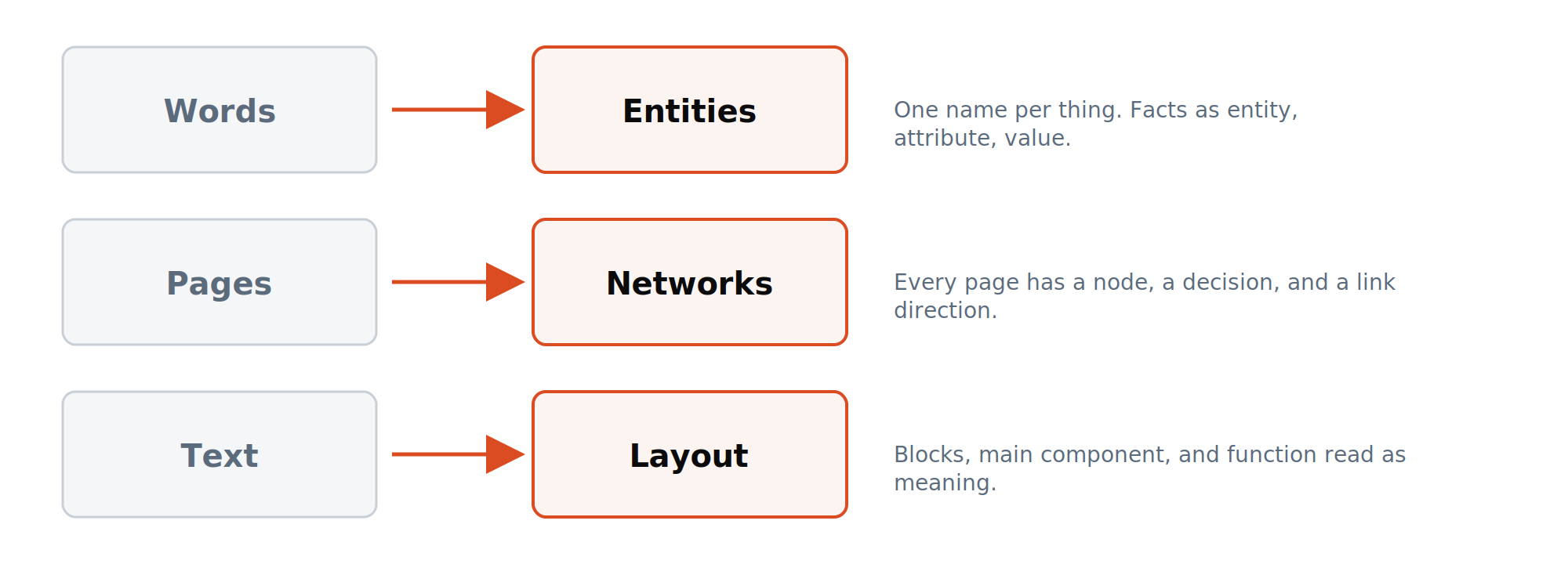
The method rests on three shifts. Words become entities: the site names things consistently and states facts about them. Pages become networks: each page has a place in a map and links in a set direction. Text becomes layout: blocks, components, and function are read as meaning alongside sentences.
Each shift depends on the one before it. A network without consistent entity names links pages that describe different things. A layout without a network places the right component on a page nobody reaches. A central entity without the other two shifts stays a definition on the About page.
How do search engines read entities on a semantic SEO site?
Search engines read a semantic SEO site as typed units: an entity, an attribute, and a value, placed in a block.
Google's public guide to its ranking systems names neural matching, which relates query concepts to page concepts. The same guide names passage ranking, which judges individual sections of a page. BERT, also named in the guide, reads word combinations for meaning and intent. All three work on meaning rather than exact strings.
Google's filing on its generative search goes further. The filing describes generating rewrites of the user's query and selecting a handful of documents responsive to the query and the rewrites. The system splits those documents into passages and links each summary sentence to a passage that verifies it. The filing is a pending application, so it describes a design, not a confirmed system.
A site built around entities and attributes produces passages that state one fact each. A site built around keywords produces paragraphs that repeat a phrase without stating a value. The first kind matches a summary sentence cleanly. The second kind matches nothing in particular. The gap shows most on pages that answer with a number, a date, or a name.
What does semantic SEO change in a website build?
Semantic SEO changes five things in a build, and the order matters.
The vocabulary is fixed before writing: one name per thing and one verb per relationship, recorded in a document every writer uses. A term added later goes through the same document first. Page decisions come before content. Every query variation is tested for demand, entity difference, similarity, predicates, and pattern, then earns a page, a section, or a sentence.
Pages are written from content briefs. The brief carries the entity, the predicate, the facts as triples, and the block order. Layout is decided per page type, with the main component matched to the query's function. A comparison gets a table, a cost query gets a calculator, and a category gets a filtered grid. A how-to query gets numbered steps.
Measurement moves to templates. Clicks and impressions are read per page type and, where a CRM exists, pipeline is read per cluster. A template fix reaches every page of that type at once. Rank tracking for a keyword set stays optional, never the primary report.
Is semantic SEO the same as schema markup, keyword clustering, or longer content?
Semantic SEO is not schema markup, not keyword clustering, and not longer content.
Schema markup supports identity and typed values. Schema does not define an entity that the visible text leaves undefined. A Service type in the code and a page that never states what the service includes send two signals that disagree. Markup repeats what the page states and never replaces it.
Keyword clustering groups strings by how often they appear together in a tool. Clustering does not decide which group deserves a page, which one is a section, or which verb the site uses for it. The page decision needs entity and predicate checks that a co-occurrence count lacks.
Longer content adds tokens, not facts. A page with two hundred words and a working calculator answers a cost query better than two thousand words about calculators. Length follows the attributes a page covers, and the brief sets word targets from them. A long page that never states a price range leaves the cost query unanswered.
Which checks show if a site already follows semantic SEO?
Four checks, run without tools, show if a site follows semantic SEO.
Read the first sentence after the H1 on the homepage. The sentence states what the business is, for whom, and where, or the site has no declared central entity. Pick one service and count the URLs that target it. More than one URL for one service is dilution. A homepage that opens with a slogan fails the first check.
Pick one relationship, such as what the business provides. Count the verbs used for it across five pages, and more than one verb is drift. Turn JavaScript off on a commercial page and reload it. A main component that disappears depends on rendering, which adds cost to reading the page.
A site that fails all four checks still has content worth keeping. The failures set the order of work: define the entity, fix the vocabulary, merge the duplicates, then fix the templates. Each step makes the next one cheaper to run.
- Google Search Central: A guide to Google Search ranking systems
- Koray Tuğberk Gübür, Search Engine Land: Visual semantics, the missing piece of topical authority
- US 2024/0289407 A1: Search with stateful chat (Google, pending application)
- Google: Search Quality Rater Guidelines (PDF)
Patents and filings describe systems Google has invented. None is a confirmed ranking factor.
What should you read after what is semantic seo?
 What is a central entityA central entity is the one entity a website is about, defined in a single sentence that every page inherits.
 What is topical authorityTopical authority is a site's standing on a topic, as a search engine judges it.
 What is a topical mapA topical map is the plan of every entity, attribute, and query a site covers.
 Semantic SEO vs traditional SEOSemantic SEO differs from traditional SEO in what an engagement is built from: an entity and a topical map instead of a .
 Semantic Content AuditSix checks. Each one has a defined failure and a defined fix.
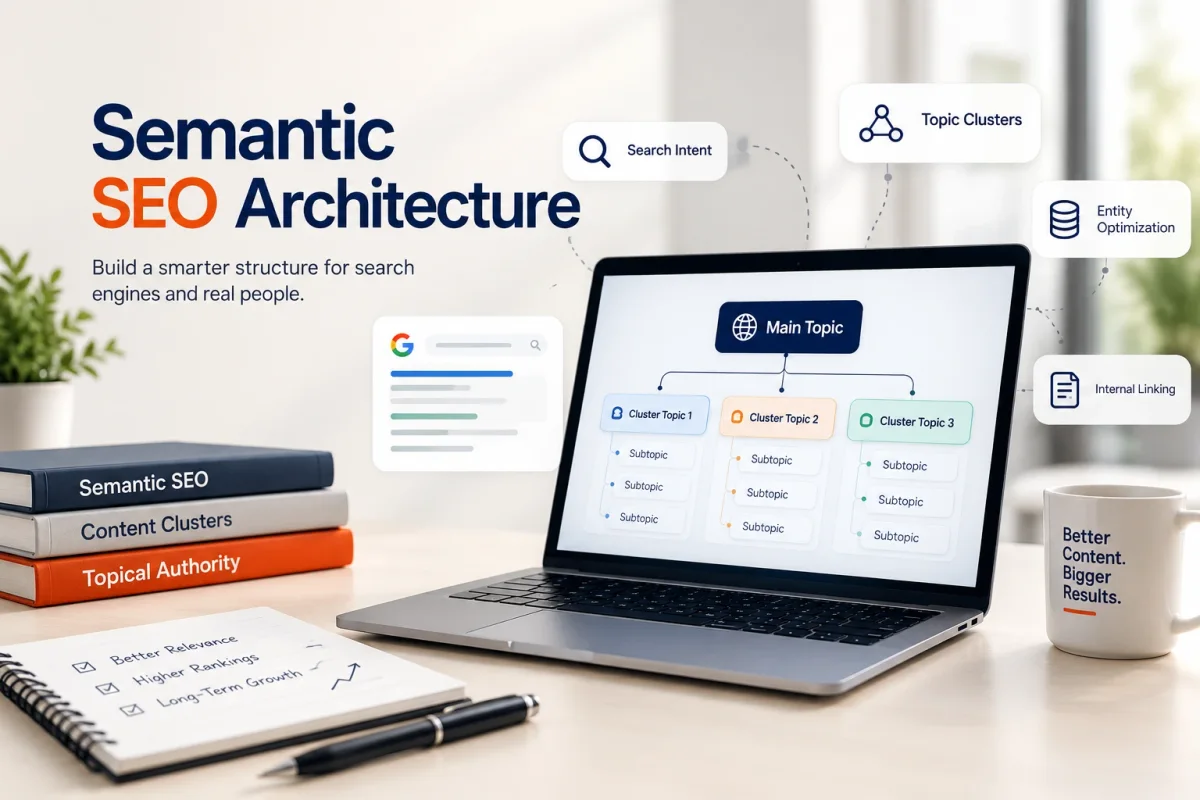 Semantic SEO ArchitectureSeven documents with a fixed structure. Every engagement produces all seven.
 Talk to usMessage the team on WhatsApp
Questions about what is semantic seo
Is semantic SEO only for large sites?
Does semantic SEO replace technical SEO?
How long does semantic SEO take to show results?
Is semantic SEO the same as entity SEO?
Where does the term semantic SEO come from?
Can an in-house team apply semantic SEO?
Does semantic SEO work for a local business?
Does semantic SEO work on sites in more than one language?
Does semantic SEO protect a site from core updates?
Does semantic SEO depend on a specific CMS?
Does AI-written content fit a semantic SEO build?
Does semantic SEO replace a separate AI search strategy?

See it applied to your site
The Semantic Content Audit uses every term in the knowledge hub. Fixed scope, written deliverable.