 Digital Vikingz
What Is a Topical Map?
A topical map is the plan of every entity, attribute, and query a site covers. The map splits its nodes into a commercial core section and an informational outer section that links inward. Every node carries a page, section, or sentence decision.

Also covered on this page: Core and outer sections, Semantic content network
What are the six parts of a topical map?
A topical map has six parts: the central entity, the core section, the outer section, the nodes, the page decisions, and the link direction.
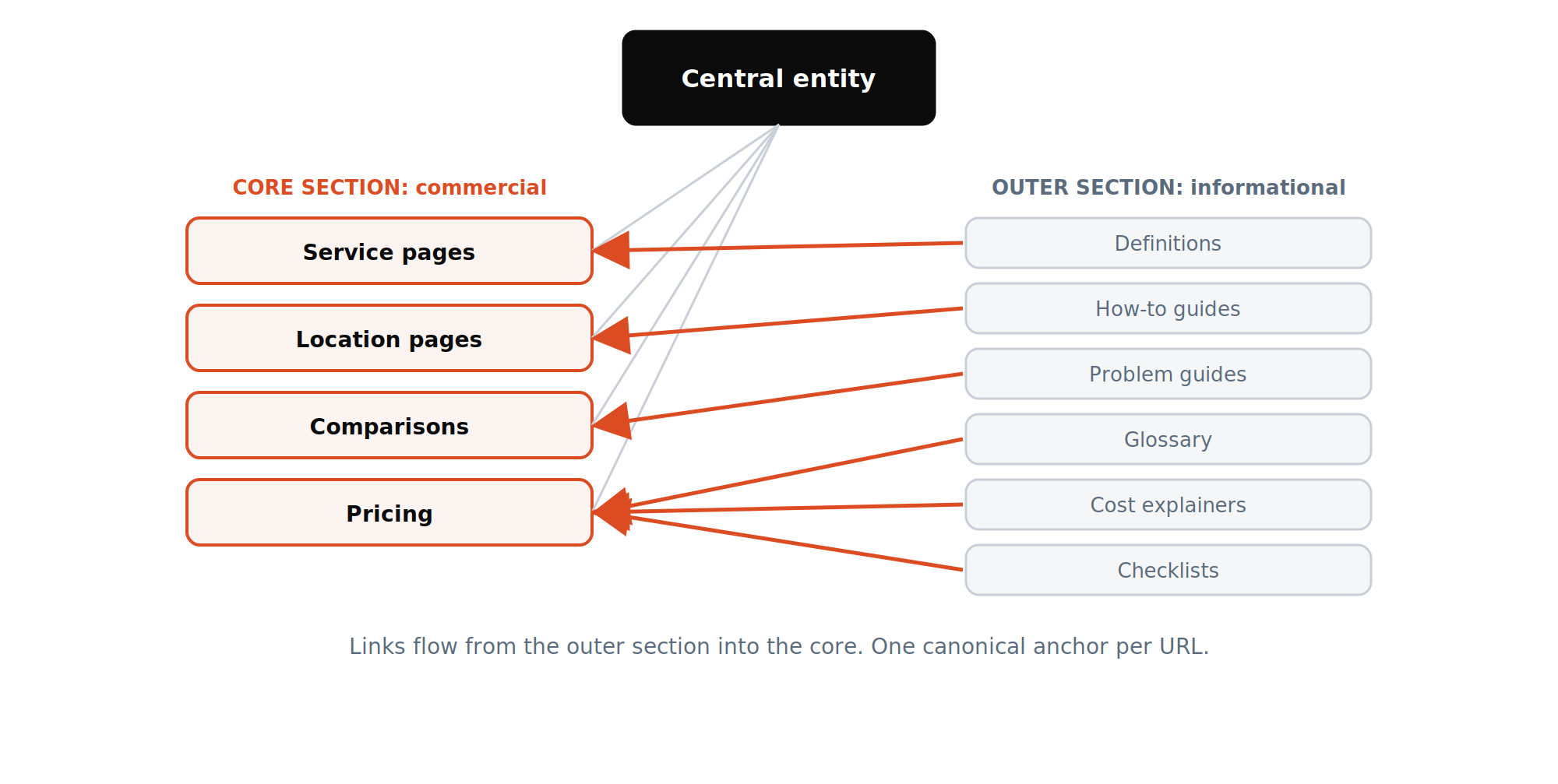
The central entity is the one thing the site is about, defined in a sentence. Every other part hangs from it. The core section holds the commercial nodes, where the site earns. The outer section holds the informational nodes that explain the topic and link inward.
A node is one row, with the entity, its attributes, the predicate, and the query network. The page decision records page, section, or sentence for each node. The link direction runs from outer to core, with one canonical anchor per URL.
A map has exactly one central entity at its root. Two central entities are two sites, or one site with a dilution problem. Every core and outer node connects back to the root through at least one attribute. A node with no path to the root belongs on another site.
How does a topical map node decide one page?
One node is one row, and the row decides one page.
Take the node for the query network around 'semantic content audit'. Entity: Semantic Content Audit. Attributes: what it checks, what it returns, what it costs, who it is for. Predicate: checks.
Query variations: 'semantic seo audit', 'semantic content audit', 'seo content audit checklist', 'semantic seo audit cost'. Page decision: one page for the first two, which share an entity and overlap in results. The checklist becomes a section on that page. The cost becomes a section on the cost page.
Page type: service page. Main component: the readiness self-test. Canonical anchor: 'Semantic Content Audit'. Roadmap position: month one, because the audit is the entry point every other service links to.
How does the core section of a topical map differ from the outer section?
The core section holds the commercial pages that convert, and the outer section holds the informational pages that pass signals inward.
Core nodes are services, products, locations, and comparisons. They carry the most important concepts and entities of the map. Outer nodes are guides, definitions, and how-tos. They bridge the central entity to the other main entities the topic touches.
Internal links flow from outer to core, always. Every outer page links to at least one core page with an anchor that carries the core entity. Every core page receives links from several outer pages, each in a different sentence context. The core rarely links out.
Outer pages carry a conversion element tied to their topic, such as a quote form or a tool entry near the top. Outer pages are the ones that tend to earn featured snippets, People Also Ask placements, and first citations in generative answers. Once demand shifts, the core shifts with it, and the page test runs on the new core before the old core changes.
How does a topical map become a semantic content network?
A topical map becomes a semantic content network when its nodes go live as pages that follow its link direction and share one vocabulary.
The map is the plan. The network is the published result: pages, sections, and links as the map decided them. A page that ignores the map's link direction breaks the network at that node. A network reads as one source because every page uses the same names, the same verbs, and the same anchors for the same targets.
Each page in the network carries part of the map inside it. The body answers its own node. The links and the closing questions point to the neighboring nodes, outer toward core. The heading order carries the reader toward the next topic, and the content brief fixes that order as the contextual vector.
The network lifts as a unit. Koray Tuğberk Gübür's articles describe informational pages that rank higher lifting the commercial pages they link to. The anchor to each core page stays canonical. The sentence around the anchor changes on every linking page, so each new page adds a new context for the same target.
How does a topical map differ from a keyword list or a sitemap?
A keyword list has no decisions, and a sitemap has no reasons.
A keyword list is strings with volumes. The list does not say which strings share an entity. Two strings with one entity look like two targets in a list and one page on a map. Nor does it say which strings deserve a page, or which page links to which.
A sitemap is URLs. The sitemap records what exists, not why. The map holds the reason for every URL and the reason every non-URL is a section instead.
Keywords stay in the map. They sit on the nodes as query variations, each with its decision attached. The map holds more keywords than a keyword list, and every one of them has a place. A keyword with no node is a query the site has decided not to answer.
How big is a topical map?
A topical map is as big as the query network, and no bigger.
A single-entity tool site fits on one page. A healthcare practice with twelve treatments and four locations is under a hundred nodes. An ecommerce site with fifty product classes is several hundred. The count follows the entity class, not the ambition of the project.
The number that matters is the ratio of nodes to pages. A map where every node is a page has skipped the page test. A sound map holds more nodes than URLs, because most variations land as sections or sentences.
Language count does not change the size. One map serves every language, with one page decision set and one block sequence. Each language adds a vocabulary built by a native editor, not a second map.
- Koray Tuğberk Gübür, Search Engine Land: How semantics and topical authority improve local SEO
- Koray Tuğberk Gübür, Search Engine Land: Query templates, expanding the scope of topical authority
- Google Search Central: Spam policies for Google web search
Patents and filings describe systems Google has invented. None is a confirmed ranking factor.
What should you read after what is a topical map?
 Query Deserves a PageQuery Deserves a Page is the test that decides if a query variation gets its own page, a section, or a sentence.
 What is a content briefA content brief is the document that turns one node of the topical map into one page.
 What is topical authorityTopical authority is a site's standing on a topic, as a search engine judges it.
 Query templatesA query template is a recurring query pattern with fixed wording and one variable entity slot, such as 'semantic SEO for.
 Semantic SEO ArchitectureSeven documents with a fixed structure. Every engagement produces all seven.
 Content ProductionEvery page passes all six stages. The check at each stage is a written gate, not a feeling.
 Talk to usMessage the team on WhatsApp
Questions about what is a topical map
Who builds the topical map?
What tools are used to build a topical map?
How does a topical map handle locations?
How is a topical map different from a content calendar?
What does a bad topical map look like?
How often does a topical map change?
Does a topical map need search volume data?
Does a topical map cover competitors' topics?
Does a topical map include off-site content?
Does a topical map include existing pages?

See it applied to your site
The Semantic Content Audit uses every term in the knowledge hub. Fixed scope, written deliverable.