One snapshot lies because 45.5% of AI Overview citations change between updates. Attribution closes the loop from citations to the pipeline. This is the framework behind our LLM visibility services, published in full.
What Is Enterprise LLM Visibility?
Enterprise LLM visibility is the measurable presence of a brand inside AI-generated answers across ChatGPT, Perplexity, Gemini, and Google's AI features. It is counted in mentions, citations, and framing. It is not a ranking.
The stakes explain the category. ChatGPT serves roughly 900 million weekly users per industry reporting. Gartner predicted traditional search volume falls 25% by 2026. Pew found users who saw an AI summary clicked external links only 8% of the time, against 15% without one.
The traffic that does arrive performs. Similarweb measured ChatGPT referrals converting at 7.1%, second only to paid search. Whatever you call the discipline, and we covered the GEO, AEO, and LLM SEO labels already, the enterprise question is the same: can you measure your presence in the answer layer?
The Three Metrics That Define LLM Visibility
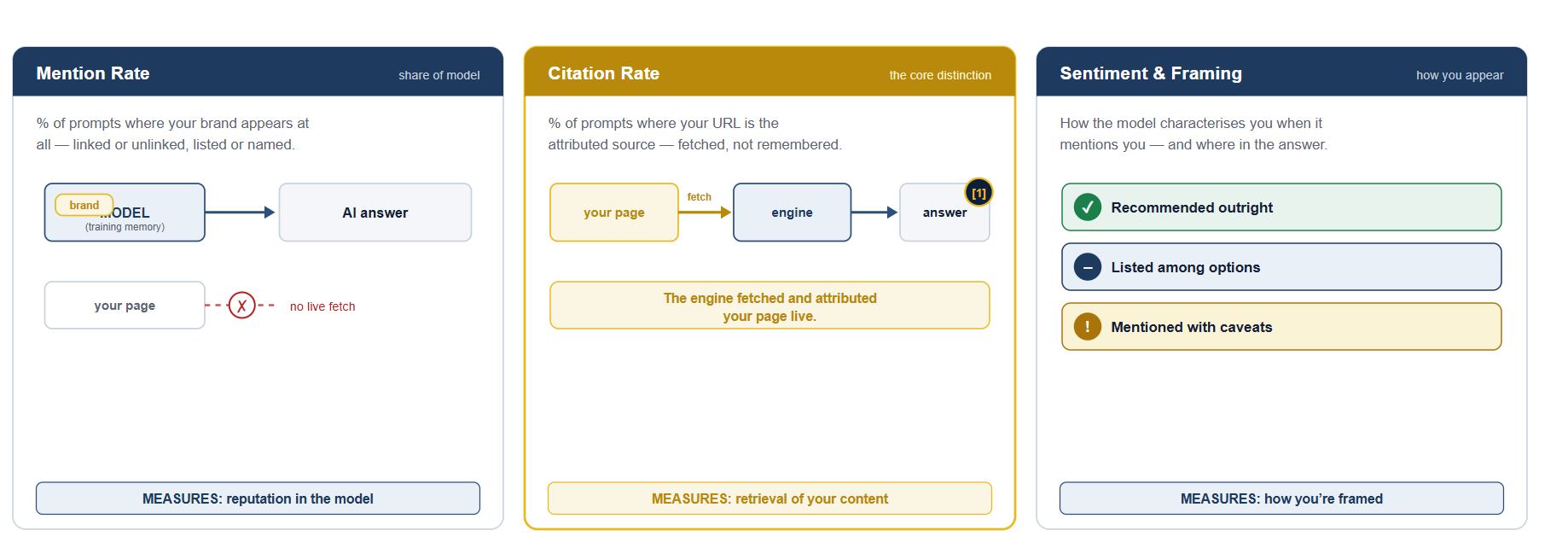
Three metrics carry the program: mention rate, citation rate, and sentiment framing. Everything else derives from these.
Mention Rate (Share of Model)
Mention rate is the percentage of tested prompts where your brand appears in the answer at all. Linked or unlinked, recommended or listed, it counts as presence.
Run competitor brands through the same prompt set and mention rate becomes AI share of voice. That relative number is the one boards understand.
Citation Rate
Citation rate is the percentage of prompts where your URL is the attributed source. It is a different metric from mentions, and the difference matters.
A brand can be mentioned from training data exposure without any retrieval happening. A citation means the engine fetched and attributed your page live. Mentions measure reputation in the model. Citations measure retrieval of your content. Enterprises need both numbers, reported separately.
Sentiment and Framing
Framing is how the model characterizes you when it mentions you. Recommended outright, listed among options, or mentioned with caveats. Position within the answer matters too.
Conversation position compounds it. Profound, measured first-turn questions trigger citations 2.5x more often than follow-ups. The first answer in a session is where source selection happens.
How to Build the Prompt Set
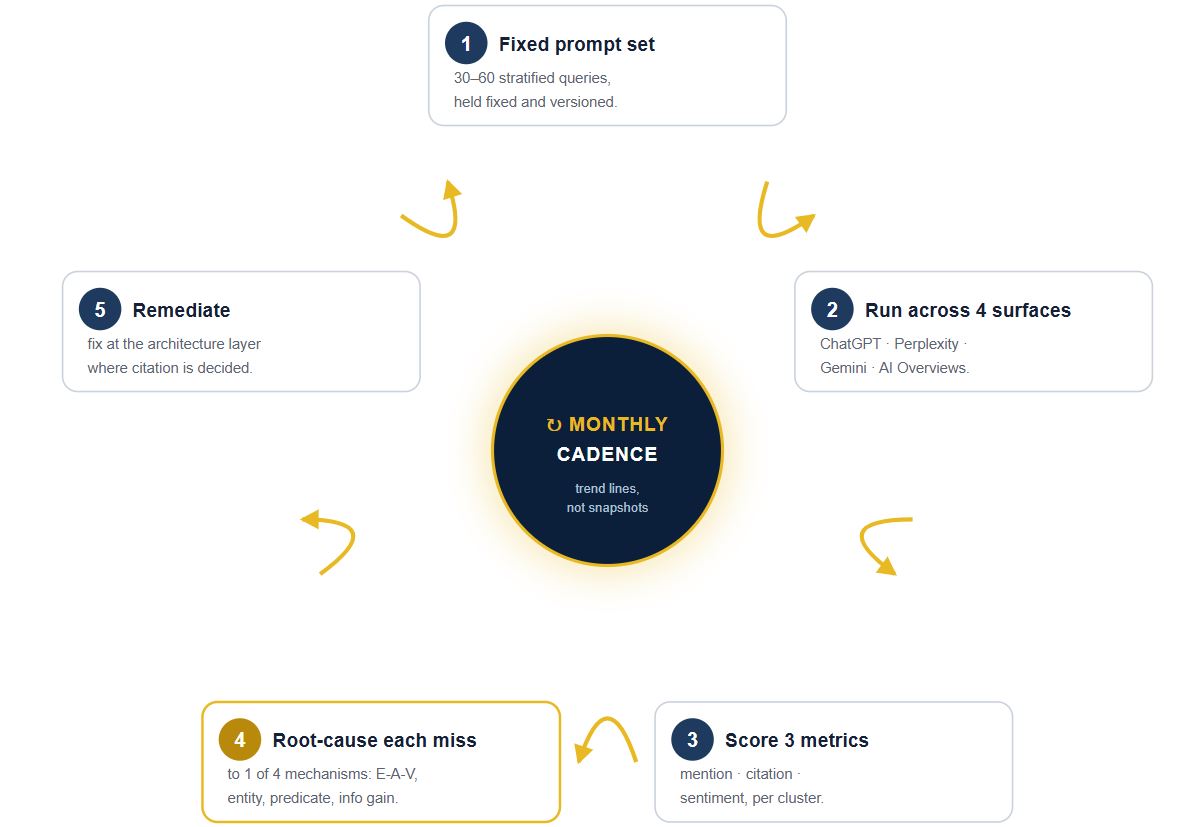
The prompt set is the instrument. Build it stratified, not random. A random prompt list produces numbers nobody can compare month to month.
We run 30 to 60 representative queries per topic cluster. Stratify them across buyer stages: awareness questions, comparison questions, and decision questions. Phrase them conversationally, because that is how users actually prompt.
Hold the set fixed between runs. Version every change. A moving instrument measures nothing.
Run it across four surfaces: ChatGPT, Perplexity, Gemini, and Google AI Overviews. The reason is arithmetic. Google's own two AI surfaces cite the same URLs only 13.7% of the time. We broke down the AI citation mechanics per platform already. One surface never represents the market.
Why One Snapshot Lies: Volatility and Cadence
AI answers are probabilistic. A single run is an anecdote, not a measurement.
The volatility is documented. Ahrefs found 45.5% of AI Overview citations change when AI Overviews update. One tracker measured Reddit's share of ChatGPT answers swinging from roughly 60% to roughly 10% inside two weeks.
The methodology answer is repetition. Multiple runs per prompt. Monthly cadence. Trend lines over snapshots. Every citation failure then gets root-caused to one of four structural mechanisms: E-A-V structure, entity definition, predicate consistency, or information gain.
From Visibility to Pipeline: The Attribution Layer
Visibility without attribution is a vanity dashboard. The scorecard has to end in sessions and pipeline, not screenshots.
Instrument the referrers first: chatgpt.com, perplexity.ai, gemini.google.com, and AI Overview clicks inside Search Console. The May 2026 rollout of clickable brand links lifted ChatGPT referrals 157.7% week over week per Similarweb, so the referral column is no longer a rounding error.
The value per session justifies the work. Semrush measured AI-referred visitors converting at 4.4x the organic rate. Seer measured cited pages earning roughly 2.1% CTR against 0.9% for uncited pages on the same AI Overview queries, and cited brands taking 35% more organic clicks. Citation rate per cluster, referral sessions per cluster, pipeline per cluster. That is the enterprise report.
The Enterprise Rollout: Governance at Scale
Enterprise scale adds governance, not different math. Multi-brand portfolios need one prompt architecture with per-brand and per-region sets. Subsidiaries need consistent entity naming, because predicate drift across brands fragments what the models learn.
The baseline run ships inside our AI citation readiness diagnostic. It establishes the starting mention rate, citation rate, and framing per cluster before any remediation begins. Everything after that is monthly cadence and root cause work.
Enterprise LLM Visibility: Measure, Root Cause, Compound
Three metrics. One fixed instrument. Four surfaces. Monthly cadence. Failures are root-caused to structure, then fixed at the architecture layer where citation is actually decided.
Most vendors sell the dashboard and stop. We run the measurement, the root cause, and the remediation as one loop, every month, per cluster. When you want the loop instead of the screenshot, start with our enterprise AI visibility engagement.
FAQs About Enterprise LLM Visibility
What is share of model in AI search?
Share of model is the percentage of tested prompts where your brand appears in the generated answer. Run competitors through the same fixed prompt set, and it becomes AI share of voice, the relative visibility number.
How many prompts do you need to measure LLM visibility?
30 to 60 per topic cluster, stratified by buyer stage and held fixed between runs. Consistency and repetition matter more than volume, because 45.5% of AI Overview citations change between updates.
Which LLM surfaces should enterprises track?
Four at minimum: ChatGPT, Perplexity, Gemini, and Google AI Overviews. Google's own two AI surfaces agree on citations only 13.7% of the time, so no single engine represents the answer layer.