 Digital Vikingz
What Is Microsemantics?
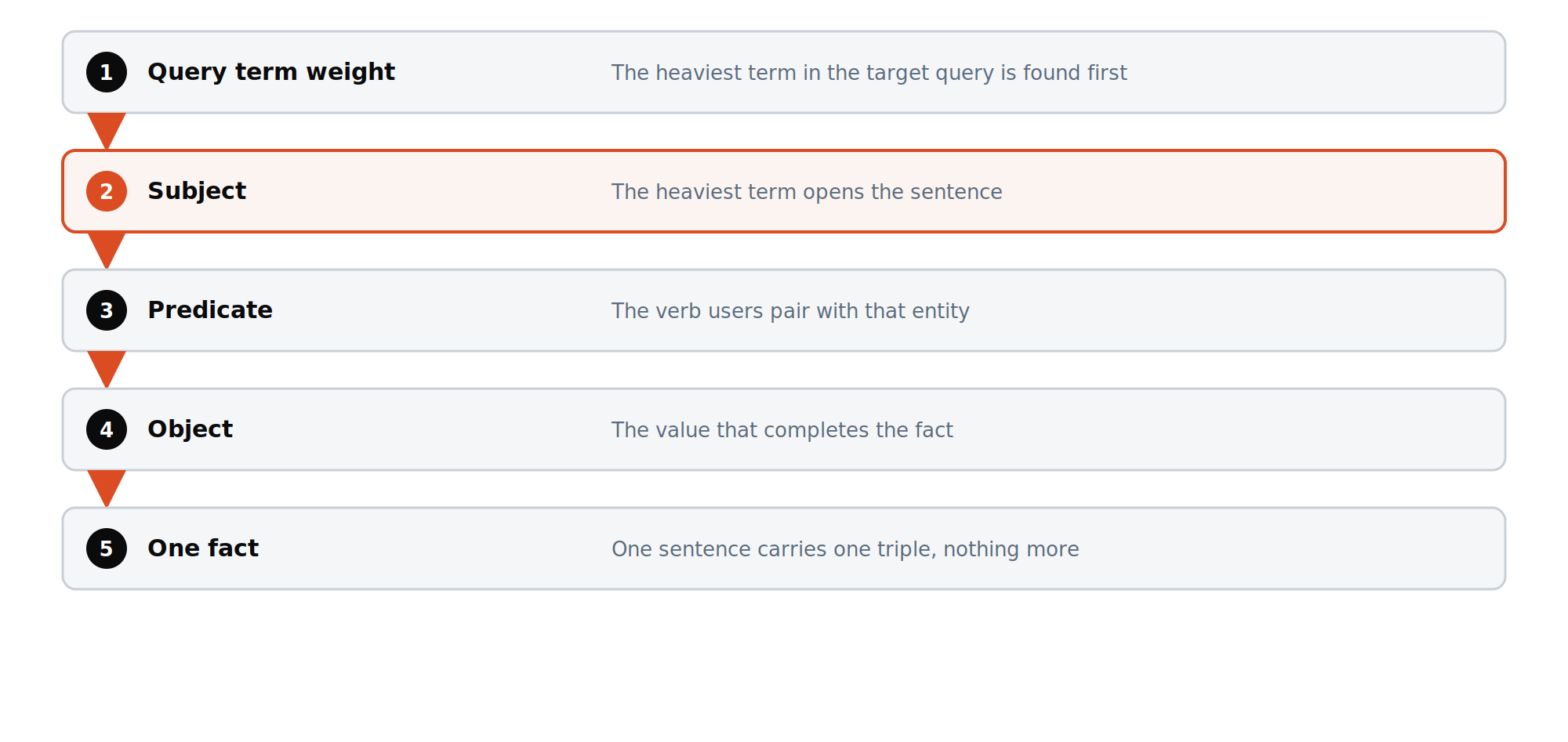
Microsemantics is the sentence-level layer of semantic SEO: subject choice, word order, and predicate choice inside each sentence. Small differences in those three change which query a sentence answers. A page built with microsemantics puts the heaviest query term in subject position and states one fact per sentence.

Why is the heaviest query term the subject of a microsemantic sentence?
The heaviest query term is the subject because search systems weight query terms unequally, and the subject position holds the weight.
Google research on query term weighting describes a model that assigns each query term its own learned weight before documents are scored. Uniform weights treat every word the same. Learned weights do not. Digital Vikingz treats the named entity as the heavier term by default, over the generic head noun around it.
Take the query 'topical map for a dental clinic'. The heavy term is topical map. The opening sentence reads: 'A topical map for a dental clinic lists every treatment, condition, and location the practice covers'. The query 'dental clinic SEO' moves the weight to the clinic. The sentence changes to: 'Dental clinic SEO starts from the treatments the practice offers'.
Weight also sets vocabulary share across the page. The heavy term appears as subject in more sentences than the light term does. A page on a topical map for a dental clinic states more facts about the map than about the clinic. Reverse the share and the page answers the other query.
How does word order change the query a microsemantic sentence answers?
Word order decides the query because the same fact written with a different subject answers a different question.
A triple runs subject, predicate, object. The subject is the entity that carries the weight. The predicate is the verb users pair with that entity. The object completes the fact.
Two sentences show the shift. 'The Semantic Content Audit checks predicate consistency across every page' answers a query about the audit. 'Predicate consistency is checked across every page by the Semantic Content Audit' answers a query about predicate consistency. The fact is identical, and the subject decides which query the sentence belongs to.
Headings follow the same rule. The H2 names the heavy term early, and the bold opener under it repeats the term as subject. A sentence that opens with a pronoun loses the entity. A pronoun carries no weight in any query, so the sentence matches nothing on its own.
How does Google's answer passage scoring patent read a sentence?
A Google patent on scoring candidate answer passages describes scoring each passage with query-dependent signals and query-independent signals.
The patent is US 9,940,367, with a priority date in 2014. Query-dependent signals include how well the passage's terms match the question. Query-independent signals include the passage's position and how closely the passage fits a language model. The patent builds candidate passages from tables and lists as well as from paragraphs.
Digital Vikingz reads each signal as a writing rule. Term match becomes: state the question's terms, in the question's vocabulary, near the start. Position becomes: put the answer first under its heading. Language model fit becomes: write plain declarative sentences, not fragments or slogans.
Google's ranking systems guide names passage ranking as a deployed system that judges individual sections of a page. The patent describes one way such scoring works and is not proof of a ranking factor. The writing rule stands on both: each passage answers its heading in its first sentence, with the heavy term as subject.
Why does microsemantics hold one fact per sentence?
One fact per sentence keeps each sentence matched to one set of query terms, so no second claim dilutes the match.
A compound sentence carries two subjects, two predicates, or both. 'The audit checks predicates and the architecture builds the map' splits the weight between two entities. Neither half leads a passage cleanly. Split it, and each sentence answers its own query.
Fewer words per sentence also raise the share of each term. Padding adds tokens and no attributes. A 2026 study on LLM rerankers found that fluent padding without attributes ranked items below the unchanged baseline in its tests. Length is not the target, and attribute coverage is.
The same rule serves generative search, where summary sentences are matched to page passages. The matching mechanism belongs to AI citation readiness. Microsemantics supplies the input: sentences that each hold one entity, one attribute, and one value.
What does a microsemantic rewrite of a service page look like?
A microsemantic rewrite keeps the facts and changes the subject, the predicate, and the sentence count.
Take a typical opener on a dental clinic's implant page: 'We are proud to offer the latest implant technology, caring staff, and flexible payment'. The subject is 'we'. The query is about dental implants. The sentence holds three claims and no value.
The rewrite leads with the entity: 'Dental implants at the clinic replace a missing tooth with a titanium post and a crown'. A second sentence states the next attribute with its own subject: 'Implant placement at the clinic uses local anesthetic'. A third sentence states the payment attribute with its value. Each sentence has the heavy term or its attribute as subject.
The check is mechanical. Read each section's first sentence and mark the subject. A pronoun, the brand name, or 'we' in subject position on a service query fails. The rewrite passes when every opener starts with the query's heavy term.
How does microsemantics shape a section opener?
A microsemantic section opener answers its heading in one declarative sentence, with the heading's entity as subject and the heading's verb as predicate.
The heading asks the question, and the opener returns it as a statement. The H2 above this section asks how microsemantics shapes an opener. The opener below it starts with the same entity and states the answer. A reader who reads only the headings and openers gets the whole page.
Preamble moves the answer off the first position. A sentence of setup before the fact pushes the fact into second place under its heading. The position signal in the passage scoring patent describes why the first position matters. Setup sentences belong after the answer, or nowhere.
The opener is not repeated in the paragraphs. The paragraphs add the mechanism, the example, and the edge case. An opener restated in the first paragraph spends a sentence and adds no attribute.
- US 9,940,367 B1: Scoring candidate answer passages (Google)
- Google Search Central: A guide to Google Search ranking systems
- Koray Tuğberk Gübür, Search Engine Land: Query templates, expanding the scope of topical authority
Patents and filings describe systems Google has invented. None is a confirmed ranking factor.
What should you read after microsemantics?
 Entity-attribute-valueEntity-attribute-value is the method of stating every fact as an entity, one property of that entity, and the property's.
 What is a source term vectorA source term vector is a website's fixed vocabulary for entities, attributes, and relationships, with one name per thin.
 AI citation readinessAI citation readiness is the degree to which each sentence on a page verifies a sentence in a generative summary.
 Query templatesA query template is a recurring query pattern with fixed wording and one variable entity slot, such as 'semantic SEO for.
 Content ProductionEvery page passes all six stages. The check at each stage is a written gate, not a feeling.
 Semantic Content AuditSix checks. Each one has a defined failure and a defined fix.
 Talk to usMessage the team on WhatsApp
Questions about microsemantics
Is microsemantics the same as keyword density?
Does microsemantics make writing sound mechanical?
Does microsemantics apply to product descriptions?
Does microsemantics matter more on short pages?
Who checks microsemantics on a draft?
Can microsemantics fix a page built for the wrong intent?
Does microsemantics apply in German, Spanish, or Italian?
How is a microsemantic change measured?
Where does microsemantics sit in the order of work?
Does microsemantics help featured snippets?
Where does the term microsemantics come from?

See it applied to your site
The Semantic Content Audit uses every term in the knowledge hub. Fixed scope, written deliverable.