 Digital Vikingz
What Is a Central Entity?
A central entity is the one entity a website is about, defined in a single sentence that every page inherits. The central entity sets the homepage H1, the predicates the site uses, and the first attribute set the topical map covers.

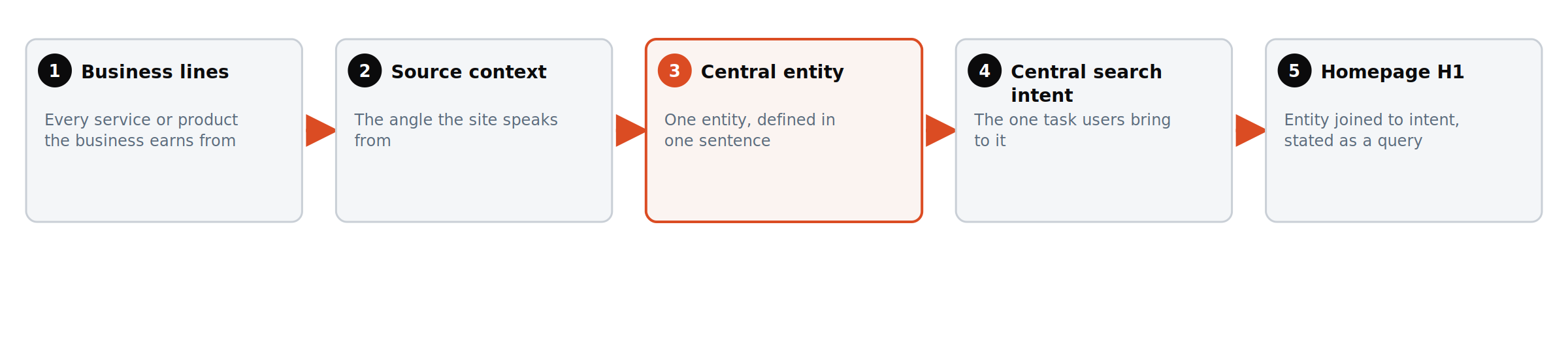
How do you identify the central entity of a website?
The central entity is the one entity that every service, product, and page on the site describes or connects to.
Start with what the business earns from. List every service or product line, then find the entity they all share. Digital Vikingz sells audits, architecture, content production, and development, and all four describe one entity: semantic SEO. A dental clinic's implants, crowns, and hygiene visits share one entity too: dental treatment.
Test the candidate with one sentence. The sentence names the business, the entity type, the audience, and the market in under twenty-five words. A candidate that needs two sentences or two entity types is too broad. A candidate that leaves out a line the business earns from is too narrow.
The central entity is a thing, not a phrase. Search demand confirms the choice but does not make it. A high-volume keyword that the business touches only at the edge is an attribute or a separate topic.
How do source context and central search intent shape a central entity?
Source context is the angle a site speaks from, and central search intent is the task users bring to its central entity.
Two sites share a central entity and still differ in source context. An agency, a course provider, and a software vendor all publish about semantic SEO. The agency sells implementation, the course provider sells learning, and the vendor sells a tool. Each source ranks different attributes first and uses different verbs.
Central search intent follows from the source context. An agency's users want someone to do the work. A course provider's users want to learn the work themselves. The homepage H1 matches that one intent, and every core page serves a step of it.
Both terms come from Koray Tuğberk Gübür's semantic SEO framework. Source context also decides which content the site leaves unpublished. A page written from a different angle spends trust that the main angle earned.
How does the central entity set the homepage H1 and the predicates?
The homepage H1 joins the central entity to the central search intent, and predicates are the verbs linking the entity to its audience.
The H1 reads as the query a user types to reach the business. The first sentence after it names the brand, the entity type, the audience, and the market. A project management SaaS opens with the product name, the category, and the teams it serves. The homepage, the About page, and the main service pages each target a different query, so they never compete.
Predicates come from the source context. An agency audits, maps, writes, and builds. A clinic examines, treats, and restores. The site picks one verb per relationship and records it before writing, and the source term vector holds the full list.
The predicate set also shapes the core pages. Each core page states one relationship between the central entity and an attribute, using the recorded verb. A service page about audits uses audits in its H1, its first sentence, and its section openers. Readers and parsers meet the same verb for the same relationship everywhere.
What is the first attribute set of a central entity?
The first attribute set is the short list of properties buyers ask about the central entity before any other question.
A service entity usually carries five: what it is, what it includes, who it is for, how it runs, and what sets its price. A project management SaaS carries features, integrations, pricing, and alternatives. Each attribute in the first set becomes a node in the core section of the topical map.
The first set is not the full set. Secondary attributes, related entities, and definitions belong to the outer section and link inward. Attributes rank by how often buyers ask about them, and that rank sets the order of sections on the homepage.
Each first-set attribute needs a value the business confirms before writing. A service with no stated scope or pricing basis leaves the attribute empty. An empty attribute gives search engines nothing to match.
How does a business with more than one line choose its central entity?
A business with several lines keeps one central entity when the lines share an audience and verbs, and separates them otherwise.
Shared audience and shared predicates mean one entity with sub-entities. An agency that sells semantic SEO and website development serves the same buyer, and development is how the SEO work ships. Development becomes an attribute of the central entity, not a second one.
Different audiences and different predicates mean two sources. A dental clinic that also sells supplies to other clinics speaks to patients in one line and to equipment buyers in the other. The clinic treats, and the shop sells. Those lines need separate sections with separate vocabularies at minimum, and often separate domains.
Forcing two unrelated lines under one central entity produces a homepage H1 that serves neither. The vocabulary drifts between the two. Internal links then pass signals across topics that share no buyers.
What does Google's entity metrics patent describe about entity types?
A Google patent on ranking search results by entity metrics describes combining relatedness, notable type, contribution, and prize metrics, weighted per entity type.
The patent draws those metrics from a knowledge graph. The weights differ for each entity type. A clinic and a software product are therefore scored on different mixes of the same metrics.
The patent describes a method, not a confirmed ranking factor. The design logic it supports is plain. A site states its entity type in the first sentence and keeps that type the same on every page. The agency reads a central entity typed three ways as three weak entities instead of one clear one.
A site controls how it connects its central entity to related entities. Consistent connections on every page state one set of relationships. Mixed connections state several, and none of them clearly.
- Koray Tuğberk Gübür, Search Engine Land: Visual semantics, the missing piece of topical authority
- US 10,235,423 B2: Ranking search results based on entity metrics (Google)
Patents and filings describe systems Google has invented. None is a confirmed ranking factor.
What should you read after what is a central entity?
 What is semantic SEOSemantic SEO optimizes a website around entities, their attributes, and the relationships between them instead of isolat.
 What is a source term vectorA source term vector is a website's fixed vocabulary for entities, attributes, and relationships, with one name per thin.
 Entity-attribute-valueEntity-attribute-value is the method of stating every fact as an entity, one property of that entity, and the property's.
 What is a topical mapA topical map is the plan of every entity, attribute, and query a site covers.
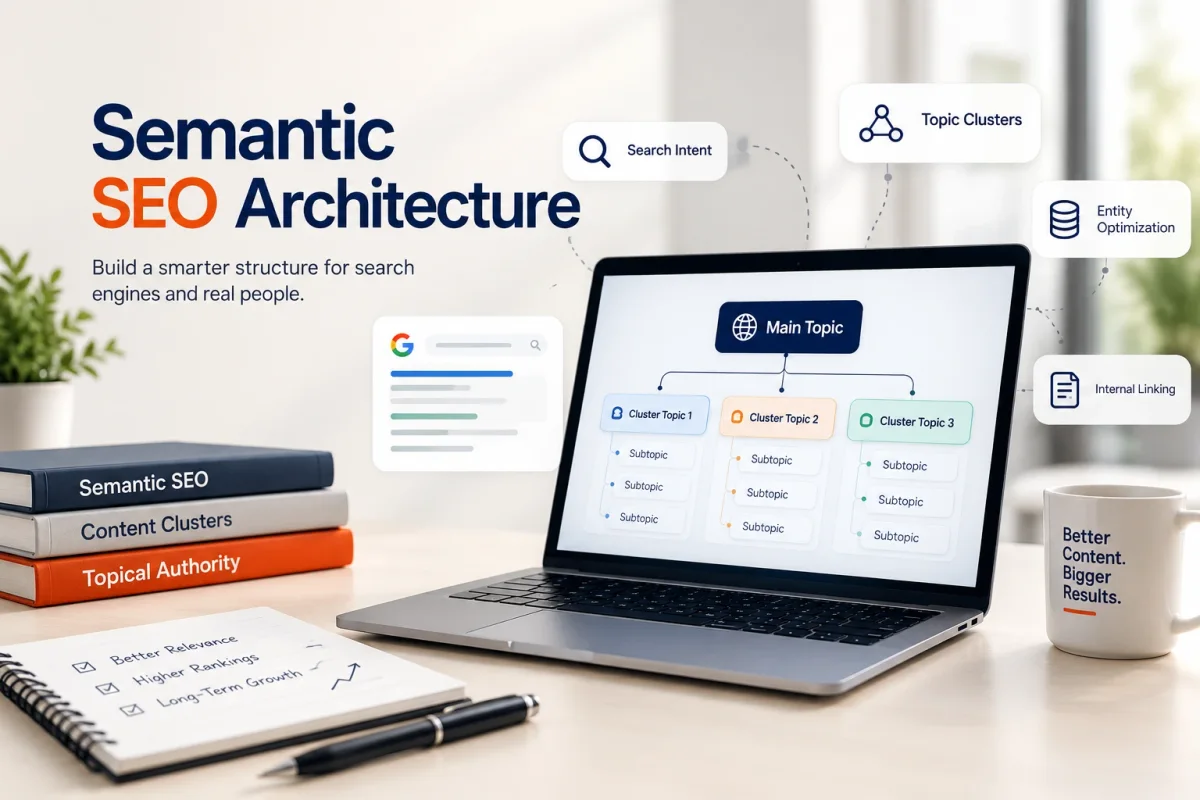 Semantic SEO ArchitectureSeven documents with a fixed structure. Every engagement produces all seven.
 Semantic Content AuditSix checks. Each one has a defined failure and a defined fix.
 Talk to usMessage the team on WhatsApp
Questions about what is a central entity
Is the central entity the same as the brand name?
Should a SaaS site use the product or the category as its central entity?
Can the central entity of a site change?
Does a local business put the location in its central entity?
Who decides the central entity in an engagement?
What does a written central entity definition contain?
What happens when a site has no clear central entity?
Does every page need to name the central entity?
Does a central entity need a knowledge panel?
Does a multilingual site keep one central entity?
Is a central entity the same as a primary keyword?

See it applied to your site
The Semantic Content Audit uses every term in the knowledge hub. Fixed scope, written deliverable.