 Digital Vikingz
What Is Centerpiece Annotation?
Centerpiece annotation is Google's label for the primary content block of a page, extracted from its HTML structure. The extraction reads the first characters after the H1 in DOM order. Boilerplate inside that window corrupts the label, so the page opens with its answer.

Also covered on this page: Extractive summary
What is centerpiece annotation in Google Search?
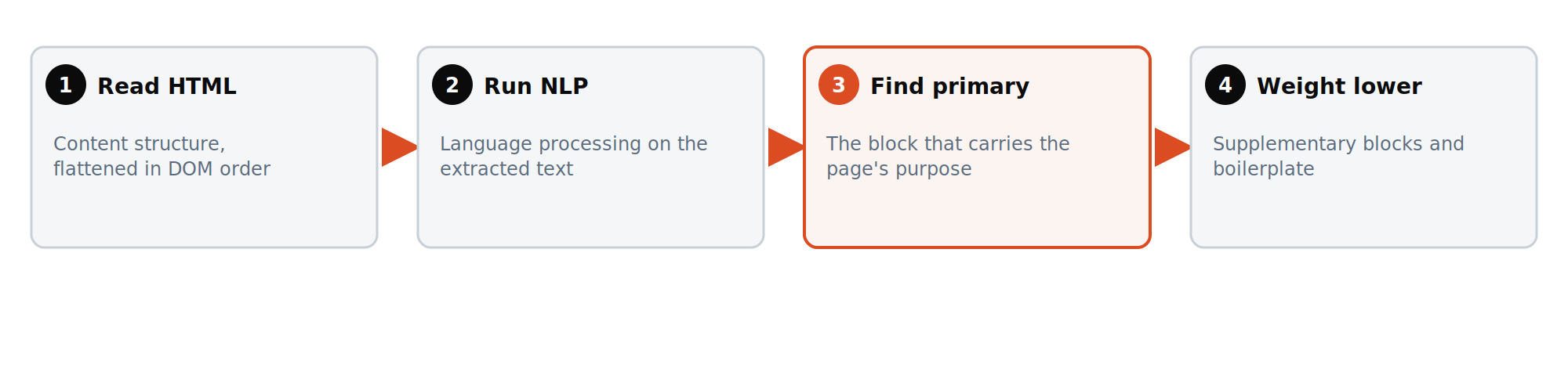
Centerpiece annotation is the step where Google marks one block of a page as its primary content and weights everything else lower.
Martin Splitt of Google described the process publicly in 2021. Google reads the HTML content structure, runs language processing on the text, and identifies the primary topic. Supplementary blocks and boilerplate then receive lower weight. The centerpiece decides what the page is about.
The label sits inside visual semantics, the wider reading of layout as meaning. Visual semantics covers every block on the page. Centerpiece annotation covers one decision: which block carries the purpose. A page with the wrong block in that position reads as a page about the wrong thing.
The centerpiece block performs the query's function or delivers its core answer. The content brief names that block before design starts. The writer and the developer then build toward the same target.
How does Google extract the centerpiece from a page's HTML?
Google flattens the page's text in DOM order and reads a short window after the H1, roughly 400 characters in the DOJ trial exhibits.
DOJ trial exhibits show centerpiece extractions from real news pages. One exhibit shows the labels of a share bar landing in the extracted text ahead of the first sentence. The share icons sat under the byline on screen. The HTML source placed them inside the primary block, so the extraction read them as content.
A second exhibit shows the target state. The update line, the author name, the share icons, and the print and read-later buttons were all excluded. The extracted text began with the standfirst and ran into the first body paragraph. Nothing but the answer entered the window.
DOM position outweighs visual position in both exhibits. CSS that moves a block on screen leaves its source order untouched. Google's layout-aware encoder patent sorts blocks by rendered position, vertical first. A page reads the same way in both systems only when source order and rendered order agree.
What must the first 400 characters after the H1 contain?
The first 400 characters carry the central entity, the main predicate, the page function as a verb, and the core answer.
Take a service page for a semantic content audit. The window names the audit, states what it checks, and says what the client receives. A reader who sees only those characters knows the offer. A crawler that reads only those characters knows the same.
Throat-clearing wastes the window. A welcome line, a brand slogan, or an announcement of what the guide covers carries no entity and no fact. Each one pushes the answer further from the H1. The rule holds for a dental clinic's service page and a project management SaaS feature page alike.
The window also matches the augmented query, not only the literal query. Before writing, the query is expanded into its entity type, attribute, context, and format. The terms from that expansion appear in the first characters, inside natural sentences. A window that covers only the literal phrase misses the rewrites Google runs beside it.
What is an extractive summary, and how does it anchor the centerpiece?
An extractive summary is the two or three declarative sentences under the H1 that answer the query alone and open the centerpiece.
The summary starts with a definition or a direct answer. The entity is the subject of the first sentence. Every sentence states a fact, not a promise. The block stays under 60 words, so it fits inside the window with room for the first body sentence.
A Google patent on scoring candidate answer passages names position in the document as a query-independent signal, next to term match. The extractive summary sits first in the main flow. Position and wording then work on the same sentences. A summary buried under an introduction gives up the position input before its wording is read.
Google's filing on its generative search describes result passages extracted verbatim from the document, taken from metadata, or generated. A summary written as a standalone answer is ready for verbatim extraction. A summary that borrows its subject from the next paragraph is not. The check is to read the summary alone and confirm it answers the query.
Which boilerplate breaks centerpiece annotation?
Any contextless word between the H1 and the first body block in DOM order breaks the centerpiece.
The usual offenders are share bars, author cards, reading time, update dates, social proof badges, and breadcrumbs. Each adds words with no relation to the entity. Ad slots and newsletter signups between the H1 and the main block do the same. None of them answers the query.
The fix is placement, not deletion. Page furniture moves above the H1 into a separate header block, or below the centerpiece. The author and the date still appear on the page. They appear outside the window.
Template audits catch the site-wide version. The same furniture labels often repeat inside the content area of every page on a template. Moving them on the template fixes every page that uses it. A template fix therefore ranks above any single-page rewrite on the issue list.
How is centerpiece annotation tested on a live page?
The centerpiece test pastes the visible text from the H1 downward into a plain file and reads the first 400 characters.
A share label, a date, an author name, a breadcrumb, a badge, or a button label inside those characters means the centerpiece is broken. Clean text reads as a standalone description of the page's purpose. The source view gives the stricter version of the test, because extraction follows DOM order.
The second test turns JavaScript off and reloads the page. A centerpiece component that vanishes without scripts is absent from the first pass. A calculator or a grid injected after load sits in that gap. Server rendering puts it back inside the window.
Moving the centerpiece on a template is a site-wide change. A recrawl spike follows the release. Other structural changes wait for a later release. Shipping them together makes the effect of the move impossible to isolate.
- Koray Tuğberk Gübür, Search Engine Land: Visual semantics, the missing piece of topical authority
- Usman Ishaq: Visual semantics in SEO
- US 9,940,367 B1: Scoring candidate answer passages (Google)
- US 2024/0289407 A1: Search with stateful chat (Google, pending application)
Patents and filings describe systems Google has invented. None is a confirmed ranking factor.
What should you read after what is centerpiece annotation?
 Visual semanticsVisual semantics is the meaning a search engine reads from a page's layout, blocks, and components alongside its text.
 Macro and micro contextMacro context is the main content of a page, placed above the fold, and micro context is the supplementary content below.
 Cost of retrievalCost of retrieval is the compute a search engine spends to crawl, render, segment, extract, and evaluate a page.
 AI citation readinessAI citation readiness is the degree to which each sentence on a page verifies a sentence in a generative summary.
 Website DevelopmentFive platforms, chosen by what the architecture needs, not by preference.
 Semantic Content AuditSix checks. Each one has a defined failure and a defined fix.
 Talk to usMessage the team on WhatsApp
Questions about what is centerpiece annotation
How do I know what the centerpiece of a page is supposed to be?
Is the centerpiece window exactly 400 characters?
Is centerpiece annotation the same as a featured snippet?
Does the H1 count as part of the centerpiece?
Can structured data define the centerpiece?
What happens to the centerpiece when a page opens with a hero image?
Can a page have two centerpieces?
Does a table of contents break the centerpiece?
Does a cookie banner enter the centerpiece?
What is the centerpiece of a product page?
Who writes the first 400 characters on a project?

See it applied to your site
The Semantic Content Audit uses every term in the knowledge hub. Fixed scope, written deliverable.