 Digital Vikingz
What Is Visual Semantics in SEO?
Visual semantics is the meaning a search engine reads from a page's layout, blocks, and components alongside its text. The reading covers which block is the main content, in what order the blocks come, and what function the page performs.

Also covered on this page: Verbalization, Structured information cards, Misleading functionality
What is visual semantics in SEO?
Visual semantics treats a page's layout as a second channel of meaning, read alongside its text.
Google's rater guidelines separate main content from supplementary content. Google's ranking systems guide names passage ranking, which scores sections of a page individually. Google holds a patent on an encoder that reads pages block by block and sorts the blocks by position. The encoder is trained to detect blocks out of order and images that do not match their neighboring text.
Koray Tuğberk Gübür named the field visual semantics in his July 2026 article on Search Engine Land. Together these sources say one thing: the arrangement of a page is read as meaning. Text says what the page is about. Layout says which part matters and what the page does.
What are the three parts of visual semantics?
Visual semantics has three parts: blocks, the centerpiece, and function.
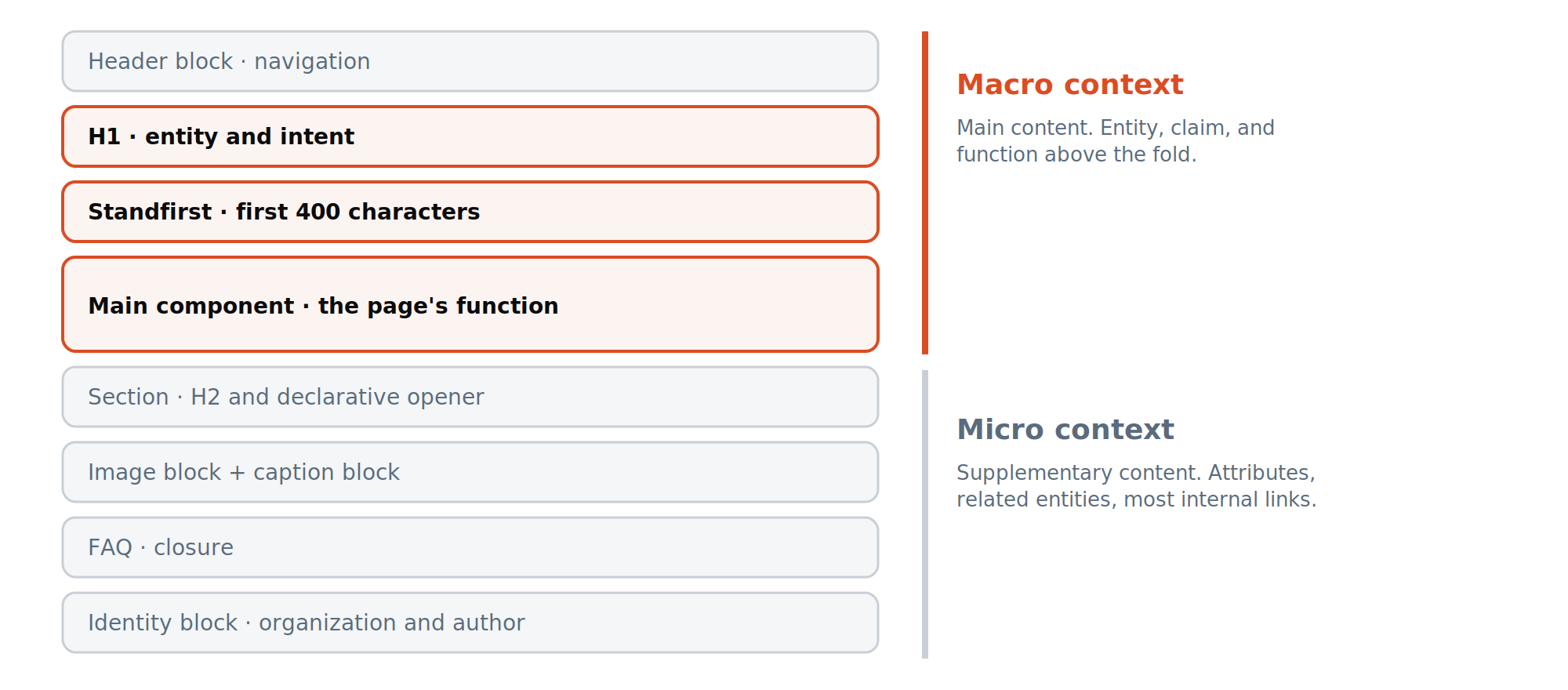
A block is a visually separable unit: a heading with its opener, a table, an image with its caption, a card. Google's segmentation patents draw block boundaries from white space and spatial layout. The split of blocks into main and supplementary regions is macro and micro context.
The centerpiece is the block that carries the page's purpose. Google's public statements place it in the first characters after the H1. Function is the task the page lets a visitor complete: compare, book, calculate, filter, read. A page has a function or it has only relevance.
What does visual semantics change in a website build?
Visual semantics adds six rules to every template, and most sites fail the same five checks against them.
The main component sits first in the code and first on screen, present in the HTML before any script runs. The first 400 characters after the H1 carry the entity, the claim, and the function. No share bar, date stamp, or carousel sits in between. Block order follows the conventional sequence for the page type: H1, standfirst, main component, sections, FAQ, identity.
Heading sizes descend without inversion, and bold is reserved for openers and labels. Every image has a caption block directly below it. The image depicts the entity named beside it. The page's function works: a compare button compares, a filter filters.
The five common failures are easy to spot. A hero carousel sits above the H1. A share bar or author widget sits between the H1 and the first paragraph. Tables are built from styled divs, and a category page has a grid and no filter. A calculator or map arrives by script after load.
How does verbalization make visual components readable?
Verbalization converts the meaning of a visual or interactive component into visible text that a crawler or a language model reads.
Every component gets text that states what it does and what it shows. A table gets a caption sentence directly above it. A tool gets a one-line description and one worked example. A card grid gets a heading that names the set and the sort logic.
Numbers shown in a chart appear in the text at least once. Icons that carry meaning have visible text beside them, because an icon alone says nothing to a text reader. Component labels use the query's vocabulary, so a user who searches installation cost finds a label that says installation cost. Alt text names the entity, the attribute, and the setting.
Verbalized text is visible text. Hidden text, aria-only text, and text in data attributes do not count. The explaining block sits directly next to its component, since the layout-aware patent embeds relationships between neighboring blocks. A block of another kind between a component and its verbalization breaks that pairing.
What do structured information card patents teach about repeated components?
Google's card patents describe fixed-field templates triggered by phrase sets, and repeated components on a site borrow that discipline by analogy.
A Google patent on search and retrieval of structured information cards describes a template with predetermined fields and a grammar of trigger phrases. The example flight card has fields for origin, destination, departure, confirmation number, and flight number. New phrases join the grammar when they share tokens with existing phrases or return the same pages. The patent does not describe reading cards from web pages.
What transfers to a website is analogy. Each card type on the site has a fixed field set, defined once. Every instance shows every field in the same order, with Not listed as a value rather than a missing field. One label names one attribute site-wide, never Cost on one card and Price on the next.
The phrase side transfers too. Card grammars grow by term overlap and by which pages answer which phrasings. The site keeps the entity head term consistent and lets one page answer every phrasing of one intent. The page then sits in the path the phrase set travels.
What is misleading functionality in Google's spam policies?
Misleading functionality is a named violation in Google's spam policies: a site that makes users believe a function exists when it does not.
The policy gives examples. A fake app store credit generator is one. Sites that claim to merge PDFs, run a countdown timer, or serve a dictionary, then lead to deceptive ads, are others. The risk on a business site is quieter: a Compare button that opens nothing, or a Get quote form that goes nowhere. A calculator that returns a static number implies a function the page does not perform.
The test is a click on every functional label. A label that promises a function the page does not perform falls under the policy. Fixing it outranks any new content on the priority list. Every calculator, filter, form, comparison, and booking flow is tested before launch and every 90 days.
Google folded the Helpful Content System into core ranking in March 2024. Its logic persists in two citable places. The misleading functionality policy is one. The rater guidelines are the other, naming page functionality and the systems that power a page as effort in main content.
- Koray Tuğberk Gübür, Search Engine Land: Visual semantics, the missing piece of topical authority
- Usman Ishaq: Visual semantics in SEO
- Google Search Central: Spam policies for Google web search
- US 12,393,768: Layout-aware multimodal pretraining for multimodal document understanding (Google)
- US 11,238,058 B2: Search and retrieval of structured information cards (Google)
Patents and filings describe systems Google has invented. None is a confirmed ranking factor.
What should you read after visual semantics?
 What is centerpiece annotationCenterpiece annotation is Google's label for the primary content block of a page, extracted from its HTML structure.
 Macro and micro contextMacro context is the main content of a page, placed above the fold, and micro context is the supplementary content below.
 Cost of retrievalCost of retrieval is the compute a search engine spends to crawl, render, segment, extract, and evaluate a page.
 What is topical authorityTopical authority is a site's standing on a topic, as a search engine judges it.
 Website DevelopmentFive platforms, chosen by what the architecture needs, not by preference.
 Semantic Content AuditSix checks. Each one has a defined failure and a defined fix.
 Talk to usMessage the team on WhatsApp
Questions about visual semantics
Is visual semantics a Google ranking factor?
Does visual semantics apply to a small local business site?
Does a page with no images lose visual semantics signals?
How does visual semantics relate to Core Web Vitals?
Does visual semantics matter for AI answers?
Can visual semantics problems be fixed without a redesign?
Do translated versions of a site need the same layout?
Is schema markup part of visual semantics?
Who owns visual semantics on a project, design or SEO?
How does visual semantics differ from UX design?

See it applied to your site
The Semantic Content Audit uses every term in the knowledge hub. Fixed scope, written deliverable.