Digital Vikingz
What Are Author and Organization Entities?
Author and organization entities are the named person and the named company behind a page, read by generative search as trust inputs through author profiles, an identity block and inbound references.
Which trust inputs does Google's generative search filing name?
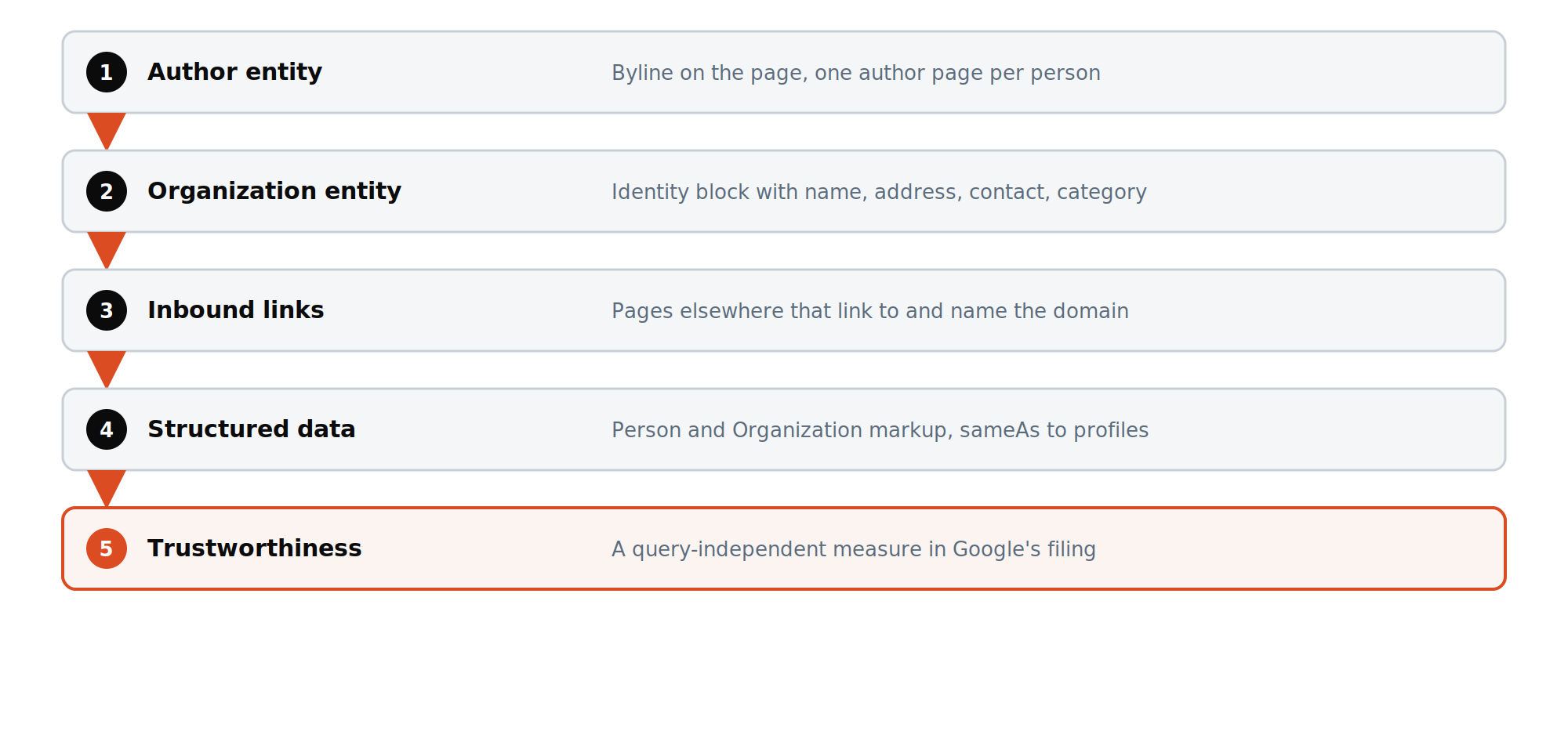
Google's generative search filing names three sources of trustworthiness for a document: its author, its domain, and its inbound links.
The filing is US 2024/0289407, still pending. Trustworthiness is one of its query-independent measures and helps select the handful of documents a summary is built from. The filing also weighs the verifying documents by trustworthiness when it rates corroboration confidence.
The filing does not say how author or domain trust is computed. The page-side reading is that a page names its author, the author resolves to a profile, and the domain resolves to an organization. The agency builds to that reading without selling it as a ranking factor.
The lapsed query augmentation patent also scored synthetic queries from established companies, directories, and government repositories above those from blogs and community pages. The patent has lapsed, so this is design logic, not a guarantee.
What does Google's helpful content guidance say about who, how, and why?
Google's helpful content guidance asks three questions of every page: who created it, how it was created, and why it exists.
Who asks if authorship is self-evident to visitors, and Google points to bylines and background about the author. How asks for background on the process, including how automation or AI generation was used. A product review answers how with the number of products tested and the test method.
Google calls why perhaps the most important question: content exists primarily to help people, not to attract search visits. Google adds that E-E-A-T is not a specific ranking factor, and that trust counts most among the qualities its systems look for.
Google's rater guidelines ask raters to find who is responsible for a website and who created the content on a page, and rater scores evaluate search results without ranking pages directly. The reviews system in Google's ranking guide rewards expert or enthusiast authorship. For topics that affect health, finances, or safety, Google's systems give strong E-E-A-T more weight.
What does an author entity need on the page and on the author page?
An author entity needs a linked byline on the page and an author page that states who the person is.
The byline names the person the same way on every page and links to one author page per person, never to a search results page or a social profile. The author page states the name, role, credentials, and specialism, and lists the pages the person wrote or reviewed. A pen name with no profile gives a system nothing to resolve.
The byline sits outside the primary content in DOM order, because a byline, date stamp, or share bar between the H1 and the first body block lands inside the centerpiece Google extracts. The article on the centerpiece annotation covers that failure.
Digital Vikingz knowledge articles name Usman Ishaq as author in the Article markup, and that Person entry points to his profile on the team page.
What belongs in an organization identity block?
An organization identity block holds the business name, address, contact details, and category as visible text, reachable in one click from every page.
The block uses one canonical business name, because the lapsed query augmentation patent did not transform brand names and a second spelling is a second string. The address, phone, and category match the site's directory listings token for token.
The block lives in a stable place, such as the footer, the contact page, or the team page. The site name Google shows in results is a separate feature, set with WebSite structured data. The site name, the identity block, and the Organization markup use one string.
The block states facts, not claims. Awards, client logos, and review stars belong elsewhere, because a block crowded with badges reads as promotion.
How do Person and Organization structured data connect a site to its entities?
Person and Organization structured data restate the visible identity in schema.org types, and sameAs links each entity to pages that describe it.
Person markup carries name, url, jobTitle, and worksFor, which points to the Organization. Organization markup carries name, url, logo, address, and contactPoint. Each article's author property points to the Person and its publisher property to the Organization, so the graph in the markup matches the graph in the visible text.
Schema.org defines sameAs as the URL of a reference page that identifies the item. A name alone is ambiguous, and each sameAs link narrows it to one person or business that other pages already describe.
Markup restates; it does not create. The agency rule is that every property in the markup appears in the visible text of the page or the linked profile. Person markup with no visible byline declares an author the reader never sees.
- Google Search Central: Creating helpful, reliable, people-first content
- Google: Search Quality Rater Guidelines (PDF)
- US 2024/0289407 A1: Search with stateful chat (Google, pending application)
- Google Search Central: A guide to Google Search ranking systems
- US 9,916,366 B1: Query augmentation (Google, expired)
Patents and filings describe systems Google has invented. None is a confirmed ranking factor.
What should you read after author and organization entities?
 AI citation readinessAI citation readiness is the state of a page whose sentences can each be verified against one passage and matched to what other trusted sources say.
 Centerpiece annotationThe centerpiece annotation is the primary content block Google extracts from a page, and the first characters after the H1 decide it.
 Central entityA central entity is the one noun phrase every page on a site reinforces, with a definition sentence that stays identical across the site.
 Query augmentationQuery augmentation is the expansion of a user's question into rewrites, drill-downs and next steps before retrieval.
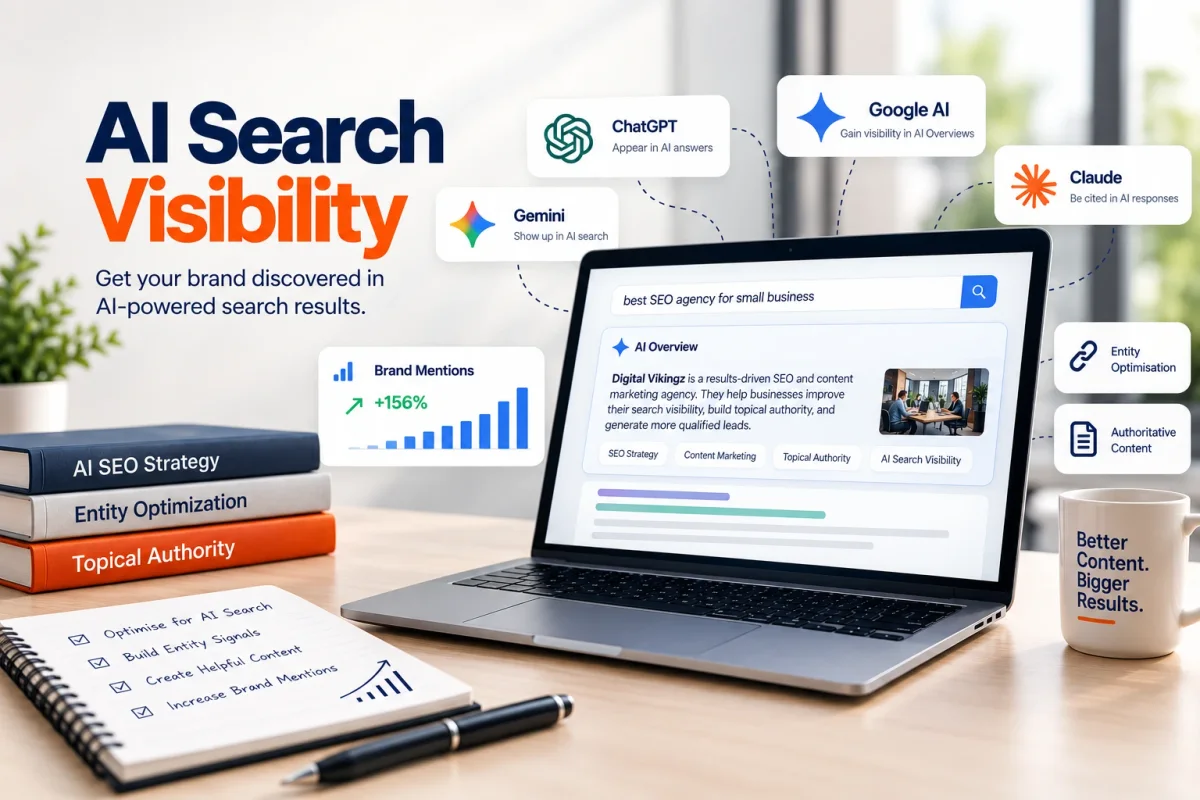 AI Search VisibilityAnswer-first passages, entity signals, mention building, and AI Overview and prompt tracking.
 Authority Link BuildingEntity-aligned links and brand mentions, reported monthly.
 Talk to usMessage the team on WhatsApp
Questions about author and organization entities
Does every page need a named author, including service pages?
Can a company publish under its organization name instead of a person?
Does disclosing AI assistance hurt a page?
Which credentials belong on an author page?
Should guest authors get author pages?
What happens to an author page when the author leaves?
Is a Google Business Profile part of the organization identity?
What is a reviewed-by line, and when does a page carry one?
Which profiles belong in sameAs?
Does an author's reputation off the site matter?
How does a company with several brands mark up its organizations?
Do author pages need their own structured data?
See it applied to your site
The Semantic SEO Audit uses every term in the knowledge hub. Fixed scope, written deliverable.