 Digital Vikingz
LLM brand visibility is the measurable presence of a business inside AI-generated answers. A check reads three things: how often the answers name the business, how accurately the answers describe the business and which pages the answers cite. AI search visibility is the wider name for the work, also called AEO (answer engine optimization) or GEO (generative engine optimization).
Five steps run the check: write a prompt set, ask each AI assistant, read the AI Overview, record every answer and read the patterns. Prompts come from buyer questions, and the enterprise LLM visibility measurement framework sizes the set for large brands. Each prompt runs several times in a clean session on ChatGPT, Gemini, Perplexity, Claude and Microsoft Copilot, and the same questions are searched in Google. Every answer becomes one row that keeps mentions and citations apart, the split behind mention rate and citation rate in GEO. Patterns across runs point to the cause, such as a page that ranks in Google and is not cited by AI.
Google Search Console, Bing Webmaster Tools and ChatGPT Business Hub add free first-party counts that the prompt check does not show. None of the three reports shows the answer text or the competitors named in the answer. A monthly re-run with the same prompts tracks the trend, and the weekly SEO and AEO report carries the rolling rates.
The fixes start with crawler access and the business's own facts, then the listings and mentions the answers cite. Digital Vikingz fixes those sources in an AI Search Visibility engagement, with Local SEO and Google Business Profile optimization for local service businesses. The free AI Visibility Checker reads crawler access first, and each check shows how semantic SEO builds topical authority that AI answers recognise.
How do you check LLM brand visibility for your business?
LLM brand visibility for one business is checked in five steps, from a fixed prompt set to a sheet that shows what to fix.
The five steps that check LLM brand visibility for one business are listed below:
- Write a prompt set from the questions your buyers ask.
- Ask each AI assistant every prompt in a clean session, more than once.
- Search the same questions in Google and read the AI Overview.
- Record each answer's mentions, citations and description in one sheet.
- Find where the answers name, cite or miss the business.
No page in the top ten results we read for "LLM brand visibility" on 13 November 2026 gave sample prompts by business type. The five steps need a spreadsheet and a private browser window, and no paid tool. The same five steps audit brand visibility in LLMs for free, and a monthly re-run turns the audit into tracking. Every check starts with the prompt set.
1. Write a prompt set from your buyers' questions
Writing a prompt set turns the questions buyers ask into a fixed list of prompts, grouped by type and kept the same for every check.
The prompts come from Google Search Console queries, sales calls, the support inbox and on-site questions. Category prompts ask for the best provider, with no brand named. Problem prompts describe a buyer problem and ask for a fix. Comparison prompts name a competitor and ask for alternatives. Branded accuracy prompts name the business and ask for its services, locations and prices. Branded prompts test the description and stay left out of the visibility count. The set holds one prompt of each type per main service, repeated for every town a local business serves.
The table below gives sample prompts for five types of business, with the category, comparison and branded accuracy prompts side by side.
| Business type | Category prompt | Comparison prompt | Branded accuracy prompt |
|---|---|---|---|
| Local plumber | Who is the best emergency plumber in [town] open now? | Which plumbers in [town] are better than [competitor] for water heater repairs? | What does [business name] charge for a call-out in [town]? |
| B2B SaaS company | What is the best [category] software for [use case]? | What are the best alternatives to [competitor] for [use case]? | Which plans does [product name] offer, and what do they cost? |
| Dental clinic | Which dentists in [city] offer same-day appointments? | Which clinics in [city] compare well with [competitor] for implants? | Where is [clinic name], and which treatments does it offer? |
| Real estate agency | Who are the best agents for first-time buyers in [area]? | Which agencies in [area] sell homes faster than [competitor]? | Which areas does [agency name] cover? |
| Ecommerce store | What is the best [product] under [price]? | Which stores sell [product] cheaper than [competitor]? | What is the return policy of [store name]? |
Each row also needs problem prompts from the support inbox of that business. Large brands stratify the set by buyer stage, as the enterprise LLM visibility measurement framework sets out. Prompt sets for several brands and regions follow the enterprise LLM visibility measurement framework. The set then goes to each AI assistant.
2. Ask each AI assistant every prompt in a clean session
Asking each AI assistant every prompt in a clean session shows the answer a new buyer gets, without your account history.
A clean session is a logged-out window or a temporary chat with memory switched off. The prompts go to ChatGPT, Gemini, Perplexity, Claude and Microsoft Copilot, with one row per assistant and run. The sheet notes whether web search was on, because an assistant with web search reads and cites live pages. Local businesses note the town the session runs from, since answers for local prompts change with location.
Each prompt runs at least three times on each assistant, because the same prompt can return a different answer on the next run. The result of an AI visibility check is a share of runs, never one screenshot. An answer with no visible sources gets one follow-up, "Which sources did you use?", and the reply is logged as the assistant's own claim.
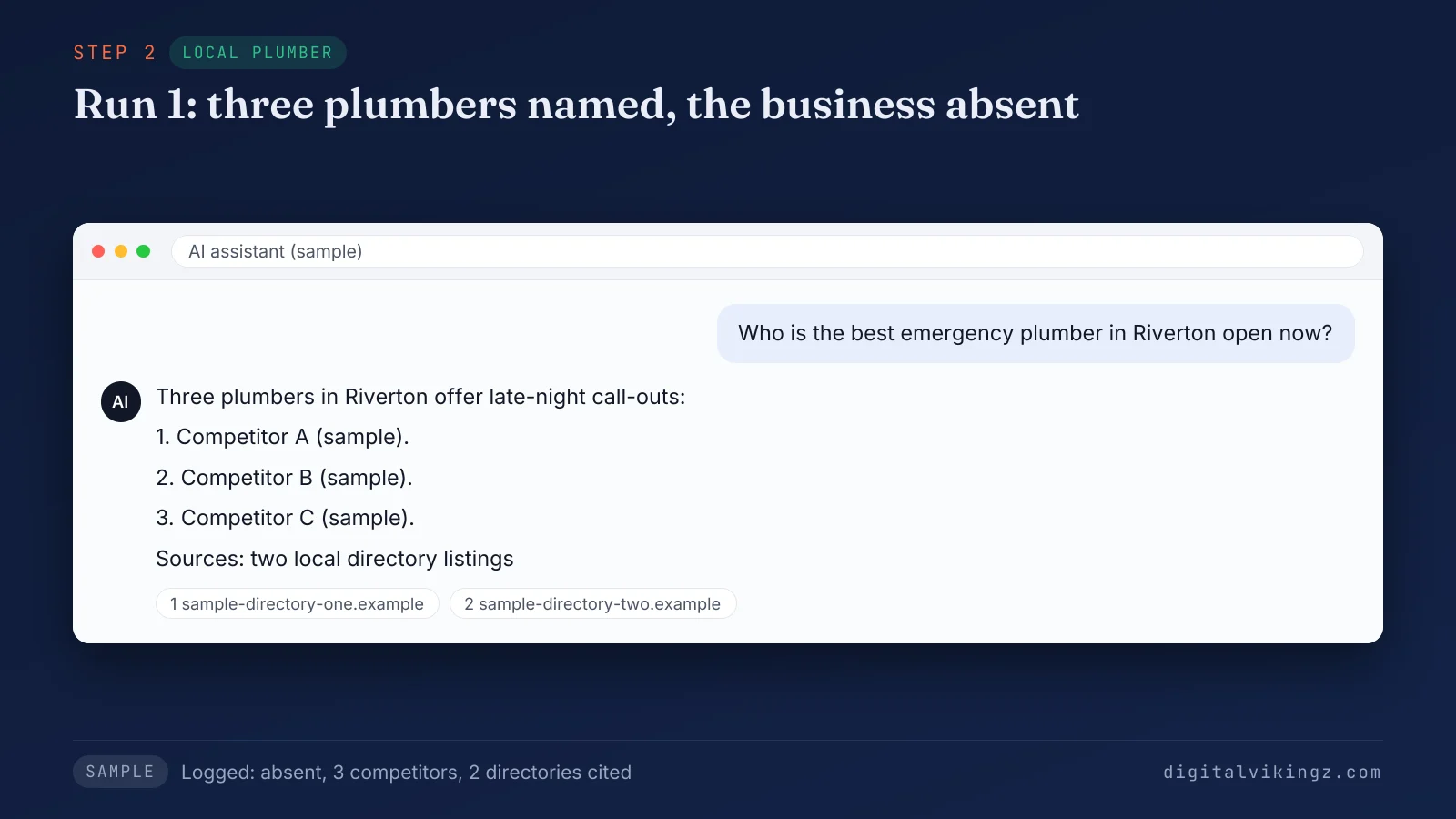
The sample answer names three Riverton plumbers and cites two directories, so the row logs Sample Plumbing Co. as absent in run 1. Google's AI Overview needs a separate reading in search.
3. Search the same questions in Google and read the AI Overview
Searching the same questions in Google shows whether an AI Overview appears, whether the overview names the business and which pages the overview links.
AI Overviews are a feature of the Google results page, so the overviews are read in search and never in a chat window. Each search runs in a private window, with the town added to the question for a local business. AI Mode is the conversational tab of Google Search. The same question asked in AI Mode is logged as a separate row with the AI Mode sources. The AI visibility row records whether the overview appeared, whether the overview named the business and every link, own pages included. Google Search Console counts the impressions in AI Overviews and AI Mode, which the free reports section covers.
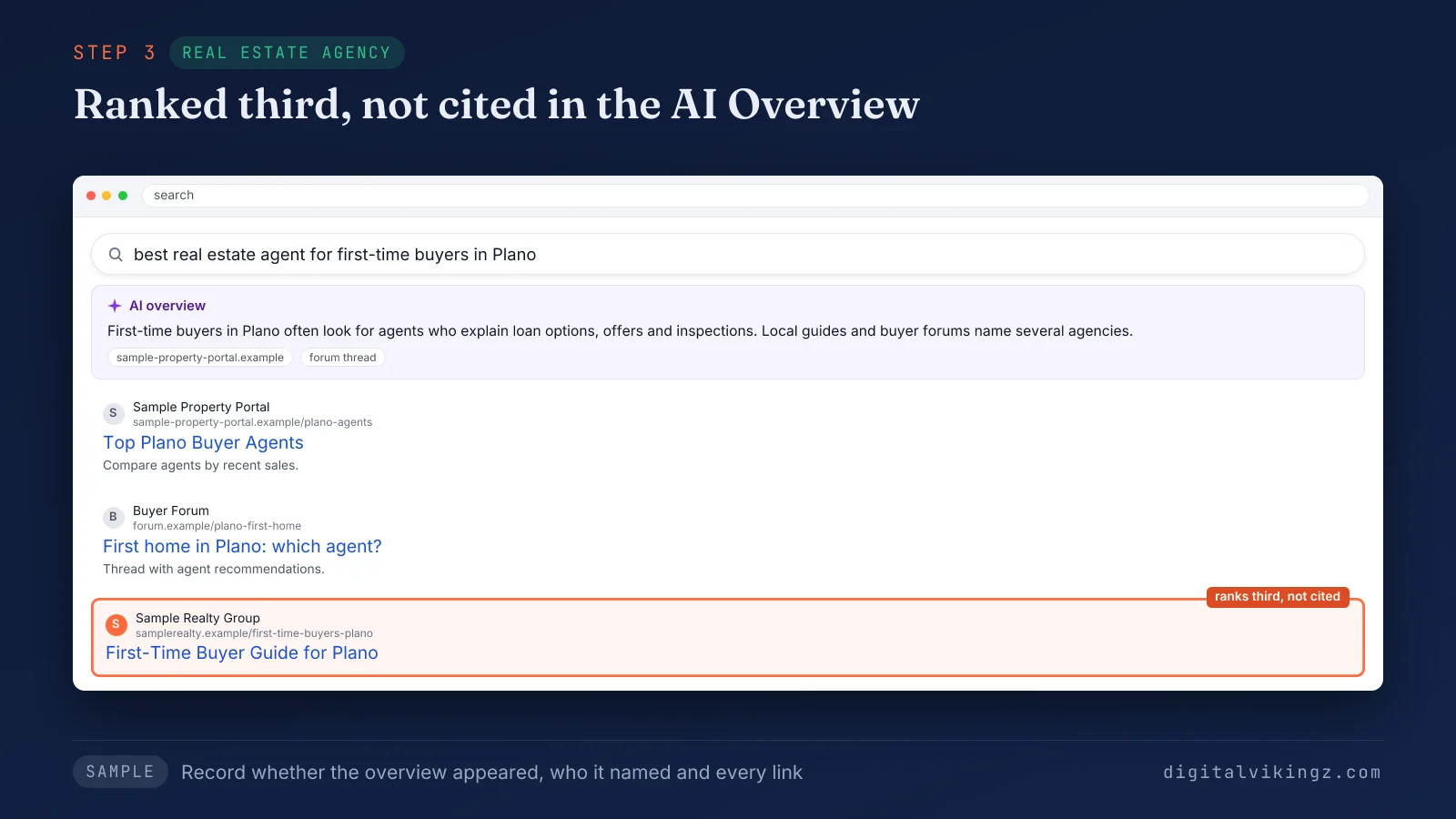
The sample AI Overview cites a property portal and a forum thread, while the agency's own guide ranks third and is not cited. Every answer from steps 2 and 3 then goes into one sheet.
4. Record each answer's mentions and citations in one sheet
Recording each answer in one sheet turns single replies into rows that show a rate, a pattern and the sources behind each answer.
The table below lists the ten columns of an AI visibility record sheet, what each column holds and a sample value.
| Column | What it holds | Sample value |
|---|---|---|
| Date | The day of the run | 13 November 2026 |
| Assistant and mode | The assistant, logged out or temporary chat, web search on or off | ChatGPT, temporary chat, web search on |
| Prompt and type | The exact prompt and its type | Category |
| Run | The run number for that prompt | 2 of 3 |
| Mentioned | Whether the answer names the business | Yes |
| Position | First, in a list, in passing or absent | In a list |
| Description accuracy | Correct, outdated, wrong or missing | Outdated: old opening hours |
| Competitors named | Every other business in the answer | Two |
| Cited URLs | Every link the answer shows | A directory listing |
| Source type | Own site, directory, review site, forum, list article or news | Directory |
Columns 5 and 9, Mentioned and Cited URLs, stay separate, because an answer can name a business without citing its website. Mention rate is the share of generative answers that name a brand in the answer text. Citation rate is the share of generative answers that link to a page on the brand's domain as a source. Each rate is counted per assistant: named or cited answers divided by all answers that assistant gave.
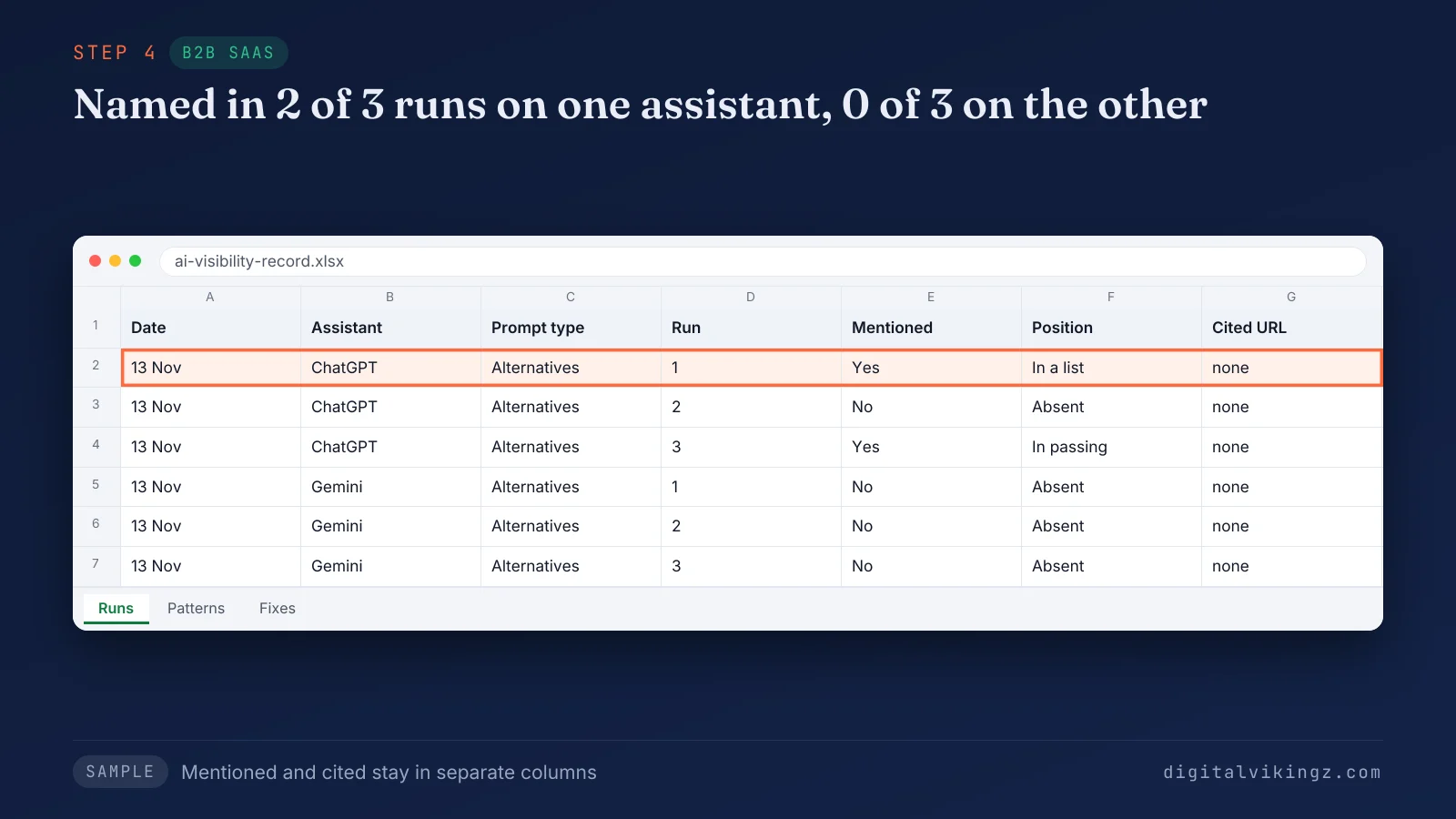
The sample sheet names the SaaS product in 2 of 3 ChatGPT runs and 0 of 3 Gemini runs, with no cited page. The two columns feed the two rates that define mention rate and citation rate in GEO. How each rate is measured and reported is set out in the guide to mention rate and citation rate in GEO. A full sheet then shows which patterns repeat.
5. Find where the answers name, cite or miss the business
Finding where the answers name, cite or miss the business turns the sheet into four patterns, and each pattern points to a different fix.
The four patterns an AI visibility check finds are listed below:
- Absent, competitor named: The answers name competitors in most runs and never name the business. The pattern points to missing mentions on the sources the answers cite.
- Named, never cited: The answers name the business and link only to directories, lists or competitors. The pattern points to pages that hold no passage the assistant can quote.
- Described wrongly: The answers name the business with an outdated or wrong service, location or price. The pattern points to the business's own pages or listings stating facts in different ways.
- Strong on one assistant, missing on another: The answers name the business on one assistant and miss the business on the others. The pattern points to a source that only one assistant reads or cites.
One pattern per prompt type is enough to rank the fixes. The second pattern often belongs to a page that ranks in Google and is not cited by AI. The seven causes behind a page that ranks in Google and is not cited by AI each have their own test. Free reports from Google, Bing and OpenAI add counts the sheet does not show.
Which free reports show how AI features see your site?
Three free reports show how AI features see a site: Google Search Console, Bing Webmaster Tools and ChatGPT Business Hub.
Each report counts the site's own appearances on one company's AI features. The reports add a platform-side reading of AI visibility, and the limits of each report decide whether the counts are enough.
The table below compares the three free reports by the AI features each one covers, what it counts and what it leaves out.
| Report | AI features covered | What it counts | What it leaves out |
|---|---|---|---|
| Google Search Console, generative AI performance report | AI Overviews and AI Mode in Google Search | Impressions by page, country, device and date | Clicks, queries and the answer text |
| Bing Webmaster Tools, AI Performance | Microsoft Copilot and Bing AI answers | Citations of the site's pages, cited pages and a sample of grounding queries | Clicks, views and the answer text |
| ChatGPT Business Hub | ChatGPT, for a verified business (beta) | Mentions, website clicks and discovery topics, aggregated above a privacy threshold | The prompts, the answer text and competitors |
Gemini, Perplexity and Claude offer no comparable report, so the prompt check is the only reading for those three assistants.
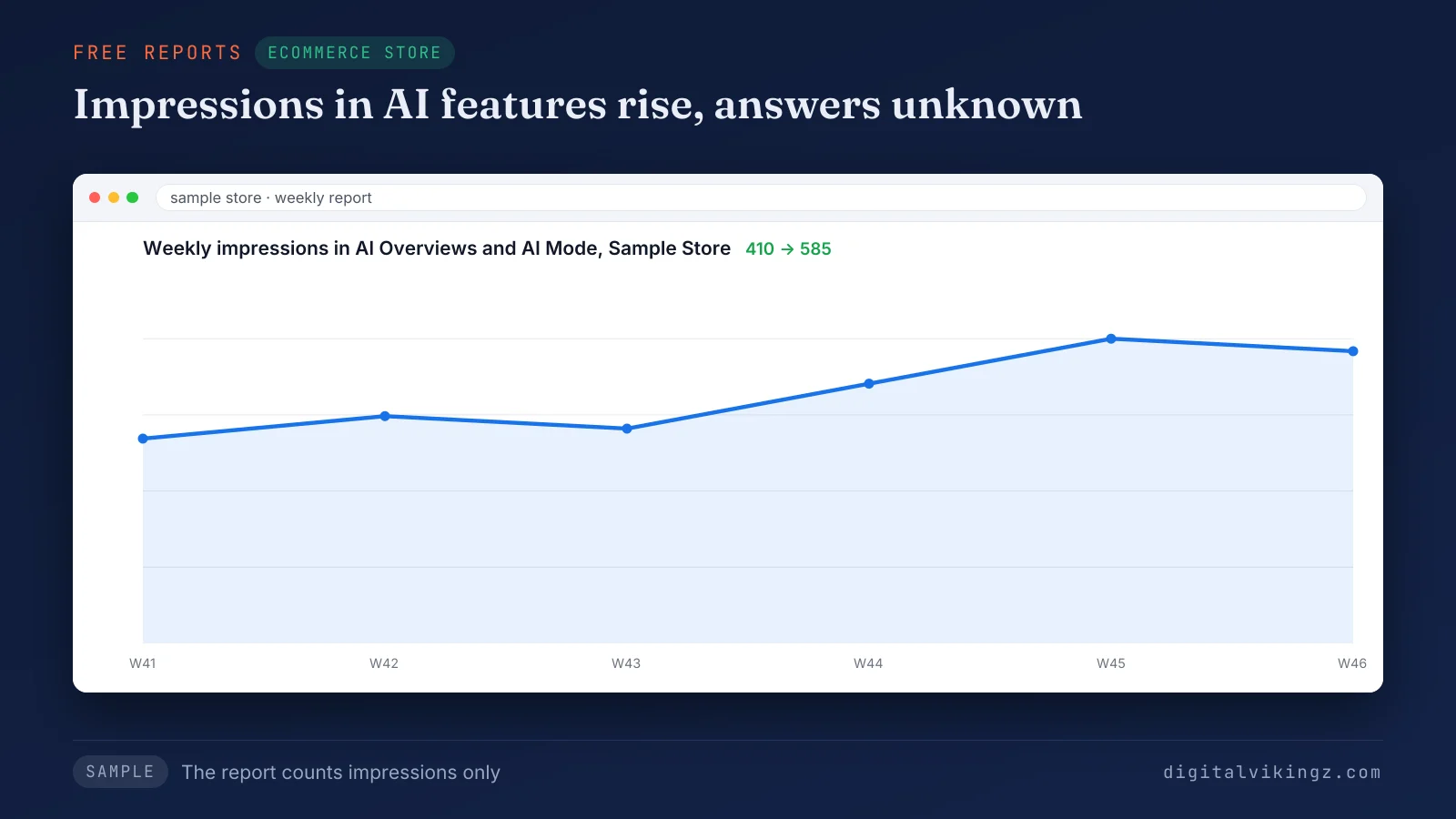
The sample store's weekly impressions in AI features rose from 410 to 585, a rise of 43 percent. The chart does not say which answers named the store. The counts still leave one question open.
Is a free report enough to check AI visibility?
A free report is not enough to check AI visibility, because no report shows the answer text or the competitors named.
The reports count how often the site appears, and the prompt check reads what the answers say and which other businesses the answers name. Google Search Console shows impressions without the answer, and Bing Webmaster Tools shows citations without the competitors beside each citation. An AI visibility check needs both readings, because a rising count can hide a wrong description. The reports and the record sheet are read side by side, month by month. The next question is how often to run the check.
How often should a business re-check its AI visibility?
A business should re-check its AI visibility once a month with the same prompt set, and after a major site or listing change.
The AI visibility re-check uses the same assistants, the same prompt types and the same ten record columns as the first check. The monthly run happens on the same day each month, so each reading compares like with like. A changed prompt starts a new baseline, so the set stays fixed between runs. A drop in one month is re-run before the drop is read as a trend.
Teams that report every week add the rolling rates to a weekly SEO and AEO report. The weekly rows, thresholds and fixes are set out in the guide to automating a weekly SEO and AEO report. The monthly run can stay manual or move to a tool.
Is a manual check or a tracking tool better for one business?
A manual check is better for a first baseline, and a tracking tool is better for a fixed prompt set run every week.
A tracking tool runs whatever prompts the team enters on a schedule, so a weak prompt set gives a weak number faster. Both methods need the same columns, the same assistants and at least three runs per prompt. A manual AI visibility check suits one business with one or two service lines, and a tracking tool suits several locations or product lines. We run client prompt sets through each provider's API on a fixed schedule, with the same columns as the manual sheet. Repeated runs also answer how much the answers move.
Do AI answers change too often to check by hand?
AI answers do not change too often to check by hand when each prompt runs at least three times.
The result is read as a share of runs, never as one answer. One answer is a sample of the answers an assistant can give, and the share of runs is the measure of AI visibility. A business named in two of three runs one month and one of three the next month is re-run before the change is read. Movement in the answers points back to the cited sources.
What should you fix first after an AI visibility check?
Crawler access comes first after an AI visibility check, then the business's own facts, its listings, third-party mentions and answer passages.
Each fix changes a source the answers draw on, since AI answers repeat what the cited pages and listings say.
The fixes after an AI visibility check, in order, are listed below:
- Confirm that search crawlers and AI crawlers can fetch the pages, with no robots.txt or firewall rule blocking the crawlers.
- State the business name, services, locations and prices the same way on every page and in the structured data.
- Correct the Google Business Profile, directory listings and review profiles that the answers cite with wrong details.
- Earn mentions on the third-party lists, reviews and forums that the answers cite for competitors.
- Write a passage that answers each prompt in its first sentence on the page that should be cited.
Fixes 1, 2 and 5 sit on the business's own site, and fixes 3 and 4 sit on sources the business does not own. The pattern sets the start: a wrong description starts at fix 2, and a named but uncited business starts at fix 5. Each fix is logged against the sheet row that found the problem, so the next run checks the same prompt.
We work through the same order inside an AI Search Visibility engagement and re-run the prompt set each month. Teams that want the fixes done by an agency start with a strategy call about an AI Search Visibility engagement. Local service businesses add their profile and directories to the first fixes.
What does a local service business fix first?
A local service business adds its Google Business Profile, listings and reviews to the first fixes, because local AI answers can cite them.
The Google Business Profile states the same name, address, phone, hours and services as the website. Review platforms the answers cite for the town carry the same name, phone and services. Directory listings that state an old address or phone number are corrected first, because the answers repeat the cited listing. A location page for each town served gives the answers one page to cite per town. AI assistants choose a local business from the profile, the reviews, the directories and the business's own site. The AI visibility check re-runs the same town prompts after each correction, so the record sheet shows which listing changed the answer.
We set those facts once across the profile, the listings and the site under Local SEO and Google Business Profile optimization. The profile, listing and location page work runs through our Local SEO and Google Business Profile optimization service. Some wrong answers still need a direct correction.
Can you change what ChatGPT says about your business?
A business can change what ChatGPT says about the business by correcting the sources ChatGPT reads.
Business Hub, an OpenAI beta opened on 10 November 2026, lets a verified owner update the business details ChatGPT holds. A corrected source shows in later answers with no fixed timeline, so the next monthly run measures the effect. Each wrong fact in the sheet is traced to its cited source before anything is edited.
A wrong fact repeated across several assistants points to a source every assistant reads, such as a directory listing. A wrong fact on one assistant only points to a source that assistant alone cites. A wrong fact with no cited source points to the business's own pages or its listings, which fixes 2 and 3 cover. The same correction rule applies to Gemini, Perplexity, Claude and Copilot answers that cite a source. Each correction is logged with its date, so the next AI visibility check shows whether the answer moved.
Questions about checking AI visibility
Businesses that check AI visibility ask five further questions, about competitors, brand audits, who runs the check, the checker and AI Mode.
Can the same check measure competitors' AI visibility?
The same check measures competitors' AI visibility, because every row records each competitor named in the answer. Each competitor's named answers divided by all answers gives a share to set beside the business's own mention rate.
Is an AI visibility check the same as a brand audit?
An AI visibility check is not a brand audit, because the check reads only AI answers and a brand audit reviews every channel. The AI visibility check answers one question: what AI assistants and AI Overviews say when buyers ask.
Should someone from the business run the check?
Anyone at the business can run the check, as long as each prompt runs in a clean session with no account history. A colleague's logged-in account carries past chats and memory, which can tilt the AI visibility reading toward the business.
Does the AI Visibility Checker replace the prompt check?
The AI Visibility Checker does not replace the prompt check, because the checker reads the site and the prompt check reads the answers. The checker shows whether crawlers can reach the pages and whether each page states what the business is.
Does AI Mode need a separate check from AI Overviews?
AI Mode needs its own reading, because AI Mode answers in a separate tab of Google Search and can cite other pages. The generative AI performance report in Google Search Console counts AI visibility in both features as impressions in one report.
What does an AI visibility check give a business?
An AI visibility check gives a business a dated record of what AI answers say, which sources they cite and what to fix first.
Each record shows how semantic SEO builds topical authority that Google and AI answer engines recognise, one prompt set at a time. Crawler access and page structure come first, and the free AI Visibility Checker reads both on up to five public pages. Run the free AI Visibility Checker on the homepage before the next prompt run. Digital Vikingz runs the prompt check and the fixes for B2B SaaS companies and local service businesses, starting with a strategy call.