Digital Vikingz

An AI agent for SEO is software that runs a multi-step SEO task toward a goal a person sets, using site data and tools. AI agents do SEO tasks in three groups: scheduled tasks they run, approval tasks they draft, and decision tasks they prepare data for.
AI agents can automate a weekly SEO and AEO report, while a person keeps the choices in how to build a topical map. Three checks decide which SEO tasks an AI agent takes: what the output changes, what it is checked against, and what a mistake costs. Every industry fills the same three groups, from posts for Local SEO and Google Business Profile Optimization to briefs that show what a content brief holds. Handing SEO tasks to AI agents starts with one scheduled task, and SEO Automation with review gates leaves the decisions on how topical authority is built with people.
What is an AI agent for SEO?
An AI agent for SEO is software that runs a multi-step SEO task toward a goal a person sets, using site data and tools.
A language model such as Claude reads data from Google Search Console, a site crawler, the CMS and the Google Business Profile. A single prompt returns one answer and stops, while an AI SEO agent reads the result of each step and chooses the next one. Agentic SEO workflows are several agents chained in order, each one handing its output to the next.
Every agent in the agentic SEO workflows we build stops at a review gate. A review gate is the point where a person approves, edits or rejects the output before anything changes on the site. The SEO tasks an AI agent takes depend on what the agent's output changes.
Which SEO tasks can AI agents do?
AI agents do SEO tasks in three groups: scheduled tasks they run, approval tasks they draft, and decision tasks they prepare data for.
A person reads the output of scheduled tasks, approves each approval task before the site changes, and makes every decision.
The table below lists fifteen common SEO tasks with the agent's part, the person's part and the group of each task.
| SEO task | Agent's part | Person's part | Group |
|---|---|---|---|
| Rank and AI answer monitoring | Checks positions and AI answers | Reads flags, decides | Scheduled task |
| Crawl and index checks | Lists broken links, redirects, missing canonical tags | Chooses fixes | Scheduled task |
| Search Console weekly report | Pulls clicks, flags threshold changes | Checks numbers, picks fixes | Scheduled task |
| Content decay detection | Lists pages losing clicks | Decides refresh, merge or remove | Scheduled task |
| Query research and grouping | Groups queries by intent | Approves the groups | Approval task |
| Content briefs | Drafts from a topical map node | Approves headings, links | Approval task |
| Article drafts | Drafts; a separate agent audits | Edits, approves publication | Approval task |
| Titles and meta descriptions | Drafts one per page | Approves before bulk change | Approval task |
| Schema markup | Generates, validates structured data | Approves the deploy | Approval task |
| Internal link suggestions | Proposes internal links, anchors | Approves each placement | Approval task |
| GBP posts and review replies | Drafts from service pages | Owner approves | Approval task |
| Strategy and source context | Summarises the data | Decides | Decision task |
| Topical map and page decisions | Lists query groups, overlaps | Decides which pages exist | Decision task |
| Claims, brand voice, regulated wording | Flags claims | Signs off every claim | Decision task |
| Link earning | Lists prospects, drafts outreach | Chooses targets, earns links | Decision task |
The group of each task follows from what its output changes on the site. Scheduled tasks, such as rank monitoring and crawl checks, come first.
Which SEO tasks can an AI agent run on a schedule?
An AI agent can run rank monitoring, crawl checks, Search Console pulls and report assembly on a schedule, because that output changes nothing.
Content decay detection belongs to the same group of scheduled tasks, as a list of pages that keep losing clicks. Scheduled tasks read data, such as rank tracking results, AI visibility checks and crawl errors, and write nothing to the site. A person reads each scheduled output and decides the response, and the agent never acts on its own flag.
A weekly report lists the Search Console changes above a set threshold, the likely cause and the fixes for the week. The method to automate a weekly SEO and AEO report, thresholds included, has a separate guide. A false flag, such as a ranking dip on a holiday weekend, costs the reader a minute to dismiss. We check every Search Console number against its source before the number appears in a report. Drafts that change the site belong to the second group, approval tasks.
Which SEO tasks can an AI agent draft for approval?
An AI agent can draft briefs, articles, meta titles, schema markup, internal links and Google Business Profile posts for a person to approve.
Approval tasks change the site, so a person approves each draft before it goes live. Each approval task has one review gate and one standard the draft is checked against. Internal link suggestions follow the same rule: the agent proposes each link, and a person approves each placement.
The standards that approval tasks are checked against are listed below:
- Content briefs: The standard is the topical map node that the brief was drafted from.
- Article drafts: The standard is the brief, checked first by a separate audit agent and then by an editor.
- Titles and meta descriptions: Page content and query set the standard, title by title, before a bulk change across store product pages.
- Schema markup: The standard is a validator result of zero errors and markup that matches the visible page.
- Google Business Profile posts: The standard is the owner's own services, offers and service areas.
Our own pipeline blocks publication until a separate audit agent passes the draft against its brief. Work that commits the business to a direction belongs to the third group, decision tasks.
Which SEO tasks need a person?
Strategy, topical map decisions, published claims and link earning need a person, because each commits the business to a direction, promise or relationship.
An AI agent still prepares the data for each decision task, from query groups to link prospect lists. Strategy stays with the owner or the SEO lead, who sets the source context the agent works inside. A person decides the topical map: which entity the site covers, which pages exist, and what the site never publishes. Our guide on how to build a topical map sets out those decisions in seven steps.
Claims on health, finance and legal pages are signed off by the qualified professional, never by the agent. Brand voice and fact-checking stay with a person on every page, because a published claim commits the business. AI agents list link prospects and draft outreach, and a person chooses the targets and earns each link. The Google Business Profile primary category and the business name, address and phone are changed only with the owner's approval. Decision tasks mark where AI agents stop short of all of SEO.
Can AI agents do all of SEO?
AI agents do not do all of SEO, because strategy, approval and accountability for each published page stay with a person.
Accountability stays with the person who approves a page, from the point of view of a business publishing under the business name. Some tools are sold as "autopilot", yet every first-hand account and Google AI Overview in our research keeps a person at the review gate. The share an agent takes grows with the number of scheduled tasks and approval tasks a site has. Each site needs a rule to decide which SEO tasks the agent takes.
How do you decide which SEO tasks to give an AI agent?
Three checks decide which SEO tasks an AI agent takes: what the output changes, what it is checked against, and what a mistake costs.
The three checks for any SEO task are listed below:
- Ask what the output changes: nothing on the site, a page on the site, or a commitment of the business.
- Ask what the output is checked against: data, a brief or written standard, or judgment alone.
- Ask what a mistake costs: a minute to dismiss, an edit before publication, or money, trust or legal exposure.
The first option of each check makes a scheduled task, the second an approval task, and the third a decision task. The highest option any check reaches sets the group, so one judged check makes the whole task a decision task.
Alt text for an online store's product images changes pages, is checked against a written alt text standard, and costs an edit when wrong. The standard is a style guide rule naming the product, color and view, so alt text is an approval task for an AI agent. The three checks apply in every industry, with different tasks in each group.
What can an AI agent do for SEO in each industry?
An AI agent does the same three groups of SEO tasks in every industry, and the industry decides which tasks fill each group.
The four samples below each show one task as the screen a person reviews, and none of them is client data. The samples cover a local plumber, a real estate agency, a SaaS company and a dental clinic, in that order.
What can an AI agent do for a plumber's SEO?
An AI agent can draft a plumber's weekly Google Business Profile posts and review replies, and the owner approves each one before posting.
GBP posts and review replies are approval tasks, because each one changes what searchers see on the profile. The agent drafts each post from the service pages of the local service business, so every post names a service the plumber sells. The owner decides which jobs, towns and offers to feature, and answers any review that disputes a job.
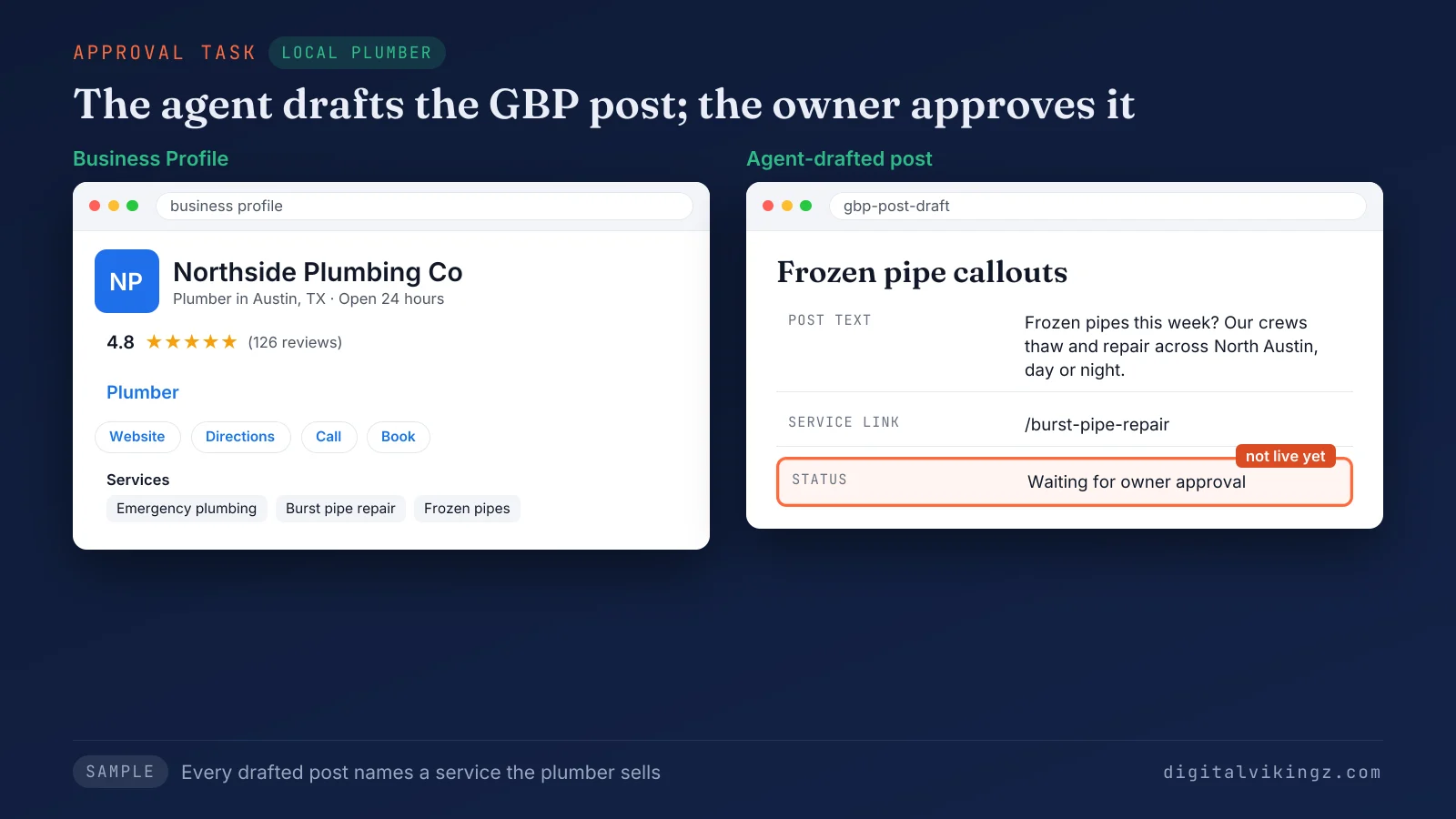
The sample profile, rated 4.8 from 126 reviews, shows the drafted post on frozen pipe callouts with the status set to waiting for owner approval. GBP posts and review replies are part of our Local SEO and Google Business Profile Optimization service. The same approval step holds for a real estate agency, whose area pages need a different task.
What can an AI agent do for a real estate agency's SEO?
An AI agent can flag a real estate agency's area pages that lose clicks in Search Console, and a person decides each page's fix.
Content decay detection is a scheduled task, and choosing to refresh, merge or remove the page is a decision task. Area pages and listing pages lose clicks for reasons that sit outside the site, so the AI agent flags the drop and stops. The person first rules out a sold listing, a new competitor page or a seasonal change as the cause of the drop.
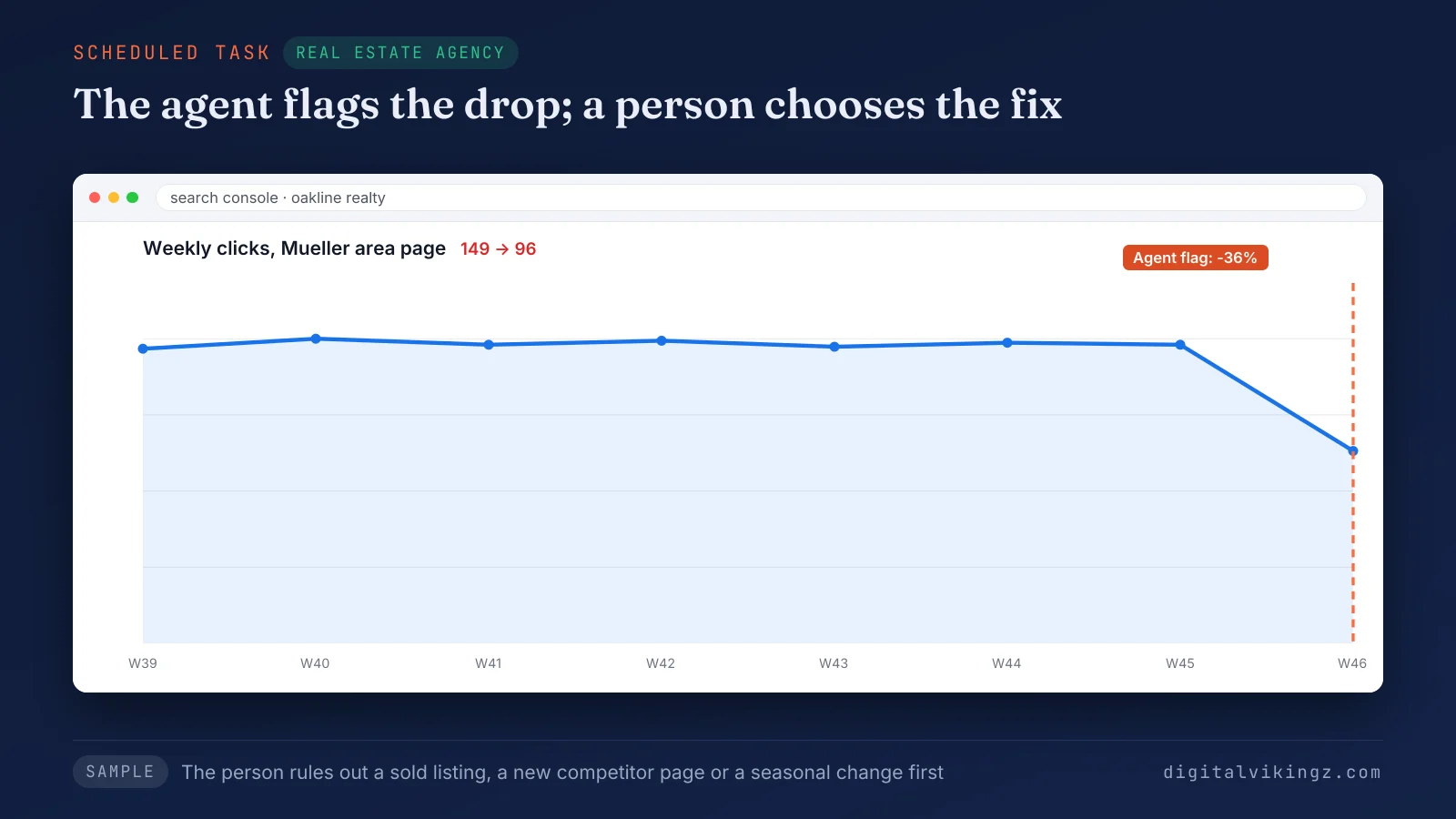
Weekly clicks on the sample area page fall from 149 to 96, a 36 percent drop. The agent's flag appears in the week the drop passes the threshold. The same split applies to a SaaS company's query research and briefs.
What can an AI agent do for a SaaS company's SEO?
An AI agent can group a SaaS company's queries by intent and draft briefs, and a person decides which comparison pages come first.
Grouping queries by intent, the step many teams call "keyword clustering", is an approval task, and the publishing order is a decision task. Each drafted brief starts from one topical map node and names the entity, the questions, the headings and the links. Our knowledge page sets out what a content brief holds. The person weighs which comparison pages and alternatives pages bring buyers closest to a decision for the B2B SaaS product.
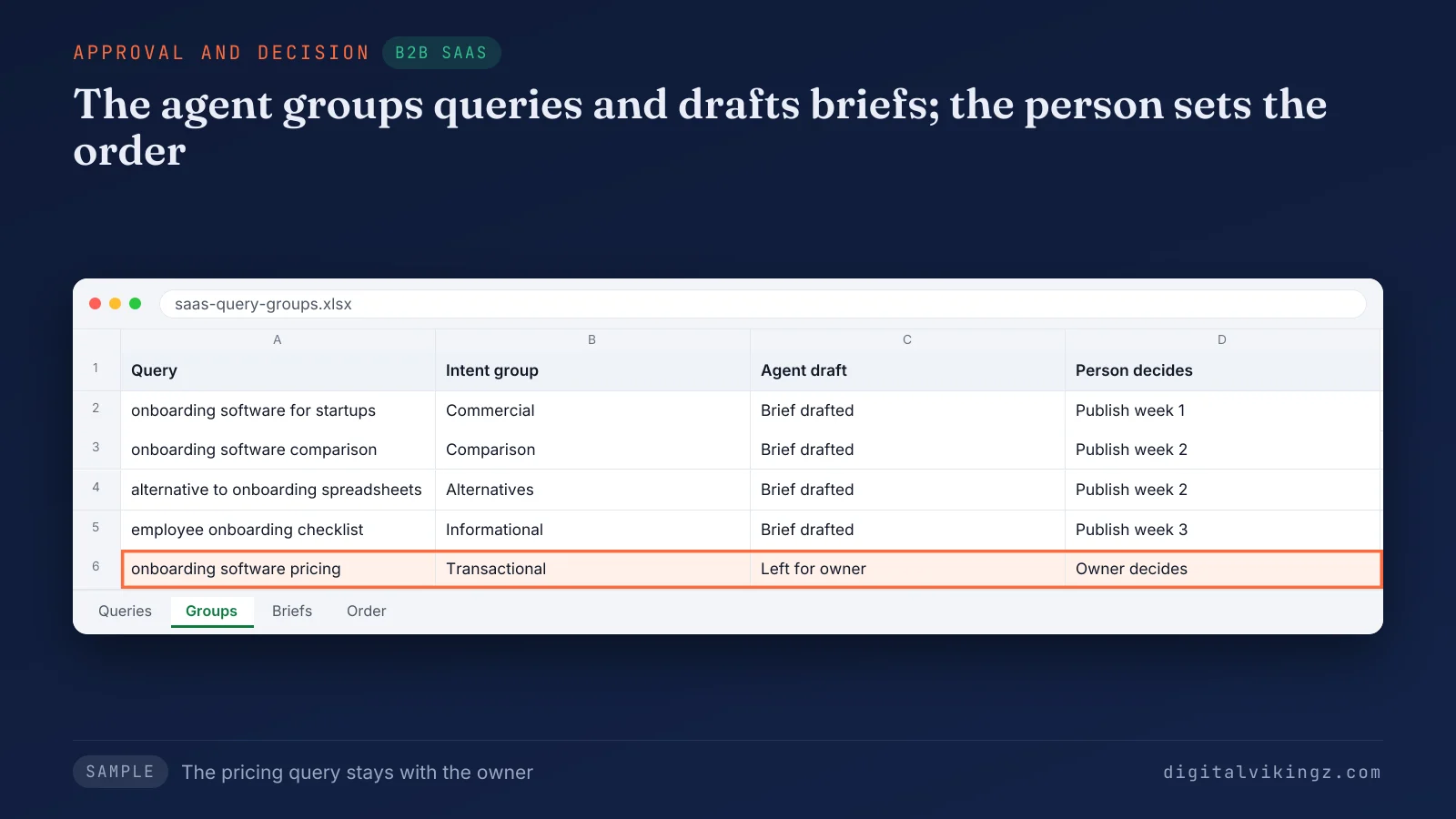
The last column of the sample sheet holds the person's decisions, and the agent leaves the pricing page query for the owner. A dental clinic splits the same work differently, because the clinic's service pages carry treatment claims.
What can an AI agent do for a dental clinic's SEO?
An AI agent can run crawl and schema checks on a dental clinic's service pages, and the dentist approves every treatment claim.
The checks are scheduled tasks, the fixes they produce are approval tasks, and treatment claims are decision tasks. Dentist schema and other structured data on the service pages pass a validator before any change goes live. The agent flags wording such as "painless" for the dentist and never writes medical advice.
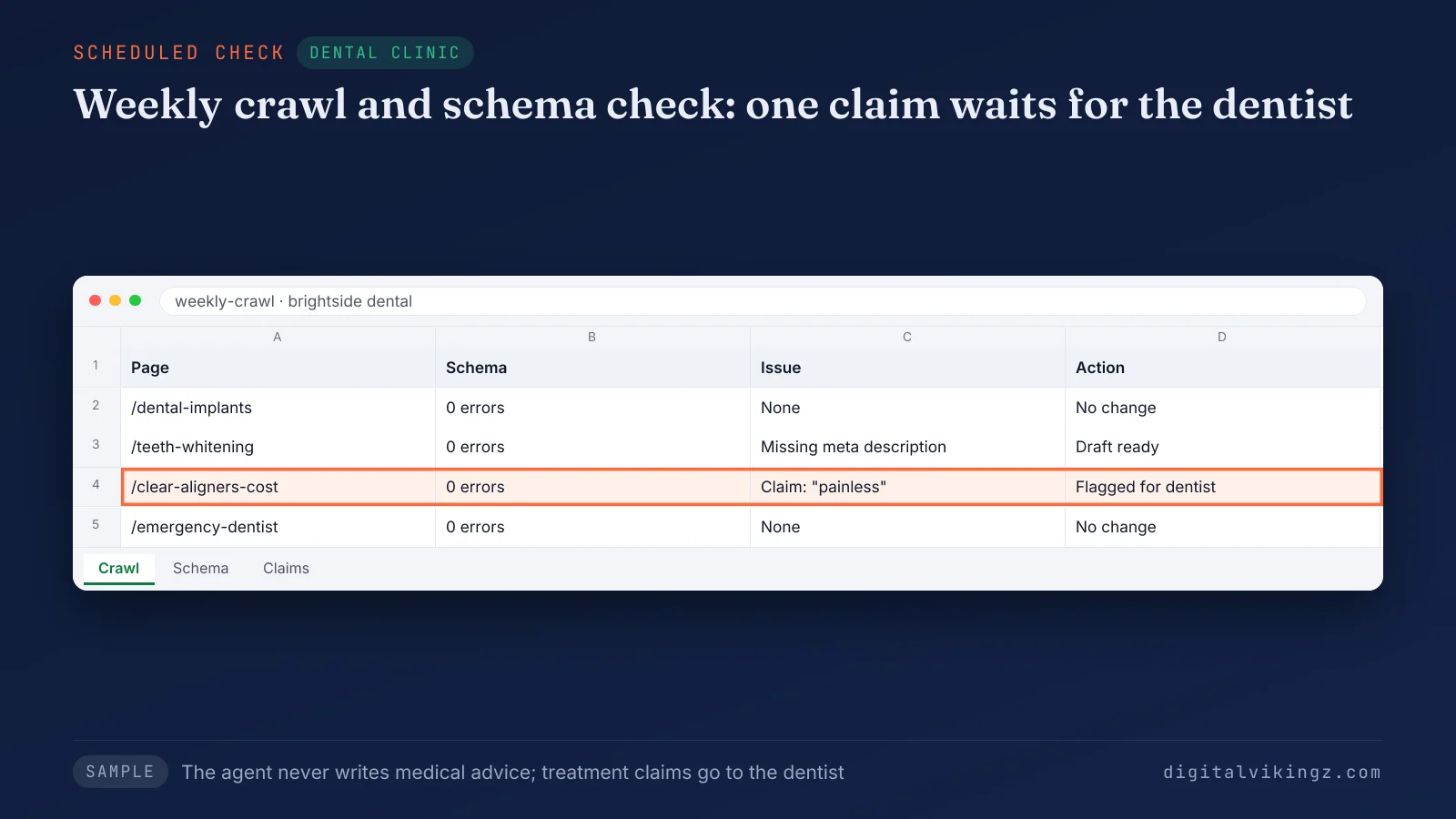
The sample check shows 0 errors in the implants page markup and a missing meta description with a draft ready. One flagged claim sits on the clear aligner cost page, waiting for the dentist. The same groups show where a team starts handing SEO tasks to an AI agent.
How do you start handing SEO tasks to AI agents?
Handing SEO tasks to AI agents starts with one scheduled task and a written review checklist, then adds approval tasks one at a time.
SEO automation with AI agents starts small, because every new task needs a separate review checklist.
The first steps to hand SEO tasks to AI agents are listed below:
- Write down the SEO tasks your team repeats every week and the tool each one uses.
- Pick one scheduled task first, such as rank monitoring or a crawl check.
- Write the review checklist before the first run, naming what the reader checks and when.
- Run the agent beside the manual version until both give the same result.
- Add approval tasks one at a time and keep every decision task with a person.
Teams that want these workflows built and handed over can ask for our SEO Automation with review gates service. The service builds the agents and trains the team on each review checklist. The time teams call "babysitting the tool" shrinks as the review checklist settles. Every failure in the next section starts when an AI agent skips the review gate.
What goes wrong when an AI agent skips the review gate?
An AI agent without a review gate puts its mistakes on the site: invented facts, repeated bulk errors, skipped items and misread reports.
Each failure grows with volume, because an agent repeats one mistake across many outputs faster than a person spots the mistake.
The four failures that a review gate catches are listed below:
- Invented facts: Drafts can state figures or claims with no source; the audit agent and the editor check each claim against the brief.
- Repeated bulk errors: One wrong rule, such as a wrong canonical tag, repeats across every page until a page-by-page review catches the rule.
- Skipped items: An agent given a large batch can skip items without an error message. Women in Tech SEO's April 2026 essay "How AI Agents Make SEOs More Valuable (Not Less!)" reports one agent clustering 205 of 900 keywords. Smaller batches and a count check catch the gap.
- Misread reports: A traffic drop can be read as a ranking loss when the cause is a tracking change; the person reading the report checks the cause.
The review gate catches all four failures before a page changes, which is why the gate sits on every approval task. Unreviewed drafts also raise the question of how Google treats SEO content drafted by an AI agent.
Does Google penalize SEO content drafted by an AI agent?
Google does not penalize SEO content for being drafted by AI, and its spam policy targets scaled pages made to manipulate rankings.
A February 2023 post on the Google Search Central blog states that Google rewards the quality of content, whatever way the content was produced. Google's spam policies list mass-generated pages that add no value for users as scaled content abuse, however the pages are made. An AI agent's draft stays inside the policy when a person checks the draft against a brief and the page adds information the reader needs. The same review applies to a draft from an AI agent and to a draft from a fixed automation script.
How is an AI agent different from a fixed automation script?
An AI agent chooses its next step from each result, while a fixed automation script repeats the same steps on every run.
Automation tools such as Zapier, Make and n8n run fixed scripts, and the same tools can also host AI agents. A fixed script suits a stable task, such as copying Search Console data into a sheet every Monday. A fixed script breaks when the data changes shape, and a person rewrites the script. An AI agent suits a task whose next step depends on the findings, such as tracing a traffic drop to the pages behind the drop. Both need the same review gate when their output changes the site.
Questions about AI agents for SEO
Teams weighing AI agents for SEO ask seven further questions, about ChatGPT, specialists, the best agent, automation share, site access, backlinks and topical maps.
Can ChatGPT do SEO?
ChatGPT can draft SEO text and answer SEO questions, and alone it has no access to a site's Search Console data, crawler or CMS. Connected to those tools with a review gate, a language model becomes part of an AI agent.
Can an AI agent replace an SEO specialist?
An AI agent replaces repetitive SEO tasks, not the SEO specialist who sets the strategy and approves the work. The specialist's week moves from assembling data to reviewing drafts and deciding.
Which AI agent is best for SEO?
No single AI agent is best for SEO, because each task group needs different data access and a different review gate. The right agent is the one connected to the site's own data for the task at hand.
How much of SEO can AI agents automate?
No measured share of SEO work exists for AI agents, and each site's share depends on its scheduled and approval tasks. Percentages of SEO work quoted online for AI agents come from opinions, not from measured site data.
Is it safe to give an AI agent access to a website?
An AI agent should read data through official APIs, such as the Search Console API, and change the site only after a person approves. Google's spam policies class scraping Google results for rank checks as machine-generated traffic, so a safe setup never scrapes Google.
Can AI agents build backlinks?
AI agents can list link prospects and draft outreach emails, and a person chooses the targets and earns each link. Google's spam policies list automated programs that create links to a site as link spam.
Does an AI agent need a topical map?
An AI agent needs a topical map or a brief as input, because without one it picks topics by search volume, not by business. The map tells the agent which entity to cover, which pages exist and which topics stay out.
What changes when AI agents take the repetitive SEO work?
AI agents take the monitoring, checking and drafting off a team's week and leave the decisions that build topical authority with people.
Digital Vikingz builds its own semantic SEO pipeline this way, with a review gate on every output and a separate agent auditing every draft. The decisions that stay with people are the ones that set how topical authority is built for a site.