 Digital Vikingz
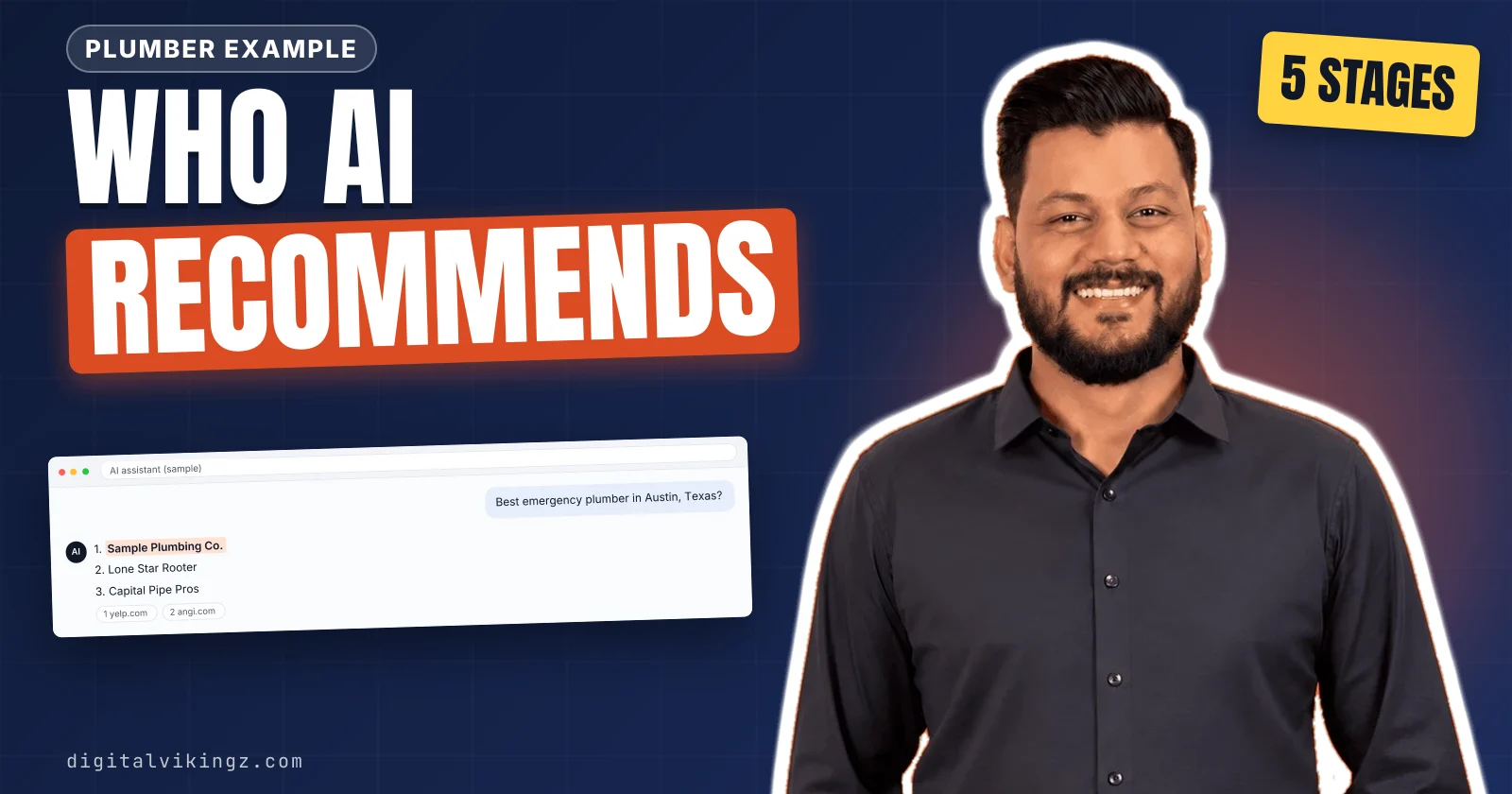
A local AI recommendation is an AI assistant's answer that names a specific business for a stated service and place. AI assistants choose a local business in five stages, and no assistant publishes its full selection formula. The stages read the request, search for candidates, match each business across sources, compare the candidates and name a short list. The search stage works like the retrieval described in how AI search engines decide which sources to cite. Naming a business and citing its page are separate outcomes, which is how mention rate and citation rate differ.
Each assistant reads its own mix of business profiles, directory listings, review sites and business websites. Consistent facts, matching services, specific reviews, third-party mentions, distance and clear pages separate the named business from the rest. Structured data plays a smaller part, as the question of whether schema markup affects AI citations shows. A top Google Maps position supports a local business without guaranteeing an AI recommendation.
Digital Vikingz aligns those signals across the website, profiles and listings in the Local SEO and Google Business Profile service. Businesses left out often lack outside mentions, the gap explained by how entity co-occurrence drives AI mentions. AI Search Visibility for local businesses adds the answer-ready pages and mentions that a map ranking alone does not supply. The same entity work sits at the center of semantic SEO for local service businesses.
How does an AI assistant choose a local business to recommend?
An AI assistant chooses a local business to recommend in five stages, from reading the request to naming a short list.
BrightLocal's 2026 Local Consumer Review Survey of 1,002 US adults found that 45 percent had used AI tools for local business recommendations. The share was 6 percent in the 2025 survey.
The five stages of an AI recommendation for a local business are listed below:
- Read the request for the service, the place and any qualifier.
- Search a web index, a maps index and business listings for candidates.
- Match each candidate to one business across the sources.
- Compare the candidates on fit, proof and distance.
- Name a short list and cite the sources behind the answer.
The five stages are our reading of OpenAI and Google documentation and of published local AI studies. Vendors document the sources and the retrieval steps, while the weight of each signal stays unpublished. Each stage narrows the field, so a local business can drop out at any point before a local AI recommendation is written. Every recommendation starts from the words of the request.
1. Read the request for the service, the place and any qualifier
Reading the request gives the AI assistant three things to match: the service, the place and any qualifier, such as "open now".
The place comes from the prompt, such as a city or "near me", or from the location the assistant holds for the user. Google states that local results calculate distance from the location data Google already holds when a searcher shares no location. A qualifier changes the sources the assistant needs, because "open now" calls for hours and a named service calls for a service page. Three prompts for one trade show the split: "best plumber in Austin" pulls reviews, and "emergency plumber open now in Austin" pulls opening hours. The prompt "plumber who installs tankless water heaters in Austin" pulls a service page. The parsed request then drives the search for candidates.
2. Search a web index, a maps index and business listings for candidates
Searching for candidates sends live queries to a web index, a maps index and business listings, and returns the pages that name possible businesses.
Google states that AI Overviews and AI Mode may use query fan-out, issuing several related searches for one question. BrightLocal reports that ChatGPT has started running "site:" searches in its fan-out queries to read a business's own pages. An assistant with live search can name a local business that opened after the model's training data was collected. Model memory still supplies background knowledge, such as which business types offer which services. An AI assistant with live search draws most candidate local businesses from the search results. Page retrieval for AI answers follows the same path as how AI search engines decide which sources to cite. Crawler access and passage structure are covered in the guide to how AI search engines decide which sources to cite. Every candidate found in the search is then matched to one business.
3. Match each candidate to one business across the sources
Matching ties the website, the Google Business Profile and each directory listing to one business through a shared name, address, phone number and category.
Search systems treat the business as an entity, meaning one thing with one set of facts across every source. Local SEO calls the name, address and phone number NAP. Conflicting details, such as an old phone number on one directory, split the evidence between two possible businesses. Outdated listings can return in answers, which is how AI assistants still name closed locations and old opening hours. LocalBusiness or Organization markup with sameAs links states the same facts in a form machines read directly. We check the name, address, phone number, hours and category on the website, the profile and the main directories before any other local work.
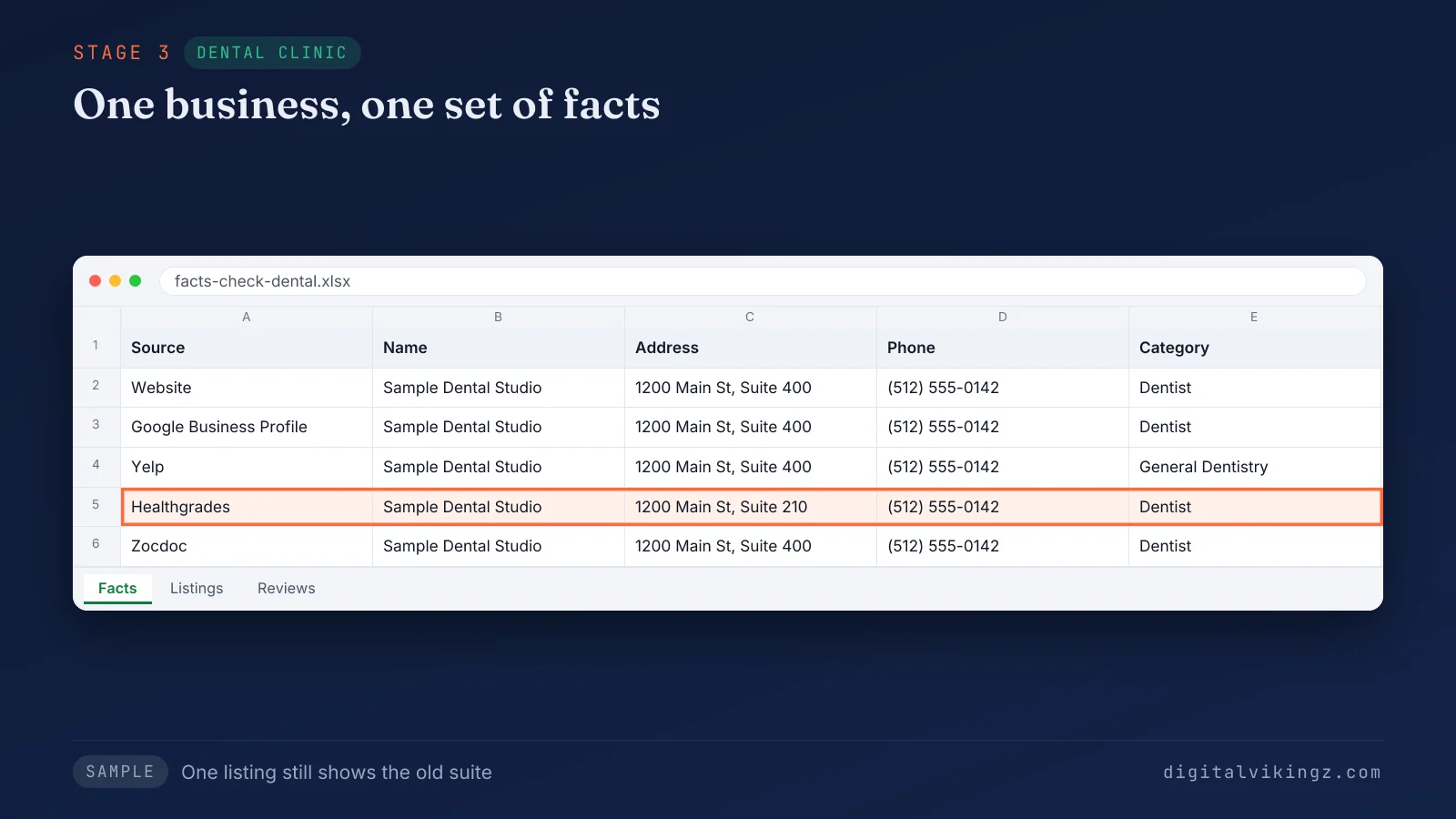
The sample clinic's Healthgrades listing still shows Suite 210, while the website and the profile show Suite 400. Matched businesses then compete on fit, proof and distance.
4. Compare the candidates on fit, proof and distance
Comparing the candidates weighs each business on fit to the request, proof from other sources and distance from the place.
Google states that its local results rest on relevance, distance and prominence, three factors that match fit, distance and proof. Fit comes from the category, the service pages and the reviews that name the service asked for. Proof comes from review volume and recency, directory listings and mentions on pages the local business does not control. Distance comes from the street address or the service area in the Google Business Profile and on the website. No AI assistant publishes the weight of each factor, and the weights differ from one assistant to the next. The strongest candidates become the short list.
5. Name a short list and cite the sources behind the answer
Naming the answer turns the strongest candidates into a short list of named businesses, in place of a page of links.
A named business appears in the answer text, and a cited source is a page linked as evidence for the answer. Local SEO uses the word citation for a directory listing, a different thing from a cited source in an AI answer. BrightLocal's 2026 Local AI Visibility Study of more than 1,300 locations found 20 to 33 percent overlap when the same search was repeated. One run of one prompt therefore shows one answer, not a pattern. A repeatable check of what ChatGPT and AI Overviews say about one business asks the same question several times from the service area.
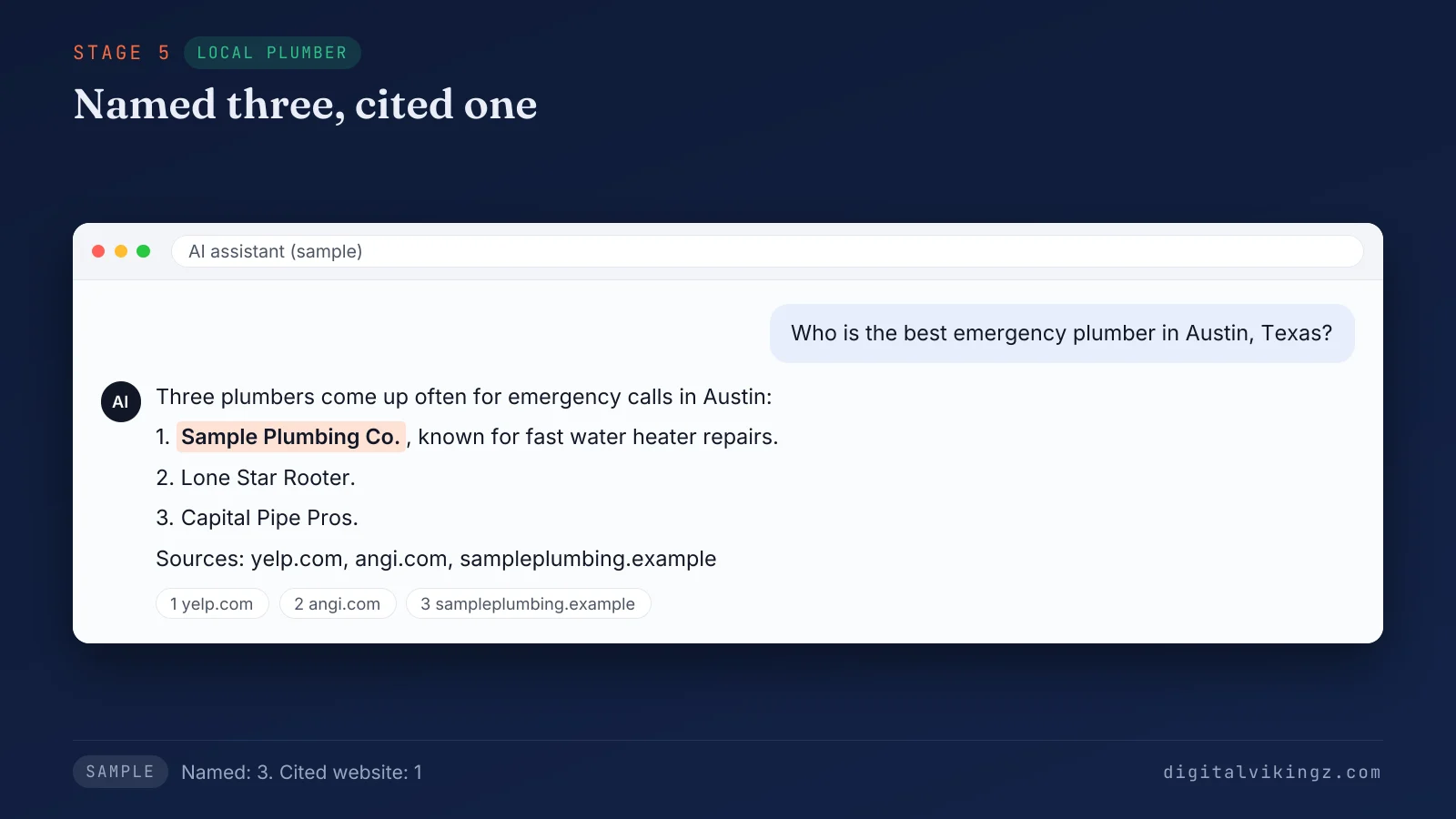
The sample answer names three plumbers and links one plumber's website, so only that plumber is both named and cited. The two outcomes are measured as two rates, which is how mention rate and citation rate differ. Each rate and its measurement are defined in the guide to how mention rate and citation rate differ. Each AI assistant builds its short list from different sources.
Which sources do AI assistants read for a local business?
AI assistants read four kinds of sources for a local business: business profiles, directory and review sites, the business website and third-party mentions.
BrightLocal's 2026 Local AI Visibility Study by Mike Hawkes counted business websites as 42 percent of all citations across more than 1,300 business locations. Google Business Profile made up 28.6 percent of the same citations.
The table below lists the index, the business profile and the review sources each AI assistant uses for local answers.
| Assistant | Index it searches | Business profile it leans on | Review and directory sources seen | Evidence |
|---|---|---|---|---|
| Google AI Overviews and AI Mode | Google Search index, with query fan-out | Google Business Profile, used for virtually every location | Yelp, Facebook, Tripadvisor, MapQuest | Google documentation; BrightLocal source study, 2026 |
| ChatGPT | ChatGPT search, with OAI-SearchBot crawling the web | Businesses in ChatGPT (beta); Apple's business listing cited (managed in Apple Business Connect) | Yelp, in 80 percent of ChatGPT local answers; Tripadvisor, BBB, Angi | OpenAI documentation; BrightLocal source study, 2026 |
| Gemini | Google Search and Google Maps (reported) | Google Business Profile (reported) | Not measured in the studies we read | Reported, not measured |
| Perplexity | Perplexity's own index with live retrieval | None documented | Not measured in the studies we read | Digital Vikingz analysis of AI citations; not measured |
| Microsoft Copilot | Bing search index (reported) | Bing Places for Business (reported) | Not measured in the studies we read | Reported, not measured |
BrightLocal's 2026 source study by Mike Hawkes covered 1,355 business locations in the US, UK and Australia. The study shows Google's AI surfaces, meaning AI Overviews and AI Mode, leaning on the Google Business Profile, and ChatGPT on Yelp. OpenAI launched Businesses in ChatGPT in beta on 10 November 2026, and local stores can claim only an existing U.S. listing. OpenAI states that claiming does not guarantee increased visibility in ChatGPT's independent recommendations. Rows marked reported rest on third-party reports.
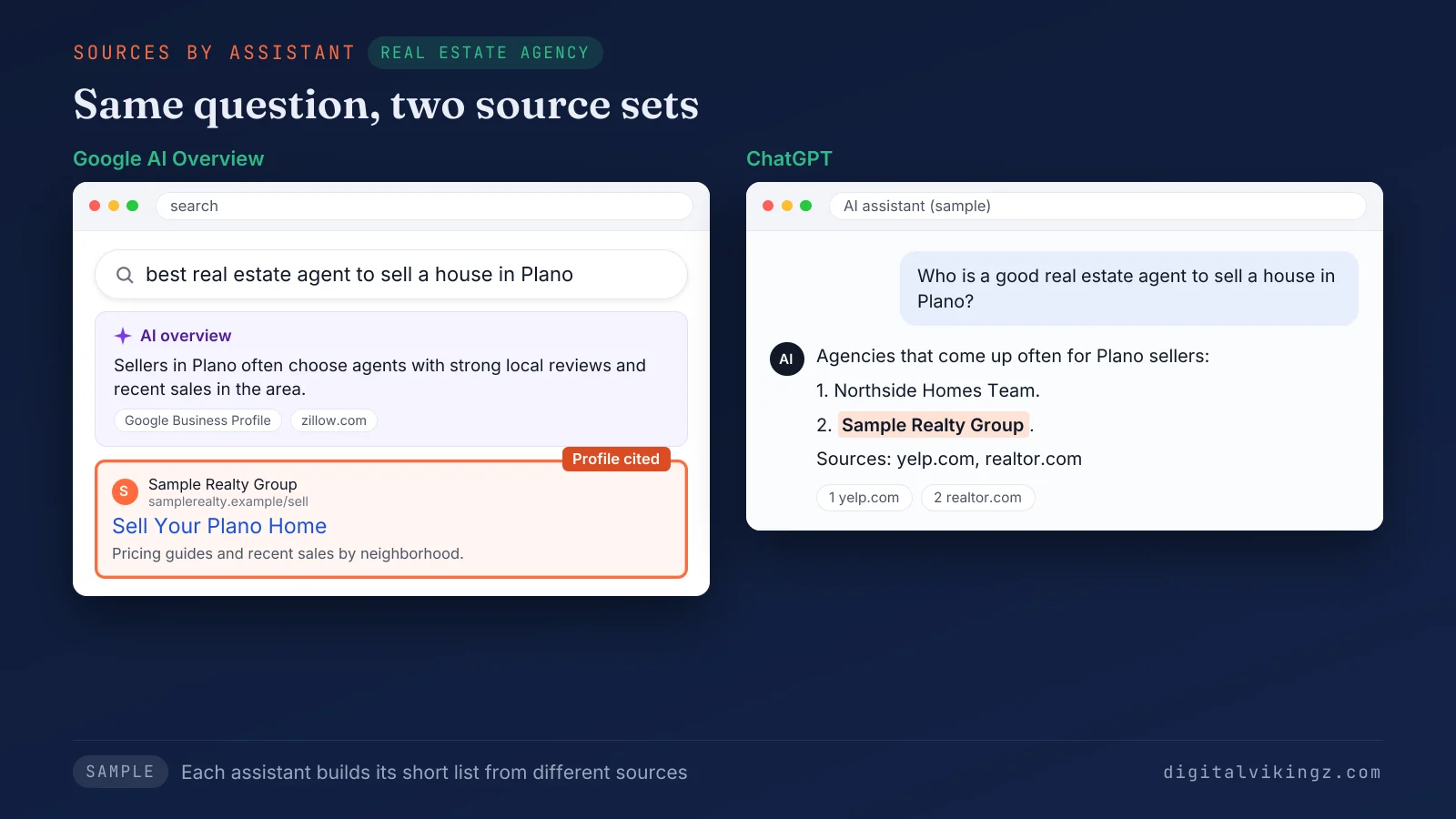
The two sample assistants answer one real estate question from different sources. Directory listings make up most third-party sources in the table.
Do directory listings affect AI recommendations?
Directory listings affect AI recommendations, because AI assistants read each listing as a source of business facts and reviews.
Yelp appeared as a source in 80 percent of ChatGPT's local answers in BrightLocal's 2026 source study of 1,355 locations. The same study found Google Business Profile used for virtually every location in AI Overviews and AI Mode. Industry directories appear beside the general ones: Zocdoc and Healthgrades for dentists, and Justia and Avvo for lawyers. Angi, HomeAdvisor and Thumbtack appear beside them for plumbers. A listing supports a local business only when its facts match the website and the profile, because a mismatch splits the evidence. Old listings left unchanged keep feeding outdated facts into answers. Listings are one of six signals behind the final choice.
What makes an AI assistant name one local business over another?
Six signals separate the local business an AI assistant names from the candidates the assistant leaves out.
The six signals behind an AI recommendation of a local business are listed below:
- Consistent facts: Consistent facts mean the same name, address, phone number, hours and services on the website, the profile and every listing.
- Matching category and services: A matching category and matching service pages tell the assistant which requests the business fits.
- Specific reviews: Specific reviews name the service, the place and the result, and new ones keep arriving on the platforms each assistant reads.
- Third-party mentions: Third-party mentions in local news, association pages and city lists confirm the business from sources the business does not control.
- Distance and a public address: Distance and a public address place the business inside the area the request names.
- Clear service and location pages: Clear service area pages give the assistant one page that answers each service in each area.
The list follows the order of the stages, not a weight, because no study publishes the weights. Google states that no special schema.org structured data is needed for its AI features. Markup still makes the facts easier for machines to read, which is the narrow answer to whether schema markup affects AI citations. The full reasoning sits in the analysis of whether schema markup affects AI citations. Reviews carry two of the six signals at once, fit and proof.
How do reviews affect AI recommendations for local businesses?
Reviews affect AI recommendations for local businesses through the review platform, review recency and the service each review names.
Google reviews reach Google's AI surfaces through the Google Business Profile. ChatGPT drew on Yelp most often in BrightLocal's 2026 source study. Recent reviews show the business still operates and still offers the service. A review that names the service and the result gives the AI assistant a match for the request. A review that says only "great service" gives the assistant no service to match. Owners often ask why a business with more Google reviews loses to a competitor with fewer. A business with more Google reviews can lose in ChatGPT when the competitor holds more reviews on the sites ChatGPT reads. A competitor can also win with reviews that name the requested service. Our review request for every finished job asks the customer to name the service. Google does not allow paid or filtered reviews, so the request goes to every customer. Strong reviews also lift Google Maps rankings, which raises a separate question.
Does ranking in Google Maps mean AI assistants recommend the business?
Ranking in Google Maps does not mean AI assistants recommend the business, although the same profile and reviews feed both.
BrightLocal's 2026 Local AI Visibility Study found tracked businesses in 66 percent of Google Maps searches and 32 to 38 percent on AI surfaces. The study by Mike Hawkes covered more than 200,000 non-branded local searches for more than 1,300 business locations over 60 days. More than half of the businesses picked by AI Overviews and AI Mode sat within 5 kilometers (3.1 miles) of the search. ChatGPT drew from a wider area, with 90 percent of its picks within 287 kilometers (178 miles). Google's AI surfaces kept 90 percent of their picks within 64 kilometers (40 miles) or less. A local business in another town can therefore appear in a ChatGPT answer when its facts and proof are stronger.
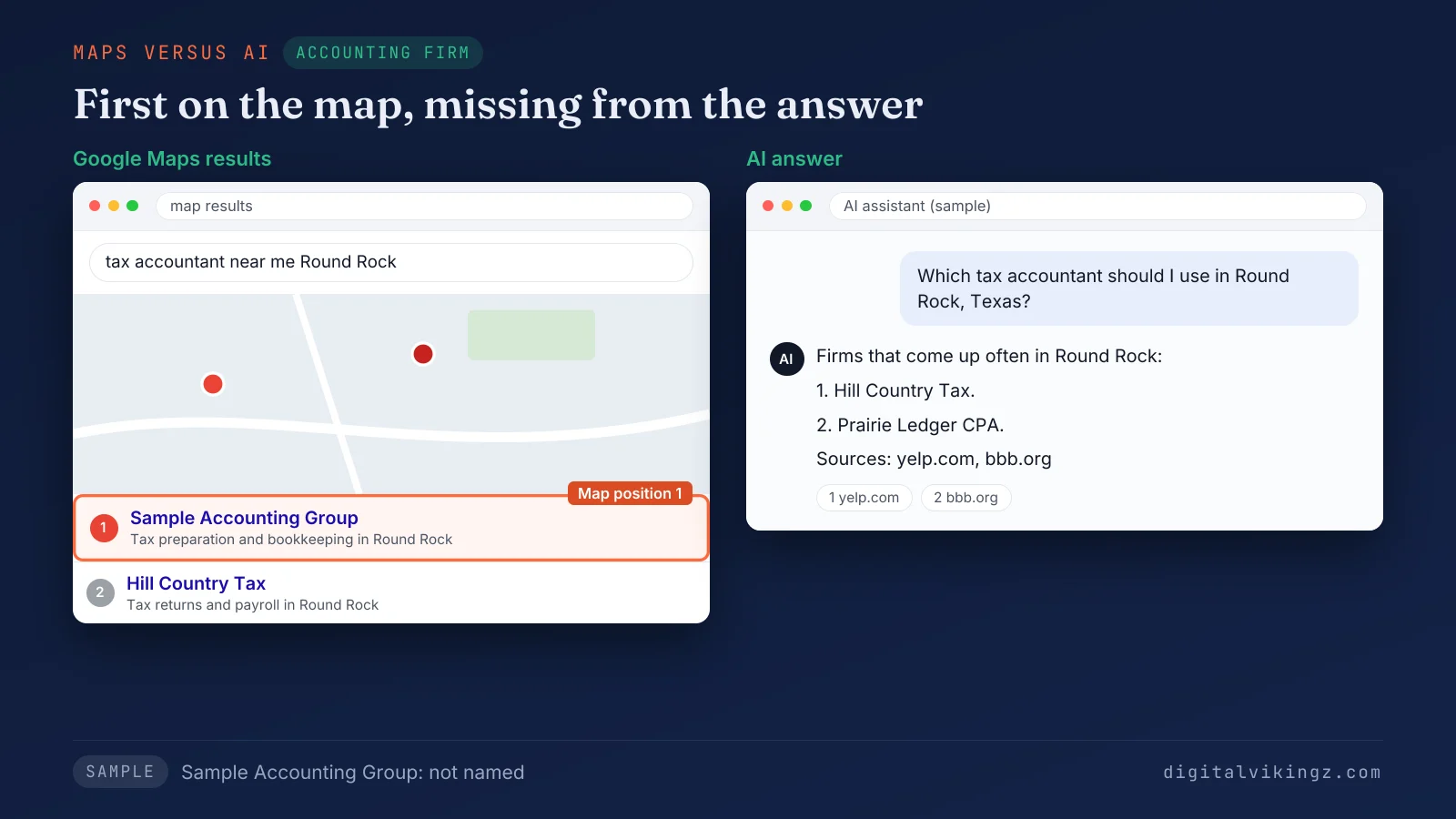
The sample accounting firm holds the first map position and is missing from the AI answer to the same question. Closing that gap takes work on facts and proof, not on map position alone.
How does a local business become the one AI assistants recommend?
A local business becomes a likely AI recommendation by keeping one set of facts on every source and earning proof where each assistant reads.
The steps that make a local business a likely AI recommendation are listed below:
- Write one version of the name, address, phone number, hours and services, and copy that version to the website, profiles and every listing.
- Match the service pages and the Google Business Profile primary category to the services sold.
- Ask every customer for a review that names the service and the place, on Google and on the review sites the assistants cite.
- List the business on the main directories and on the industry directories of its trade, with the same facts.
- Earn mentions in local news, association pages and city lists that name the business beside its service.
- Ask the assistants the customer's question from the service area several times, and record the businesses named and the sources cited.
We run the steps in that order, because reviews and mentions pay off only after the facts match. Each step changes a source an AI assistant reads, so each step can be checked in the next round of answers. The profile, listing and page work sits inside the Local SEO and Google Business Profile service. Businesses that want the steps run for them start with a strategy call about the Local SEO and Google Business Profile service. Businesses left out of AI answers tend to share the same causes.
Why does an AI assistant leave out a local business?
An AI assistant leaves out a local business when the facts conflict, the services are unclear or other sources rarely mention the business.
The six causes that leave a local business out of AI answers are listed below:
- Conflicting facts: Two sources give different names, addresses or phone numbers for the business. The fix is one version of the facts on every source.
- Outdated listings: An old listing still shows a closed location or past opening hours. The fix is a corrected or removed listing.
- Category and service mismatch: The profile category or service pages describe a service other than the one requested. The fix is a category and a page per service sold.
- Reviews on unread platforms: The reviews sit only on a platform the assistant rarely reads. The fix is steady reviews on Google and the directories each assistant cites.
- Few third-party mentions: No local news, association page or city list names the business. The fix is earned mentions beside the service and the city.
- Blocked search crawler: A robots.txt rule blocks OAI-SearchBot, and OpenAI does not show opted-out sites in ChatGPT search. The fix is an allow rule for OAI-SearchBot.
Mentions work by pairing the business name with its service and city, the core of how entity co-occurrence drives AI mentions. The pairing and its measurement are explained in the guide to how entity co-occurrence drives AI mentions. Most of these causes also hold a business back in local SEO.
Is getting recommended by AI different from local SEO?
Getting recommended by AI is different from local SEO in its output, while the two share most of their inputs.
Local SEO ranks a Google Business Profile in a list of map results, and an AI assistant names a few businesses inside one answer. AI answers can give more weight to third-party mentions and to facts that agree across many sources. We treat the two as one entity project with two measurements: map positions and AI answers. The answer-ready pages and the mention work belong to AI Search Visibility for local businesses. The AI side of the work is set out on the page about AI Search Visibility for local businesses. Short answers to the remaining questions follow.
Questions about AI recommendations for local businesses
Can a business pay for an AI assistant's recommendation?
Paying an AI assistant does not buy an independent recommendation, because OpenAI and Google keep paid placements apart from AI answers and local rankings. OpenAI states that advertising does not influence ChatGPT's independent answers, and Google states that no local business can pay for a better local ranking.
What is AI local search?
AI local search is the use of an AI assistant to find a business for a service in a place. The same phrase also names a family of optimization algorithms in computer science, which is a separate topic.
Can a new local business appear in AI recommendations?
A new local business can appear in AI recommendations once its profile, listings and website are live, because assistants with search read current sources. The new business still needs reviews and mentions to compete with older businesses for the same service.
Does blocking AI crawlers stop AI assistants from recommending a business?
Blocking OAI-SearchBot keeps the website out of ChatGPT search answers, while the profiles and listings about the business stay readable. OpenAI recommends allowing OAI-SearchBot in robots.txt for any local business website that wants to appear in ChatGPT search results.
Do AI assistants recommend the same businesses to every user?
AI assistants do not recommend the same businesses to every user, because answers change with location and from one run to the next. BrightLocal's 2026 Local AI Visibility Study measured 36 percent crossover for ChatGPT between map points, against about 47 percent for Google's AI surfaces.
Do service-area businesses get recommended less often than storefronts?
Service-area businesses were recommended slightly less often than storefront locations in BrightLocal's 2026 Local AI Visibility Study. The study measured a 33.6 percent mention rate for local businesses with storefronts against 29.4 percent for service-area businesses.
What do AI recommendations change for a local business?
AI recommendations shrink the answer to a few named businesses, so a local business now competes for a place in a short list.
A local AI recommendation names only businesses the assistant can match. Semantic SEO builds the one entity that Google and AI answer engines recognize across the website, profile and listings. The page structure behind that entity is set out in semantic SEO for local service businesses. Service, location and problem pages are mapped to the profile in the guide to semantic SEO for local service businesses. Digital Vikingz maps those pages, profiles and listings for local service businesses, and a strategy call sets the first fixes.