 Digital Vikingz
White label SEO is an outsourcing arrangement in which a third-party provider performs SEO work that an agency sells under its own brand. An SEO reseller program differs from white label work in who sets the scope and whose brand the client sees.
White label SEO works in six steps, from the agency's sale to the provider's delivery and the agency's report to the client. The agency owns the client relationship, the price and the sign-off, and the provider owns the delivery work.
White label services cover seven deliverables: audits, keyword and topic plans, on-page and technical fixes, content, links, local SEO and reports.
A white label report contains the work done, query and page changes, leads or calls, and the next month's plan. A branded weekly SEO and AEO report uses the same parts on a weekly cycle, with a cause and a fix for each change.
White label SEO cost depends on the deliverables, the number of client sites or locations, and the pricing model the provider uses. Our wholesale rates follow what semantic SEO costs for direct clients: one price per deliverable, quoted in writing.
A white label provider should pass eight checks: sample work, method, branding, communication, access, client protection, change control and exit terms.
The client should own its accounts and content, and the agency and provider should hold user access only. Many providers now draft with AI agents, so the agency should ask which SEO tasks AI agents can do and which a person reviews.
White label local SEO is white label SEO for local businesses, focused on the Google Business Profile, citations, reviews and map pack rankings. Our AI agent for daily Google posts writes one post a day, with its picture, for a home-service business.
A white label partnership goes wrong in six ways: brand leaks, client poaching, spam links, thin content at scale, slow starts and lock-in. An agency should start with one client, one deliverable and a provider that passed the eight checks. Digital Vikingz delivers the White-Label SEO for Agencies service: semantic SEO work under the agency's brand, with no client contact.
What is white label SEO?
White label SEO is an outsourcing arrangement in which a third-party provider performs SEO work that an agency sells under its own brand. The client sees only the agency's name on reports, emails and invoices, and the provider stays out of sight.
The provider can be another agency, a consultant or a freelancer. Agencies also call the model SEO outsourcing, SEO fulfillment or white label SEO services.
The agency gains an SEO service to sell without hiring an SEO team. The model sits close to three other buying terms: SEO reseller programs, private label SEO and white label software.
How is an SEO reseller program different from white label work?
An SEO reseller program differs from white label work in who sets the scope and whose brand the client sees. A reseller program sells the provider's fixed packages at a wholesale rate, and some programs leave the provider's name on reports.
Most providers treat private label SEO as another name for the same model, and one marketplace uses the term for a more customized service.
The four terms an agency meets when buying SEO fulfillment are compared below:
| Term | What the agency buys | Whose brand the client sees | Who sets the scope |
|---|---|---|---|
| White label SEO | SEO work done by a provider | The agency's brand only | The agency |
| SEO reseller program | The provider's fixed packages at a wholesale rate | The agency's brand, sometimes with the provider's name | The provider |
| Private label SEO | Usually the same model; for some providers, a more customized service | The agency's brand only | The agency |
| White label SEO software | Report and audit tools with the agency's logo | The agency's brand on the tool | No one; the tool does no work |
Branded SEO software formats the reports, and a provider still has to do the audits, content, links and fixes. The day-to-day work follows the same six steps whatever name the provider uses.
How does white label SEO work?
White label SEO works in six steps, from the agency's sale to the provider's delivery and the agency's report to the client.
The six steps of a white label engagement are listed below:
- Sell and scope the SEO service to the client under the agency's brand and price.
- Collect access, goals and a baseline from the client, then send the brief to the provider.
- Agree the plan with the provider: audit, keyword or topic plan, content and fixes.
- Deliver the work through the provider, in the agency's templates, with no client contact.
- Check every deliverable at the agency before release to the client.
- Report results to the client under the agency's brand and agree the next month's work.
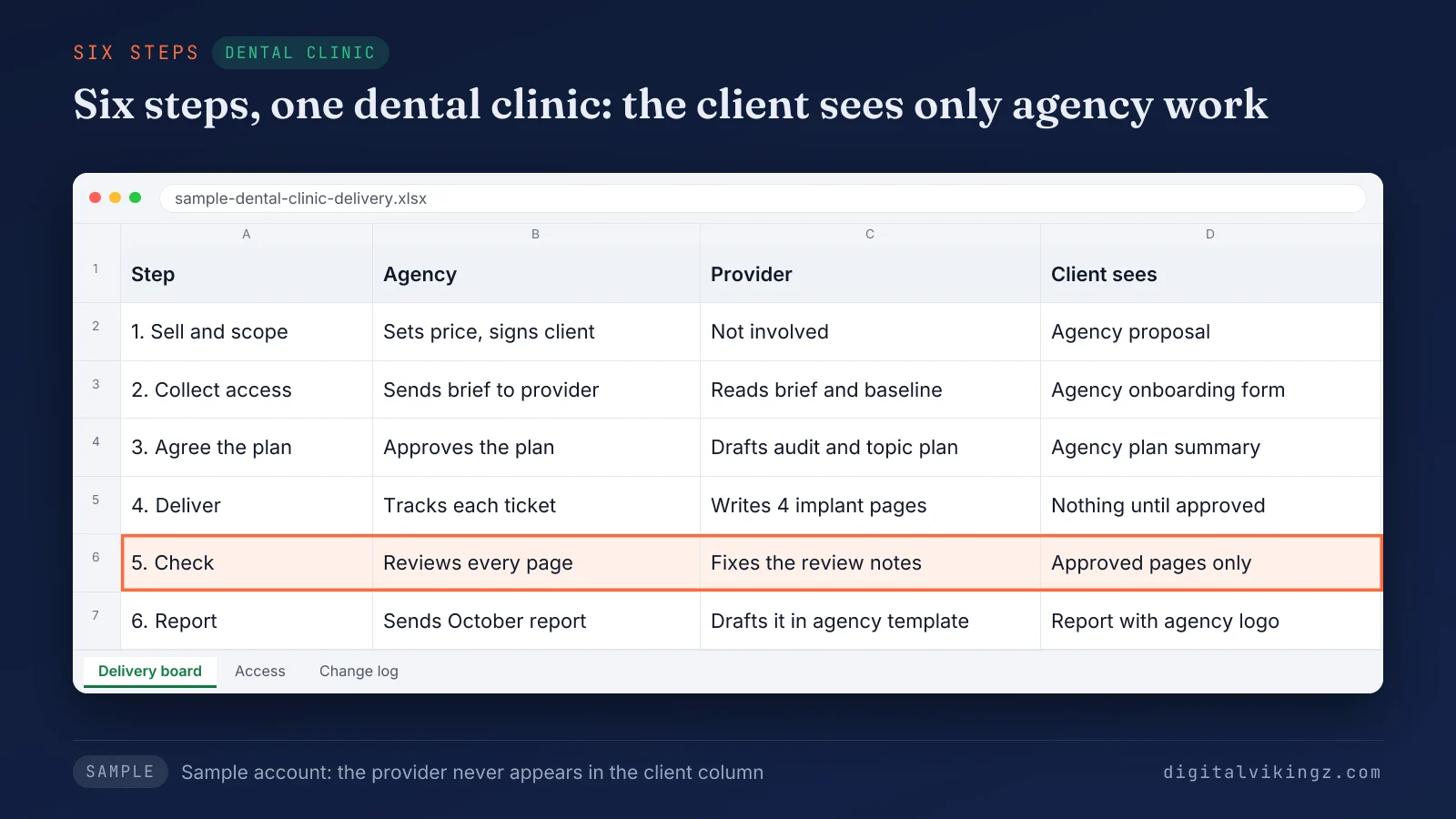
The sample board follows one dental clinic account through the six steps, and the client column shows only agency material.
Agencies differ in how much work stays in-house: some keep strategy and reporting, and some hand the provider every step except the sale. Each step has one owner, and the owner changes between agency and provider.
Who does what between the agency, the provider and the client?
The agency owns the client relationship, the price and the sign-off, and the provider owns the delivery work.
The usual split of tasks between the client, the agency and the provider is shown below:
| Task | Client | Agency | Provider |
|---|---|---|---|
| Contract and price | Signs with the agency | Sets the price and signs the client | Signs a separate contract with the agency |
| Strategy | Approves the goals | Approves the plan | Drafts the plan |
| Delivery | Grants access | Reviews and releases each deliverable | Does the audits, content, links and fixes |
| Communication | Talks to the agency | Answers every client question | Answers the agency only |
| Reporting | Reads the report | Sends the report under its brand | Drafts the report in the agency's template |
| Accounts and content | Owns every account and page | Holds user access | Holds user access granted by the client |
The client keeps ownership of accounts and content in every row, a point the provider checks return to. Communication needs the closest watch, because the client must never need to reach the provider.
Who talks to the client in a white label partnership?
The agency talks to the client, and the provider talks only to the agency. A client question goes to the agency's account manager, who passes the question to the provider in a shared channel or ticket.
The provider answers the agency, and the agency replies to the client in its own words, from its own email domain. The agency and the provider should agree a response time for client questions before the first client starts.
A provider joins a client call only when the agency invites the provider, usually as part of the agency's team. What reaches the client, besides answers, is the set of deliverables the provider produces.
What do white label SEO services include?
White label services cover seven deliverables: audits, keyword and topic plans, on-page and technical fixes, content, links, local SEO and reports.
The seven deliverables a white label provider can produce are defined below:
- SEO audit: a written review of a client site's technical, content and link issues, in the agency's template.
- Keyword and topic plan: the list of queries and pages the client site will target, in priority order.
- On-page and technical fixes: changes to titles, headings, internal links, speed and indexing, made in the client's CMS or handed to its developer.
- Content: briefs, articles and service pages written for the client's queries and published under the client's name.
- Link building: placements on other sites, earned by outreach in the agency's name or a neutral name.
- Local SEO: Google Business Profile work, citations and location pages for clients that serve a local area.
- Reporting: the monthly or weekly record of work done and results, under the agency's logo.
Providers sell the seven as packages or one by one, so an agency can buy a single deliverable such as content. A newer deliverable extends the keyword and topic plan to AI answers.
What do white label services include for AI search?
White label work for AI search includes entity coverage, a topical map, answer-first page structure and AI answer tracking. AI search covers Google AI Overviews and AI Mode, ChatGPT, Perplexity and Gemini.
A topical map lists every topic and page the client site needs, one page per question. Answer-first pages open each section with a one-sentence answer an AI answer can quote.
AI answer tracking records which prompts name or cite the client on a fixed schedule.
We deliver AI search work as semantic SEO, so the map, the briefs and the pages share one vocabulary for the client. An agency should ask a provider for one sample AI answer check before buying.
Every deliverable, AI search work included, reaches the client through one report.
What does a white label report contain?
A white label report contains the work done, query and page changes, leads or calls, and the next month's plan. The report carries the agency's logo, colors and domain, and no provider name, footer or link.
The five parts of a white label SEO report are listed below:
- Work done: the pages published, fixes made and links earned in the period.
- Search results: clicks, impressions and positions for the client's main queries and pages, from Google Search Console.
- Leads: calls, forms and bookings from organic search, from the client's analytics.
- AI answers: the prompts in which AI assistants named or cited the client.
- Next steps: the work planned for the next period and the reason for each item.
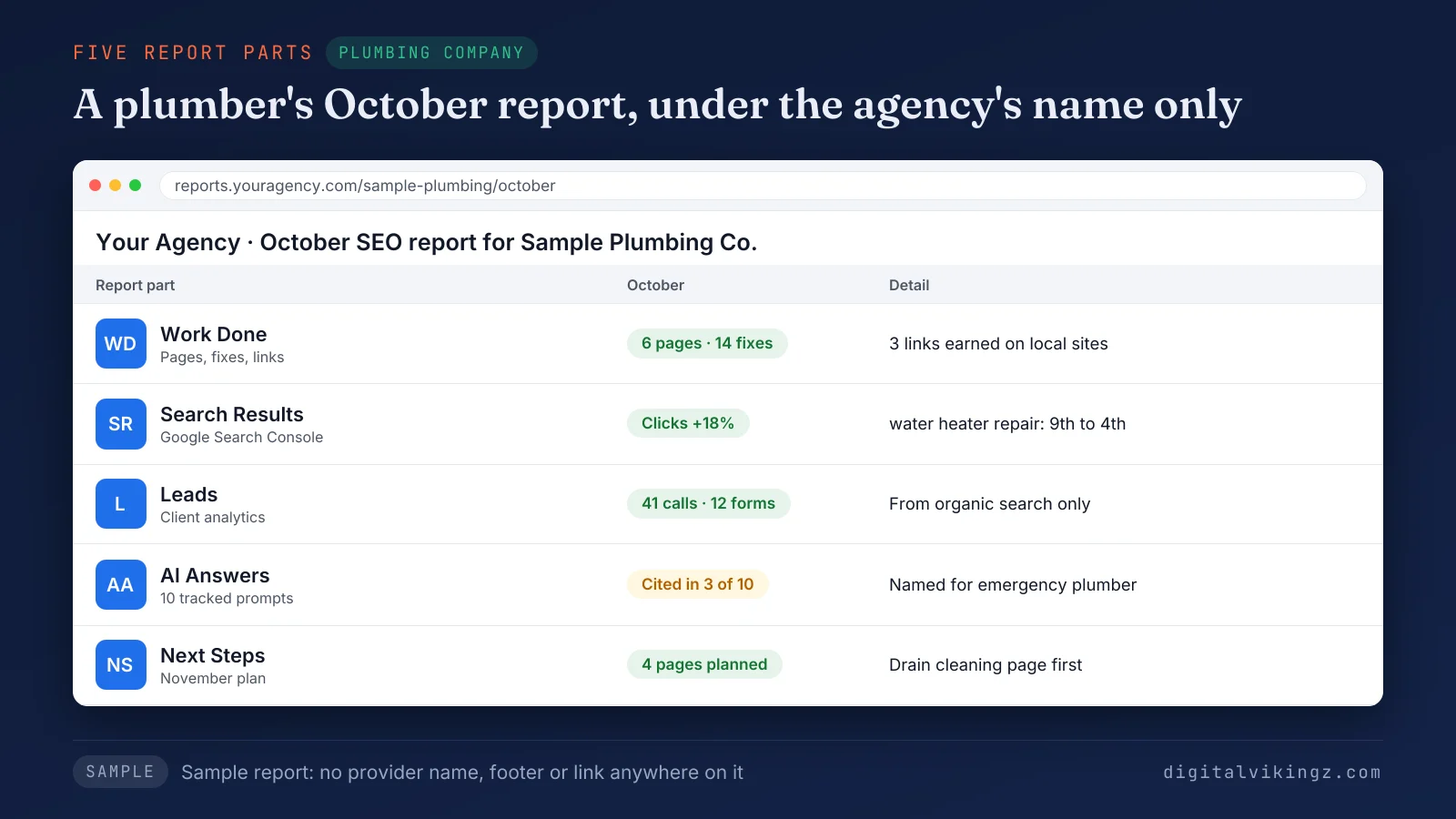
The sample October report for a plumbing company shows the five parts, with the agency's name in the header and no provider name.
A branded weekly SEO and AEO report uses the same parts on a weekly cycle, with a cause and a fix for each change. Our guide shows how to automate a branded weekly SEO and AEO report from Google Search Console and AI answer data.
How much does white label SEO cost?
White label SEO cost depends on the deliverables, the number of client sites or locations, and the pricing model the provider uses.
The four pricing models providers use are listed below:
- Per deliverable: a fixed wholesale rate for each audit, article, link or report.
- Per client per month: a package of set deliverables for one client site.
- Per location: a local SEO package priced for each business location.
- Per hour: a rate for consulting or custom work outside a package.
The agency sets its own client price above the wholesale rate, and the difference is the agency's margin. A client price of 1.5 times the wholesale rate gives the agency a gross margin of 33 percent. A client price of 2 times the wholesale rate gives a gross margin of 50 percent.
Agencies should compare quotes by price per deliverable, because package names hide different amounts of work. No neutral source publishes a standard white label price or markup, so provider price lists are sales material.
Our wholesale rates follow what semantic SEO costs for direct clients: one price per deliverable, quoted in writing. The page on what semantic SEO costs lists each engagement shape and the scope factors behind each price.
Is white label work worth it for an agency?
White label work is worth the cost for an agency whose clients want SEO the team has no capacity to deliver. The agency keeps the client relationship and adds an SEO service without salaries, recruiting time or SEO tool subscriptions of its own.
The model stops paying off when the agency resells work nobody at the agency reviews, because the agency's name carries every mistake. An agency with steady SEO demand across many clients can reach the point where an in-house SEO hire costs less than wholesale rates.
The provider an agency chooses decides most of that outcome.
What should an agency check in a white label provider?
A white label provider should pass eight checks: sample work, method, branding, communication, access, client protection, change control and exit terms.
The eight checks, what to ask the provider for and the pass sign for each are listed below:
| Check | Ask the provider for | Pass sign |
|---|---|---|
| Sample work | One audit, two articles and one report for a client in a similar industry | Work the agency would send unedited |
| Method | How links are earned and how content is briefed | Editorial outreach, no paid links, one brief per page |
| Branding | A report and an outreach email in the form the client receives | No provider name, footer, subdomain or email domain |
| Communication | A named account manager and a response time | One contact and a written response time |
| Access | The accounts and roles the provider needs | User roles only, never ownership of client accounts |
| Client protection | Non-disclosure and non-solicitation terms | Both terms in the contract, covering every client |
| Change control | A change log and a rollback plan for site edits | Every edit logged and reversible |
| Exit terms | The notice period and the handover list | No annual lock-in; content, links and data stay with the client |
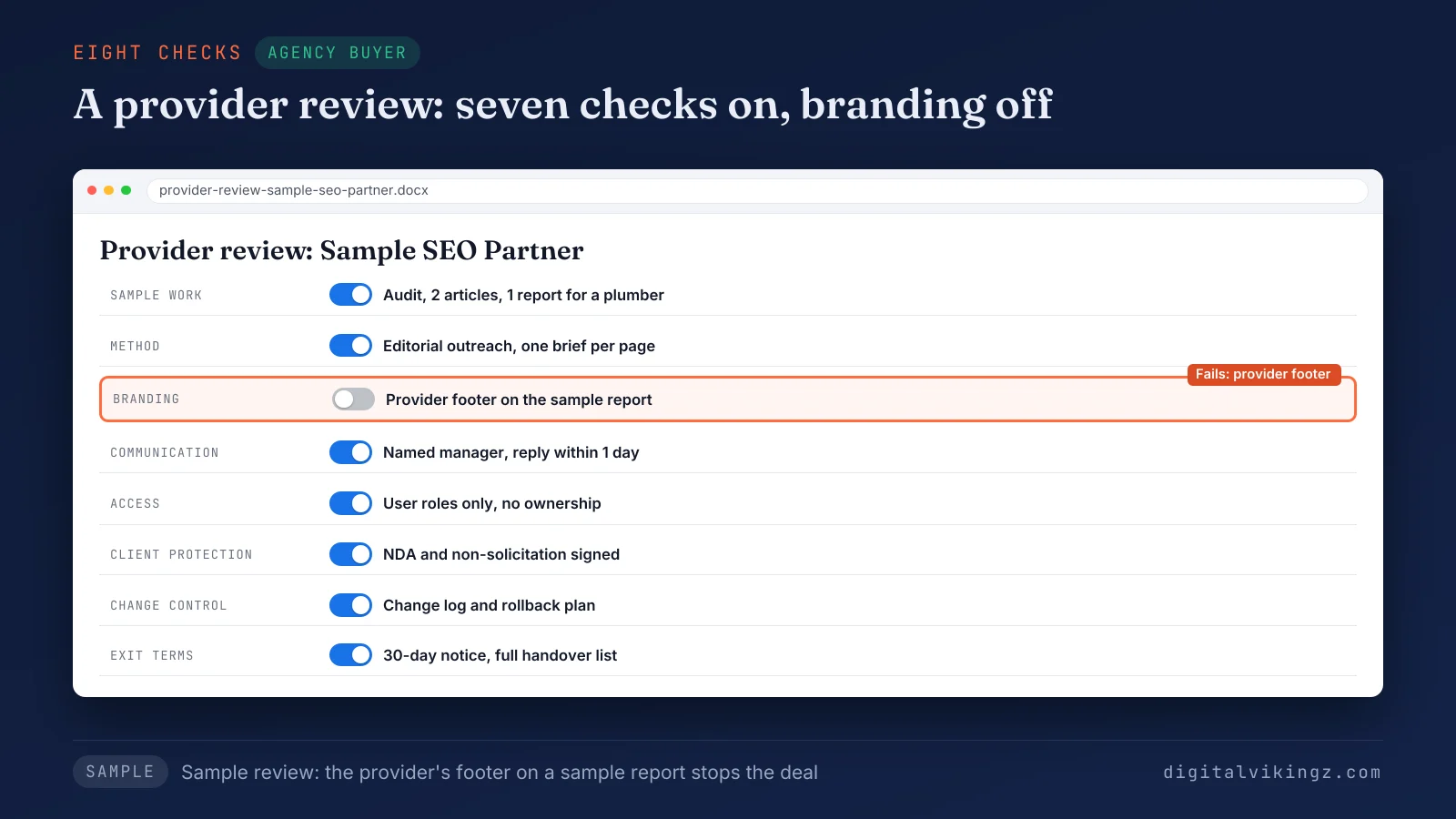
The sample review passes a provider on seven checks and stops on branding, because the provider's footer appears on the report.
Google's guidance on hiring an SEO asks related questions about examples of past work, Google Search Essentials and shared site changes. Access and exit terms, checks 5 and 8, decide what the agency keeps if the provider leaves.
Who should own the client's accounts and content?
The client should own its accounts and content, and the agency and provider should hold user access only. Google Search Console separates owners, full users and restricted users, and only an owner can add or remove other users.
A provider added as a full user can view all data and take some actions without owning the property. A restricted user has simple view rights on most data.
Google advises giving an SEO only read access to Search Console during an audit. Analytics, the CMS and the domain registrar follow the same rule: the client owns the account, and partners get named logins.
The handover list at exit covers every account, every published page, every earned link and every working file. Ownership protects the client, and a check on each deliverable protects the agency's name.
How does an agency check a provider's work before release?
An agency checks a provider's work before release with an acceptance check per deliverable: brief match, facts, links, branding and client fit.
An article passes when the article follows its brief, states facts with sources and carries no provider name. An audit passes when each issue names the page, the cause and the fix. A link report passes when each placement shows the linking page, the anchor text and the date.
The first month with a new provider should run on one client as a pilot, judged by the acceptance checks above.
Many providers now draft with AI agents, so the agency should ask which SEO tasks AI agents can do and which a person reviews. Our breakdown of which SEO tasks AI agents can do marks the review step for each task.
Can a white label provider guarantee rankings?
No white label provider can guarantee rankings, because no provider controls how Google ranks pages. Google's guidance on hiring an SEO states that no one can guarantee a number one ranking on Google.
A provider that promises a position is a warning sign, and an agency's own proposals should promise work, not rankings. Local clients add one more set of deliverables to check: the work behind the map results.
What is white label local SEO?
White label local SEO is white label SEO for local businesses, focused on the Google Business Profile, citations, reviews and map pack rankings. The provider does the profile work, and the agency approves anything the client sees on Google.
The five deliverables of white label local SEO are listed below:
- Google Business Profile optimization: categories, services, hours and photos kept complete and accurate.
- Google Business Profile posts: regular updates on the profile, approved under the agency's name.
- Citations: one consistent name, address and phone number across directories.
- Review requests: a process the client uses to get more Google reviews from customers.
- Map pack tracking: the client's position in local results across the service area.
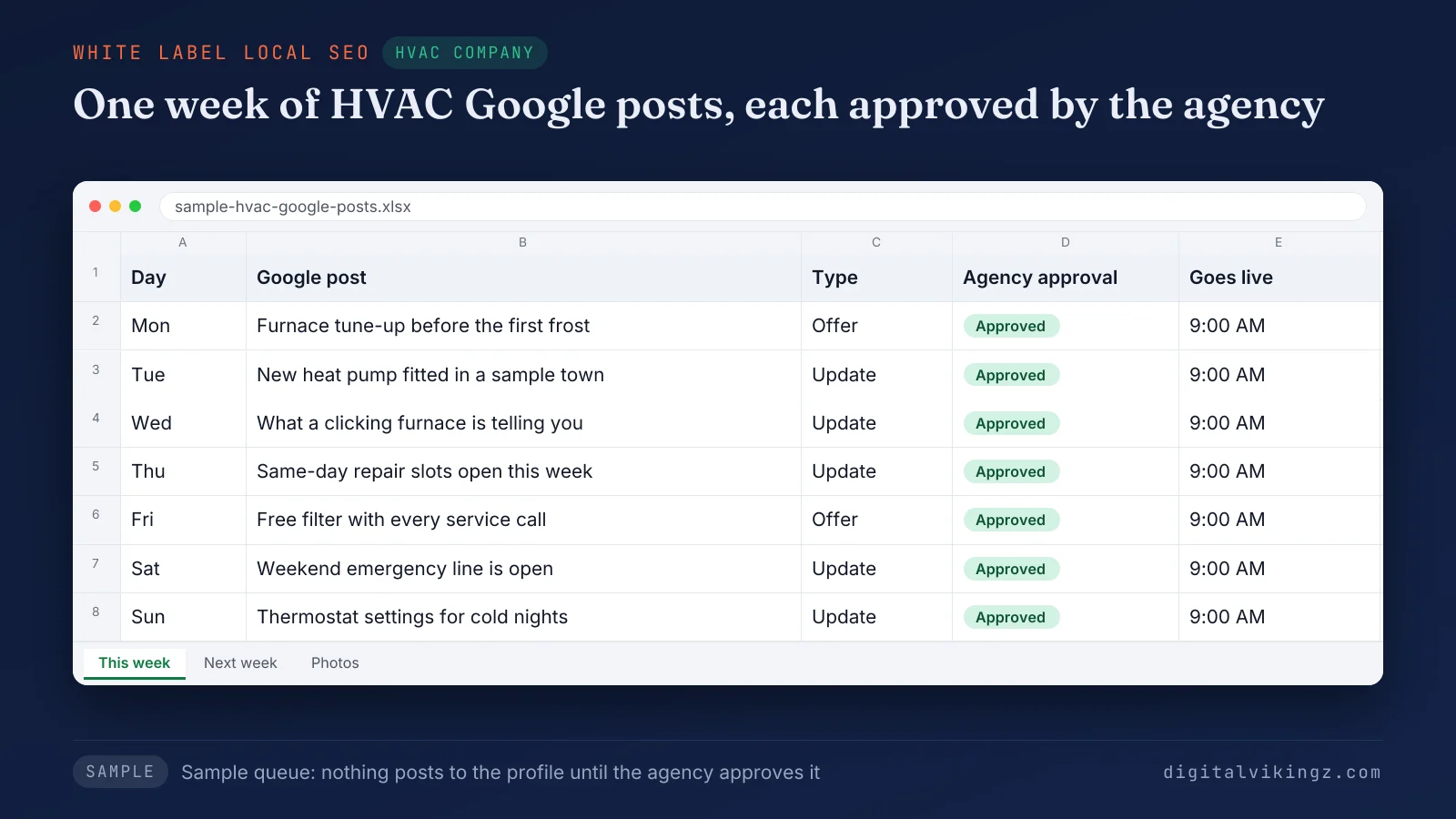
The sample queue lists one week of Google posts for an HVAC company, each approved by the agency before posting. An AI agent can draft each day's post, and in white label work the agency should approve each post before publication.
Our AI agent for daily Google posts writes one post a day, with its picture, for a home-service business. A free preview of the AI agent for daily Google posts shows the post for one business from its website.
How does a provider get access to a client's Google Business Profile?
A provider gets access to a client's Google Business Profile as a manager, invited by an owner of the profile. Google Business Profile managers can edit profile information, respond to reviews and manage posts.
Only owners can add or remove users or remove the profile, so ownership stays with the client. Each profile has one primary owner, and only owners can change user roles.
The client should stay the primary owner, and the agency and the provider should each hold manager access. Wrong access is one of six ways a white label partnership goes wrong.
What goes wrong in white label SEO?
A white label partnership goes wrong in six ways: brand leaks, client poaching, spam links, thin content at scale, slow starts and lock-in.
The six failure points and the control for each are listed below:
- Brand leak: a provider name in a report footer, a default subdomain or an email signature, controlled by a branding check on every template.
- Client poaching: a provider selling directly to the agency's client, controlled by a non-solicitation clause.
- Spam links: links bought for rankings, which Google's spam policies class as link spam, controlled by a placement list.
- Thin content at scale: many pages made to manipulate rankings, which Google calls scaled content abuse, controlled by one brief and one review per page.
- Slow start: weeks between the client's signature and the first delivered work, controlled by an onboarding checklist agreed before the sale.
- Lock-in: a long contract with no handover, controlled by a notice period and an exit list.
Google's spam policies apply to the client's site, whoever produced the links or pages. Checks 3, 6 and 8 in the provider checklist cover brand leaks, client poaching and lock-in.
Every failure lands on the agency's name, because the client only knows the agency. Agencies also ask a legal question about the arrangement itself.
Is white labeling legal?
White labeling is a legal and common way to subcontract SEO work, as long as the agency's client contract allows subcontracting. The agency stays responsible to its client for every deliverable, whoever produced the work.
The provider contract should carry non-disclosure, non-solicitation and data-handling terms, reviewed by the agency's lawyer. The agency's own client agreement decides whether the client hears about subcontractors.
Contract law varies by state and country, so the final wording belongs to a lawyer.
Questions agencies ask about white label work
Is white label the same as white hat SEO?
No, white label describes who sells the work, and white hat describes a method that follows Google's rules. A white label provider can use white hat methods or spam methods, so the method needs its own check.
Who buys white label services?
Web design, PPC and marketing agencies buy white label services most, along with freelancers whose clients ask for SEO. Design shops often add a provider's SEO work to sell a monthly service after a website launch.
Does an agency need SEO knowledge to resell a provider's work?
Yes, an agency needs enough SEO knowledge to scope the work, judge the provider's plan and explain results to the client. The provider does the work, and the client still asks the agency every question.
Which white label provider is the best?
The best white label provider for an agency is the one whose sample work for the agency's industry needs no edits. Most best-provider lists in search results are written by providers, and one list ranks its own author first.
How is white labeling different from outsourcing SEO?
Outsourcing SEO is any outside help with SEO, and white labeling is the form of outsourcing in which the client sees only the agency. An agency can outsource one task, such as link building, and deliver the rest of the SEO work itself.
How should an agency start white label SEO?
An agency should start with one client, one deliverable and a provider that passed the eight checks. A first audit under the agency's brand shows the provider's method, branding and communication before any monthly work starts.
The agency then reviews the first report and signs the client for monthly work. A second client follows only after the first client passes the acceptance checks.
Digital Vikingz delivers the White-Label SEO for Agencies service: semantic SEO work under the agency's brand, with no client contact. Scope a first client for our White-Label SEO for Agencies service on a 30-minute call.