 Digital Vikingz
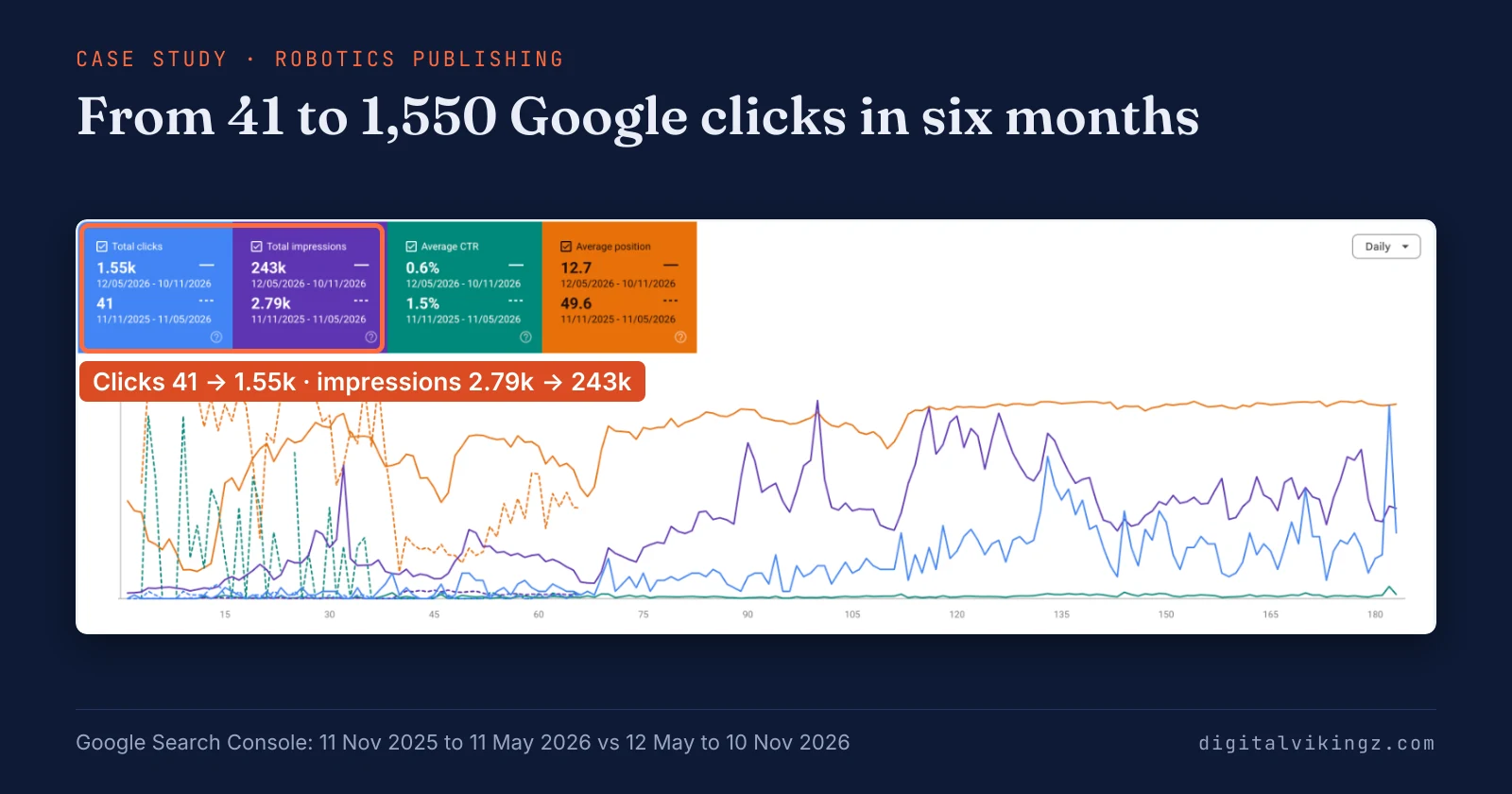
Our robotics news site SEO case study follows an English-language robotics news and investing publication, with humanoid robot profiles, robotics company lists and investing guides, through the six-month semantic SEO program Digital Vikingz ran from November 2025 to April 2026. Google clicks grew from 41 in the program window to 1.55k in the six months after it. Searches on robot models, robotics companies and robotics investing carried the gain, while branded searches stayed a very small share.
Results at a glance
| Metric | Program window | Six months after | Change |
|---|---|---|---|
| Clicks, all queries | 41 | 1.55k | about 38x |
| Impressions, all queries | 2.79k | 243k | about 87x |
| Average CTR | 1.5% | 0.6% | -0.9 points |
| Publication name query, clicks | 1 | 11 | 11x |
| Article on a second humanoid robot model, clicks | 1 | 138 | 138x |
| Profile of one humanoid robot model, clicks | 0 | 240 | New after the program |
The program window column covers the six-month program, 11 Nov 2025 to 11 May 2026, and the six months after column covers 12 May to 10 Nov 2026, both read in Google Search Console (Search type Web) on 13 November 2026.
The starting point
The robotics publication had almost no search presence in the program window. Search Console data for the site begins on 7 March 2026. Daily clicks sat at 0 to 3 from March to May 2026.
Demand for robotics company lists showed in the program window, and the site did not yet rank for it. The robotics companies list showed 1,792 times in the program window and earned no clicks. The page sat at an average position of 66.2 in that window.
Robot model articles showed the same gap. The article on how a humanoid robot learns tasks showed 111 times in the program window. The same article earned 1 click in that window.
What we did
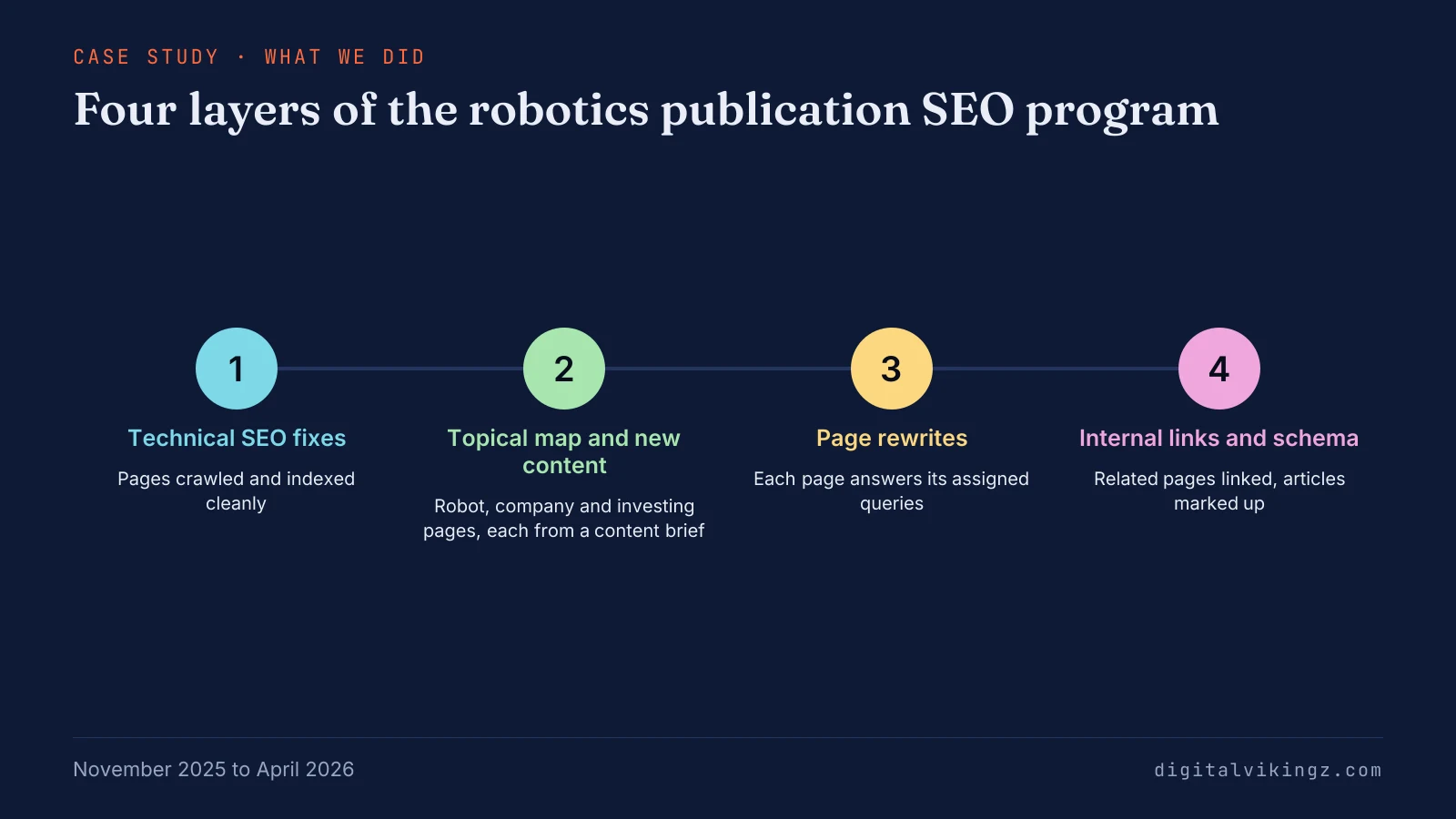
The four layers of the robotics publication's SEO program are listed below:
- Technical SEO fixes. We fixed technical SEO issues so search engines crawl and index the publication's pages cleanly.
- A topical map and new content. We built a topical map with robotics as the central entity, from humanoid robot models and robotics companies to robotics investing, and wrote new pages, each from a content brief.
- Rewrites of existing pages. We rewrote existing pages so each answers the queries the topical map assigns to it.
- Internal links and schema. We linked related profiles, lists and guides to one another and added schema markup that describes the publication and its articles.
What changed in Google Search
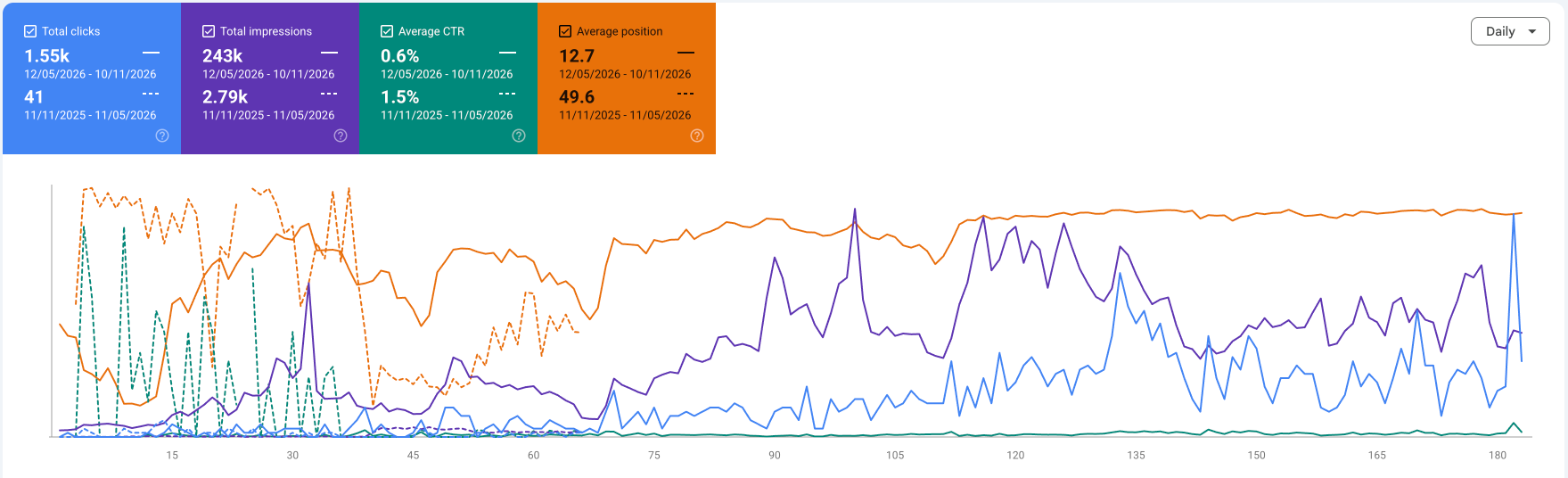
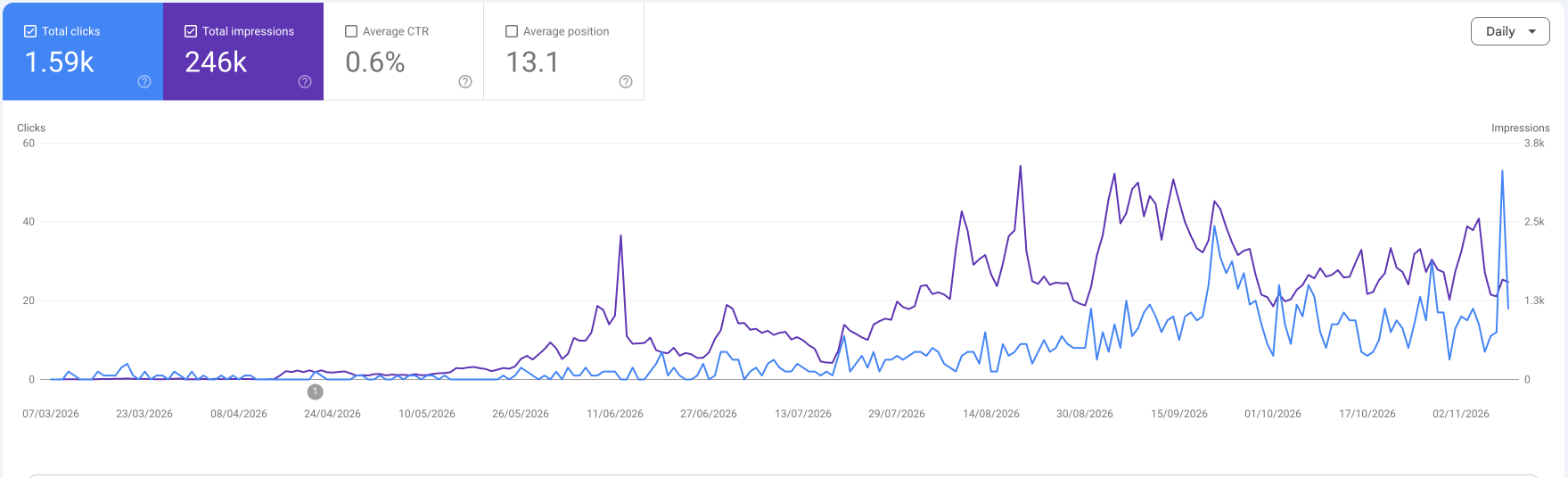
Daily clicks for the robotics publication rose after the program window. Daily clicks reached about 2 to 8 in June and July 2026. Daily clicks ran at about 10 to 20 from mid-August 2026.
Pages that first showed in Google after the program window carried most of the click gain. We count these pages as later results of the content layer, since none had impressions in the program window. The pages listed below earned these clicks in the six months after:
- Profile of one humanoid robot model: 240 clicks.
- Robotics investing guide: 222 clicks.
- Humanoid robot startups list: 150 clicks.
- Autonomous robot ETFs list: 141 clicks.
- Two ETF comparison pages: 51 and 40 clicks.
Pages that already showed in Google in the program window grew as well. The article on a second humanoid robot model went from 1 to 138 clicks. The article on how a humanoid robot learns tasks went from 1 to 62 clicks.
The robotics companies list went from 0 to 51 clicks. The same page went from 1,792 to 33,158 impressions. The homepage went from 32 to 87 clicks.
Robot model searches led the query gains. The most clicked spelling of searches for one humanoid robot model went from 0 to 65 clicks. A comparison search between two robotics ETFs went from 0 to 16 clicks.
Branded searches carried a very small share of the gain. The publication's name query went from 1 to 11 clicks. A close variant of the name went from 0 to 5 clicks, and almost all of the gain came from non-branded searches on robot models, robotics companies and robotics investing.
What changed in AI search
Two reports measure how often AI search features show or cite the robotics publication's pages. The Google report holds data from 18 May 2026, and the Bing report was read for 14 May to 11 Nov 2026, so each figure describes a level after the program window, not a change. We keep the two reports apart, since each counts a different thing.
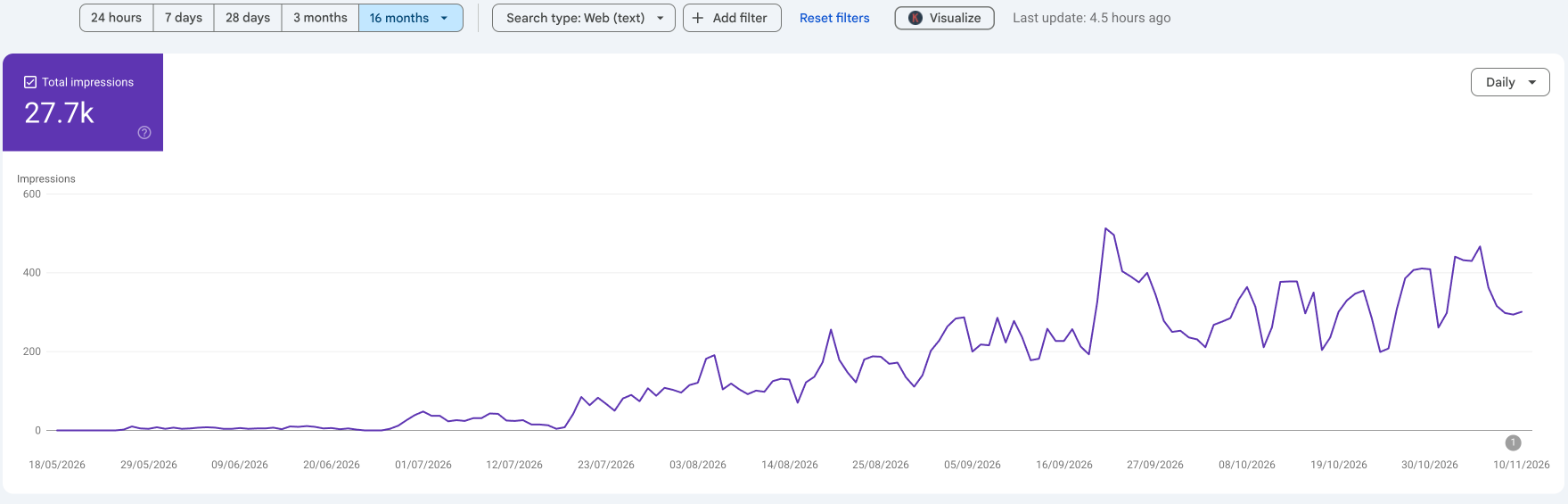
Google Search Console's Generative AI features report, in beta, counted 27.7k impressions for the publication's pages between 18 May and 10 Nov 2026. Daily impressions stayed near zero until late June 2026. Daily impressions ran at about 200 to 470 in October and early November 2026.
The pages most shown in Google AI features are listed below:
- Robotics investing guide: 6,480 impressions.
- Autonomous robot ETFs list: 3,831 impressions.
- Profile of one humanoid robot model: 3,231 impressions.
- Humanoid robot startups list: 2,952 impressions.
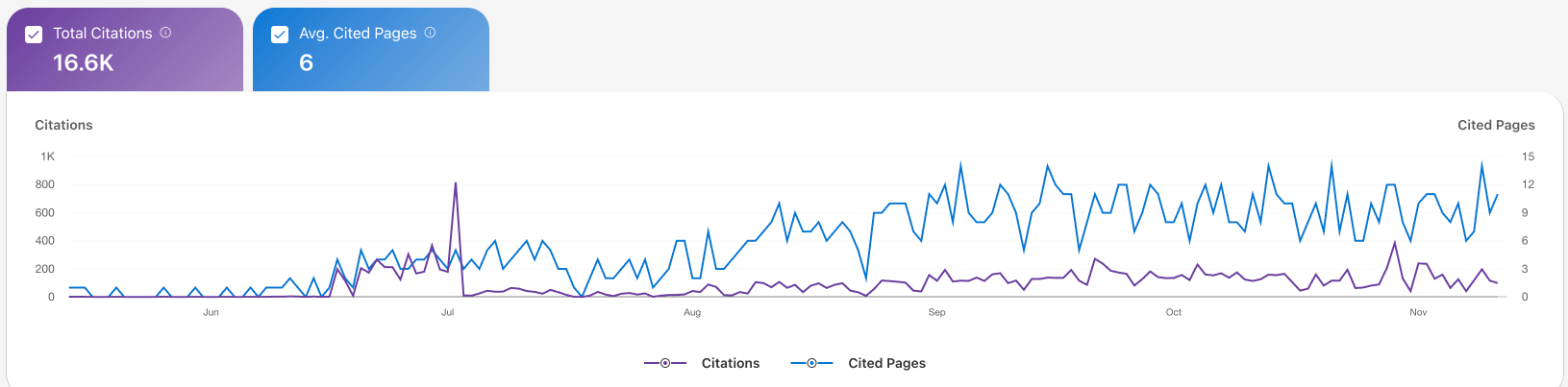
Bing Webmaster Tools' AI Performance report, which covers Microsoft Copilot and partners, counted 16.6K citations between 14 May and 11 Nov 2026. The report lists 55 cited pages across the period.
The pages most cited in Bing's AI Performance report are listed below:
- Autonomous robot ETFs list: 5.0K citations.
- Humanoid robot startups list: 2.7K citations.
- News article on one consumer robot maker: 2.6K citations.
- Robotics investing guide: 1.9K citations.
What did not move
The limits of the robotics publication results are listed below:
- Click-through rate. Average CTR fell from 1.5% to 0.6%, because impressions grew faster than clicks.
- Average position. Average position moved from 49.6 to 12.7. We do not treat that figure as a headline result, since the site was close to new and one average blends every query.
- Data span. Search Console holds no data for the site before 7 March 2026, so the program window figures come from 7 March to 11 May 2026 only.
- Timing. Daily clicks climbed most from mid-August 2026, months after the program window, and the data does not show what started that rise.
- AI search baseline. The Google AI features report holds data from 18 May 2026 only, and the Bing figures were read for 14 May to 11 Nov 2026, so neither shows a change against the program window.
- Pages that lost clicks. The about page fell from 5 to 3 clicks. Two older news articles fell from 1 click to 0 each.
What this means for your business
The points a robotics, technology or other niche publication can act on are listed below:
- Give each entity that readers search for its own page. Robot model pages and robotics lists led the click gains here, with one page per robot, company group or comparison.
- Plan the topical map before the pages. A topical map assigns each robot, company and investing question to one page, so new articles do not compete with one another.
- Build list and comparison pages that AI answers can cite. Lists and guides ranked among the most shown and most cited pages in both AI reports here, and our AI Search Visibility work plans pages for that use.
- Record a search and AI baseline at the start. The AI figures in this case cover May to November 2026 only, which left no AI figure from the program window.
SEO for news publishers in this case rested on entity pages, lists and guides that each answer one group of queries, written from a content brief. Digital Vikingz plans and writes those pages through Semantic Content Writing.