Digital Vikingz
What Is Centerpiece Annotation?
The centerpiece annotation is the primary content block Google extracts from a page, and the first characters after the H1 decide it.

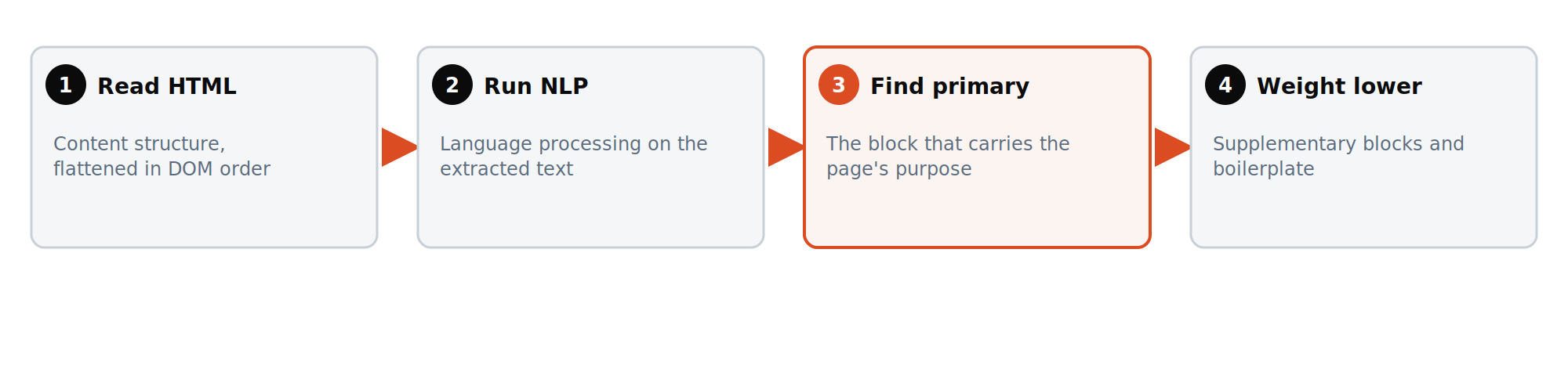
What is centerpiece annotation in Google Search?
In Google Search, the centerpiece annotation marks one block of a page as its primary content and weights everything else lower.
Martin Splitt of Google described the process in 2021: Google reads the HTML content structure, runs language processing on the text, identifies the primary topic and weights boilerplate lower.
Visual semantics reads every block; centerpiece annotation makes one decision, which block carries the purpose. The content brief names that block before design starts, so the writer and the developer build toward the same target.
How does Google extract the centerpiece from a page's HTML?
Google flattens the page's text in DOM order and reads a short window after the H1, roughly 400 characters in the DOJ trial exhibits.
One exhibit shows share bar labels landing in the extracted text of a news page ahead of the first sentence: the icons sat under the byline on screen, but inside the primary block in the HTML. A second exhibit shows the target state, with the extracted text running from the standfirst straight into the first body paragraph.
DOM position outweighs visual position, because CSS that moves a block on screen leaves its source order untouched. Google's layout-aware encoder patent describes sorting blocks by rendered position, so source order and rendered order need to agree.
What must the first 400 characters after the H1 contain?
The first 400 characters carry the central entity, the main predicate, the page function as a verb and the core answer.
A Semantic SEO Audit page names the audit, what it checks and what the client receives inside the window, so a reader or a crawler that sees only those characters knows the offer.
A welcome line, a brand slogan or an announcement of what the guide covers carries no fact and pushes the answer away from the H1.
The window also serves query augmentation, the expansion of a user's question into rewrites, drill-downs and next steps before retrieval. We expand the query into its entity type, attribute, context and format before writing and place those terms in the first sentences.
What is an extractive summary, and how does it anchor the centerpiece?
An extractive summary is the set of declarative sentences under the H1 that stand alone as the page's answer and can be lifted into a snippet or an AI response without the rest of the page.
The summary anchors the centerpiece by opening it: two or three sentences under 60 words that fit inside the 400-character window. The first sentence is a definition or a direct answer with the entity as its subject.
A Google patent on scoring candidate answer passages describes document position as a query-independent signal beside term match, so a summary buried under an introduction gives up that input. Google's filing on its generative search describes passages extracted verbatim, which suits a summary that answers the query without the next paragraph.
Which boilerplate breaks centerpiece annotation?
Any contextless word between the H1 and the first body block in DOM order breaks the centerpiece.
The usual offenders are share bars, author cards, reading time, update dates, badges, breadcrumbs, ad slots and newsletter signups.
The fix is placement, not deletion: page furniture moves above the H1 or below the centerpiece. The same furniture repeats across a template, so one template fix repairs every page and ranks above single-page rewrites.
How is centerpiece annotation tested on a live page?
The centerpiece test pastes the visible text from the H1 downward into a text file and reads the first 400 characters.
A share label, date, author name, breadcrumb or button label inside those characters means the centerpiece is broken. The source view gives the stricter test, because extraction follows DOM order.
The second test reloads the page with JavaScript off. A calculator or grid injected after load is absent from the first pass, and server rendering puts it back.
Moving the centerpiece on a template is a site-wide change, so we ship it alone and measure its effect before the next structural release.
- Koray Tuğberk Gübür, Search Engine Land: Visual semantics, the missing piece of topical authority
- US 9,940,367 B1: Scoring candidate answer passages (Google)
- US 2024/0289407 A1: Search with stateful chat (Google, pending application)
Patents and filings describe systems Google has invented. None is a confirmed ranking factor.
What should you read after the centerpiece annotation?
 Visual semanticsVisual semantics is the meaning a search engine reads from layout: block order, component types, typography and the function a page performs.
 Macro and micro contextMacro context is the main content that declares the entity and the intent, and micro context is the supplementary content below it that expands the attributes and carries most of the internal links.
 Cost of retrievalCost of retrieval is the computing a search engine spends to crawl, render, segment and evaluate a page, and fewer, cleaner pages cost less and reach the ranking stages that matter.
 AI citation readinessAI citation readiness is the state of a page whose sentences can each be verified against one passage and matched to what other trusted sources say.
 SEO Website DevelopmentFive platforms, chosen by what the architecture needs, not by preference.
 Semantic SEO AuditSix checks. Each one has a defined failure and a defined fix.
 Talk to usMessage the team on WhatsApp
Questions about the centerpiece annotation
How do I know what the centerpiece of a page is supposed to be?
Is the centerpiece window exactly 400 characters?
Is centerpiece annotation the same as a featured snippet?
Does the H1 count as part of the centerpiece?
Can structured data define the centerpiece?
What happens to the centerpiece when a page opens with a hero image?
Can a page have two centerpieces?
Does a table of contents break the centerpiece?
Does a cookie banner enter the centerpiece?
What is the centerpiece of a product page?
Who writes the first 400 characters on a project?
See it applied to your site
The Semantic SEO Audit uses every term in the knowledge hub. Fixed scope, written deliverable.