 Digital Vikingz
What Is Cost of Retrieval?
Cost of retrieval is the computing a search engine spends to crawl, render, segment and evaluate a page, and fewer, cleaner pages cost less and reach the ranking stages that matter.

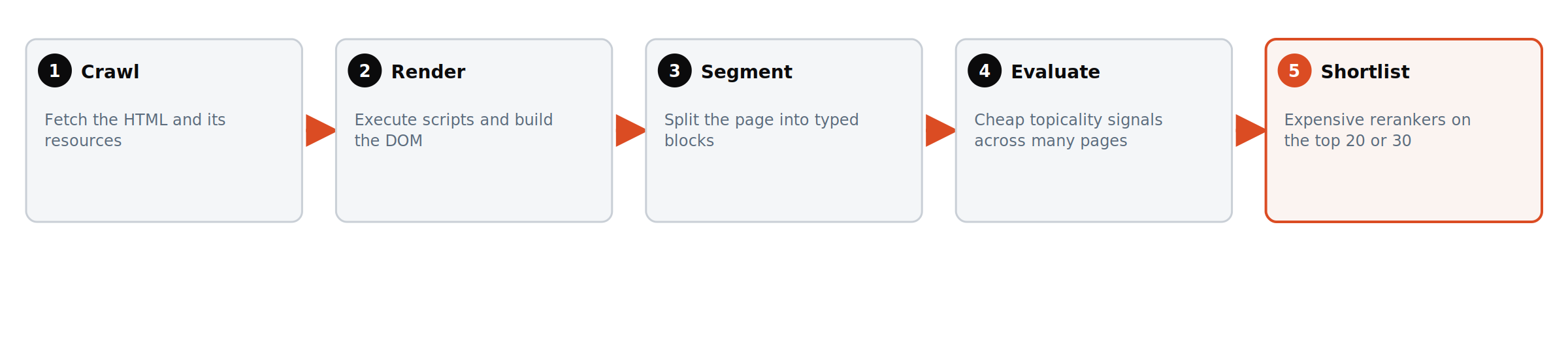
What is cost of retrieval in search?
Cost of retrieval is the compute a search engine spends to understand a page, from the first fetch to the final evaluation.
The work runs in stages: the crawler fetches the HTML, the renderer executes scripts and builds the DOM, the segmenter splits the page into blocks and the extractor pulls the primary content.
Koray Tuğberk Gübür put cost of retrieval in the denominator of his topical authority formula. Cost of retrieval is not a term in any published Google document. The verified part is narrower: Google runs cheap signals on many pages and expensive models on few.
How does Google's shortlist turn cost of retrieval into a gate?
Google runs cheap signals on many documents and expensive rerankers on a shortlist, so a page that fails early is never read in depth.
Pandu Nayak's testimony in the DOJ trial describes the funnel. Core topicality, PageRank and localization signals take tens of thousands of documents down to a shortlist, and new pages without clicks are judged on topicality first.
RankBrain, by the same testimony, looks at the top 20 or 30 documents only, because it costs more than some other ranking components. Depth of content matters after that point, not before.
Google's filing on its generative search describes summarizing a handful of documents per query and names saving compute as one reason to return a standard results page.
What do cheap first-pass signals read on a page?
A cheap pass reads the title, the H1, the first characters after the H1, the first blocks, the heading skeleton and the rendered dimensions.
A title written as the query matches on the first read, and a heading skeleton that names entities lets passages score without a full reading. A page that hides its entity until the fourth paragraph pays for a deeper read it rarely receives.
Contextless labels such as Share, Print, Updated, Read time and Tags inside the content area add tokens with no entity, and across a thousand pages they become thousands of tokens of noise. One template fix cleans every page.
The Content Warehouse API leak shows Google storing a page's rendered dimensions and DOM. A render without layout shift keeps those block positions consistent between crawls.
How do rendering and DOM size raise cost of retrieval?
Every script that builds primary content after load, and every empty node around it, adds work before the page is read.
Primary content belongs in the initial HTML response. Content that appears only after a click, scroll or hover is unsafe for the first pass, while tabbed content passes when it sits in the DOM on load.
Render-blocking resources in the head delay everything below them. Third-party scripts, inline SVG bloat, base64 images and large inline scripts raise file size. Empty spacer divs render as blocks with no content, and Google's layout-aware encoder patent lists padding as one of its block types. Lean markup with shallow nesting costs less to parse and render.
How does page count change cost of retrieval?
Page count is a cost, because every URL is crawled, rendered and evaluated, and pages without a distinct intent add cost without adding coverage.
Google's ranking systems guide states that deduplication hides very similar pages and shows only the most relevant, so two near-duplicates earn one listing while the site pays to crawl and evaluate both.
The same guide states that site diversity generally limits a site to two listings in the top results. A third page on the same query competes with the site's own two listings and adds cost without a listing.
Query deserves a page decides page, section or sentence for each query variation, and cost of retrieval is the reason that decision matters. A dental clinic with one page per treatment and one per staffed office costs less than one with a page per suburb.
When does pruning lower cost of retrieval?
Pruning lowers cost when a page's intent has no distinct results page type, or when the page sits too close to a sibling.
The audit reads every indexable URL against the live results for its query. A page whose query returns the same results page type as a sibling's merges into that sibling, and a page with no demand and no distinct entity folds into a section.
Search Console statuses mark candidates. Crawled, currently not indexed means Google fetched the page and declined it; Discovered, currently not indexed means Google knows the URL and has not crawled it.
Merges redirect to the surviving page, which absorbs anything unique. We ship one structural change per cycle and judge it after a full crawl cycle.
- Koray Tuğberk Gübür, Search Engine Land: Visual semantics, the missing piece of topical authority
- Google Search Central: A guide to Google Search ranking systems
- US 2024/0289407 A1: Search with stateful chat (Google, pending application)
- US 12,393,768: Layout-aware multimodal pretraining for multimodal document understanding (Google)
Patents and filings describe systems Google has invented. None is a confirmed ranking factor.
What should you read after cost of retrieval?
 What is topical authorityTopical authority is the state in which a site ranks across the whole network of queries around one topic, assigned by Google to a source that covers the topic with consistent depth and vocabulary over time.
 Query Deserves a PageQuery deserves a page is the test that decides if a search query earns its own URL or becomes a heading on an existing page, judged by prominence, demand and relevance to the business.
 What is the centerpiece annotationThe centerpiece annotation is the primary content block Google extracts from a page, and the first characters after the H1 decide it.
 Visual semanticsVisual semantics is the meaning a search engine reads from layout: block order, component types, typography and the function a page performs.
 Semantic SEO AuditSix checks. Each one has a defined failure and a defined fix.
 SEO Website DevelopmentFive platforms, chosen by what the architecture needs, not by preference.
 Talk to usMessage the team on WhatsApp
Questions about cost of retrieval
Is cost of retrieval the same as page speed?
Is there a size limit for a page's HTML?
Does a large site automatically carry a high cost of retrieval?
How is cost of retrieval measured?
Does moving a section to a subdomain lower cost of retrieval?
Does cost of retrieval matter for a single-page site?
Which platform has the lowest cost of retrieval?
Does removing pages hurt topical coverage?
Does longer content raise cost of retrieval?
How often is cost of retrieval reviewed?
Who fixes cost of retrieval issues, SEO or development?
See it applied to your site
The Semantic SEO Audit uses every term in the knowledge hub. Fixed scope, written deliverable.