 Digital Vikingz
What Is Entity-Attribute-Value in Semantic SEO?
An entity-attribute-value triple is one fact in machine-readable order, the thing, the property and the value, and content built from triples is content a search engine or an AI system can verify.

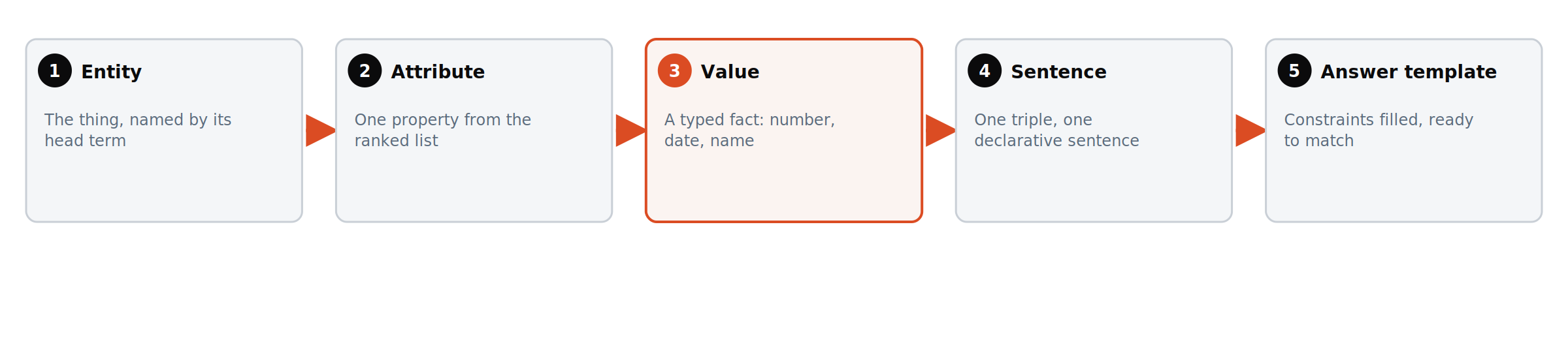
What are the three parts of an entity-attribute-value triple?
An entity-attribute-value triple names a thing, one property of that thing and the value the property takes.
The entity is the thing, named by its canonical term. The attribute is the property, such as output, format or pricing basis. The value is the fact: a number with a unit, a full date, a name or a list.
A triple from this site reads: the Semantic SEO Audit (entity) returns (output) a written issue map ranked by the cost of each fix (value).
The predicate is the verbal form of the attribute: output becomes returns and integration becomes integrates with. The source term vector fixes the predicate for each attribute.
What are root, rare, and unique attributes of an entity?
Root attributes belong to every member of an entity type, rare attributes belong to some members, and unique attributes belong to one.
Root attributes define membership in the type. Every dental clinic has treatments, a location, opening hours and practitioners.
Rare attributes separate members inside the type. Sedation dentistry, weekend hours or multilingual staff apply to some clinics, and buyers filter by them once the root set is satisfied.
Unique attributes belong to one member, such as a method, a dataset or a guarantee no competitor offers. Each unique claim sits with its evidence, because other sources rarely confirm it. Pages cover root attributes first, rare second and unique last.
How does a ranked property list set attribute order for an entity type?
A ranked property list is the ordered set of attributes for an entity type, and its top attribute decides what a page shows first.
Knowledge graphs store attributes per entity type, and Google's entity metrics patent weights its metrics differently for each type. A software product and a clinic therefore share no property list.
Digital Vikingz builds the list from the query network, and the attributes users ask about most rank highest. The top attribute becomes the first section, the first table column and the first card field.
Order stays the same across every entity of the type. Ten service pages list their attributes in one sequence, so each property sits in the same place.
How does Google's answer template patent use entity-attribute-value facts?
Google's patent on generating query answers describes retrieving entity-attribute-value facts and choosing the answer template whose constraints they satisfy best.
The patent names the constraints: type, temporal, relationship, singular or plural, and unit. A date template needs a full date, and a quantity template needs a number with its unit. The template with the most satisfied constraints becomes the answer.
Each page states the answer sentence in the template's shape. A question about which insurance plans a clinic accepts expects the clinic name, each plan and the treatments covered.
A missing value drops the template, so a "Contact us for details" line where a fact belongs gives the system nothing to fill. The patent describes an answer system, not a ranking factor.
How is a page written from entity-attribute-value triples?
A page is written from triples by collecting the facts first, assigning each fact to a block and writing one sentence per triple.
The entity-attribute matrix lists the attributes each entity carries and the values to collect for each one. Values come from the business before writing, and a writer flags an empty value instead of filling it with an adjective.
The content brief assigns each triple to a block. Macro context holds the triples that answer the query, and micro context below holds secondary attributes.
Repeated attributes across several entities belong in a table. Google's patent on scoring answer passages describes building candidate passages from tables and lists as well as paragraphs. The sentence above the table names the entities and attributes it holds.
What breaks entity-attribute-value writing on a page?
Entity-attribute-value writing breaks when sentences carry adjectives instead of values, bundle several facts or leave a value empty.
An adjective is a claim without a value. "Fast delivery" states nothing a machine verifies, and a written report delivered as a shared document states a fact.
A compound sentence bundles two triples, and Google's generative search filing describes linking each summary sentence to one verifying passage. Each fact therefore gets its own sentence.
Vague wording often hides an empty value. "Pricing on request", "flexible timelines" and "many integrations" each name an attribute and withhold its value. The fix is the value itself, or the attribute leaves the page until the business confirms it.
- US 10,031,953 B1: Generating query answers (Google)
- US 10,235,423 B2: Ranking search results based on entity metrics (Google)
- US 9,940,367 B1: Scoring candidate answer passages (Google)
- US 2024/0289407 A1: Search with stateful chat (Google, pending application)
Patents and filings describe systems Google has invented. None is a confirmed ranking factor.
What should you read next about entity-attribute-value triples?
 What is a central entity?The one noun phrase every page on a site reinforces.
 What is a source term vector?The vocabulary a site speaks: canonical terms, allowed synonyms and banned terms.
 What is microsemantics?Relevance at sentence level, decided by word order, subject choice and dependency structure.
 What is a query template?A repeatable search pattern with a variable entity, such as [service] in [city].
 Semantic Content WritingBriefs and pages written from your topical map.
 Semantic SEO StrategySeven documents with a fixed structure. Every engagement produces all seven.
 Talk to usMessage the team on WhatsApp
Questions about entity-attribute-value
Is entity-attribute-value the same as schema markup?
Does entity-attribute-value writing suit opinion content?
How many attributes belong on one page?
Does entity-attribute-value apply to product descriptions?
Should attribute values carry dates?
What is the difference between an attribute and a sub-entity?
Does every sentence on a page need a value?
How does entity-attribute-value apply to a local service page?
Does entity-attribute-value writing work in German, Spanish, or Italian?
How does an audit check entity-attribute-value coverage?
Does entity-attribute-value writing make pages shorter?
See it applied to your site
The Semantic SEO Audit uses every term in the knowledge hub. Fixed scope, written deliverable.