Digital Vikingz
How Do You Choose a Semantic SEO Agency?
A semantic SEO agency is chosen on three written proofs: a page decision per URL, a vocabulary fixed before writing, and measurement per template with pipeline. An agency that supplies all three before the contract is a semantic SEO agency.

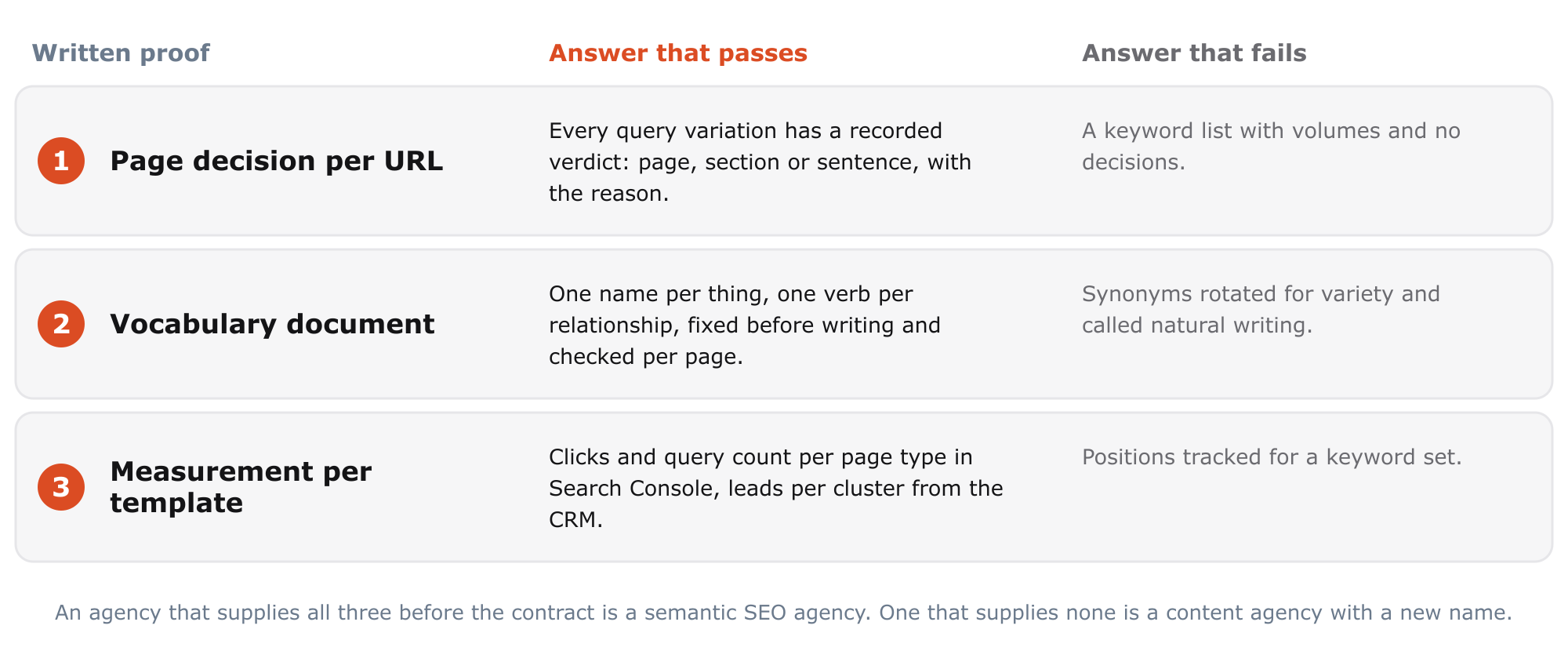
What three proofs separate a semantic SEO agency from a keyword agency?
Three documents separate the two, and each one exists before the first page is written.
The first is a page decision per URL: a recorded verdict of page, section or sentence for every query variation, with the reason, from the query deserves a page test. A keyword agency has a keyword list with volumes instead.
The second is a vocabulary document, the source term vector: one name per thing and one verb per relationship, checked on every page. A keyword agency rotates synonyms instead.
The third is measurement per template: clicks and query count per page type in Google Search Console, and leads per cluster where a CRM exists. A keyword agency reports positions.
An agency doing the work has all three ready for the first call.
Which twelve questions does a buyer ask on the first call?
Twelve questions cover the method, the proof and the contract, and each one has an answer that passes and an answer that fails.
The twelve questions, with the passing answer, the failing answer and the document that proves it.
| Question | Answer that passes | Answer that fails | Document that proves it |
|---|---|---|---|
| What is my site about, in one sentence? | One sentence naming the central entity, type, audience and market, on the call. | A request for the keyword list first. | Central entity definition |
| Which of my pages compete with each other? | Named URLs, the query they split and the merge target. | More pages recommended. | Page decision per URL |
| How do you decide if a query gets its own page? | A named test with checks: demand, entity, similarity, predicate, pattern. | Search volume alone. | Query deserves a page record |
| How is vocabulary kept consistent across writers? | Canonical terms, allowed aliases and banned variants, checked per page. | A style guide about tone. | Source term vector |
| What is in a content brief? | Entity, predicate, facts as triples, section order, component per section, links with anchors. | An outline of headings. | A sample brief |
| What order do pages publish in, and why? | A roadmap in dependency order, hardest high-trust topics first. | A calendar with a monthly count. | Publishing roadmap |
| How are internal links decided? | Outer to core, one canonical anchor per URL, recorded next to the URL. | Writers add links where they fit. | Internal linking architecture |
| Which links from other sites are worth placing? | The linking page shares the topic and passes the client's own page test. | Domain rating targets and monthly counts. | Placement gate record |
| What do you report, and where does the number come from? | Query count per template and clicks per page from Search Console, leads per cluster from the CRM. | Positions for a keyword set. | A sample report |
| How does the site get cited by ChatGPT and AI Overviews? | One fact per passage, a named author, consensus wording, next-step coverage, measured on a prompt set. | A separate GEO service with a tool subscription. | Prompt-set baseline |
| Who decides the strategy, by name? | One named person owns the map and the vocabulary; another owns what ships. | A team. | Team page |
| What do we own when the contract ends? | The audit, the topical map, the vocabulary and the roadmap stay with the business. | Access ends with the contract. | Service agreement |
Ten passing answers mark a semantic SEO agency. Ten failing answers mark a keyword agency with a new name.
What does a written quote from a semantic SEO agency contain?
A written quote names the engagement shape, the value used for each scope factor, the deliverables as documents and the pricing basis.
The shape decides the basis: an audit is a flat fee, the Semantic SEO Strategy a fixed-scope project and production a monthly program. Each factor value is checkable against the site: site size, query network size, language count, who produces the pages, and the platform when a rebuild is in scope.
Deliverables are named as documents or pages, never as hours. Industry, competition and ambition change the strategy, not the cost, so they do not appear as price factors. How semantic SEO is priced covers each factor.
How does a buyer check an agency's results before paying?
Results are checked in Google Search Console, with the window named, and then confirmed by a client who speaks.
A rank tracker screenshot is the agency's tool reporting on the agency's keywords; a Search Console panel is Google's record of clicks, impressions, click-through rate and average position. A 16-month panel shows if the site held through core updates, and a 28-day panel hides them.
Then ask for an introduction to a client in a comparable industry, without the agency on the call.
Anonymised panels are normal; a live property can be opened on a call. Results, measured in Google Search Console shows the panel format, and client feedback shows reviews tied to the project and the date.
How is an AI search visibility agency vetted differently?
An AI search visibility agency is vetted on the same three proofs plus a prompt-set baseline, because citation is a structural outcome, not a separate service.
Buyers call the work GEO, AEO or LLM visibility. Ask how the agency measures citation: a fixed prompt set run on each system, with a sentence-level record of who is cited, re-run monthly. Ask what changes on the page when the record shows a gap: passage independence, one fact per sentence, a named author, consensus wording and follow-up coverage.
A tool subscription and a share-of-voice number are a measurement, not a method. AI Search Visibility sets out the six requirements and the test for each.
Which answers end the conversation?
Five answers end the conversation, because each one describes an engagement that cannot produce topical authority.
- A guarantee of rankings or citations.Nobody controls what Google or a generative system chooses, so a guarantee is an empty promise or a risky tactic.
- A keyword list presented as the strategy.The decisions are the strategy, and a list has none.
- A report with no Search Console panel in it.The agency's tool is reporting the agency's work.
- No named owner of the map.A map owned by a team is owned by nobody, and the vocabulary drifts with every new hire.
- More content as the answer to a traffic drop.A drop after a core update is a structural fault, and more pages on the same structure spread it.
Each one also works as a direct question on the call.
How does a buyer compare two semantic SEO agency quotes?
Two quotes are compared on the three proofs first and the number second, and only like for like.
An audit is compared with an audit and a strategy with a strategy.
A quote that passes all three at a higher number buys a plan. A quote that fails all three at a lower number buys pages without one, and the merges those pages create are paid for later.
- Koray Tuğberk Gübür, Search Engine Land: Query templates, expanding the scope of topical authority
- Google Search Central: A guide to Google Search ranking systems
- Google Search Central: Creating helpful, reliable, people-first content
- US 2024/0289407 A1: Search with stateful chat (Google, pending application)
Patents and filings describe systems Google has invented. None is a confirmed ranking factor.
What should you read after how to choose a semantic SEO agency?
 How much does semantic SEO costThe cost of semantic SEO depends on four things, site size, the size of the query network, the number of languages and which side runs production, and the full page explains how each one moves the scope.
 Semantic SEO versus keyword SEOKeyword SEO asks which words a page contains, and semantic SEO asks which entity the page is about and how it connects to every other page on the site.
 What is a topical mapA topical map is the list of every topic a site will cover, split into a core section that sells and an outer section that teaches, with a decision on which topics earn a page and which earn a heading.
 Query Deserves a PageQuery deserves a page is the test that decides if a search query earns its own URL or becomes a heading on an existing page, judged by prominence, demand and relevance to the business.
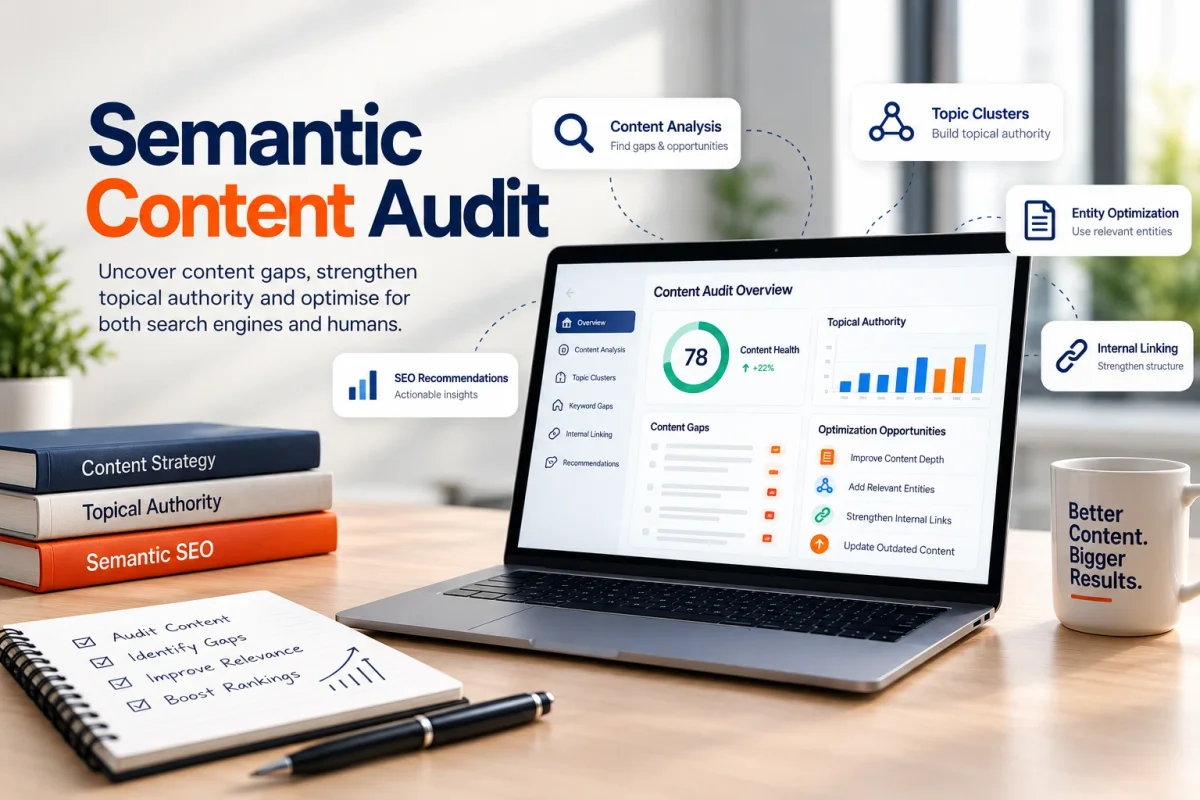 Semantic SEO AuditSix checks. Each one has a defined failure and a defined fix.
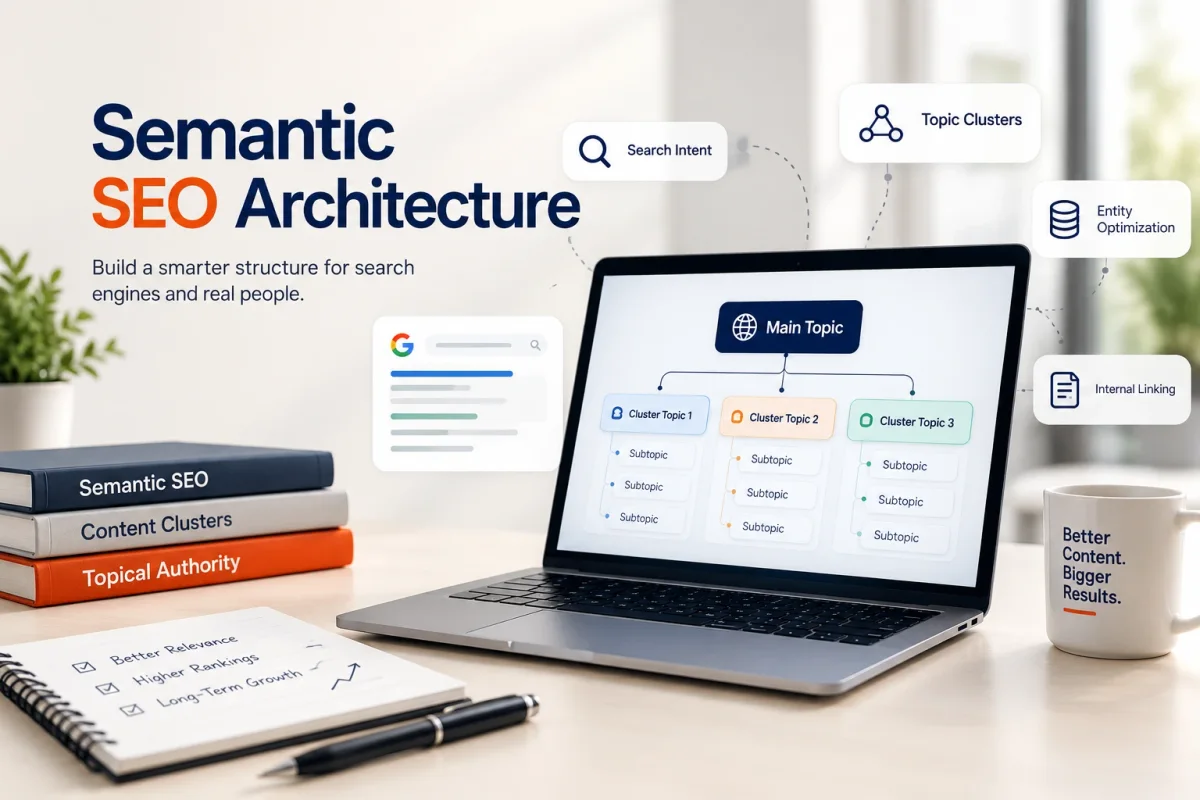 Semantic SEO StrategySeven documents with a fixed structure. Every engagement produces all seven.
 Talk to usMessage the team on WhatsApp
Questions about choosing a semantic SEO agency
Do I ask for a sample topical map?
Does the agency need to be in my country?
Is a cheaper audit a sign of a weaker agency?
What if the agency refuses to guarantee results?
How long does the first engagement run?
Does white-label matter to me as the end client?
Who owns the documents when the contract ends?
Do I speak to a past client?
Does the agency need access before quoting?
Is a strategy call a sales call?
What does a bad topical map look like on a call?
See the three proofs on your own site
On a 30-minute call we name your central entity, show which pages compete and decide which layer comes first. You keep that answer with or without an engagement.