 Digital Vikingz
What Is Information Gain in SEO?
Information gain is what a page adds beyond what the top results already say, and the gain earns trust only when the new claim carries its evidence. A Google patent describes scoring that difference per document, relative to the pages a user has already viewed.
What does Google's information gain patent describe?
Google's patent on link information gain describes scoring the additional information a document holds beyond the documents a user already viewed.
The patent is US 11,354,342, with a priority date in 2018. The score is relative: one document scores high for a user who has read nothing on the topic and low for a user who has read three pages saying the same thing. The patent describes using the score to choose which documents to present next.
Google's filing on its generative search describes a related behavior: content a profile or session shows the user already read is omitted, or the summary goes deeper.
Digital Vikingz treats the patent and the pending filing as design logic, not a guarantee. A page that restates the top results offers no reason to be read after them.
What counts as information gain on a page?
Information gain counts when a page states an attribute, value, method or result that the top results do not state.
Four kinds qualify. First-party data is a number the business measured itself. Method is how the business does the work, with its own decision rules. Coverage is an attribute of the entity that no ranking page states. Examples are worked cases built from the business's own niche.
Each kind is specific to one business, which makes the gain hard for a competitor to copy the week it is published.
Suppose every ranking page defines a topical map and none shows a filled node row. A page that shows the row, with its page decision, reason, page type and main component, adds an attribute the others lack. The definition is consensus, and the node row is the gain.
How does a page support an information gain claim with evidence?
An information gain claim carries its basis in the same block: the measurement, the method, the sample and the date.
Evidence turns a claim only one site makes from an assertion into a checkable fact. A sentence such as 'service pages with the main component first earned more calls' needs its page count, period, comparison and how calls were counted.
Google's guidance on helpful, people-first content asks if content provides original information, reporting, research or analysis, and asks content that draws on other sources to add substantial value instead of rewriting them.
How generative systems rate confidence in a claim belongs to AI citation readiness, and the page-side rule here is narrower: every unique claim sits next to its basis, in the same block.
Where does information gain sit relative to consensus wording?
Consensus facts come first, in the wording the field uses, and the information gain block follows them.
A page that opens with its unique claim asks for trust before showing it knows the basics. A page that opens with consensus establishes the entity and its agreed attributes, so the gain reads as an addition, not a contradiction.
The balance is set per section: each H2 opens with the agreed answer, and the paragraphs after it carry the method, data or example the top results lack.
The ratio differs by page type. A definition page is mostly consensus with one gain block, such as a worked example. A methodology page is mostly gain inside a short consensus frame. A service page carries its gain in the process and the deliverables.
How is information gain found before a page is written?
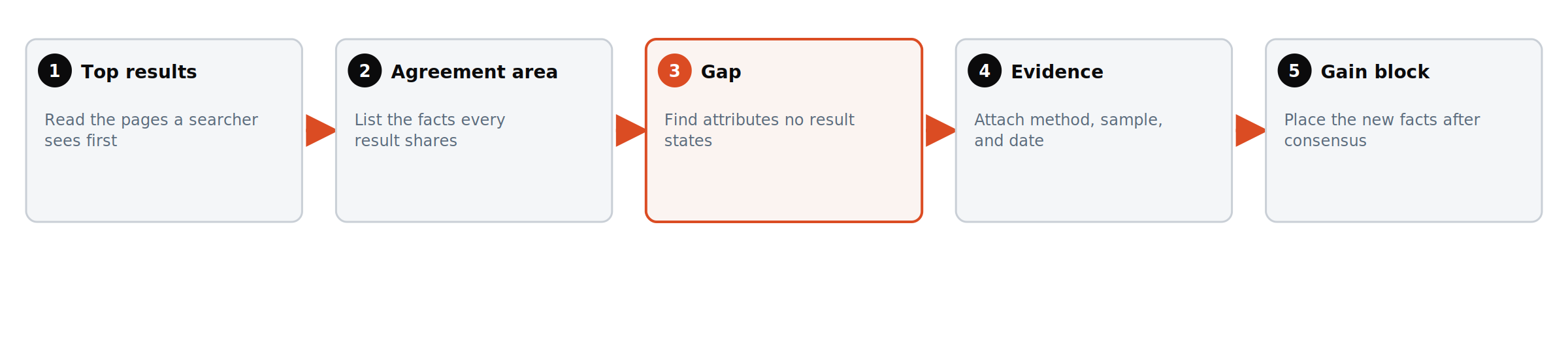
Information gain is found by listing what the top results already say, then listing what the business knows that they do not.
Read the top results and record every attribute and value they share: the agreement area. Record the attributes some cover and others miss, and the questions none of them answer.
List what the business holds: measurements from its own work, its process and decision rules, and the questions buyers ask on calls. The overlap between the gaps and that knowledge is the gain set, and gaps without evidence stay out.
The content brief records both lists: consensus facts as triples in the field's wording, and gain facts in a marked block with their evidence. A brief with no gain block is a brief for a page the search engine already has.
Which pages fail to add information gain?
Pages fail to add information gain when every fact on them already appears in the top results.
Rewording does not count, because a synonym for a consensus fact is the same fact. Added length does not count either, because the attribute set stays the same. An AI-generated summary of the top results holds nothing beyond them.
Google's rater guidelines name pages auto-generated in bulk without curation as showing no effort, and count the effort that goes into page functionality. A working calculator or filter is gain that text alone does not match.
Templated page sets fail the same way: a location page that swaps only the place name repeats its sibling. The gain for each page in a set is the facts true of that value alone.
- US 11,354,342 B2: Contextual estimation of link information gain (Google)
- Google Search Central: Creating helpful, reliable, people-first content
- US 2024/0289407 A1: Search with stateful chat (Google, pending application)
- Google: Search Quality Rater Guidelines (PDF)
Patents and filings describe systems Google has invented. None is a confirmed ranking factor.
What should you read after information gain?
 AI citation readinessA page whose sentences can each be verified against one passage.
 What is a content briefThe document that turns one row of the topical map into one page.
 MicrosemanticsRelevance at sentence level, decided by word order, subject choice and dependency structure.
 Author and organization entitiesThe named person and the named company behind a page.
 Semantic Content WritingBriefs and pages written from your topical map.
 AI Search VisibilityGet named in ChatGPT, Perplexity, Gemini and AI Overviews.
 Talk to usMessage the team on WhatsApp
Questions about information gain
Does a small business produce information gain without original research?
How often does information gain need refreshing?
Can information gain come from images or diagrams?
Does information gain conflict with topical coverage?
Is information gain the same as E-E-A-T?
Does citing another site's data count as information gain?
Does information gain make pages longer?
Can two pages on one site share the same information gain?
Do FAQs carry information gain?
Who supplies the information gain on a client page?
Does translated content carry information gain?
See it applied to your site
The Semantic SEO Audit uses every term in the knowledge hub. Fixed scope, written deliverable.