Digital Vikingz
What Are Macro Context and Micro Context?
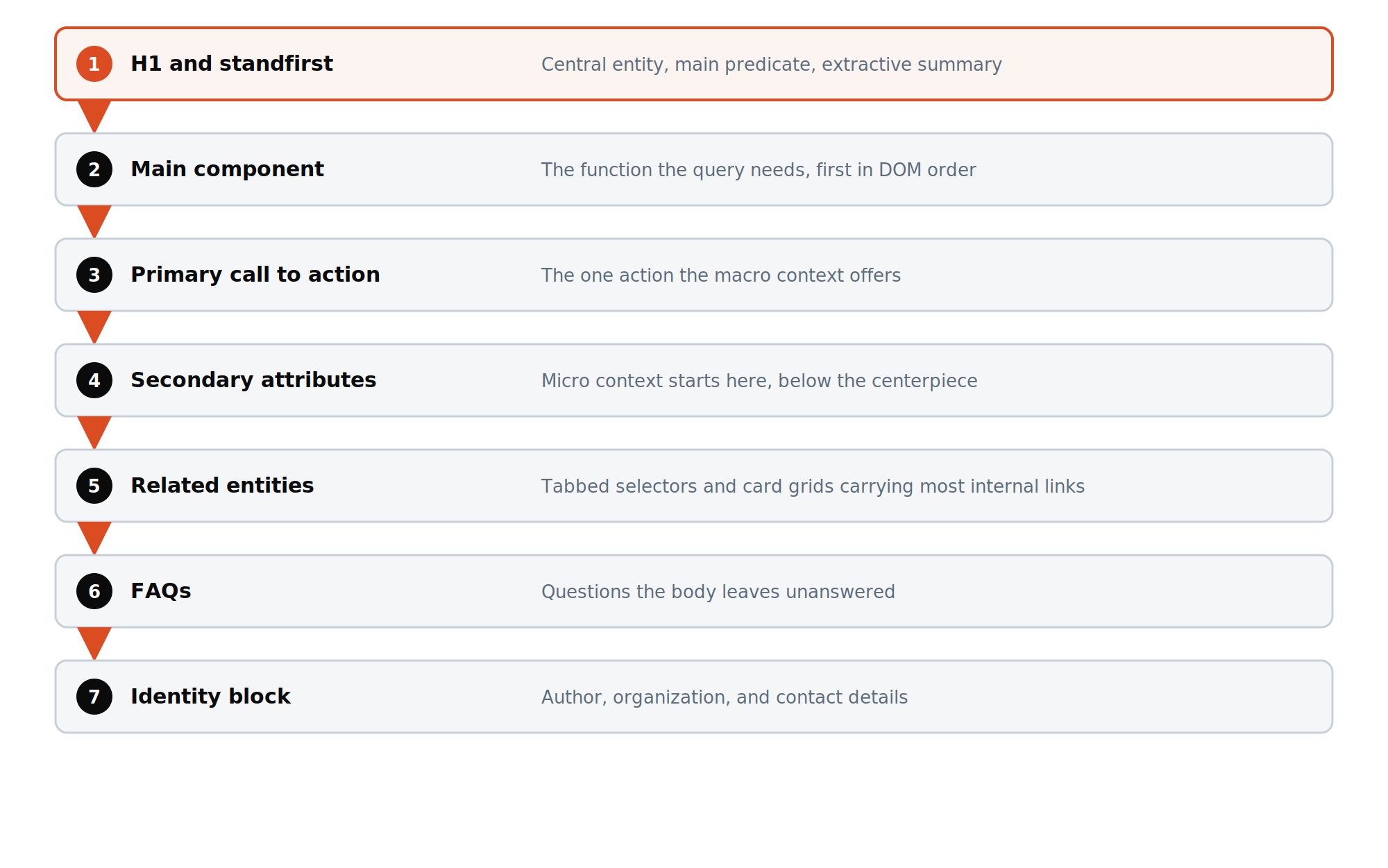
Macro context is the main content that declares the entity and the intent, and micro context is the supplementary content below it that expands the attributes and carries most of the internal links.

What are macro context and micro context on a web page?
Macro context is a page's main content and micro context is its supplementary content, the same split Google's rater guidelines draw.
Google's Search Quality Rater Guidelines define Main Content as the part that helps the page achieve its purpose, and Supplementary Content as the part that supports the visit. Macro and micro context are the build terms for those two regions.
Centerpiece annotation decides one block; the macro and micro split assigns every block. One predicate runs through the macro context, and the micro context introduces the neighbors: other attributes, related entities and next steps. A page that argues two predicates above the fold reads as two pages sharing one URL.
What belongs in the macro context above the fold?
The macro context holds four blocks: the H1, the standfirst, the centerpiece component and the primary call to action.
The query's answer and the main predicate live here in full, so a reader who stops at the fold already has the answer. Ads, newsletter signups, popups, chat widgets and promo strips stay out of the space between the H1 and the centerpiece. A secondary attribute that needs more than one paragraph moves below the fold.
A project management SaaS feature page for task dependencies shows the pattern. The macro context names the feature, states what it does, shows the dependency view and offers the trial beside it. Integrations, pricing tiers and customer stories wait below.
What belongs in the micro context below the fold?
The micro context holds secondary attributes, related entities, FAQs, experience blocks, and most of the page's internal links.
The page widens here from the query to its neighbors. The drill-downs and next steps a generative model produces for the query find their blocks in this region; a next step with no block on the page and no page in the cluster sends the session elsewhere.
Tabbed selectors compress several sub-entities into one component. Each tab holds a short snippet that mirrors the opening of the child page, plus a link to it, and the tab content sits in the DOM on load.
Conversion bands belong here too: after the definition, after the service list and before the FAQs. Each band repeats the primary call to action as one action and handles objections in text.
Where do internal links sit between macro and micro context?
Internal links sit in the micro context, from the middle to the bottom of the page, and never inside the centerpiece.
Link density is low above the fold and high below it. A wall of links near the top reads as navigation, not main content, and the centerpiece carries no internal links at all.
Each target page receives one canonical anchor phrase across the site, varied only inside its dual-entity form. A link to the same target appears once per page. Card grids use each child page's H1 as the anchor, and anchors never read click here or read more.
A lapsed Google patent on query augmentation describes treating a click on another link on the landing page as a long click. The patent has expired, so this is design logic, not a guarantee: links placed where a satisfied reader looks next earn the click.
How do Google's segmentation patents draw the line between blocks?
Google's segmentation patents describe splitting a page into blocks by white space and spatial boundaries, then reading the blocks in order.
A granted Google patent on document segmentation based on visual gaps describes dividing a document by its white space into a hierarchy of blocks. The line between macro and micro context is one of those gaps, set on purpose through spacing, borders and background changes.
Google's layout-aware pretraining patent defines a block by a clear spatial boundary and describes sorting blocks by their upper-left corner, vertical position first.
The Content Warehouse API leak shows separate flows for main text, boxes and asides. We build callouts as separate blocks and keep one uninterrupted main flow.
- Koray Tuğberk Gübür, Search Engine Land: Visual semantics, the missing piece of topical authority
- Google: Search Quality Rater Guidelines (PDF)
- US 7,676,745 B2: Document segmentation based on visual gaps (Google)
- US 12,393,768: Layout-aware multimodal pretraining for multimodal document understanding (Google)
Patents and filings describe systems Google has invented. None is a confirmed ranking factor.
What should you read after macro and micro context?
 What is the centerpiece annotationThe centerpiece annotation is the primary content block Google extracts from a page, and the first characters after the H1 decide it.
 Visual semanticsVisual semantics is the meaning a search engine reads from layout: block order, component types, typography and the function a page performs.
 What is a topical mapA topical map is the list of every topic a site will cover, split into a core section that sells and an outer section that teaches, with a decision on which topics earn a page and which earn a heading.
 Query Deserves a PageQuery deserves a page is the test that decides if a search query earns its own URL or becomes a heading on an existing page, judged by prominence, demand and relevance to the business.
 SEO Website DevelopmentFive platforms, chosen by what the architecture needs, not by preference.
 Semantic SEO StrategySeven documents with a fixed structure. Every engagement produces all seven.
 Talk to usMessage the team on WhatsApp
Questions about macro and micro context
Is the fold a fixed line in pixels?
Can reviews and ratings sit in the macro context?
Does a sidebar beside the main content count as macro context?
Are the site header, menu, and footer part of the micro context?
Where does the buying guide go on an ecommerce category page?
When does a micro-context block become its own page?
Where do links to external sources sit?
Does the macro and micro split apply to blog posts?
Does the split change between mobile and desktop?
How does the split work on a homepage?
How is the macro and micro split checked on an existing page?
See it applied to your site
The Semantic SEO Audit uses every term in the knowledge hub. Fixed scope, written deliverable.