 Digital Vikingz
What Is Visual Semantics in SEO?
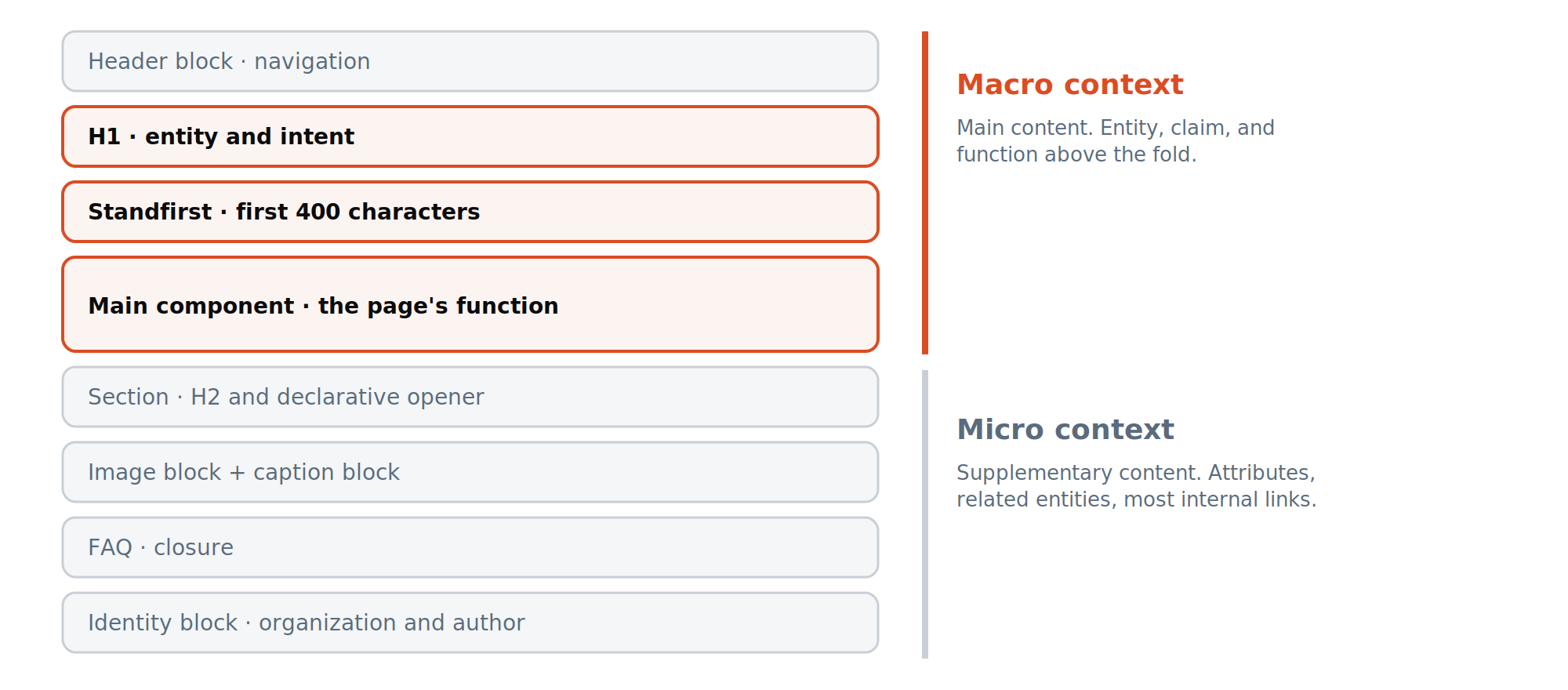
Visual semantics is the meaning a search engine reads from layout: block order, component types, typography and the function a page performs.

What is visual semantics in SEO?
Visual semantics treats layout as a second channel of meaning, read alongside the text.
Google's rater guidelines separate main content from supplementary content, and the ranking systems guide names passage ranking, which scores sections individually. A Google patent describes an encoder that reads a page block by block and is trained to detect blocks out of order and images that do not match their text.
Koray Tuğberk Gübür named the field in his July 2026 article on Search Engine Land. Text says what the page is about; layout says which part matters and what the page does.
What are the three parts of visual semantics?
Visual semantics has three parts: blocks, the centerpiece and function.
A block is a visually separable unit: a heading with its opener, a table, an image with its caption, a card. Google's segmentation patents describe drawing block boundaries from white space. The split into main and supplementary blocks is macro and micro context.
The centerpiece is the block that carries the page's purpose, decided by the first characters after the H1. Function is the task a visitor completes on the page: compare, book, calculate, filter or read.
What does visual semantics change in a website build?
Visual semantics adds six rules to every template.
The main component sits first in the code and on screen, in the HTML before any script runs. The first 400 characters after the H1 carry the entity, the claim and the function, with no share bar, date stamp or carousel in between.
Block order follows the page type: H1, standfirst, main component, sections, FAQ, identity. Heading sizes descend without inversion. Every image has a caption below it and depicts the entity named beside it. Every function works: a compare button compares, a filter filters.
Five failures are common: a hero carousel above the H1, a share bar under the H1, tables built from styled divs, a category grid without a filter and a calculator that loads by script.
How does verbalization make visual components readable?
Verbalization is turning the meaning of a component, an image or a table into visible text a crawler or a language model can read.
Every component gets visible text that states what it does and shows: a caption sentence above a table, a one-line description and a worked example for a tool, a heading that names the set and the sort logic for a card grid.
Chart numbers appear in the text at least once. Icons that carry meaning have visible text beside them. Labels use the query's vocabulary, so a search for installation cost meets a label that says installation cost. Alt text names the entity, the attribute and the setting.
Hidden text, aria-only text and data attributes do not count. The explaining block sits next to its component, because the layout-aware patent describes embedding the relationships between neighboring blocks.
What do structured information card patents teach about repeated components?
A structured information card is a repeated component with a fixed set of fields, read as data when every field is visible text, as on a product, provider or pricing card.
Google's card patents teach one discipline by analogy: every repeated component keeps a fixed field set. A Google patent on structured information cards describes a template with predetermined fields, such as origin, destination and flight number on a flight card, and a grammar of trigger phrases that grows when new phrases share tokens or return the same pages. The patent does not describe reading cards from web pages, so the lesson for a website is an analogy.
Each card type has one field set, and every instance shows every field in the same order, with Not listed as a value rather than a gap. One label names one attribute site-wide, never Cost on one card and Price on the next.
What is misleading functionality in Google's spam policies?
Misleading functionality is a component that implies a function it does not perform, which Google names as spam and which outranks every other fix in priority.
Google's spam policies cite fake app store credit generators and sites that claim to merge PDFs or run a countdown timer, then serve deceptive ads. The business-site version is quieter: a Compare button that opens nothing, a Get quote form that goes nowhere, a calculator that returns a static number.
We click every functional label and test every calculator, filter, form and booking flow before launch and every 90 days.
Google folded the Helpful Content System into core ranking in March 2024. The logic of that system survives in this policy and in the rater guidelines, which count page functionality as effort in main content.
- Koray Tuğberk Gübür, Search Engine Land: Visual semantics, the missing piece of topical authority
- Google Search Central: Spam policies for Google web search
- US 12,393,768: Layout-aware multimodal pretraining for multimodal document understanding (Google)
- US 11,238,058 B2: Search and retrieval of structured information cards (Google)
Patents and filings describe systems Google has invented. None is a confirmed ranking factor.
What should you read after visual semantics?
 What is the centerpiece annotationThe centerpiece annotation is the primary content block Google extracts from a page, and the first characters after the H1 decide it.
 Macro and micro contextMacro context is the main content that declares the entity and the intent, and micro context is the supplementary content below it that expands the attributes and carries most of the internal links.
 Cost of retrievalCost of retrieval is the computing a search engine spends to crawl, render, segment and evaluate a page, and fewer, cleaner pages cost less and reach the ranking stages that matter.
 What is topical authorityTopical authority is the state in which a site ranks across the whole network of queries around one topic, assigned by Google to a source that covers the topic with consistent depth and vocabulary over time.
 SEO Website DevelopmentFive platforms, chosen by what the architecture needs, not by preference.
 Semantic SEO AuditSix checks. Each one has a defined failure and a defined fix.
 Talk to usMessage the team on WhatsApp
Questions about visual semantics
Is visual semantics a Google ranking factor?
Does visual semantics apply to a small local business site?
Does a page with no images lose visual semantics signals?
How does visual semantics relate to Core Web Vitals?
Does visual semantics matter for AI answers?
Can visual semantics problems be fixed without a redesign?
Do translated versions of a site need the same layout?
Is schema markup part of visual semantics?
Who owns visual semantics on a project, design or SEO?
How does visual semantics differ from UX design?
See it applied to your site
The Semantic SEO Audit uses every term in the knowledge hub. Fixed scope, written deliverable.