 Digital Vikingz
What Is a Source Term Vector?
A source term vector is the vocabulary a site speaks, recorded as canonical terms, allowed synonyms and banned terms, and checked on every page before publication.
What does a source term vector contain?
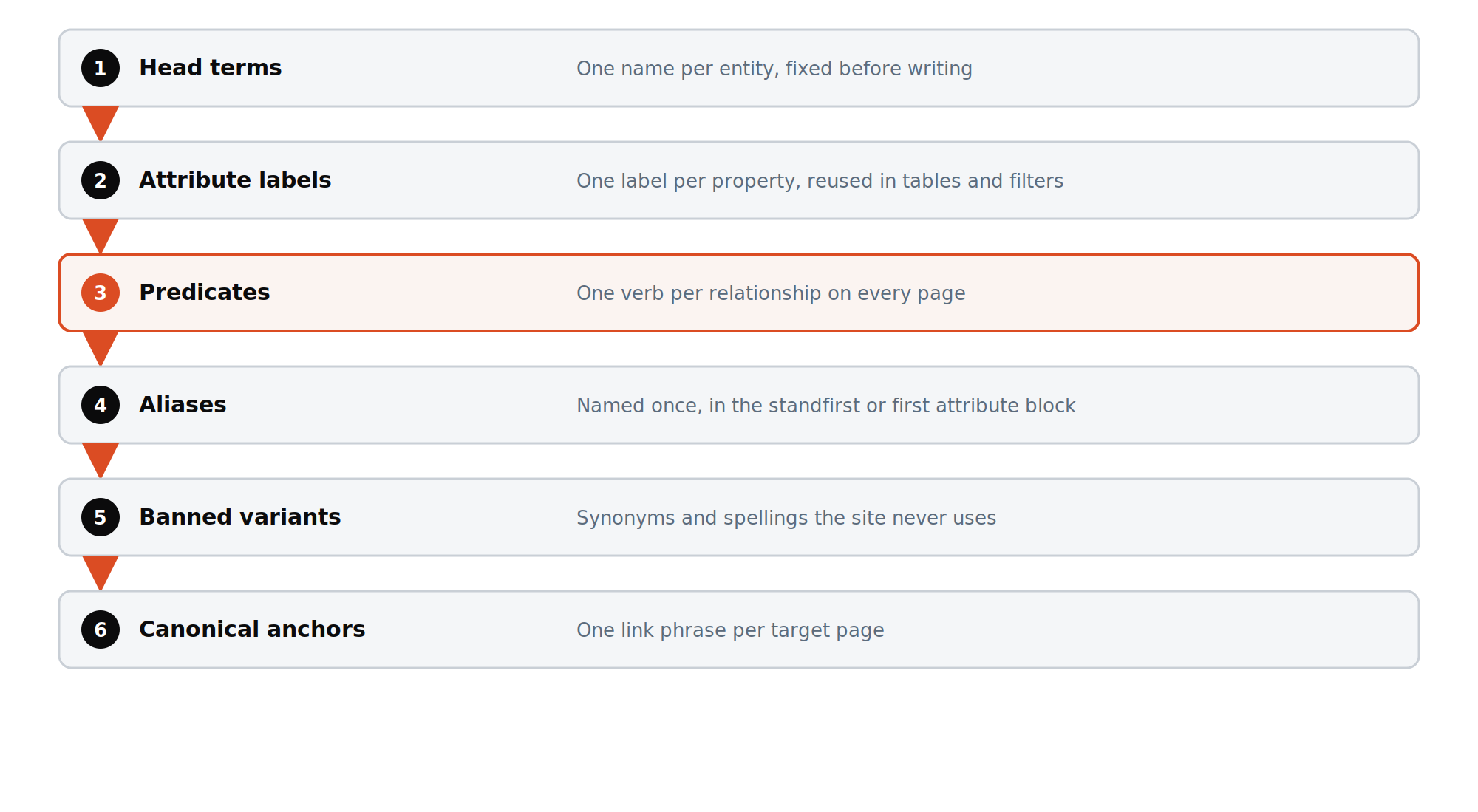
A source term vector holds a canonical term per entity, a label per attribute, a verb per relationship, the allowed synonyms and the banned terms.
The document is a spreadsheet with one row per term: the canonical term, its allowed synonyms and its banned terms. An editor checks every page against the sheet before publication.
The Digital Vikingz vector names the planning document a topical map, never a keyword map, and the writing document a content brief, never a content outline. The one entity a site is about is its central entity, never its main topic.
Each allowed synonym carries a placement rule, such as once in the standfirst, and the page then continues in the canonical term.
How does vocabulary drift break a source term vector?
Vocabulary drift is one thing named several ways across pages, and it splits one source into several weaker ones.
One writer calls a service an audit, another calls it a review and a third calls it an assessment. The site then describes three services where it sells one. The check against banned terms stops each variant before publication.
Google's card patents describe features that fire from phrase sets that grow by term overlap, so a phrasing that lacks the canonical term adds nothing to the set. The patents cover cards, not web pages, so the lesson is an analogy: shared canonical terms connect phrasings.
What is semantic dilution, and how does a source term vector prevent it?
Semantic dilution is the central entity's signal spread across too many terms, pages or unrelated entities, so no single one carries enough weight.
Drift concerns names, and dilution concerns scope. A source term vector prevents it by recording what the site names and what it leaves out. A page that covers its own entity plus four neighbors gives each one a fifth of its attention. Google's research on query term weighting gives each query term its own weight, so a page concentrated on the heavy term states more about it.
Terms outside the vector need a decision before they appear: attribute, related entity or out of scope. The decision is recorded in the vector, so the next writer inherits it.
Two pages targeting one service split clicks, internal links and anchors, so the vector assigns one canonical page per entity.
What synonym policy does a source term vector set?
The synonym policy allows synonyms inside a page and bans them across a template.
Inside one page, a synonym adds coverage for how users phrase the query. Across a template, a synonym breaks the pattern every page in the set shares. A project management SaaS page covers tool, software and app as phrasings of one query, and none of the three earns its own page.
Names never take synonyms: brand, product, person and place names keep one spelling on every page.
Search language wins over internal language. Users search for installation cost while the business says pricing, so the vector records installation cost as canonical and pricing as banned.
Why does a source term vector fix one anchor phrase per page?
One canonical anchor phrase per page tells search engines and readers the same thing about the target every time it is linked.
A Google patent on query augmentation describes treating repeated link text as a query the target page answers. The patent has expired, so Digital Vikingz treats it as design logic, not a guarantee.
The anchor comes from the canonical term of the target page and never names the source page's topic or says click here. A page about the Semantic SEO Audit takes Semantic SEO Audit as its anchor, not audit service or our review.
The topical map records the phrase next to the URL, so every writer links the same way.
What is predicate consistency in a source term vector?
Predicate consistency is one verb for each relationship, used on every page that states that relationship.
The predicate is the verb that links an entity to its object. One page saying the audit checks and another saying it reviews writes the relationship two ways.
Every page in a query template uses the same predicate in its first sentence, and the entity value is the only part that changes. Predicates also differ by object: pages about uploading a file and pages about sharing a post need different verbs.
The site adopts the verb users pair with the entity in searches and records it in the vector beside the relationship it names.
- US 11,238,058 B2: Search and retrieval of structured information cards (Google)
- US 9,916,366 B1: Query augmentation (Google, expired)
- Koray Tuğberk Gübür, Search Engine Land: Query templates, expanding the scope of topical authority
Patents and filings describe systems Google has invented. None is a confirmed ranking factor.
What should you read next about the source term vector?
 What is a central entity?The one noun phrase every page on a site reinforces.
 What is an entity-attribute-value triple?One fact in machine-readable order: the thing, the property and the value.
 What is microsemantics?Relevance at sentence level, decided by word order, subject choice and dependency structure.
 What is a content brief?The document that turns one row of the topical map into one page.
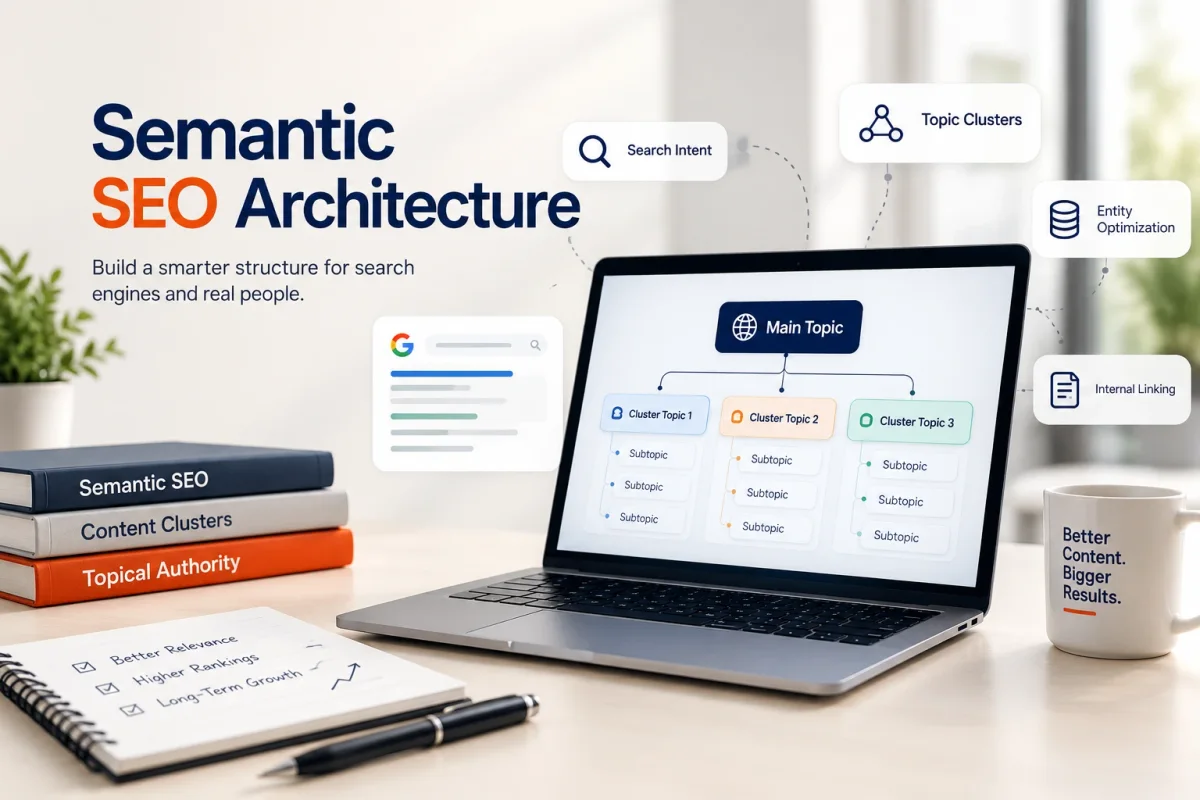 Semantic SEO StrategySeven documents with a fixed structure. Every engagement produces all seven.
 Semantic SEO AuditSix checks. Each one has a defined failure and a defined fix.
 Talk to usMessage the team on WhatsApp
Questions about the source term vector
Who maintains the source term vector?
How many terms does a source term vector hold?
What happens to published pages when the source term vector changes?
Does the source term vector apply to off-site mentions?
How does a source term vector work across languages?
Is a source term vector the same as a style guide?
Does a source term vector cover structured data?
Does a source term vector cover image captions and alt text?
How is vocabulary drift found on an existing site?
Should the vocabulary follow the terms competitors use?
When does a new term enter the source term vector?
See it applied to your site
The Semantic SEO Audit uses every term in the knowledge hub. Fixed scope, written deliverable.