Digital Vikingz
Semantic SEO for Ecommerce and Retail
Semantic SEO for ecommerce organizes an online store by product class, so every category, collection and product page states the attributes buyers filter by. The page test decides which category and collection pages exist, and every listing carries a working filter and typed values for Google Search and AI shopping agents.

Which pages does an ecommerce website need?
An ecommerce website needs category, collection, brand and product pages, plus buying guides and support pages. The table gives each of the eight query patterns its verdict, page type, main component and trust element.
| Query pattern | Verdict | Page type | Main component | Trust element |
|---|---|---|---|---|
| [product class] | Page | Category page | Product grid with a filter on at least two attributes | Price and stock status as text |
| [attribute] [product class] | Page or section | Collection page with demand and a distinct product set, otherwise a filter state | Filtered grid with the attribute named in the heading | Attribute value visible on every card |
| [brand] [product class] | Page | Brand collection page | Brand block plus filtered grid | Brand name written one way |
| [product name] | Page | Product page | Buy box with price, variants and availability as text | Reviews with method and count; specs as a typed table |
| best [product class] for [use] | Page | Ranked entity list | Ranked list with the deciding attribute value per item | Sort rule and count stated in text; scoring source named |
| [product class] buying guide | Page | Buying guide in the outer section | Attribute explainer linking to each filter | Author named; links inward to the category |
| [product A] vs [product B] | Section | Section on the category or guide page, unless demand is high | Two-column typed comparison | Both entities in the same sentence |
| [product class] size guide, care, returns | Page | Support page, one per class | Size table or steps | Dated, with the policy as text |
What is the central entity of an ecommerce website?
The product class is the central entity of an ecommerce website, and every product in the class shares one attribute set.
Every running shoe has a drop, a weight, a stack height and a price. Every sofa has a width, a material and a seat count. The architecture lists each class attribute once, and category, collection and guide pages show every filtered attribute as text and as a working filter.
How do core and outer sections split an ecommerce website?
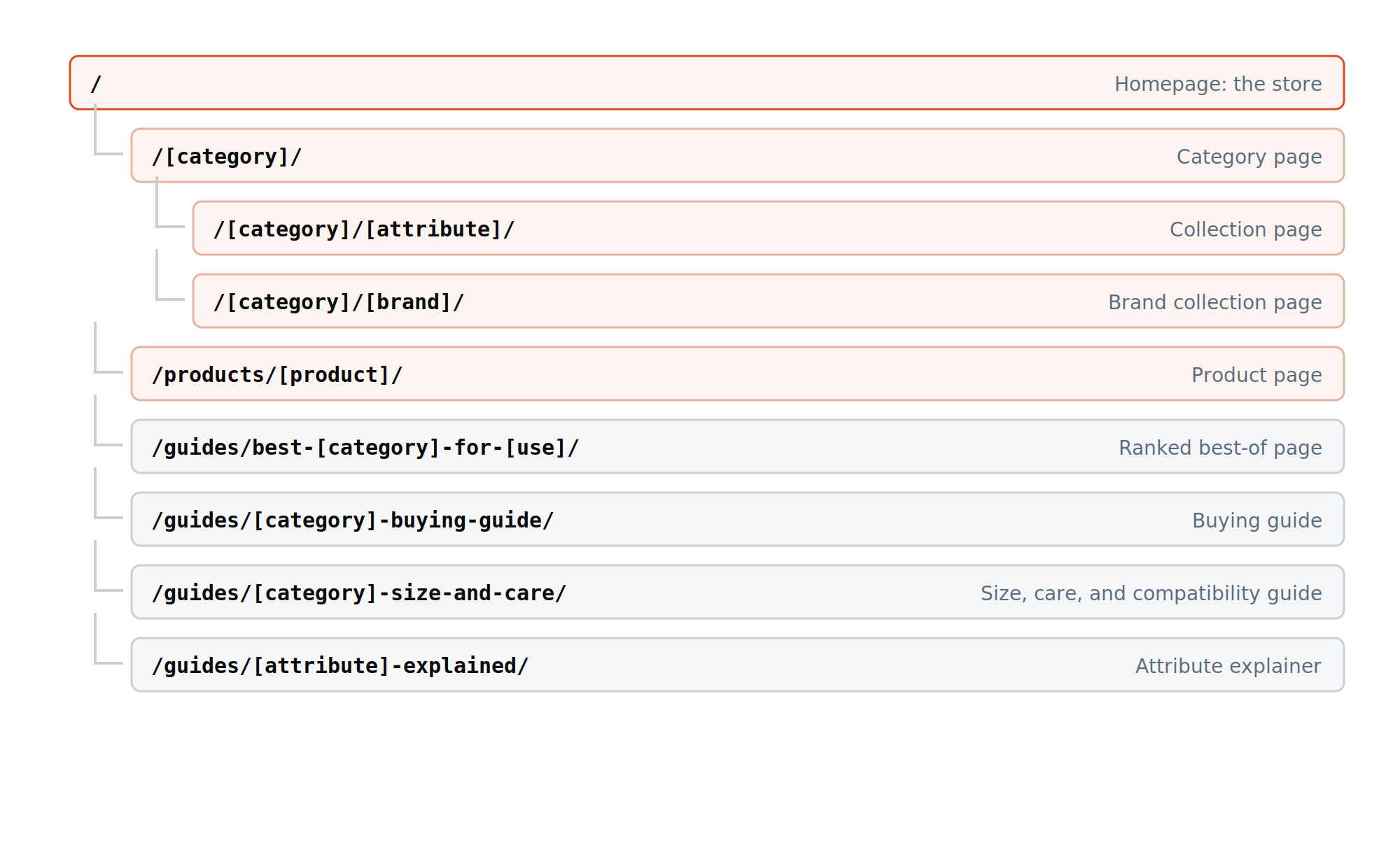
The core section holds the pages that sell. The outer section holds guides that explain attributes and link inward.
- Category pages
- Collection pages that pass the page test
- Brand pages
- Product pages
- Buying guides per class
- Best-of pages
- Care, size and compatibility guides
- Material and attribute explainers
Where do ecommerce websites go wrong?
Ecommerce websites go wrong with indexed filter URLs, shared descriptions and empty category pages.
'Red leather sofas under 1000' is a filter state, not a page. Indexed filter URLs create thousands of near-duplicate listings that fail demand and similarity.
The same three sentences on every variant read as template output. Each product needs sentences true only of it, and an n-gram check across the catalogue finds the shared ones.
A grid alone says nothing about the class. A category query asks for a filter and a definition block above the grid.
What makes an ecommerce page trustworthy to search engines and buyers?
An ecommerce page earns trust from five elements a buyer can check:
- Reviews with count, method and date
- Prices and stock as visible text, never only in an image or script
- Shipping and returns on the product page as text
- Brand and organization identity block one click away
- Original product photography with a caption per image
What is measured on an ecommerce site?
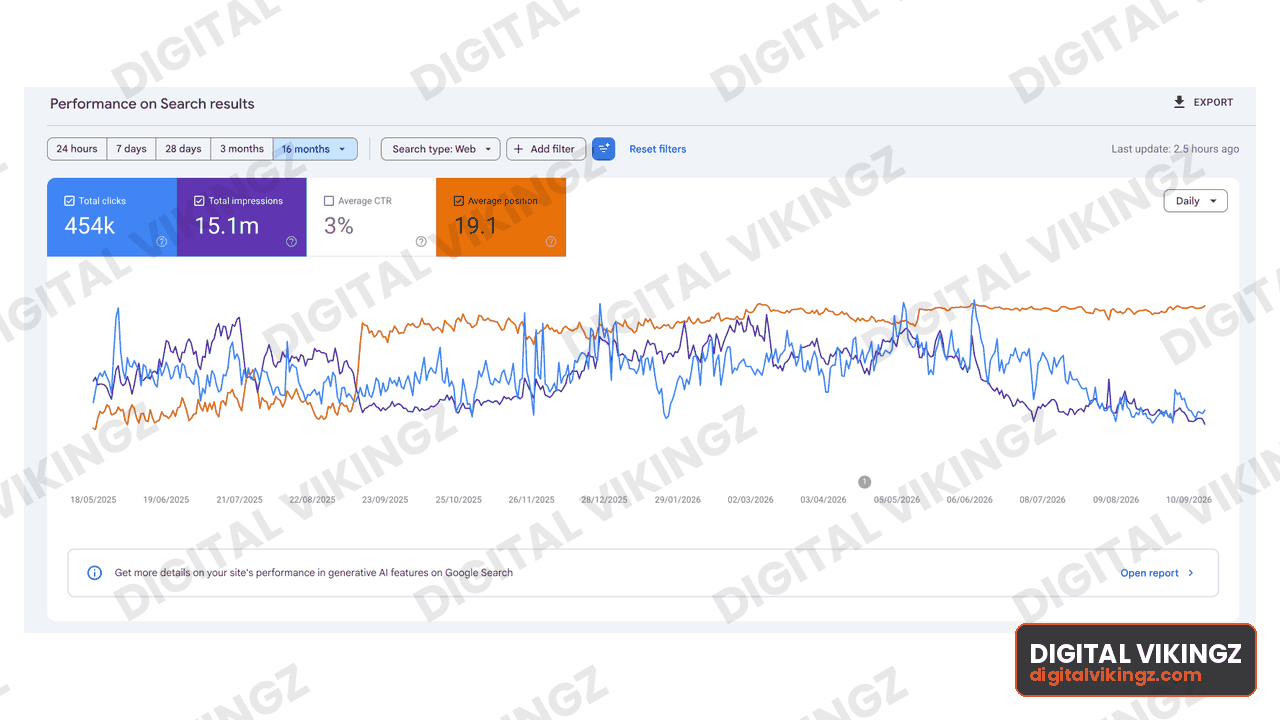
Semantic SEO for ecommerce is measured by revenue per template:
- Clicks per template from Google Search Console, and revenue per template: category, collection, product, guide
- Filter usage as a proxy for listing-page function
- Index coverage: excluded pages falling as filter URLs are consolidated
- Query count per category page as coverage grows
Which services fit an ecommerce website?
Shopify and WooCommerce SEO, the Semantic SEO Audit, Semantic SEO Strategy and SEO Website Development fit most stores.
 Semantic SEO AuditA written issue map of entity coverage, page structure and cannibalization.
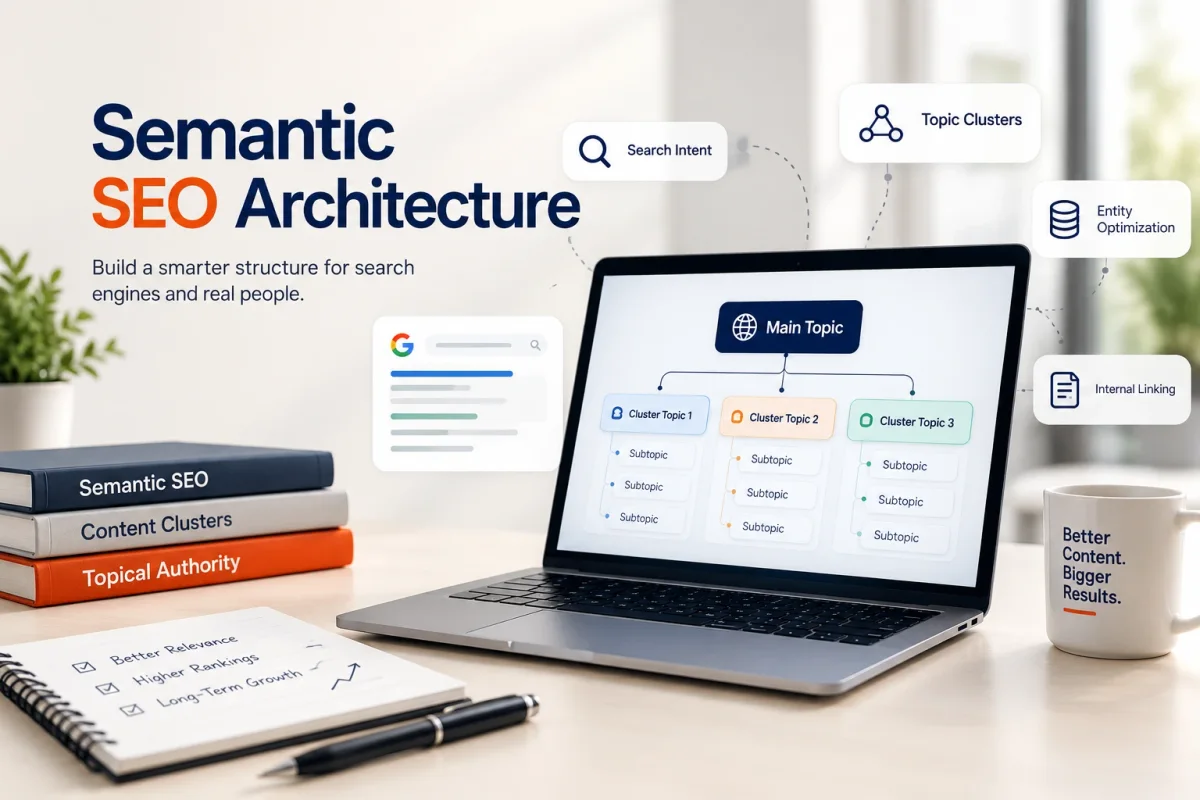 Semantic SEO StrategySource context, topical map and a 12-month roadmap.
 SEO Website DevelopmentStores built from the topical map on Shopify, WooCommerce or Next.js.
 Shopify and WooCommerce SEOCollections, products and guides as one cluster, with product data AI shopping agents can read.
 Query Deserves a PageThe test behind every verdict in the table
 Talk to usMessage the team on WhatsApp
Questions about semantic SEO for ecommerce
What do we do with the thousands of filter URLs already indexed?
Do product descriptions matter if the specs table is complete?
Do best-of pages belong on the blog?
Which platforms do you build on?
Can we use the manufacturer's product descriptions?
What happens to a product page when the item is discontinued?
Which product claims need evidence on the page?
How does a store selling into the US, UK, Germany and the UAE handle currency and language?
We are replatforming. How are product and category URLs kept?
Which structured data types does an ecommerce site use?
Who supplies product data and photography?
Map your site in thirty minutes
Bring your store. The call names its central entity and the first page decisions. Run the free AI Visibility Checker for a first read.