 Digital Vikingz
Semantic SEO for Finance and Fintech
Semantic SEO for finance from Digital Vikingz builds finance and fintech websites around financial products and their typed attributes: rate, fee, term and eligibility. Every commercial page leads with a working calculator or comparison. Every rate and fee carries a date, and each page names the regulator and the author.

Which pages does a finance website need?
A finance website needs product category, rate, calculator, review and comparison pages, plus regulatory guides. The table gives each query pattern its verdict, page type, component and trust element.
| Query pattern | Verdict | Page type | Main component | Trust element |
|---|---|---|---|---|
| [product type] | Page | Product category page | Comparison table ranked by the deciding number, sort rule in text | Regulator named; rates dated |
| best [product type] for [need] | Page | Ranked entity list | Ranked list with the value per item and the scoring source | Score source named; conflicts of interest stated |
| [product type] rates | Page | Rate page | Rate table with date, provider and conditions as columns | Update date at the top; historical rates as a chart |
| [product type] calculator | Page | Tool page | The calculator first, with the default case rendered without JavaScript | Formula stated; assumptions listed |
| [provider] [product] review | Page | Review page | Pros and cons as labeled lists; fee table | Method stated; date; author named |
| [product A] vs [product B] | Page | Comparison page | Two-column typed table with the deciding attribute first | Both entities in each sentence |
| [regulation] explained | Page | Regulatory guide in the outer section | Definition block; who it applies to; dates | Regulator source linked; author credential |
| is [product] worth it, is [provider] safe | Section | FAQ block on the product or review page | One fact per answer; the number and the date | Regulator status as text |
What is the central entity of a finance website?
The financial product is the central entity of a finance website, and it is a set of numbers with a date on each one.
Rate, fee, term, minimum, eligibility and regulator are its attributes. A page that states them as dated text competes, and a page that hides them behind a form or in an image does not. Google patents describe choosing the display from the value type compared, so numbers appear as charts and ranked tables. Each page's main component follows the value type the query asks about.
How do core and outer sections split a finance website?
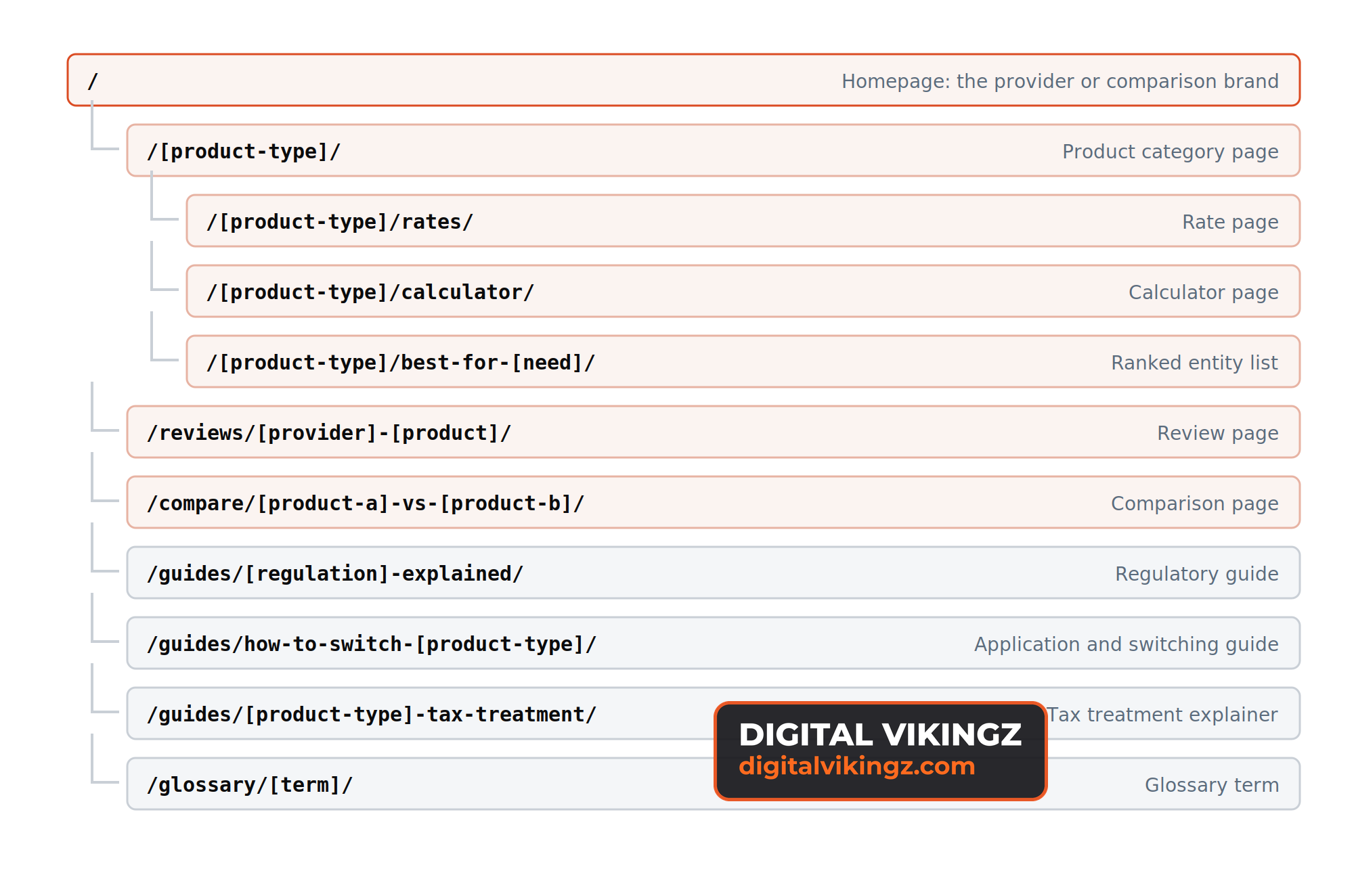
The core section holds the pages that convert. The outer section holds regulatory and how-to guides that link inward.
- Product category pages
- Rate pages
- Calculator pages
- Comparison and review pages
- Regulatory guides
- Glossary of product terms
- How-to guides for applications and switching
- Tax treatment explainers
Where do finance websites go wrong?
Finance websites go wrong with rates hidden in images, script-only calculators and unscored 'best' lists.
A rate the crawler cannot read as text is not on the page, and a rate without a date fails verification.
The main component vanishes with scripts off. The default case renders as HTML, and the script enhances it.
A ranked list without a stated scale and source is an unranked list. The page states what was scored, how, by whom, and where the site earns a commission.
What makes a finance page trustworthy to search engines and buyers?
A finance page earns trust from a named regulator, dated values and disclosed relationships:
- Regulator named on every product page, with the license or registration as text
- Author with financial credential; reviewed-by where the jurisdiction expects it
- Every rate, fee and limit dated in adjacent text
- Commission and affiliate relationships stated on the page
- Identity block: registered entity, address, regulator number
- Calculators with the formula and assumptions visible
What is measured on a finance site?
Semantic SEO for finance is measured per template and tool:
- Clicks per template in Google Search Console: category, rate, calculator, comparison, review
- Calculator completions by page
- Index coverage after rate-page consolidation
- Citations for 'best', 'rates' and 'vs' queries in AI Overviews, ChatGPT and Perplexity
From the results page
No finance property is on the results page yet. The finance architecture uses the same method as the properties shown there.
Which services fit a finance website?
Semantic SEO Strategy, SEO Website Development, Authority Link Building and AI Search Visibility fit most finance websites.
 Semantic SEO StrategySource context, topical map and a 12-month roadmap.
 SEO Website DevelopmentRate, calculator and product templates built from the topical map.
 Authority Link BuildingEntity-aligned links and brand mentions.
 AI Search VisibilitySourced, dated answers that AI assistants can verify and cite.
 Query Deserves a PageThe test behind every verdict in the table
 Talk to usMessage the team on WhatsApp
Questions about semantic SEO for finance
How often do rate pages need updating?
Can affiliate sites use this architecture?
What about jurisdiction-specific products?
Do regulatory guides belong on the blog?
Which financial promotion rules apply to the pages?
Who supplies rates, fees and product data?
Can rate tables update from a feed without breaking the page?
Do translated finance pages need a finance editor in that language?
Which structured data types does a finance site use?
We are merging two brands onto one site. What happens to their rate and review pages?
Do customer reviews of our own firm belong on the site?
Map your site in thirty minutes
Bring your site. The call names its central entity and the first page decisions. Run the free AI Visibility Checker for a first read.