Digital Vikingz
Semantic SEO for Healthcare and Medical Practices
Semantic SEO for healthcare is how Digital Vikingz structures a medical practice website: conditions, treatments, providers and locations built as connected entities. Every clinical page names a credentialed author, and every medical claim carries its source for Google Search and AI answers to verify.

Which pages does a healthcare website need?
A healthcare website needs condition guides, treatment pages, service-location pages and provider profiles. The table gives each query pattern its verdict, page type, component and trust element.
| Query pattern | Verdict | Page type | Main component | Trust element |
|---|---|---|---|---|
| [condition] | Page | Condition guide | Definition block, then symptoms, causes, diagnosis, treatments as typed sections | Credentialed author, reviewed-by line, sources per claim |
| [condition] symptoms | Section | Section on the condition page, unless demand is high and distinct | Symptom list with onset and severity as typed values | Consensus wording from clinical sources |
| [treatment] | Page | Treatment page | What it treats, procedure, recovery and risks as a labeled list | Who performs it, named, with credential |
| [treatment] cost | Section | Section on the treatment page | Cost factors table; range as text with the date | Insurance accepted, as text |
| [specialty] in [city] | Page | Service-location page | Provider cards with credentials, then map and booking | Address, hours, phone as text; Google Business Profile matched |
| [provider name] | Page | Provider profile | Credential, specialty, conditions treated, locations, booking | License number where the jurisdiction allows it |
| [condition] vs [condition] | Section | Section on the more searched condition page | Two-column typed comparison | Both entities in each sentence |
| is [treatment] safe, does [treatment] hurt | Section | FAQ block on the treatment page | Question-answer pairs, one fact per answer | Answer sourced; author named |
What is the central entity of a healthcare website?
The practice is the central entity of a healthcare website, linked to its conditions, treatments and providers.
Google's rater guidelines put medical content in the group where a wrong answer causes harm. Google's generative search patent filing describes rating confidence by how many trustworthy pages agree. Both read the author, the credential, agreement with consensus and a physical place with named providers. The architecture builds those inputs into every template.
Condition
Treatment
Provider
How do core and outer sections split a healthcare website?
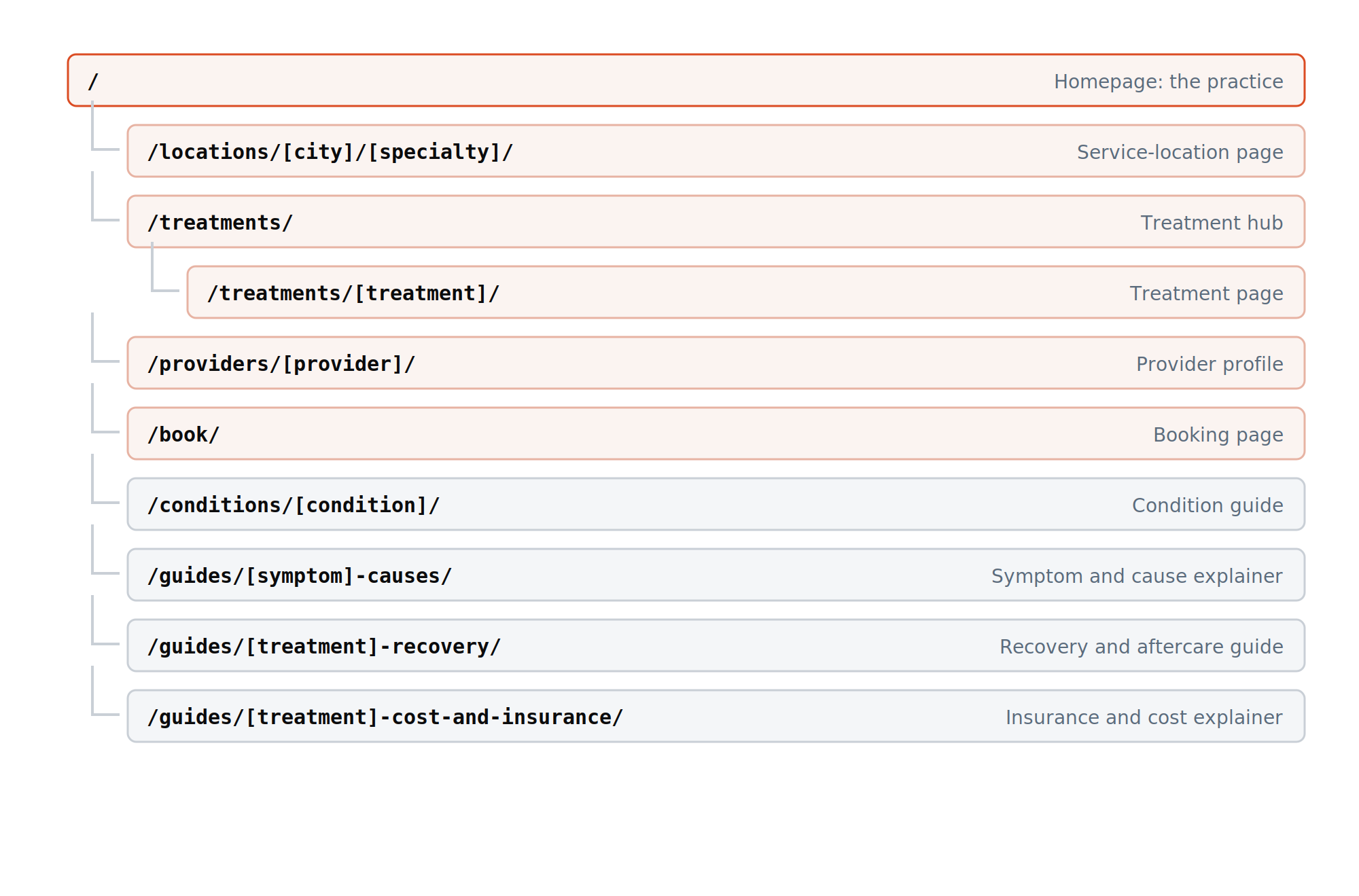
The core section wins bookings. The outer section holds condition and recovery guides that link inward.
- Service-location pages
- Treatment pages
- Provider profiles
- Booking page
- Condition guides
- Symptom and cause explainers
- Recovery and aftercare guides
- Insurance and cost explainers
Where do healthcare websites go wrong?
Healthcare websites go wrong with unreviewed condition pages, copied suburb pages and unsupported claims.
A page with no credentialed author has one fewer trust input than every competitor that names one.
'Physiotherapy in [suburb]' across twelve suburbs fails the page test on demand and similarity. One location page exists per clinic, with the suburbs in a service-area block.
'Our treatment is the most effective option' is a unique claim with no evidence. Consensus claims use consensus wording, and practice claims need the practice data beside them.
What makes a healthcare page trustworthy to search engines and buyers?
A healthcare page earns trust from named, credentialed people and sourced claims:
- Named author with credential on every clinical page
- Reviewed-by line with the reviewer's credential and date
- Source per clinical claim, in the same block
- Provider profiles with credential, specialty and license where allowed
- Identity block: registered practice name, address, phone, regulator
- Google Business Profile matched to the location page token for token
What is measured on a healthcare site?
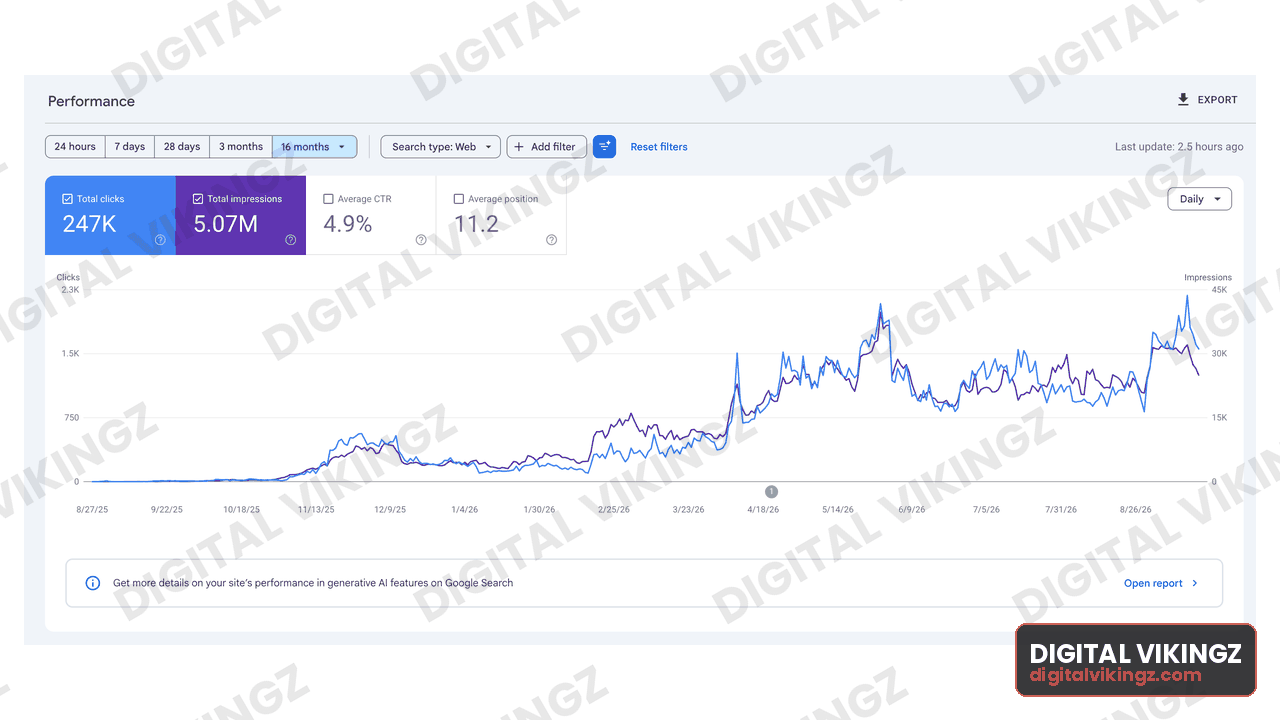
Semantic SEO for healthcare is measured in bookings by template and source page:
- Clicks per template in Google Search Console: condition, treatment, service-location, provider
- Booking form submissions by source page
- Citations for condition and treatment queries in AI Overviews, ChatGPT and Perplexity
- Map pack presence per location, read from the Google Business Profile
Which services fit a healthcare website?
The Semantic SEO Audit, AI Search Visibility, Semantic Content Writing and Local SEO and Google Business Profile fit most practices.
 Semantic SEO AuditA written issue map of entity coverage, page structure and AI citation readiness.
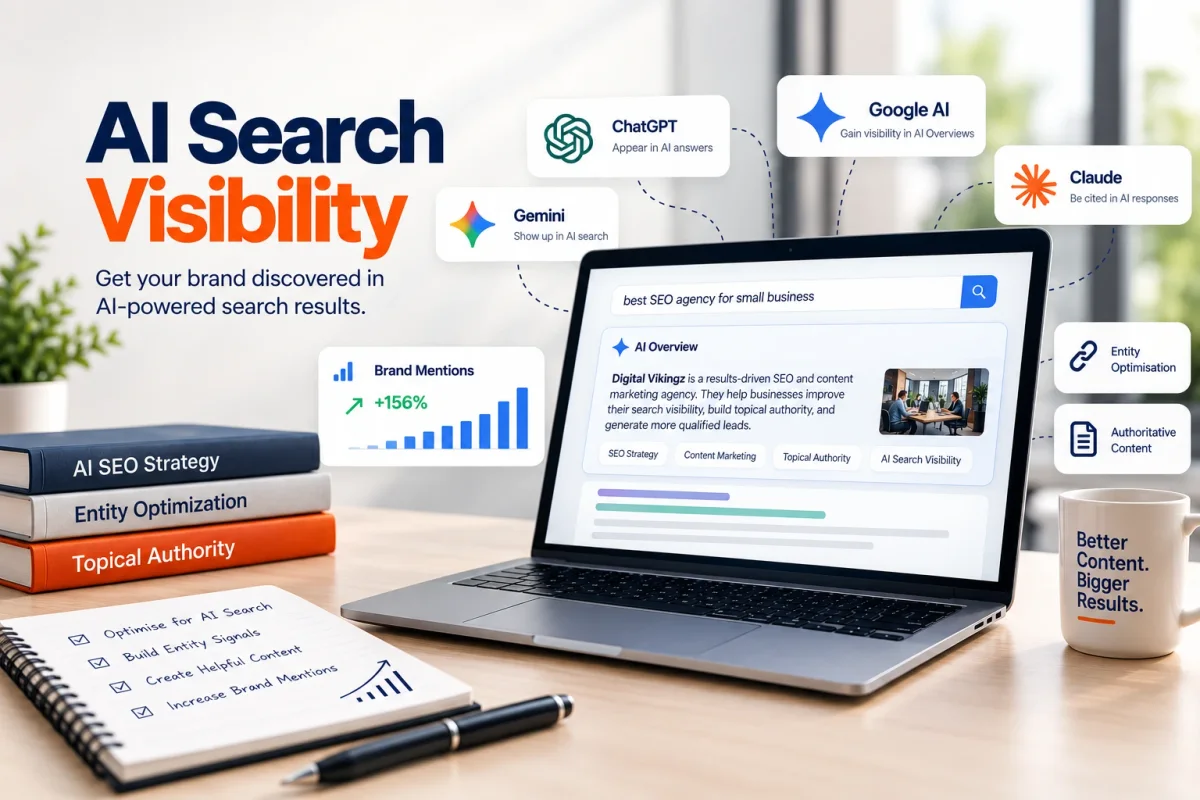 AI Search VisibilityAnswer-first passages and citation tracking in AI Overviews, ChatGPT and Perplexity.
 Semantic Content WritingBriefs and pages in map order, with clinician review of every clinical claim.
 Local SEO and Google Business ProfileOne profile and one page per clinic, stating the same name, address and phone.
 Query Deserves a PageThe test behind every verdict in the table
 Talk to usMessage the team on WhatsApp
Questions about semantic SEO for healthcare
Who writes clinical content, and who reviews it?
Can we rank for a condition without a clinician on staff?
What about telehealth with no physical location?
Do you write in German, Spanish or Italian for clinics abroad?
Which advertising rules apply to a medical practice website?
Can we publish patient testimonials?
Do booking forms on the website raise patient privacy issues?
How are providers who work at several locations shown?
Which structured data types does a medical practice site use?
We are moving to a new website. What happens to existing condition pages?
Can the site stay on our practice-management platform's website builder?
Map your site in thirty minutes
Bring your site. The call names its central entity and the first page decisions. Run the free AI Visibility Checker for a first read.