 Digital Vikingz
What Is Topical Authority?
Topical authority is the state in which a site ranks across the whole network of queries around one topic, assigned by Google to a source that covers the topic with consistent depth and vocabulary over time.
What is the topical authority formula?
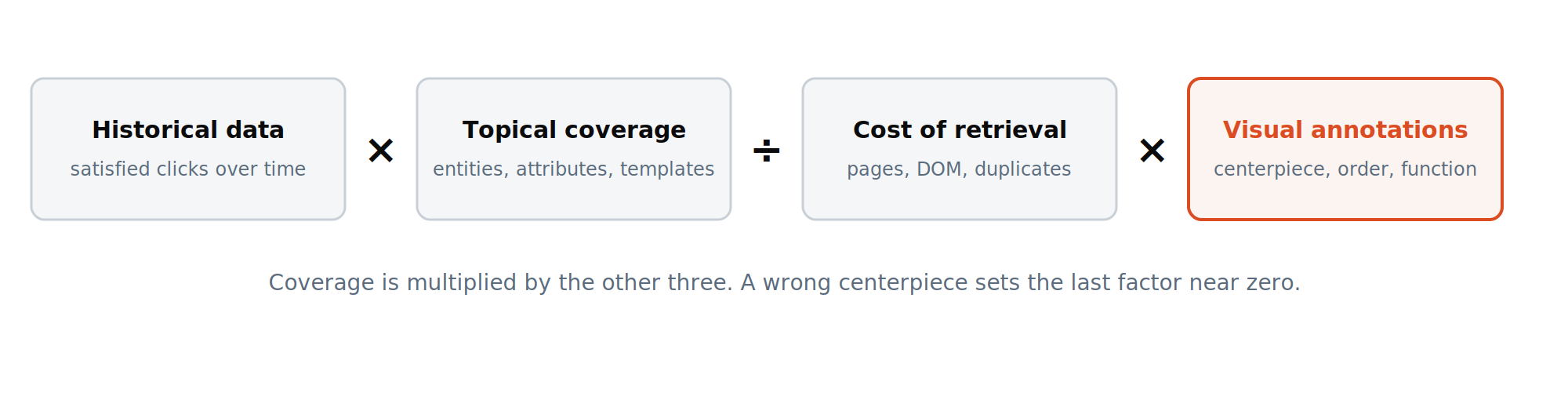
The topical authority formula multiplies historical data by topical coverage, divides by cost of retrieval, and multiplies the result by visual annotations.
The formula is Koray Tuğberk Gübür's, published in his July 2026 article on Search Engine Land. Topical authority is a product, not a sum, so a factor near zero pulls the whole result toward zero. Deep coverage on a broken layout scores low for that reason.
The formula works best as a diagnosis, because each factor points at a different fix: history at clicks over time, coverage at the topical map, cost at pages and templates, annotations at layout. A site that publishes heavily and still stalls usually has coverage to spare and a fault in one of the other three factors.
The divisor, cost of retrieval, charges for every page, script and duplicate a search engine crawls, renders and evaluates.
What do the four factors of topical authority measure?
Each factor measures one thing: earned history, answered scope, understanding cost and declared function.
Historical data is satisfied clicks over time on the topic's queries. Pandu Nayak's testimony in the DOJ trial notes that many documents have no clicks and are ranked on core topicality signals first.
Topical coverage is how much of the topic the site answers: every entity in the class, every attribute and every query template variation. Coverage without a page decision for each topical map node is a pile of pages.
Visual annotations measure if each page's layout declares its function. A wrong main component multiplies the other three factors by a number near zero. One template carries the annotation across every URL built on it.
How is topical authority built with entity classes and query templates?
Topical authority is built by two methodologies, and the strongest sites use both.
The first methodology covers every entity of a class through its shared attributes. Every product has a price, a material and a size, and covering every product through those attributes signals coverage of the whole topic.
The second methodology covers every variation of a query template, such as 'How to [task]' across many tasks or '[Service] in [city]' across many cities. Authority attaches to the format, and the variations need not be topically related. A Google patent on query suggestion templates swaps the entity in grouped past queries for a placeholder such as [city]. Gübür's query templates article describes both methodologies.
The hybrid covers all entities, attributes and template variations in the order the topical map sets. Outer pages answer informational queries and link to the core pages that hold the commercial intents. Each outer page links to its core page with one canonical anchor.
How is topical authority lost?
Topical authority is lost through duplicate pages, vocabulary drift, off-topic publishing and template changes, and one failed factor can reject the whole site.
Two pages for one query split the click history between them. Google's ranking systems guide states that deduplication shows only the most relevant of very similar pages. Publishing off-topic content spends the trust earned on-topic. A template change that moves the main component below a carousel changes the visual annotation on every page at once.
Vocabulary drift is the quiet version of the same failure. One page calls the service a content audit, the next an SEO review and a third a site health check. A search engine sees three weakly connected entities, each holding a third of the coverage. Recovery starts with the failed factor, not with more coverage.
How is topical authority measured in Search Console?
Topical authority is read in Search Console, per template, over months.
Query count per page type is the leading indicator. A category page that ranks for forty queries this month and ninety next month is gaining coverage the engine recognizes. Impressions rise before clicks, and clicks rise before CTR settles.
A site gaining topical authority often shows falling average CTR while clicks climb, because the site starts appearing for many new queries at low positions. Clicks and query count are read together, never CTR alone.
Reports group pages by template, not by URL, because a layout change or a vocabulary fix lands on a template. A template that gains queries while its siblings stall shows which layout works.
- Koray Tuğberk Gübür, Search Engine Land: Visual semantics, the missing piece of topical authority
- Koray Tuğberk Gübür, Search Engine Land: Query templates, expanding the scope of topical authority
- Google Search Central: A guide to Google Search ranking systems
Patents and filings describe systems Google has invented. None is a confirmed ranking factor.
What should you read next about topical authority?
 What is a topical map?Every topic a site will cover, split into a core section that sells and an outer section that teaches.
 What is cost of retrieval?The computing a search engine spends to crawl, render, segment and evaluate a page.
 What is visual semantics?The meaning a search engine reads from layout: block order, component types and typography.
 What is a query template?A repeatable search pattern with a variable entity, such as [service] in [city].
 Semantic SEO StrategySeven documents with a fixed structure. Every engagement produces all seven.
 Authority Link BuildingEach placement passes five gates and is reported in the monthly placements table.
 Talk to usMessage the team on WhatsApp
Questions about topical authority
Does publishing more pages build topical authority?
How long does topical authority take to build?
Can a small site have topical authority?
Do backlinks build topical authority?
Is topical authority a Google ranking factor?
What is the relationship between topical authority and a topical map?
Can topical authority transfer to a new topic?
Do subdomains share topical authority with the root domain?
Does an exact-match domain build topical authority faster?
Do SEO tool authority scores measure topical authority?
Is topical authority judged per page or per site?
See it applied to your site
The Semantic SEO Audit uses every term in the knowledge hub. Fixed scope, written deliverable.