 Digital Vikingz
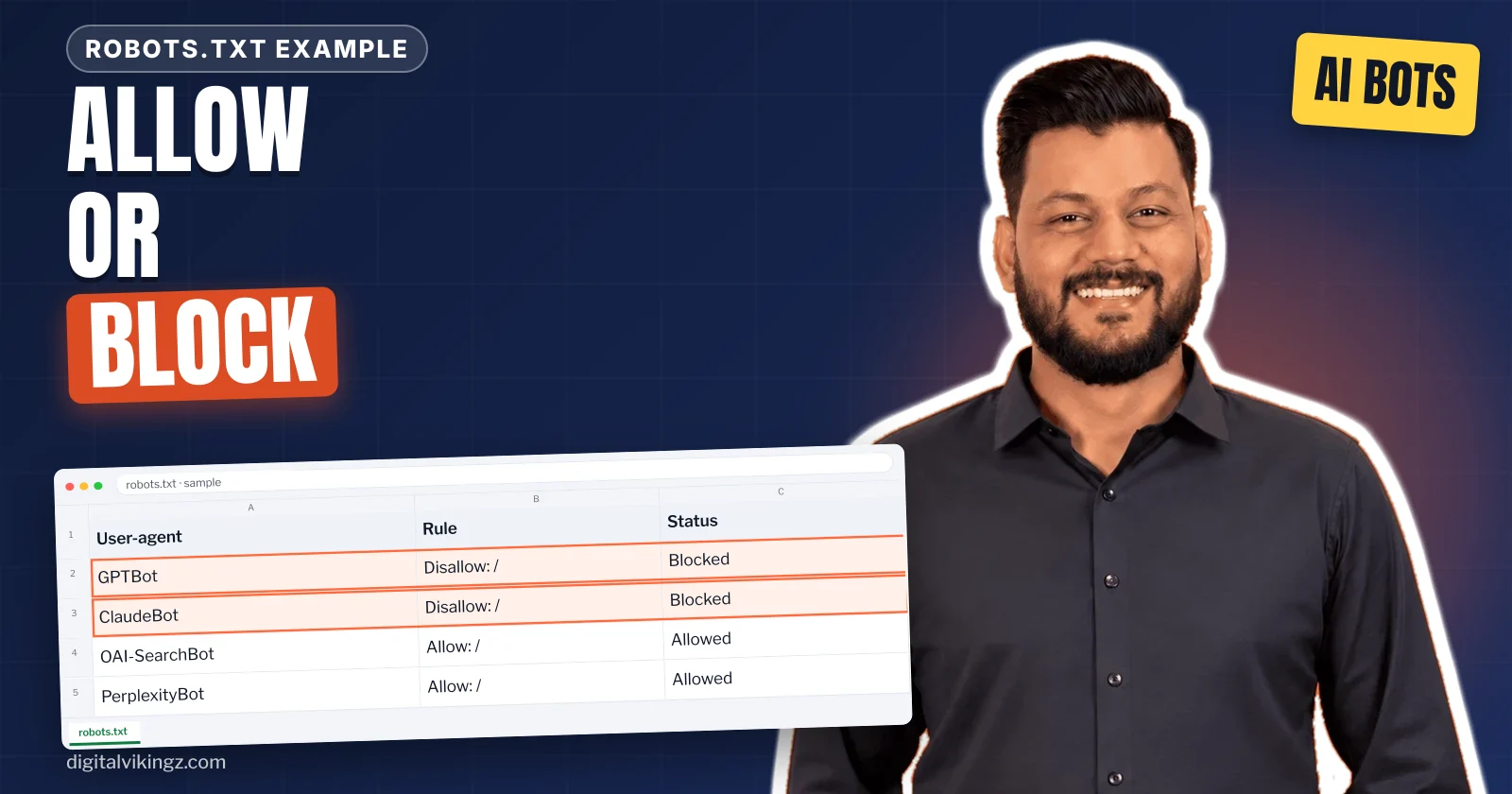
AI crawlers are bots run by AI companies that fetch pages to train models, build search indexes or answer a user's question. Each bot does one of three jobs: training, search or a user-requested fetch. The AI crawlers list below holds 14 bots and control tokens from six operators: OpenAI, Anthropic, Perplexity, Google, Apple and Common Crawl.
Most AI bots respond to robots.txt rules, but user-triggered fetchers may not, and OpenAI does not say for OAI-AdsBot. Block by job: block training bots if you object to training, and allow search bots if you want citations. Four changes cover most sites: pick a split, edit robots.txt, verify the bots in your log and recheck after a day.
What are AI crawlers?
AI crawlers are bots run by AI companies that fetch pages to train models, build search indexes or answer a user's question. Each bot names itself in a user-agent string, and most also read a matching group in robots.txt.
Sample, not a client: a plumber in Austin finds GPTBot in the server log and asks what the bot wants. The question is fair.
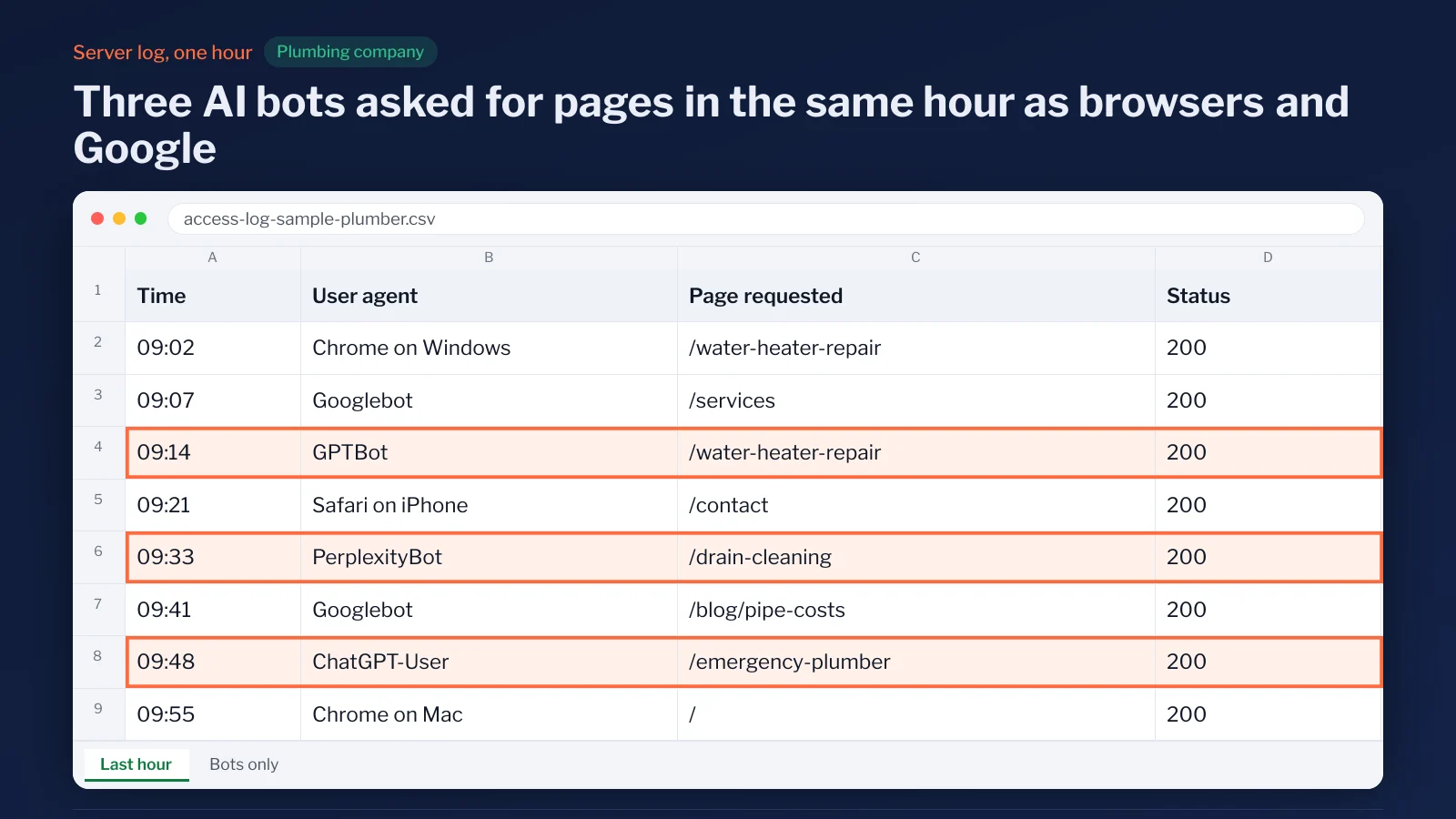
Figure 1 shows a sample server log in which three AI bots request pages within the same hour. The answer depends on the bot's job, and the next sections sort every major bot by job.
How is an AI crawler different from Googlebot?
Googlebot crawls pages to build the Google Search index, while an AI crawler may train a model or fetch a page for an answer. Google-Extended is a robots.txt token, and Google says the token does not affect inclusion in Google Search.
Blocking GPTBot or ClaudeBot does not block Googlebot, because each bot reads its own robots.txt group. Search stays untouched.
The three jobs an AI crawler can do
An AI crawler does one of three jobs: training, search or a user-requested fetch. The three jobs are listed below:
- Training crawlers collect pages that may train a model; examples are GPTBot and ClaudeBot.
- Search crawlers index pages so an AI answer can name them; examples are OAI-SearchBot and PerplexityBot.
- User-triggered fetchers visit one page because a person asked; examples are ChatGPT-User and Perplexity-User.
Jobs come first, names second. The job decides the decision, because blocking a training bot and blocking a search bot have different costs. Search crawlers and fetchers decide if an assistant can name your page, as covered in how AI search engines pick the sources they cite.
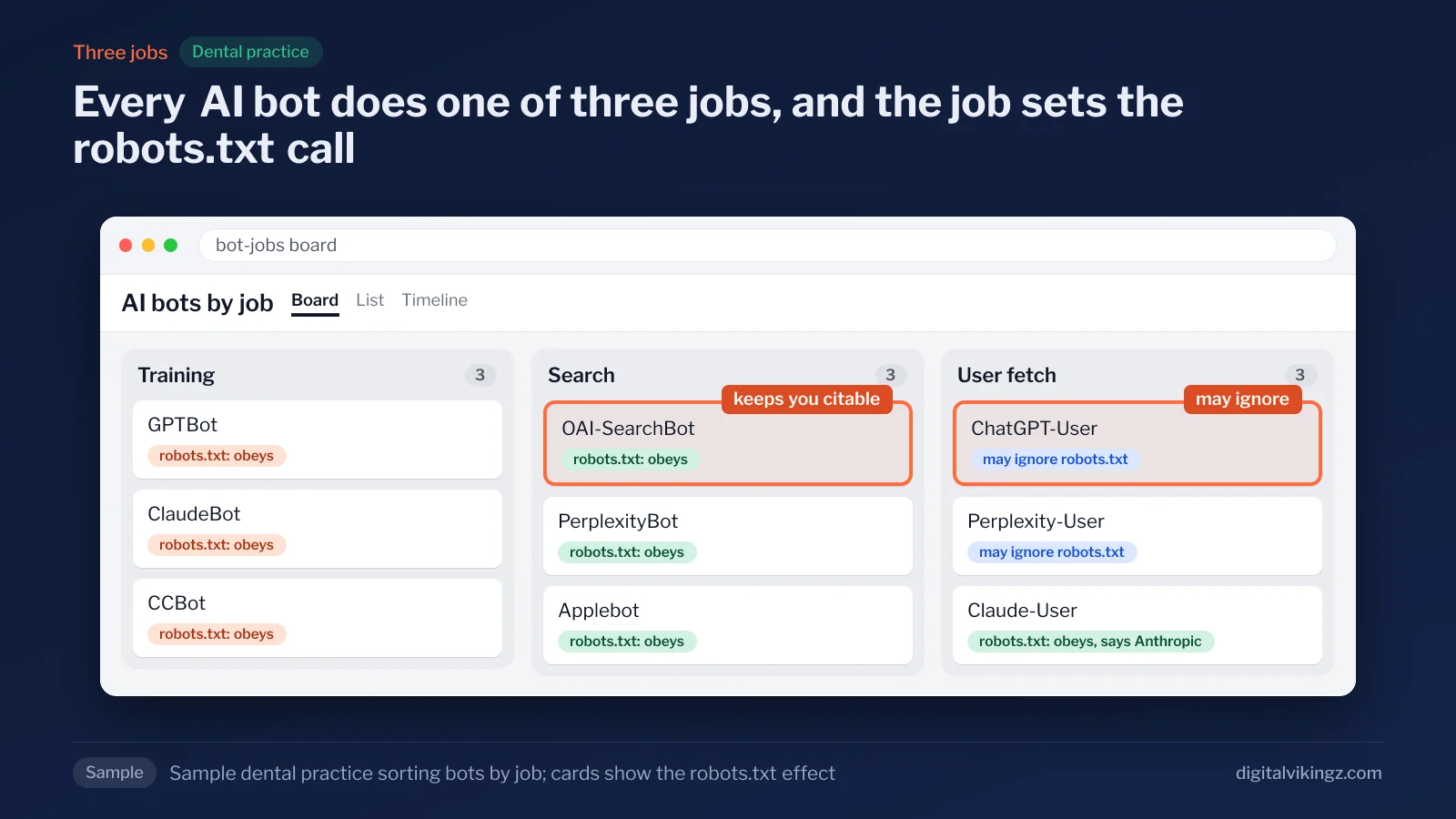
Figure 2 sorts the main bots into the three jobs.
Which AI crawlers are on the list?
AI crawlers on the list number 14 bots and control tokens from six operators: OpenAI, Anthropic, Perplexity, Google, Apple and Common Crawl. The table gives each bot's operator, job and robots.txt behaviour, as the operator describes them.
| Bot | Operator | Job | robots.txt behaviour |
|---|---|---|---|
| GPTBot | OpenAI | Training | Obeys; disallow signals no training |
| OAI-SearchBot | OpenAI | Search | Obeys |
| ChatGPT-User | OpenAI | User fetch | Rules may not apply |
| OAI-AdsBot | OpenAI | Ad landing page check | Not stated |
| ClaudeBot | Anthropic | Training | Honours it; supports Crawl-delay |
| Claude-SearchBot | Anthropic | Search | Honours it |
| Claude-User | Anthropic | User fetch | Honours it, says Anthropic |
| PerplexityBot | Perplexity | Search | Managed there; allowing recommended |
| Perplexity-User | Perplexity | User fetch | Generally ignores it |
| Google-Extended | Control token (Gemini) | Token; no user agent of its own | |
| Google-CloudVertexBot | Vertex AI Agents crawl | Own token | |
| Applebot | Apple | Search | Obeys; data may feed training |
| Applebot-Extended | Apple | Control token (Apple) | Token; opts out of training |
| CCBot | Common Crawl | Open web archive | Blockable with a rule |
Table 1. The 14 bots and tokens we counted on 22 November 2026.
Fourteen rows, six operators. We read each operator's page on 22 November 2026. Names and version numbers change, so check the operator's page again before you edit a file.
OpenAI: GPTBot, OAI-SearchBot and ChatGPT-User
OpenAI runs three bots you will see in logs: GPTBot for training, OAI-SearchBot for search and ChatGPT-User for user requests. A fourth bot, OAI-AdsBot, checks pages submitted as ChatGPT ads and does not train models, according to OpenAI. OpenAI says each setting is independent, so a site can allow OAI-SearchBot and disallow GPTBot.
Read the string as well as the name. OpenAI gives a full user-agent string for each bot and notes that version numbers may change. The GPTBot string, for example, ends with GPTBot/1.4; +https://openai.com/gptbot.
Anthropic: ClaudeBot, Claude-SearchBot and Claude-User
Anthropic runs three bots: ClaudeBot for training data, Claude-SearchBot for search quality and Claude-User for user requests. Anthropic's help article lists the bot names and what disabling each one does, but gives no full user-agent strings.
Anthropic says its bots honour robots.txt and support the Crawl-delay extension. Disabling Claude-User or Claude-SearchBot may reduce your visibility in Claude search results, according to Anthropic. We print no strings for Anthropic.
Perplexity: PerplexityBot and Perplexity-User
Perplexity runs two bots: PerplexityBot surfaces and links sites in Perplexity search, and Perplexity-User fetches a page for one question. Perplexity says PerplexityBot is not used to crawl content for AI foundation models, and it recommends allowing the bot in robots.txt if you want to appear in its results.
Perplexity-User generally ignores robots.txt rules, because a user asked for the fetch. Once PerplexityBot is in, the next question is how Perplexity chooses its sources.
Google: Google-Extended and Google-CloudVertexBot
Google-Extended is a robots.txt token, not a crawler, that controls Gemini training and grounding use of content Google already crawls. Google says Google-Extended does not affect inclusion in Google Search and is not a ranking signal. A token never visits, so no log line carries its name.
Google-CloudVertexBot has its own token and only affects crawls that site owners request for building Vertex AI Agents. Google also lists user-triggered fetchers, such as Google-Agent, that generally ignore robots.txt.
Apple and Common Crawl: Applebot-Extended and CCBot
Applebot-Extended and CCBot are the two other names on the list: Applebot-Extended covers Apple training, and CCBot builds the Common Crawl archive. Apple says disallowing Applebot-Extended keeps content out of Apple model training while Applebot still crawls for search, and you can confirm Applebot by reverse DNS in the applebot.apple.com domain.
Common Crawl says CCBot runs on dedicated IP ranges with reverse DNS and uses its own named string, CCBot/2.0 (https://commoncrawl.org/faq/). Common Crawl's archive is open to researchers and others, which is why CCBot appears on AI crawler lists.
Which AI crawlers obey robots.txt?
Training and search crawlers on the list respond to robots.txt rules, while user-triggered fetchers may not and OpenAI does not say for OAI-AdsBot. Anthropic says all of its bots honour robots.txt, including Claude-User. OpenAI and Perplexity say their user fetchers may ignore robots.txt, because a person starts the request.
One bot stays unknown. OpenAI does not state robots.txt behaviour for OAI-AdsBot, so treat the answer for that bot as unknown. Sample, not a client: an owner disallows ChatGPT-User, then reads on OpenAI's page that robots.txt rules may not apply.
Do user-triggered fetchers obey robots.txt?
No, user-triggered fetchers such as ChatGPT-User and Perplexity-User may ignore robots.txt, because a person starts each fetch. Anthropic is the exception among these operators: it says Claude-User honours robots.txt.
Robots.txt is a request, not a lock. A firewall rule or a login should control a fetcher's access to a page, because robots.txt may not stop the bot. Blocking a fetcher also stops an assistant from reading your page when a user asks about you.
How do you verify an AI bot?
Check an AI bot by matching its user-agent string to the operator's published IP list, because any client can copy a user-agent name. Google says a user-agent string can be spoofed, and Common Crawl says other crawlers falsely use the CCBot name.
Sample: a log line says GPTBot/1.4, but the address sits outside OpenAI's list, so the visitor is not GPTBot.
The checks to run are listed below:
- Find the request in your server log and copy the IP address and the user-agent string.
- Open the operator's IP list, such as openai.com/gptbot.json or claude.com/crawling/bots.json.
- Match the IP address to the list, or run a reverse DNS lookup for Applebot and CCBot, which publish hostnames.
- Treat a mismatch as a fake bot and block that address at the firewall.
Never trust the name alone.
Anthropic adds that blocking by IP may break its own robots.txt reads, so use robots.txt to opt out and IP lists to verify.
Should you block AI crawlers?
Block AI crawlers by job: block training bots if you object to training, and allow search bots if you want citations. Each job has a different cost, so the choice is one decision per bot group and not one switch for all.
No public source shows how much a training crawl changes which brands an assistant names, so treat that effect as unknown. The next sections take the groups one at a time.
Training crawlers: what blocking changes
Blocking a training crawler tells the AI company to leave your pages out of model training. Anthropic says a ClaudeBot block covers future materials, so earlier crawls may remain in training data.
You should block GPTBot, ClaudeBot, Google-Extended, Applebot-Extended and CCBot if you object to model training. Sample, not a client: a publisher of paid reports blocks the training bots so the reports stay out of model training. The call is one of principle.
Search crawlers and fetchers: what blocking removes
Blocking search crawlers and user fetchers removes your pages from the AI answers those bots serve. OpenAI says sites opted out of OAI-SearchBot will not appear in ChatGPT search answers, though they can still show as navigational links. Anthropic says disabling Claude-SearchBot may reduce your visibility and accuracy in Claude search results.
Perplexity recommends allowing PerplexityBot to appear in Perplexity results. Allowing a search bot makes a citation possible and promises none. An off-site AI visibility audit shows which sources assistants cite for your buyers, so you can judge what a block would remove.
A starting split for most business sites
Most business sites should keep search crawlers open and decide the training crawlers on principle. The table pairs each goal with the bots to allow and the bots to block, from the operators' own descriptions.
| Goal | Allow | Block |
|---|---|---|
| Be named in AI answers | OAI-SearchBot, PerplexityBot, Claude-SearchBot, Claude-User | Nothing |
| Keep content out of model training | The search bots | GPTBot, ClaudeBot, Google-Extended, Applebot-Extended, CCBot |
| Keep paid or private pages out of every AI product | None | Every AI bot, plus a login or firewall rule for the fetchers |
Table 2. A starting split by goal.
Pick one row per site section, since a pricing page and a members area have different goals. Operators change bot behaviour, so recheck their pages before each change.
What our own robots.txt allows
Our robots.txt names eight bots, and each group has Allow: / with Disallow: /api/. Seven of them sit on Table 1. The eighth, Amazonbot, does not.
Each group also repeats a longer list of Disallow lines for admin paths and tracking parameters.
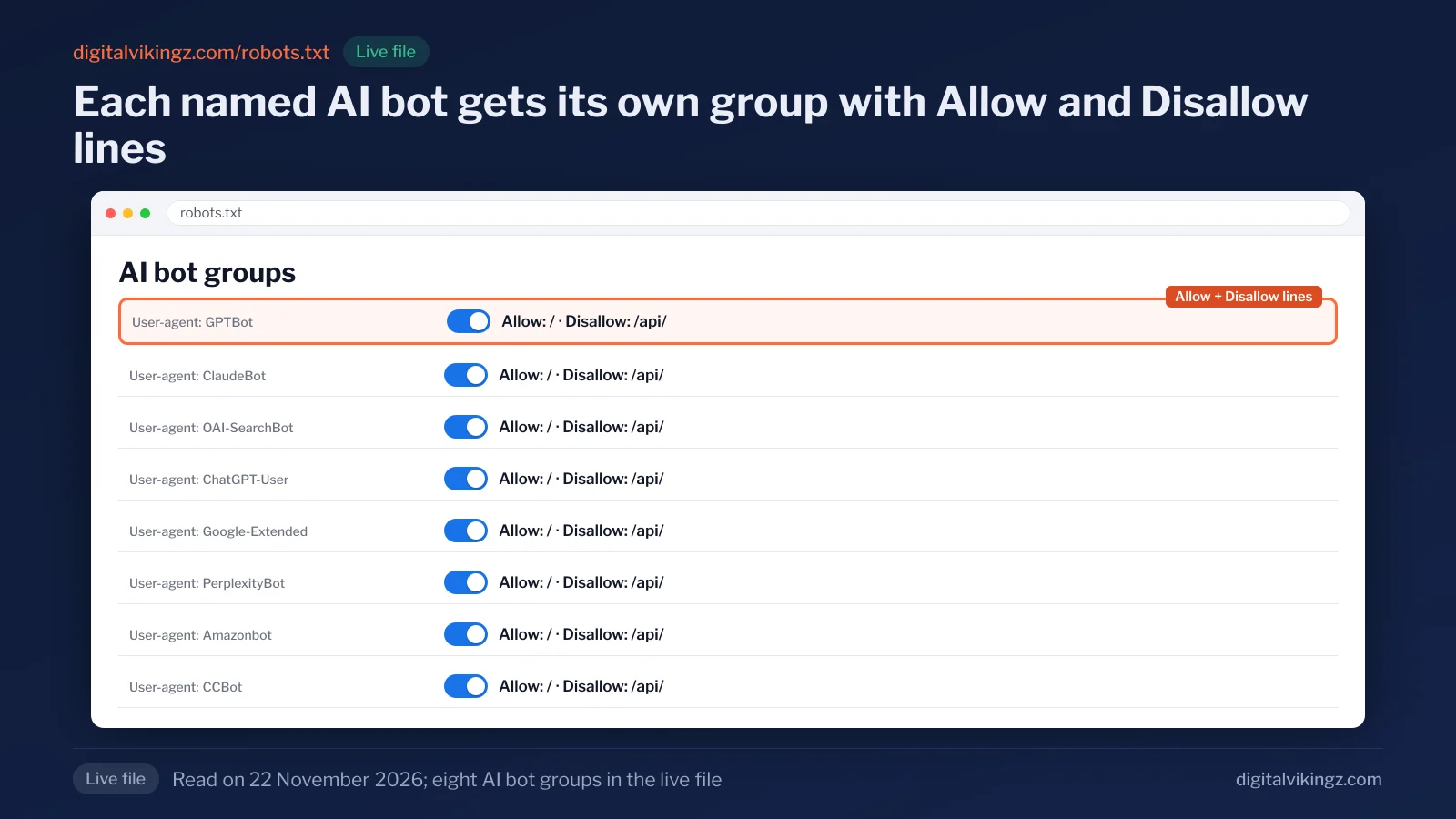
Figure 3 shows the AI bot groups in digitalvikingz.com/robots.txt, read on 22 November 2026. The groups are GPTBot, ClaudeBot, OAI-SearchBot, ChatGPT-User, Google-Extended, PerplexityBot, Amazonbot and CCBot.
Bots without a named group, such as Claude-SearchBot and Perplexity-User, follow the general group, which allows them. We allow every AI bot because we want to be named in AI answers, and we have no test showing a traffic effect.
Which robots.txt rules should you copy?
Three robots.txt setups cover most sites: allow every AI crawler, block training crawlers only, or block every AI crawler. Each group names a user-agent token, and the group's rules apply to that bot only. Pick one setup, then copy the block.
Allow every AI crawler
Allowing every AI crawler means naming each token in a group and giving the group Allow: /. The rules to allow every AI bot are given below:
User-agent: GPTBot
User-agent: OAI-SearchBot
User-agent: ChatGPT-User
User-agent: ClaudeBot
User-agent: Claude-SearchBot
User-agent: Claude-User
User-agent: PerplexityBot
User-agent: Perplexity-User
User-agent: Google-Extended
User-agent: Applebot-Extended
User-agent: CCBot
Allow: /
Paste the block as written.
Block training crawlers only
Blocking training crawlers only means giving GPTBot, ClaudeBot, Google-Extended, Applebot-Extended and CCBot a Disallow: / rule. The rules to block training crawlers are given below:
User-agent: GPTBot
User-agent: ClaudeBot
User-agent: Google-Extended
User-agent: Applebot-Extended
User-agent: CCBot
Disallow: /
Search and fetch bots keep their current access, so OAI-SearchBot and PerplexityBot still reach your pages.
Block every AI crawler
Blocking every AI crawler means adding a Disallow: / rule for each AI token you want stopped, including the search bots. The rules to block every AI bot are given below:
User-agent: GPTBot
User-agent: OAI-SearchBot
User-agent: ChatGPT-User
User-agent: ClaudeBot
User-agent: Claude-SearchBot
User-agent: Claude-User
User-agent: PerplexityBot
User-agent: Perplexity-User
User-agent: Google-Extended
User-agent: Applebot-Extended
User-agent: CCBot
Disallow: /
OAI-AdsBot and Google-CloudVertexBot are not in this block; add them if you want them stopped.
A full block costs the search visibility covered in the previous section. User-triggered fetchers may still reach the page, so add a firewall rule for any bot you must stop.
What else touches AI access besides robots.txt?
Four other controls touch AI access: llms.txt, no-training preference signals, agent fetchers and firewall or login rules. Each of them ties back to the bots in Table 1, so the decision above still applies.
How is robots.txt different from llms.txt?
Robots.txt sets which crawlers may fetch which URLs, while llms.txt only points AI agents to key pages and controls no access. A site can publish both files, because each file answers a different reader.
Robots.txt follows the Robots Exclusion Protocol, a published standard for crawler rules. Our guide to what llms.txt is and what a business should put in the file covers the format in full.
New no-training preference signals
Anthropic began recognising a machine-readable no-training signal on 30 October 2026, based on an IETF aipref draft, and the rollout continues. A robots.txt rule that names ClaudeBot takes priority over the general signal, according to Anthropic. Google plans to support the AIPREF training signal in early 2027, according to its crawler documentation.
The standard is still a draft, so keep your robots.txt rules and treat the signal as an addition. Anthropic says the signal is rolling out across all Anthropic services over time and globally.
AI agents and hosted browsers
Operators list agent fetchers such as Google-Agent and Claude-Agent apart from their crawlers, because a user starts each task. Google says Google-Agent is used by agents hosted on Google infrastructure to act on a user's request. Anthropic documents Claude-Agent, a browser Anthropic hosts, in a separate help article.
Google's user-triggered fetchers generally ignore robots.txt, so plan any control for agents at the firewall or login. Google-Agent uses IP ranges from user-triggered-agents.json, Google says. Google is also experimenting with the Web Bot Auth protocol, using the agent.bot.goog identity.
Operators add agents often, so we list only the ones documented on 22 November 2026. The list will change.
How do firewalls and rate limits change what robots.txt does?
A firewall or CDN bot rule can block a crawler even when robots.txt allows the crawler. Perplexity says a web application firewall may need an explicit rule to let PerplexityBot and Perplexity-User in. Cloudflare's Bot Fight Mode cannot be skipped with a WAF rule and can still challenge its bots, Perplexity says.
Each operator publishes IP lists, so a rule can match the user-agent and the IP range together. Sample, not a client: a store on Cloudflare allows PerplexityBot in robots.txt but still challenges the bot at the edge.
Place the skip rule above any custom rule that blocks or challenges requests, says Perplexity's Cloudflare guide. The guide sets the rule action to Skip and lists the security features to bypass. Perplexity's AWS WAF guide matches each user-agent with its own IP set.
Anthropic says the company aims to crawl without disruption and respects Crawl-delay where appropriate. A rate limit at the firewall can slow a bot that does not support Crawl-delay. Anthropic supports Crawl-delay for ClaudeBot, for example Crawl-delay: 1.
How do you check what your site allows today?
Check what your site allows by reading your robots.txt, your server log and your firewall rules, in that order. A robots.txt that allows a bot does not help if a firewall blocks the same bot.
The steps to check your site are listed below:
- Open yourdomain.com/robots.txt and read the group for each bot in Table 1.
- Search your server log for each bot name and note the status code each request received.
- Check your CDN and firewall for bot rules that override robots.txt.
Sample, not a client: a dental clinic site on a managed host allows GPTBot in robots.txt while the host returns a 403 error. Run the AI Visibility Checker for AI bot access to test Google, Bing and the AI crawlers behind ChatGPT and Claude.
Four changes to make this week
Four changes cover most sites: pick a split, edit robots.txt, verify the bots in your log and recheck after a day. Do them in that order. The four changes are listed below:
- Pick one row from Table 2 for each section of the site.
- Edit robots.txt with the matching setup and save the file at the top level of each host.
- Verify every bot in your log against the operator's IP list, and check that no firewall rule overrides your robots.txt.
- Recheck the log and the AI Visibility Checker after about 24 hours, because OpenAI says search systems need that long to adjust.
We run monthly citation checks inside AI Search Visibility against a fixed prompt set, and we quote the scope in writing after a strategy call.
FAQ: Questions about AI crawlers
Is GPTBot the same as ChatGPT-User?
No, GPTBot collects content that may train OpenAI models, while ChatGPT-User fetches one page when a user asks.
Does blocking GPTBot remove my site from ChatGPT?
No, OpenAI says GPTBot covers training and OAI-SearchBot decides if a site appears in ChatGPT search results.
Does Google-Extended affect my Google rankings?
No, Google says Google-Extended does not affect inclusion in Google Search and is not a ranking signal.
Does PerplexityBot train AI models?
No, Perplexity says PerplexityBot is not used to crawl content for AI foundation models.
How long do robots.txt changes take to work?
OpenAI and Perplexity say their systems can take about 24 hours to reflect a change, and the other operator pages we read state no time.
Do I need a separate robots.txt for each subdomain?
Yes, Anthropic says to add the rules to the robots.txt of every subdomain you want to opt out from.
Does blocking Applebot-Extended remove my site from Siri?
No, Apple says disallowing Applebot-Extended keeps pages out of training, and your content stays discoverable in Spotlight, Siri and Safari.
Start with the goal table
Start with the goal table, edit robots.txt and check your log tomorrow. We built this AI crawlers list from the operators' own pages, so read those pages again before each change. The wider plan for being cited is in our guide to how AI SEO works and how to get cited.