 Digital Vikingz
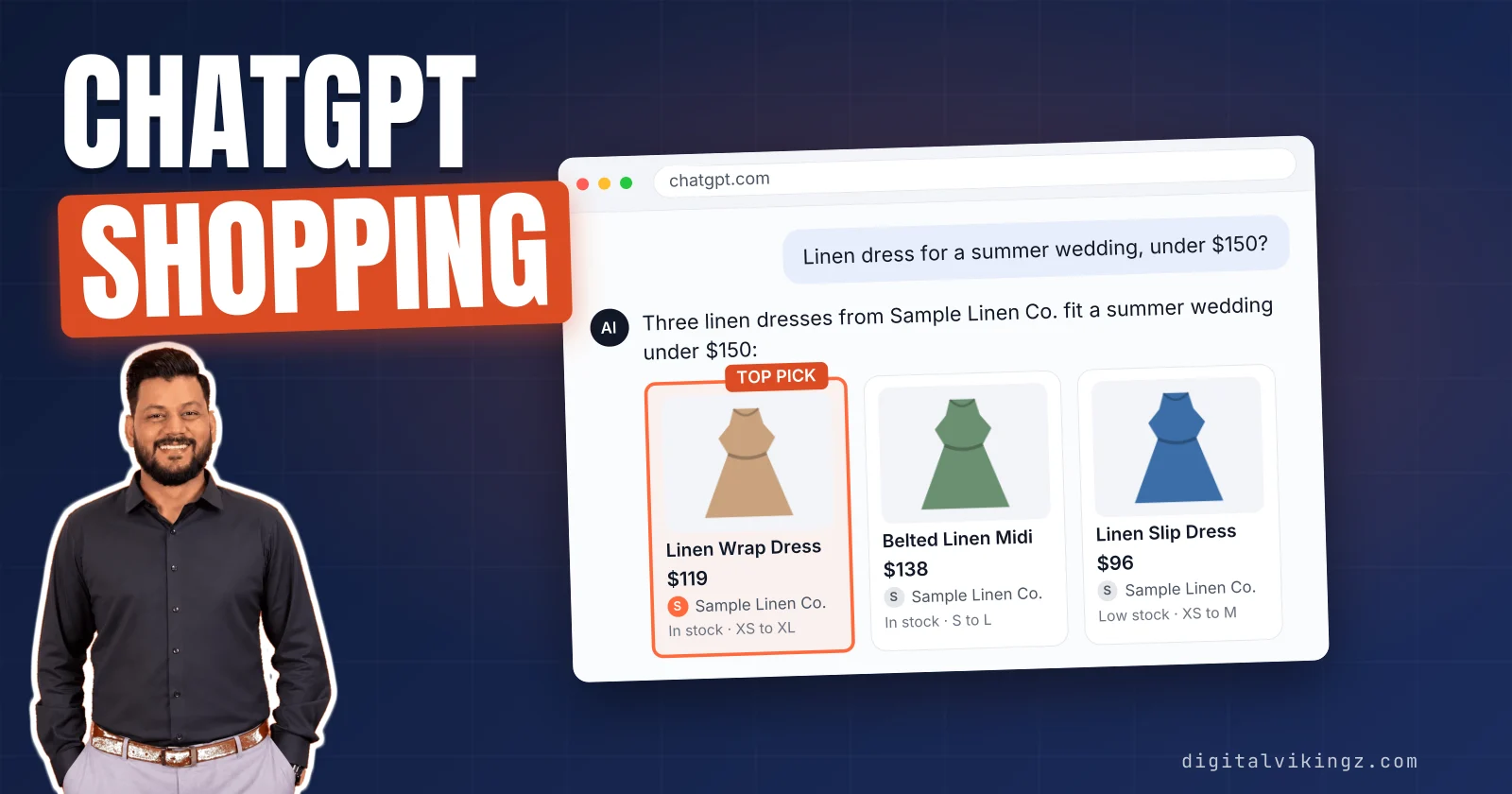
ChatGPT shopping is the product discovery feature in ChatGPT that shows product results with images, prices and buying links for shopping questions. ChatGPT chooses products to recommend in two steps: matching products to the shopper's question, then ranking the stores that sell each product.
ChatGPT ranks stores that sell the same product by availability, price, quality and whether each store is the maker or primary seller. ChatGPT gets product data from four routes: Shopify Catalog, direct merchant feeds, third-party data providers and crawled web pages.
Crawled pages follow the crawler rules in our guide on how new brands get cited by ChatGPT. Shopify products get into ChatGPT through Shopify Catalog, which shares eligible products with ChatGPT by default through Shopify agentic storefronts.
Shopify stores can sell on ChatGPT when the store sells to US customers, the products meet Shopify Catalog rules and the store policies are complete. A Shopify store gets products recommended by ChatGPT by writing complete product data, keeping price and stock accurate, and earning reviews and crawler access.
Buying guides that compare models by attribute are the method in the mattress retailer SEO case study. Seven Shopify product fields carry the details ChatGPT shows and compares: title, description, variants, price, inventory, images and store policies.
Attribute-led product pages are the method in the women's fashion boutique SEO case study. ChatGPT shopping went through four changes from September 2025 to March 2026, ending with checkout on merchant sites and Shopify stores included by default.
Monthly upkeep of product data, prices and policies is the work of Shopify and WooCommerce SEO for AI shopping. ChatGPT does not charge a fee on Shopify orders: Shopify states that selling in ChatGPT carries only the store's standard payment processing fees.
Buyer prompts, run as a five-step check of what ChatGPT says about your business, show which products and stores appear. A Shopify store starts with ChatGPT shopping by confirming Shopify Catalog access, then fixing the product data ChatGPT compares and checking results with buyer prompts.
Product price, stock, shipping and returns are part of the store checks in the AI Visibility Checker for store pages.
What is ChatGPT shopping?
ChatGPT shopping is the product discovery feature in ChatGPT that shows product results with images, prices and buying links for shopping questions. ChatGPT shows product results when a question signals shopping intent, such as a request for a gift or a product under a set budget.
Each result can carry product details, a review summary and the list of stores that sell the item. Each buying link sends the shopper to a store that sells the product. Shoppers also call the feature ChatGPT shopping mode or the ChatGPT shopping assistant.
A store owner meets buyers in product results before those buyers reach the store's own pages. The product data a store publishes shapes how the store appears in those results. ChatGPT shopping also includes a guided mode for bigger purchases, called shopping research.
What does ChatGPT shopping research do?
ChatGPT shopping research builds a personalized buyer's guide by asking follow-up questions and comparing products across the web. OpenAI launched shopping research for logged-in users on the Free, Go, Plus and Pro plans.
The shopper describes the need, answers clarifying questions and receives the guide after a few minutes. A buyer's guide compares products attribute by attribute, so a missing attribute can leave a product out of the comparison.
Product data that states size, material and price in text gives the guide more attributes to compare. Shopping research and quick answers both show organic product results, kept apart from ads.
Are ChatGPT shopping results ads?
ChatGPT shopping results are not ads: OpenAI states that product results are organic and that ads are separate. Paid placements in ChatGPT run as separate ads, and the sections below cover only organic product results.
A store therefore earns a place in product results through the quality of its product data. Product data, reviews and store details decide the organic results, through two steps.
How does ChatGPT choose which products to recommend?
ChatGPT chooses products to recommend in two steps: matching products to the shopper's question, then ranking the stores that sell each product.
The four inputs ChatGPT considers when matching products to a question are listed below:
- Query and context: the shopper's question, plus context such as Memory and custom instructions, shapes which products ChatGPT surfaces.
- Structured product data: price, product description and other metadata come from first-party and third-party providers, with other third-party content about the product.
- Earlier model responses: the answer ChatGPT generates before any new search results can shape which products appear.
- OpenAI policies: safety standards and product policies keep some products, such as prohibited items, out of ChatGPT product results.
OpenAI notes that the weight of each input depends on the request, so a stated budget shifts the focus to price.
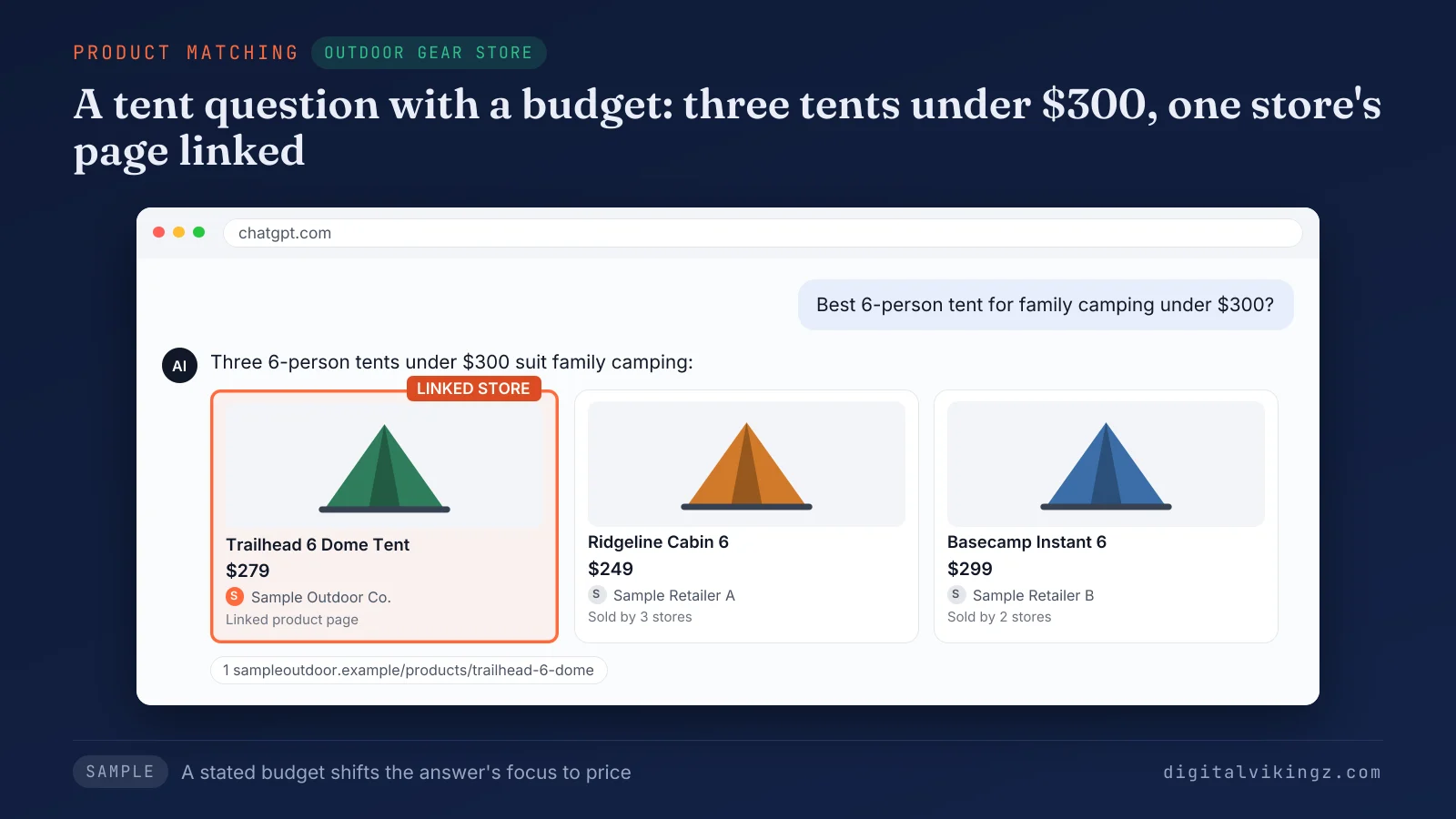
The sample answer to a 6-person tent question under $300 lists three tents and links Sample Outdoor Co. as one seller.
The second step, ranking stores, decides which seller of a product a shopper sees first in the answer.
How does ChatGPT rank stores that sell the same product?
ChatGPT ranks stores that sell the same product by availability, price, quality and whether each store is the maker or primary seller. The merchant list appears after a shopper selects a product and draws on data from third-party providers or the merchants.
The first price in an answer usually comes from the first merchant listed. A Best price label marks the lowest price ChatGPT knows when several stores sell the item. The four merchant factors appear on OpenAI's help page on shopping with ChatGPT search, which notes that rankings will evolve.
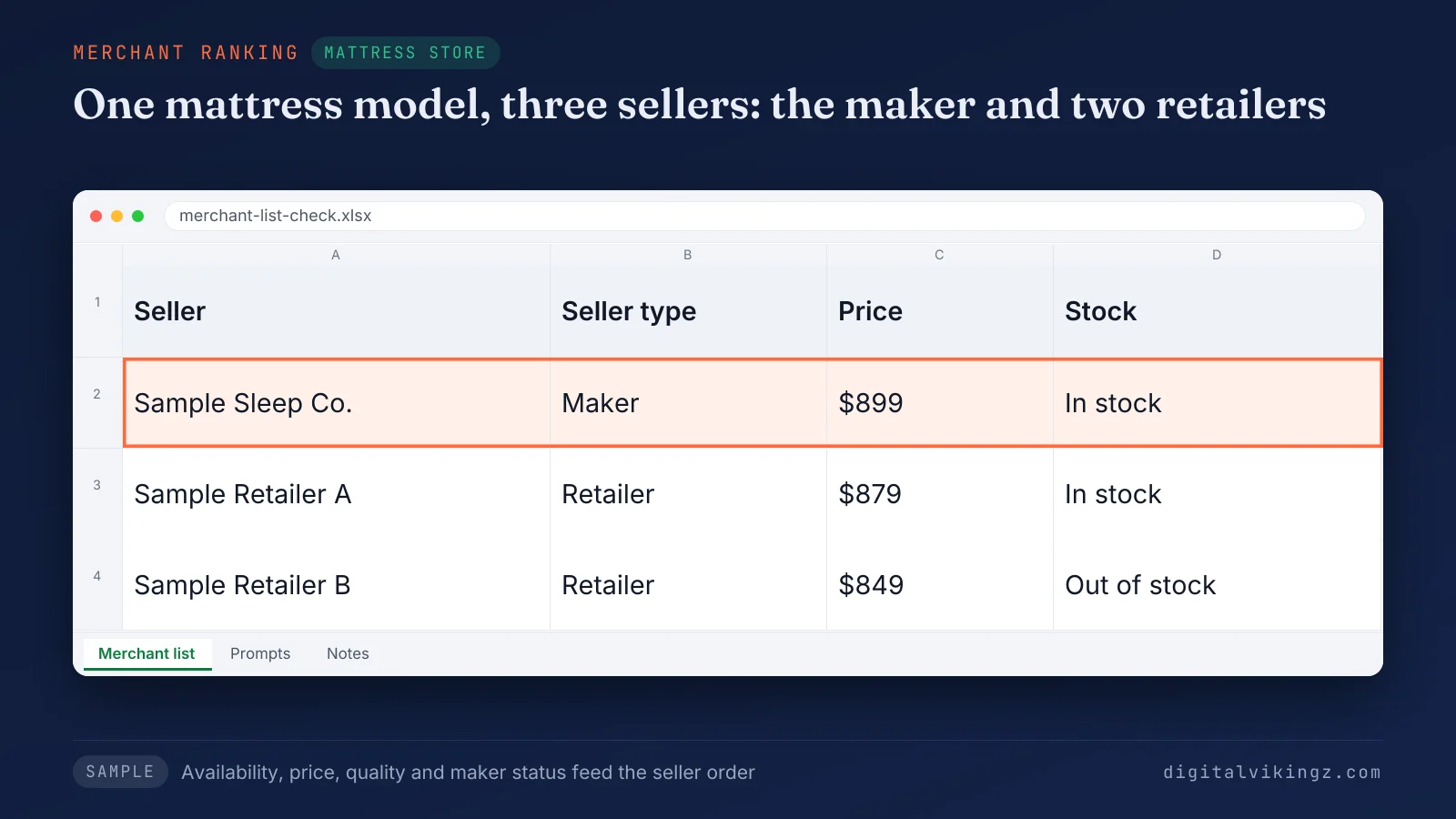
The sample merchant list shows one mattress model at $899 from the maker, in stock. Two retailers list the same model at $879 in stock and at $849 out of stock.
A brand that makes its own products can lead on the maker factor, while a reseller competes on stock and price. Both steps depend on the product data ChatGPT receives, and that data arrives by several routes.
Where does ChatGPT get product data?
ChatGPT gets product data from four routes: Shopify Catalog, direct merchant feeds, third-party data providers and crawled web pages. OpenAI states that product data from Shopify merchants already reaches ChatGPT through Shopify Catalog, with no additional work required.
Merchants on other platforms can apply to OpenAI to share a direct product feed. OpenAI's help page names no third-party provider, so no store can choose which provider describes its products.
OpenAI's crawler OAI-SearchBot brings crawled pages into ChatGPT search, and a store's robots.txt and CDN must allow the crawler. A store that blocks OAI-SearchBot keeps its product pages out of ChatGPT search.
Crawled pages follow the crawler rules in our guide on how new brands get cited by ChatGPT. The guide on how new brands get cited by ChatGPT lists the robots.txt and CDN settings OAI-SearchBot needs.
Do reviews affect ChatGPT product recommendations?
Reviews do affect ChatGPT product recommendations: OpenAI lists reviews among the details ChatGPT may weigh and shows review summaries built from public websites.
OpenAI states that review summaries are model-generated and that reviews and ratings are not verified by OpenAI. Feature labels such as Budget-friendly and Most popular are also generated by ChatGPT and carry no guarantee.
Stores should collect reviews on public review sites and show reviews on product pages that crawlers can read. Reviews sit outside the store's catalog, while the catalog itself reaches ChatGPT through Shopify.
How do Shopify products get into ChatGPT?
Shopify products get into ChatGPT through Shopify Catalog, which shares eligible products with ChatGPT by default through Shopify agentic storefronts. Shopify agentic storefronts are a Shopify feature that makes a store's catalog available to AI channels such as ChatGPT.
Shopify describes the ChatGPT channel as a discovery-focused referrer: shoppers find products in ChatGPT and buy on the store's own checkout. The full online store checkout opens in ChatGPT's in-app browser, or in a new tab on ChatGPT web.
Store branding, customizations and payment methods therefore carry over to every ChatGPT order. No ChatGPT direct checkout setting exists in the Shopify admin. Shopify needs no extra app to connect a store's products to ChatGPT.
Eligibility decides which stores and products Shopify Catalog shares.
Which Shopify stores can sell on ChatGPT?
Shopify stores can sell on ChatGPT when the store sells to US customers, the products meet Shopify Catalog rules and the store policies are complete.
The requirements a Shopify store meets to sell on ChatGPT are listed below:
- US customers: the store sells to United States customers from any home country.
- Shopify Catalog content: the storefront is public, and every product is paid and has a title and an image.
- Supplemental terms: the owner accepts the Shopify Agentic Storefronts Supplemental Terms of Service.
- Store policies: Terms of service, Privacy policy and Return and refund policy are complete in Settings > Policies.
- Consumer products: B2B-only products are not supported.
- Permitted products: items on OpenAI's prohibited list stay out of ChatGPT.
Shopify asks for legal disclosures within the first 6,000 characters of each product description. The Shopify Help Center keeps the list, and eligible stores confirm the ChatGPT setting in the Shopify admin.
How do you check that ChatGPT is active in Shopify?
A Shopify store owner checks that ChatGPT is active under Sales channels > Agentic, where ChatGPT appears in the list of agentic storefronts. Agentic does not appear on the Settings > Sales channels page that lists installed channels.
ChatGPT shows as active by default for an eligible store, with Shopify Catalog access switched on. A business profile claimed through the ChatGPT Business app is optional and adds no products to ChatGPT.
Products reach ChatGPT through Shopify Catalog, whatever the state of the business profile. Shopify Catalog also replaces the product feed that stores on other platforms send.
Do Shopify stores need a product feed for ChatGPT?
Shopify stores do not need a product feed for ChatGPT: Shopify Catalog shares eligible products and keeps price and availability up to date. Shopify states that merchants do not need to build or maintain a product feed in ChatGPT.
WooCommerce stores and other stores outside Shopify reach ChatGPT through crawled product pages and third-party providers. A WooCommerce store can also apply to OpenAI to send a direct product feed.
OpenAI says a feed is not required when ChatGPT already crawls a site, and that a feed gives greater control over how products appear. Every route carries the product data a store writes and can change.
How can a Shopify store get products recommended by ChatGPT?
A Shopify store gets products recommended by ChatGPT by writing complete product data, keeping price and stock accurate, and earning reviews and crawler access. ChatGPT decides each recommendation, so the steps below raise a product's chances without guaranteeing a place.
The steps that help ChatGPT recommend a Shopify store's products are listed below:
- Name the product type and the main attribute in each product title, such as "linen wrap dress" rather than a collection name.
- Write sizes, materials, fit and compatibility as text in the description and the variant names, not inside images or theme tabs.
- Keep price, stock and variants accurate in Shopify, so Shopify Catalog sends ChatGPT the values the product page shows.
- Complete the shipping and return policies, because OpenAI tells shoppers to check return policies before buying.
- Earn product reviews on public review sites and display the reviews on each product page.
- Allow OAI-SearchBot in robots.txt and in the CDN, so ChatGPT can read product pages beyond the catalog.
Product descriptions should state each attribute and its value in a full sentence and avoid promotional phrases such as "best choice". Collection pages, product filters and duplicate product URLs form a separate Shopify SEO checklist for Google rankings.
Buying guides that compare models by attribute are the method in the mattress retailer SEO case study. One mattress model page rose from 16 to 64 Google clicks after the program, as the mattress retailer SEO case study reports.
Which Shopify product fields does ChatGPT read?
Seven Shopify product fields carry the details ChatGPT shows and compares: title, description, variants, price, inventory, images and store policies.
The table below maps each Shopify product field to the detail ChatGPT uses and the page that states the detail.
| Shopify field | What ChatGPT uses the field for | Stated by |
|---|---|---|
| Title | Product name in results; ChatGPT may simplify titles that differ across stores | OpenAI; Shopify |
| Description | Product description, with legal disclosures in the first 6,000 characters | OpenAI; Shopify |
| Variants | Size and color options shoppers confirm before buying | OpenAI |
| Price | Price shown in results and the Best price label | OpenAI |
| Inventory | Availability, a merchant ranking factor | OpenAI; Shopify |
| Images | Product imagery, with at least one image required | OpenAI; Shopify |
| Store policies | Return and refund terms shoppers check before buying | OpenAI; Shopify |
Each product description should state two facts no other product shares, such as the fabric and the fit.
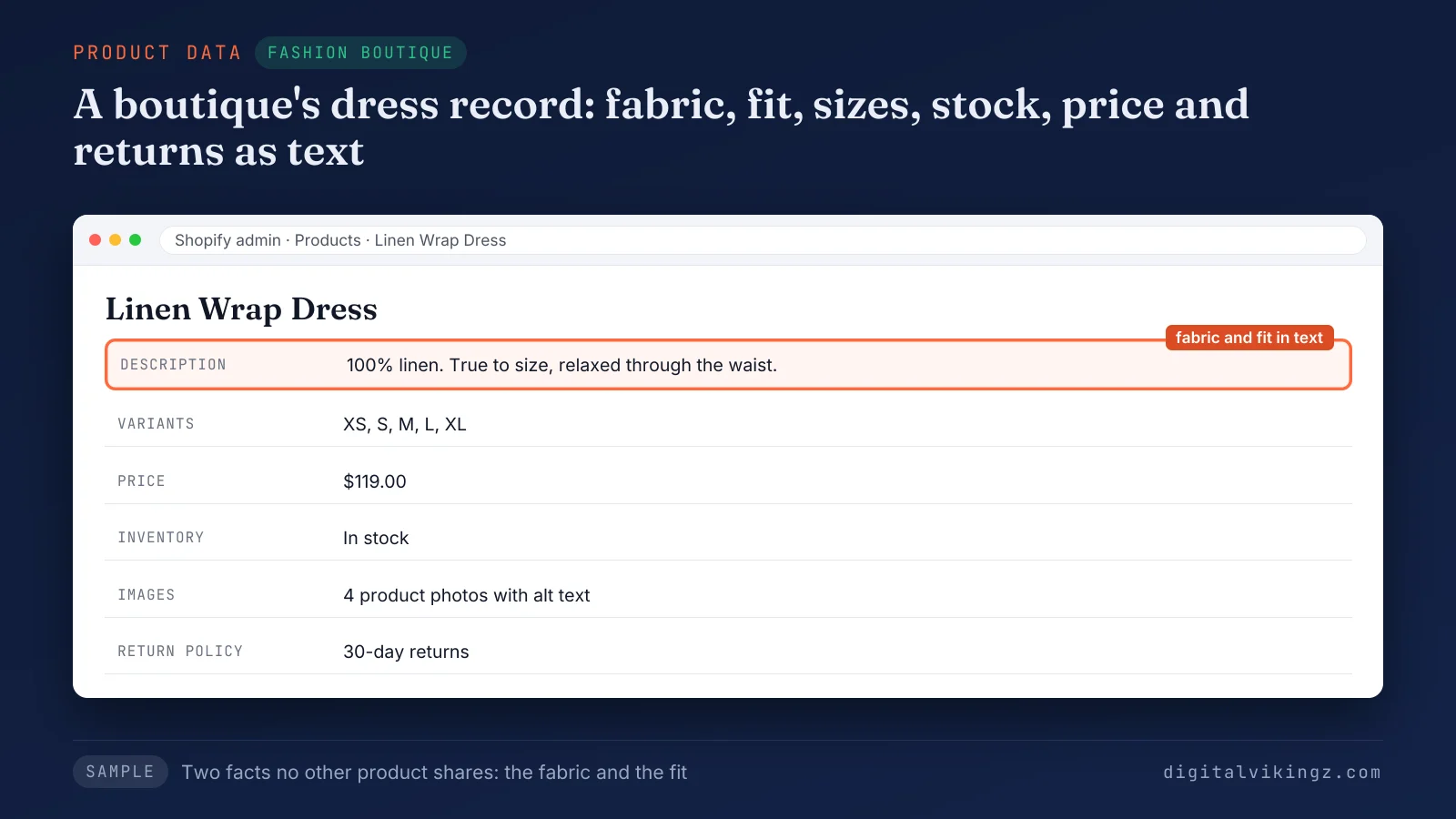
The sample linen wrap dress lists sizes XS to XL as variants, stock as in stock, a $119 price and a 30-day return policy. The description states the fabric as 100% linen and the fit as true to size, in text rather than in an image.
Attribute-led product pages are the method in the women's fashion boutique SEO case study. One boutique product page rose from 8 to 62 Google clicks after the program, as the women's fashion boutique SEO case study reports.
What changed in ChatGPT shopping?
ChatGPT shopping went through four changes from September 2025 to March 2026, ending with checkout on merchant sites and Shopify stores included by default.
The four dated changes to ChatGPT shopping are listed in the table below.
| Date | Change | Source |
|---|---|---|
| September 2025 | Instant Checkout let US shoppers buy from some merchants inside ChatGPT | Search Ai (12 November 2026); scandiweb (2 November 2026) |
| 24 November 2025 | OpenAI introduced shopping research, a guided buyer's guide mode | OpenAI announcement (24 November 2025) |
| March 2026 | OpenAI moved away from standalone Instant Checkout, and purchases now complete on merchant websites or apps | OpenAI merchants page; Search Ai; scandiweb |
| March 2026 | Shopify agentic storefronts made ChatGPT active by default for eligible Shopify stores | Digital Commerce 360 (17 March 2026); Shopify Help Center |
The checkout change sends every ChatGPT sale to the store's own checkout, so product data and store policies now carry the sale.
Monthly upkeep of product data, prices and policies is the work of Shopify and WooCommerce SEO for AI shopping. Our Shopify and WooCommerce SEO for AI shopping service checks markup, prices and feeds every month.
Does ChatGPT charge a fee on Shopify orders?
ChatGPT does not charge a fee on Shopify orders: Shopify states that selling in ChatGPT carries only the store's standard payment processing fees. OpenAI states that purchases starting in ChatGPT carry no fees.
Fees reported by eMarketer and PYMNTS in January 2026 applied to Instant Checkout, the in-chat checkout OpenAI has since moved away from. A Shopify store that prefers to stay out of ChatGPT can switch the channel off.
Can a Shopify store opt out of ChatGPT?
A Shopify store can opt out of ChatGPT by turning off Shopify Catalog access for ChatGPT under Sales channels > Agentic.
The steps to remove ChatGPT's access to a Shopify store's products are listed below:
- Go to "Sales channels > Agentic" in the Shopify admin.
- Turn off "Allow Shopify to manage for me".
- Click "ChatGPT".
- Turn off "Shopify Catalog access".
- Click "Save".
Shopify notes that product data can take up to 7 days to stop flowing to ChatGPT. Crawled pages can still show products in ChatGPT, so Shopify points stores to a separate guide on hiding products from AI channels.
Blocking /products/ in robots.txt is not a safe opt-out, because the same rule stops Google from crawling product pages. A store that stays can check how often ChatGPT recommends its products.
How do you check if ChatGPT recommends your products?
A store owner checks if ChatGPT recommends the store's products by asking ChatGPT customers' buying questions and recording which products and stores appear.
We run ten prompts per category, each naming a product type, one attribute and a budget. Each prompt records three results: whether the product appears, whether the store appears in the merchant list and whether the price shown is correct.
A product shown without the store points to merchant ranking, while a missing product points to product data. A Shopify store repeats the same prompts every week, so each result compares with the week before.
Clicks from ChatGPT can arrive tagged utm_source=chatgpt.com, which separates ChatGPT visits in analytics. Google counts AI Overviews and AI Mode impressions in the Google Search Console generative AI report, which does not cover ChatGPT.
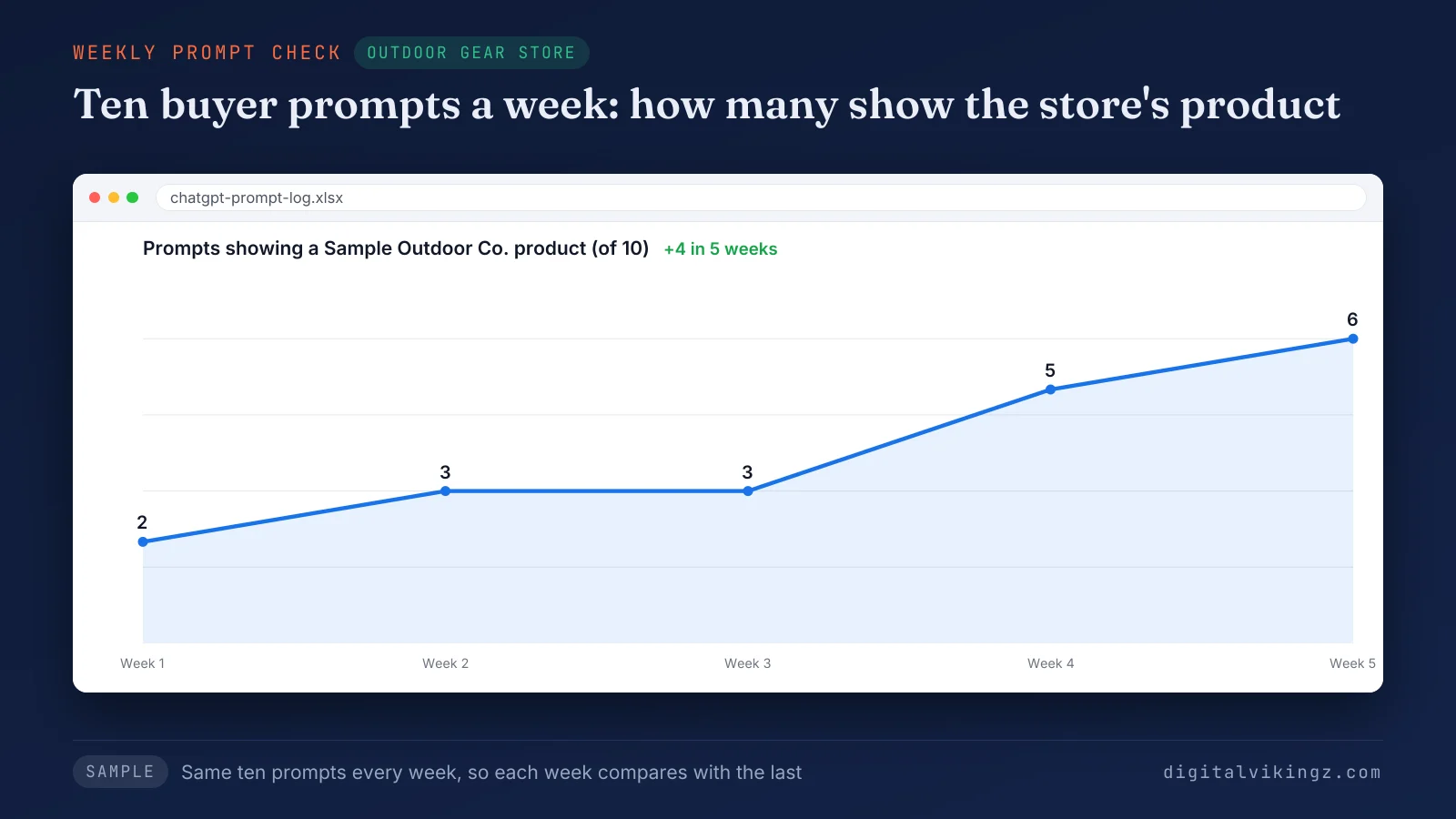
The sample chart shows a Sample Outdoor Co. product in 2 of 10 test prompts in week 1 and 6 of 10 in week 5.
Buyer prompts, run as a five-step check of what ChatGPT says about your business, show which products and stores appear. The five-step check of what ChatGPT says about your business works the same way for product questions.
ChatGPT shopping FAQ
Shopify stores ask six more questions about ChatGPT, on shopping research, crawlers, llms.txt, regions, Google Shopping and the Shopify plugin.
Is ChatGPT shopping research gone?
No OpenAI announcement says ChatGPT shopping research was removed, as of 18 November 2026. We found no OpenAI help or news page that retires the mode.
Does blocking GPTBot remove products from ChatGPT?
Blocking GPTBot does not remove products from ChatGPT, because GPTBot collects training data and OAI-SearchBot builds the search index. Shopify Catalog data also reaches ChatGPT without any crawler.
Do I need an llms.txt file for ChatGPT shopping?
You do not need an llms.txt file for ChatGPT shopping, because no major AI platform has confirmed that its crawlers read llms.txt. Shopify already serves a default /llms.txt file for every store. Our guide on what llms.txt is and what it should say covers when a custom file is worth writing.
Is ChatGPT shopping available outside the US?
ChatGPT shopping is live in the US only, and OpenAI states that shopping will expand to more regions over time.
Is ChatGPT shopping the same as Google Shopping?
ChatGPT shopping is not the same as Google Shopping: ChatGPT ranks products from its own sources, and OpenAI names no Google data source. Peec AI research, published by Precis in June 2026, reported that ChatGPT carousels drew on Google Shopping's organic results.
Is the Shopify plugin for ChatGPT the same as selling on ChatGPT?
The Shopify plugin for ChatGPT is a store-management tool, separate from selling on ChatGPT through Shopify Catalog. Shopify documents the plugin and selling on ChatGPT on separate help pages.
Where should a Shopify store start with ChatGPT shopping?
A Shopify store starts with ChatGPT shopping by confirming Shopify Catalog access, then fixing the product data ChatGPT compares and checking results with buyer prompts.
Digital Vikingz treats each step as part of how semantic SEO builds topical authority that Google and AI answer engines recognise, product by product.
Product price, stock, shipping and returns are part of the store checks in the AI Visibility Checker for store pages. Run the AI Visibility Checker for store pages on the product page that sells best.