 Digital Vikingz
Chiropractor SEO puts a chiropractic clinic in Google's map pack, organic results and AI answers for nearby new patients. Google ranks clinics in the map pack on three factors: relevance, distance and prominence.
A clinic should give its Google Business Profile the Chiropractor primary category, patient-worded services and an appointment link. Condition pages match each condition search, such as sciatica in a town, to one page about the clinic's service.
Clinics should measure the work in calls, direction requests, website clicks and booked new-patient visits, split by office and provider. AI assistants choose a chiropractor to name by matching the clinic's facts across its profile, website, directories and reviews.
What is chiropractor SEO?
Chiropractor SEO is local SEO that puts a chiropractic clinic in Google's map pack, organic results and AI answers for nearby new patients. Chiropractic searches add conditions, auto accident visits, insurance and individual chiropractors to the usual local search.
Take a solo clinic in Lakeside (a sample, not a client). A patient types "chiropractor near me" and sees a map pack first, then a column of website links, and above or beside both, an AI answer. Three surfaces, one search.
A patient who says a clinic shows up on the map means the map pack, the local listings Google shows with a map. Organic results are the website pages Google lists as links. AI answers are the replies of ChatGPT, Gemini, Perplexity and Google's AI Overviews.
Chiropractic SEO, SEO for chiropractors and local SEO for chiropractors name the same work. Google Ads and Local Services Ads are paid channels, and the page covers unpaid results only. We measure the work in booked new-patient visits, not in rankings alone.
Local SEO covers the map pack, and organic SEO covers the website results. Our guide on local SEO vs organic SEO explains which a service business needs first.
A clinic with a full schedule still asks if the work is needed.
Do chiropractors still need SEO when referrals fill the schedule?
Yes, a chiropractor still needs SEO when referrals fill the schedule, because a referred patient can look up the clinic before calling. A search for the clinic's name shows the profile, the reviews and the opening hours.
Sample, not a client: a friend names a solo clinic in Lakeside, and the patient searches the name and reads the profile before dialing. Wrong hours lose that call.
Nobody outside the clinic's own intake records knows how many referred patients search first. The clinic can ask each new patient how the patient found the clinic. Referred patients and new patients both start with a search, so the next step is to know which searches patients type.
Which searches does a chiropractic clinic need to win?
A chiropractic clinic needs to win five types of patient search: near-me searches, condition searches, auto accident searches, insurance searches and specialty searches.
The five types of patient search a chiropractic clinic targets are listed below:
- Near-me searches: "chiropractor near me" and "chiropractor in" with a town name.
- Condition searches: a condition with a town, such as "sciatica chiropractor in Lakeside".
- Auto accident searches: "auto accident chiropractor" with a town name.
- Insurance searches: a clinic that takes the patient's plan, such as "chiropractor that takes my insurance near me".
- Specialty searches: a provider type, such as "pediatric chiropractor" or "sports chiropractor".
Auto accident appears in 2 of the 14 chiropractic SEO pages we read on 22 November 2026, and a first visit appears in 1. Specialty searches follow the same pattern as condition searches. Each type gets its own page.
Every one of the five searches ends on a map pack listing, an organic page or an AI answer.
How does Google rank chiropractic clinics in the map pack?
Google ranks chiropractic clinics in the map pack on three factors: relevance, distance and prominence. Google's local ranking help page states: "Local results are mainly based on relevance, distance, and popularity."
The same Google page heads the third factor "Prominence". Popularity and prominence name one factor.
Google defines the three local ranking factors as listed below:
- Relevance: "Relevance is how well a Business Profile matches what someone is searching for."
- Distance: "Distance refers to how far each business is from the customer who's searching."
- Prominence: "Prominence means how well-known a business is."
Picture two clinics in Lakeside (a sample, not a client). One has the Chiropractor category and a full services list, and the other has an empty profile. The first matches "chiropractor near me" better.
Chiropractor SEO gains relevance from the clinic's category, services and condition pages. Prominence comes from reviews, links and health directory listings. Distance favors the clinic closest to the patient, and no profile setting moves a clinic closer.
A clinic has one Google Maps ranking for each search at each searcher location. Our guide on what moves a clinic higher on Google Maps explains the work behind relevance and prominence.
Relevance starts with the Google Business Profile a clinic sets up.
How should a chiropractic clinic set up its Google Business Profile?
A chiropractic clinic should give its Google Business Profile the Chiropractor primary category, patient-worded services, the street address, accurate hours and an appointment link. Google Business Profile was called Google My Business until 2021.
The profile settings that decide a chiropractic clinic's relevance are listed below:
- Choose Chiropractor as the primary category.
- List each service the clinic offers in the words patients type.
- Show the street address, because patients visit the clinic.
- Add the online booking page as the appointment link.
- Enter the hours the front desk answers the phone, plus holiday hours in the special hours field.
- Keep the business name to the registered clinic name, with no added words such as "best chiropractor".
Google's guidelines do not permit unnecessary information in a business name. A breach can lead to suspension of the profile. Google asks for categories that complete the statement "This business IS a" rather than "this business HAS a".
A secondary category fits only a service line the clinic runs as its own department. A service area applies only when the clinic visits patients away from the office.
The public Q&A section no longer exists on profiles, because Google began removing the section in December 2025. The services list, the description and the website now carry those answers.
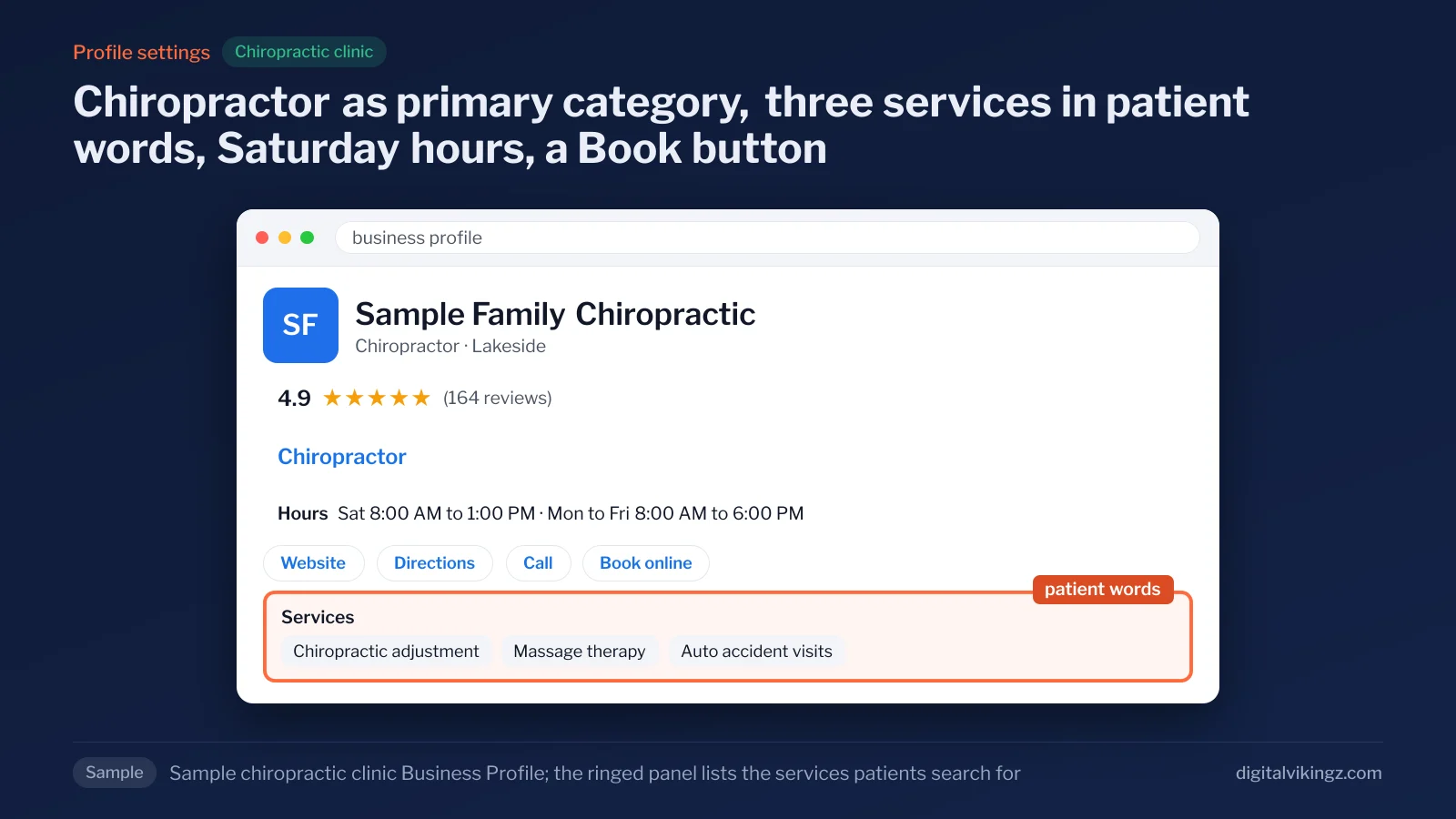
A chiropractic clinic profile names one primary category, the services patients search for and the hours a patient can book.
Figure 1 shows a sample profile for Sample Family Chiropractic in Lakeside with Chiropractor as the primary category. The sample lists chiropractic adjustment, massage therapy and auto accident visits, with Saturday hours from 8:00 AM to 1:00 PM.
Each setting above is one part of how to optimize a Google Business Profile. Our 13-step guide on how to optimize a Google Business Profile sets out the full profile setup in order.
The profile names the services, and condition pages say more about each one.
Condition and technique pages for a chiropractic clinic
A condition page matches one condition search, such as sciatica in a town, to one page about the clinic's service. One condition, one page.
Back pain appears in 9 of the 14 chiropractic SEO pages we read on 22 November 2026, and neck pain appears in 8.
A condition page states the parts listed below:
- Heading: the condition and the town, in the words patients type.
- Service: what the clinic offers for the condition, stated as a visit and never as a result.
- Provider: the chiropractor who sees patients for the condition, with the name, degree and license as the chiropractor supplies them.
- Booking: the appointment link, the phone number and the office hours.
- Insurance: the plans the clinic accepts for the visit.
- Review line: the name of the credentialed reviewer and the review date.
Sample, not a client: Sample Family Chiropractic publishes "Sciatica chiropractor in Lakeside". The page names the clinic's service, the chiropractor, the booking button and a reviewed-by line.
Each condition page carries one condition and one town, never a list of conditions, so the page answers the search it was built for. A technique page follows the same parts, with the technique named as a service the clinic offers. No page states what a technique does, what a visit achieves or how a patient will feel.
Our healthcare page sets one rule for clinical pages: a credentialed author, a reviewed-by line and a source for each claim.
A patient on a condition page next asks about insurance, accident visits and the first visit.
New-patient pages for insurance, auto accidents and the first visit
A chiropractic clinic needs three new-patient pages beyond condition pages: an insurance page, an auto accident page and a first-visit page. Each page answers a question the patient asks before booking, and each page links to the booking path.
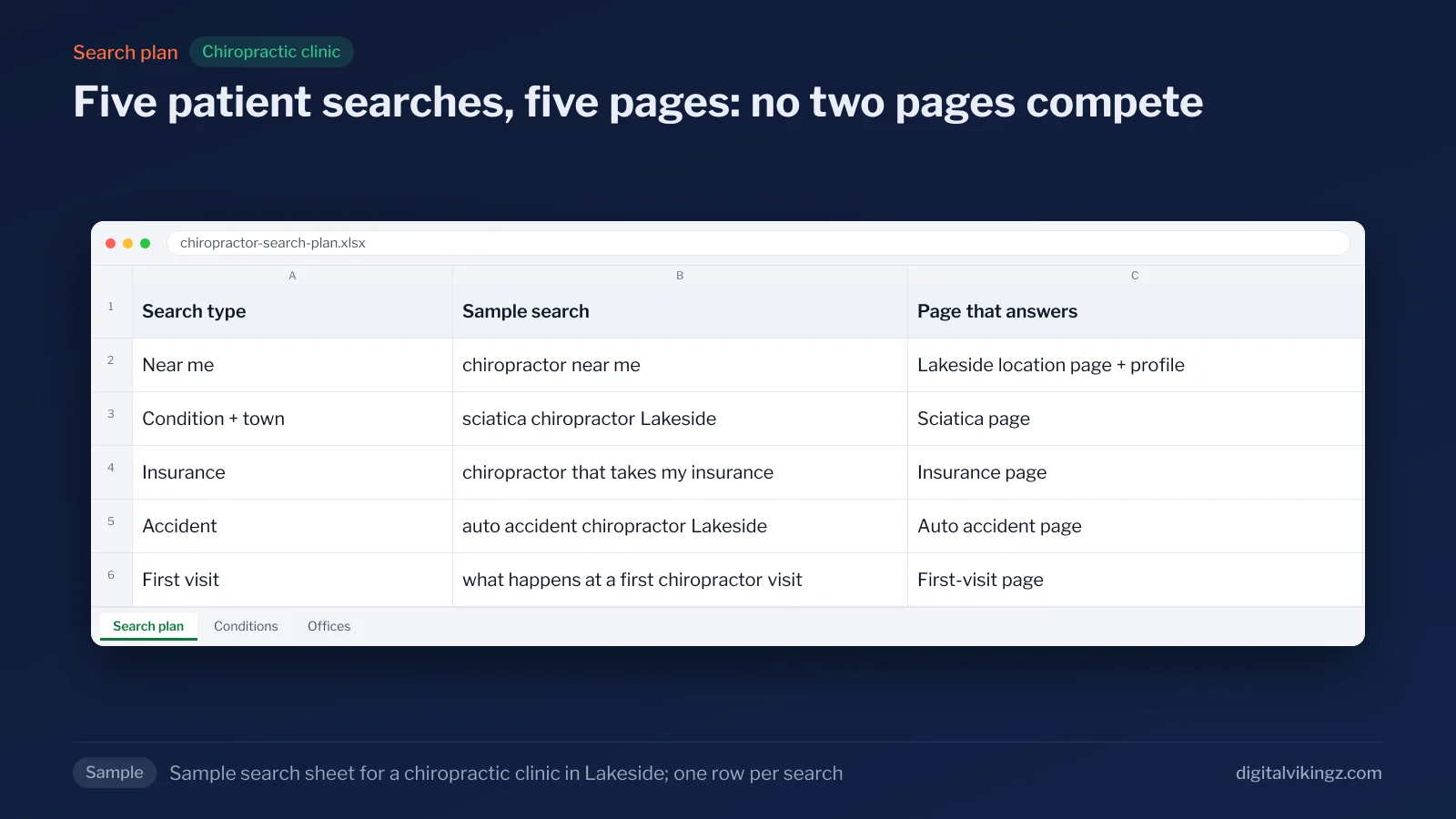
Each chiropractic search goes to one page that answers the search.
Figure 2 routes five sample searches to five pages. The near-me search goes to a location page, and the condition search goes to a condition page.
The accident search goes to an auto accident page. The insurance search goes to an insurance page, and the specialty search goes to a provider page.
The auto accident page needs the most care in its wording.
Auto accident pages: what to state and what to leave out
An auto accident page states the clinic's visit types, the intake phone and the booking link, and leaves out legal and medical advice. The page names the accident search in the patient's words, such as "auto accident chiropractor", with the town.
Sample, not a client: a searcher types "auto accident chiropractor in Lakeside". The clinic's page shows visit types, an intake phone number and a booking button. Nothing on the page talks about a claim.
The page states facts the clinic can show and makes no promise about a claim, a case or a result. The page names no claim amount or case outcome. We advise a clinic to check the wording of the page with its own adviser, because rules on these pages can differ by state.
The page leaves out the points listed below:
- Legal advice: any statement about a claim, a case or a lawyer.
- Medical advice: any statement about injuries, recovery or treatment results.
- Promises: any outcome stated as certain.
- Prices: any fee the clinic does not charge.
Insurance details sit on their own page, because the patient checks them before booking.
Insurance and cash-pay details on the page
An insurance page lists the plans the clinic accepts and states the cash-pay option when the clinic offers one. The clinic supplies the plan list and updates the page when the list changes.
A fee appears only when the clinic sets a fee, and the page never quotes a price the clinic does not charge. Plans change often, so the page carries a last-updated date.
Sample, not a client: a searcher types "chiropractor that takes my insurance near me" and lands on the clinic's insurance page, which shows a plan list and a cash-pay line. That page should appear in the organic results.
The first-visit page answers the last question before booking.
The first-visit page and the booking path
A first-visit page tells a new patient how to book and what to bring, and gives one clear booking path.
The first-visit page covers the points listed below:
- Booking: the appointment link and the phone number, side by side.
- Arrival: the address, the parking and the arrival time the clinic asks for.
- Paperwork: the forms the patient fills in before the visit.
- Provider: the name and photo of the chiropractor the patient meets.
Chiropractor SEO ends at a booked visit. The booking path finishes the work, so the booking button on the profile links to the same booking page. The page links to the insurance page and to the condition pages.
A new patient should reach the booking path in one tap from any page.
Pages answer the patient's questions, and reviews and listings show that other patients agree.
How do reviews and health directories affect a chiropractic clinic's map pack rank?
Reviews and health directories affect a chiropractic clinic's map pack rank because Google bases prominence partly on reviews and on links from other websites. Google's local ranking help page states: "More reviews and positive ratings can help your business's local ranking."
Every patient gets the same review request, and the request offers no reward. Google's content policy bars incentives for reviews and bars selective requests for positive reviews.
A patient can leave a review at any time through the clinic's review link. Our guide on how to get more Google reviews from every customer gives the request wording for each channel.
Directories come next. A clinic finds its directories by searching its own name and "chiropractor in" with its town, then noting each directory that appears. Each directory listing should show the same name, address and phone number as the profile.
Sample, not a client: a clinic searches its own name and finds a directory it never claimed. The listing shows an old phone number. The clinic corrects the number the same day.
Google also states: "Positive reviews and helpful replies can help your business stand out." We advise a chiropractic clinic to reply without the reviewer's name or the service, so the reply never confirms that the reviewer is a patient. Our guide on how to respond to Google reviews covers clinic replies.
A clinic with more than one chiropractor or office needs one set of rules for all of its profiles.
How should a clinic with several chiropractors or offices set up local SEO?
A chiropractic clinic with several offices should give each staffed office its own Google Business Profile and its own location page. Google's guidelines state: "All locations must also have the same category if they provide the same service."
Each office profile carries its own photos, because each profile belongs to one address. Google reviews the photos on each profile before the photos show on Search and Maps. Our guide to Google Business Profile photos explains what to upload for each profile and how often.
Sample, not a client: a clinic in Lakeside opens a second office in a nearby town. Each office gets its own profile, location page and photo set.
Chiropractor SEO for several offices repeats the same profile, page and review rules once for each office. Each office is its own place on the map. Each location page states the address, the hours, the phone number, the chiropractors and the booking link.
Each chiropractor gets a bio page that states the degree and license as the chiropractor supplies them. The bio page keeps the chiropractor's name identical to the name on the profile and in every directory.
One question remains for a clinic with several chiropractors: which of them gets a profile.
Should each chiropractor in a clinic have a Google Business Profile?
Yes, each chiropractor can have a separate profile when the chiropractor is public-facing and reachable at the clinic during stated hours. Google describes an individual practitioner as "a public-facing professional, typically with their own customer base."
Google adds: "Support staff should not create their own Business Profiles." Google also states: "A practitioner shouldn't have multiple Business Profiles to cover all of their specializations."
Google's guidelines state for several practitioners at one location: "The organization should create a Business Profile for this location, separate from that of the practitioner."
A chiropractor with a separate profile links the profile to that chiropractor's bio page.
Measuring chiropractor SEO in booked new-patient visits
A chiropractic clinic should measure SEO in calls, direction requests, website clicks and booked new-patient visits, split by office and provider. The Performance report of a Google Business Profile shows the searches that found the profile and the calls, direction requests and website clicks that followed.
A tracking phone number on the website counts the calls from each source. The clinic's booking records supply the count of new-patient visits behind those calls. A ranking is not a patient.
Profile links need tags so that Google Analytics 4 can count those visits on their own. Google Business Profile UTM tracking adds utm_source, utm_medium and utm_campaign tags to profile links, so GA4 separates those visits from other Google traffic. Our guide to Google Business Profile UTM tracking shows how to tag every profile link.
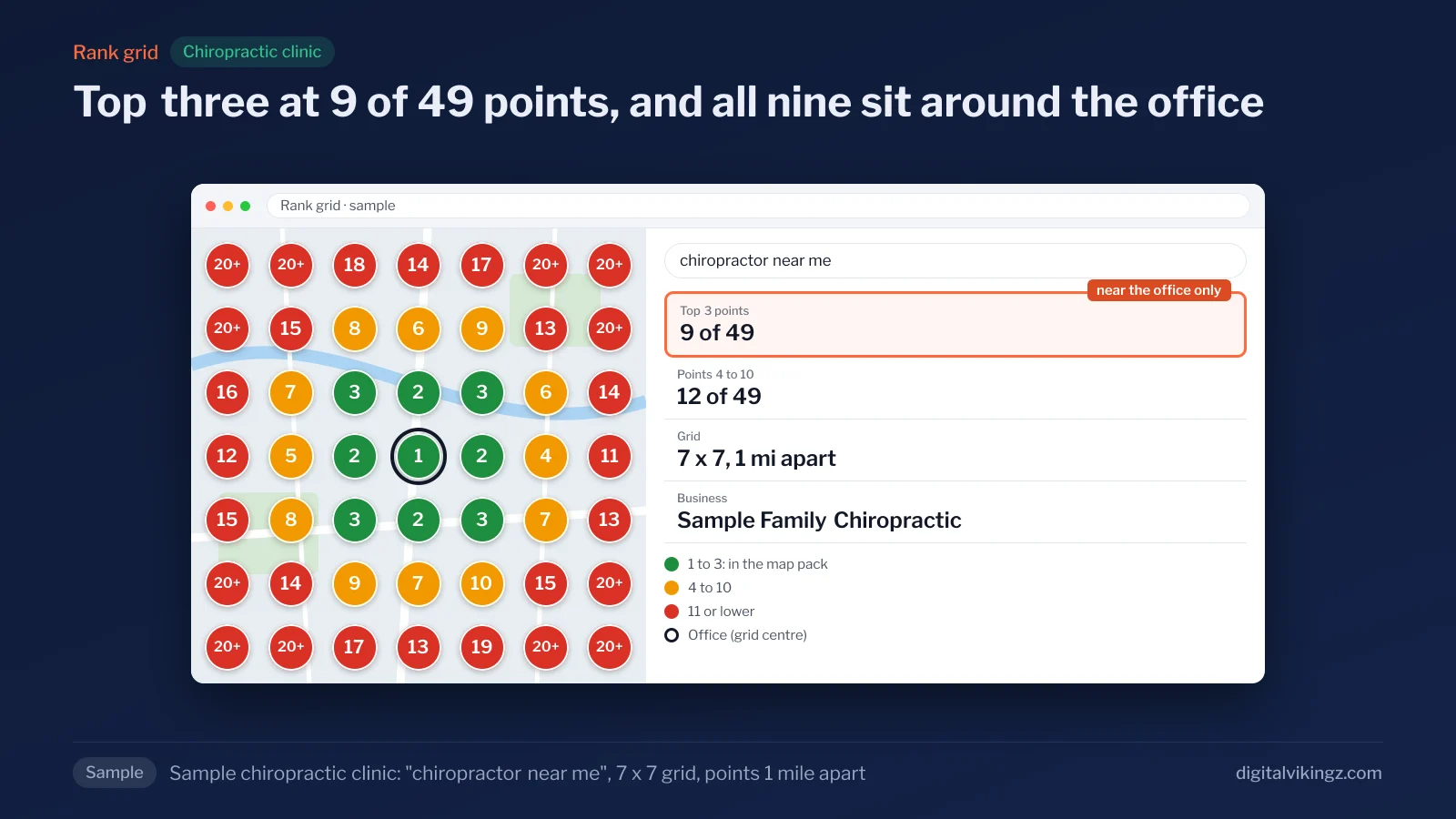
A rank grid shows where around the office a chiropractic clinic appears in the map pack.
Figure 3 shows a sample rank grid for "chiropractor near me" around Sample Family Chiropractic in Lakeside. The grid scores the clinic's map pack position at each point around the office.
A monthly report lists the same measures every month, so a clinic can compare each month with the last. Sample, not a client: Sample Family Chiropractic reads one month, with calls by source from the tracking number and new-patient visits from the booking records.
Nobody outside the platforms knows how many patients an AI answer sends. The clinic asks each new patient how the patient found the clinic.
The same measures apply to a dental practice, a law firm or a trade business, with different pages behind them.
How does chiropractor SEO differ from SEO for dentists and other practices?
Chiropractor SEO shares profile, review and page work with other local practices and adds condition, auto accident and provider pages. The base work is the same.
Dental SEO shares profile, review and page work with other local service businesses and adds practitioner profiles, treatment pages and insurance searches. Our guide to dental SEO shows the same work for a dental practice.
HVAC SEO shares the profile, review and page model of other local service businesses, and differs in its two seasonal peaks. Our guide to HVAC SEO shows how a trade plans for both peaks.
Sample, not a client: a dental practice and a chiropractic clinic in Lakeside both fill a profile and ask for reviews. The dental practice adds treatment pages. The chiropractic clinic adds condition pages.
A healthcare website is built from conditions, treatments, providers and locations. Our semantic SEO for healthcare practices such as chiropractic clinics applies the same structure to a chiropractic clinic.
AI answers add a third surface to the same profile, pages and reviews.
How do AI assistants choose a chiropractor to name?
AI assistants choose a chiropractor to name by matching the clinic's facts across its profile, website, directories and reviews, then naming a short list. No assistant publishes its full selection formula.
Google states: "There are no additional requirements to appear in AI Overviews or AI Mode, nor other special optimizations necessary." Google's AI features page lists up-to-date Business Profile information among its SEO fundamentals.
BrightLocal's 2026 Local AI Visibility Study by Mike Hawkes counted business websites as 42 percent of all citations across more than 1,300 business locations. Google Business Profile made up 28.6 percent of the same citations. The study covers local businesses in general, and no source in our research measured chiropractic clinics alone.
Sample, not a client: a patient asks an assistant for a chiropractor in Lakeside who takes a stated plan. The answer names a short list and cites a profile, a clinic website and a directory.
AI assistants choose a local business in five stages. Our guide on which local business AI assistants recommend explains each stage.
Ranking in Google Maps does not mean AI assistants recommend the clinic, although the same profile and reviews feed both. The sources behind each answer come next.
Sources AI assistants read about a chiropractic clinic
AI assistants read four kinds of sources about a chiropractic clinic: business profiles, directory and review sites, the clinic website and third-party mentions.
Each source must carry the same facts, which are listed below:
- Name: the registered clinic name.
- Address and phone: the same address and phone number on every source.
- Services: the same service names on the profile and the website.
- Providers: the same chiropractor names on the bio page and in each directory.
Sample, not a client: Sample Family Chiropractic shows the same name, address and phone number on its profile, its website and one directory.
Google generates Knowledge Panels automatically and does not take applications. Our guide on how to get a Knowledge Panel for a business covers the sources Google reads.
A clinic then checks what each assistant names.
How to check which chiropractor an AI assistant names
A clinic should check its AI answers by asking the same questions in each assistant and recording each answer with its date. AI answers change from one run to the next, so one run of one prompt shows one answer, not a pattern.
The steps to check which chiropractor an AI assistant names are listed below:
- Write five prompts a patient would type, one for each type of patient search.
- Ask each prompt in ChatGPT, Gemini and Perplexity, and search the prompt on Google for AI Overviews.
- Record the clinics named, the sources cited and the date.
- Repeat the check each month and compare the lists.
Perplexity numbers its citations, so the sources behind each answer are easy to read. Our guide on how Perplexity chooses its sources explains the numbered links.
We have run no such check on a chiropractic clinic, and we claim no result from the method. A free first read of the clinic website comes from our AI visibility checker for local business pages.
The pages an assistant reads carry the clinic's claims, so the next section sets guardrails.
Compliance guardrails for chiropractic SEO copy
Chiropractor SEO copy follows three guardrails: Google's content policies, the US rule on reviews and the clinic's state advertising rules. Google's Maps content policy does not allow harmful content that contains deceptive or misleading health or medical information.
The US FTC rule makes fake reviews and incentives tied to positive or negative sentiment unlawful. A clinic checks its state chiropractic board's advertising rules before publishing testimonials, result statements or before-and-after photos.
Sample, not a client: a condition page draft says what the service does for a patient. The reviewer removes the sentence and keeps the visit details.
We write SEO copy and structure, and we give no legal advice.
Clear guardrails make the choice of a provider easier.
How do you choose a chiropractor SEO company?
A chiropractic clinic should choose an SEO company that shows its method in writing, reports calls and booked visits, and promises no ranking.
A chiropractic clinic judges an SEO company on the criteria listed below:
- Method: the steps for the profile, the pages and the reviews, in writing.
- Report: calls, direction requests, website clicks and booked new-patient visits, split by office.
- Access: manager access to the profile, with the clinic keeping ownership.
- Compliance: reviews requested from every patient without a reward, and copy without result claims.
Ask for the method first. Sample, not a client: a clinic owner compares two written quotes.
One names the profile, the pages, the reviews and the report. The other names only "SEO".
Our service covers profile updates, weekly posts, review replies, location and service pages and a monthly report. Our Local SEO and Google Business Profile optimization for chiropractic clinics starts with a 30-minute strategy call.
We have not published a chiropractic case study. Our closest published result is a day spa brand with three locations in three states. Its non-branded Google clicks rose 42 percent, from 5.5k to 7.81k, between two equal windows before and during a six-month program.
Our day spa SEO case study shows both windows as Google Search Console reads them. A clinic with no address or service area is not a fit for our service.
A clinic with one person who owns the pages, the reviews and the reports may run the work in house. Our guide to in-house semantic SEO or an agency sets out five questions that decide the model.
What to fix first depends on what the profile and the pages show today.
Questions chiropractic clinic owners ask about SEO
How long does chiropractor SEO take to work?
Chiropractor SEO usually shows map pack gains over two to four months, according to our Local SEO and Google Business Profile service. Reviews, posts and pages add up over that time, and category and detail fixes are picked up within weeks. No one controls Google, so no timeline is a promise.
How much does chiropractor SEO cost?
Chiropractor SEO from Digital Vikingz is priced monthly by the number of locations a clinic has. We quote the exact scope in writing after the strategy call.
Is a Google Business Profile enough for a chiropractor?
No, a Google Business Profile alone does not cover prominence, which Google bases partly on reviews and on links from other websites. Condition pages and a location page give the profile pages to link to and pages to rank in organic results.
Does a chiropractic clinic need a blog to rank?
No, a chiropractic clinic does not need a blog to enter the map pack, which rests on relevance, distance and prominence. Condition pages and a clear location page answer patient searches without a blog.
Can a chiropractic clinic pay Google for a better map pack position?
No chiropractic clinic can pay Google for a better map pack position. Google states: "There's no way to request or pay for a better local ranking on Google."
Do review stars from a clinic's own website show in Google results?
Review stars from a clinic's own website do not show in Google results, because Google treats them as self-serving reviews. Google's review snippet rules exclude a business's own reviews from star results, including embedded Google review widgets.
What should a chiropractic clinic fix first?
A chiropractic clinic should fix the primary category and services first, then the condition pages, the insurance and first-visit pages and the review request. An audit ranks those fixes by effect. Our guide to a local SEO audit shows how to run one in seven steps.
Sample, not a client: Sample Family Chiropractic fixes its category and services on day one, then writes the first condition page.
Weekly posts keep the profile current. Our daily Google posts for chiropractic clinics add a post to the profile every day.
Start with the profile, because the profile sets relevance and the other fixes build on the profile.