 Digital Vikingz
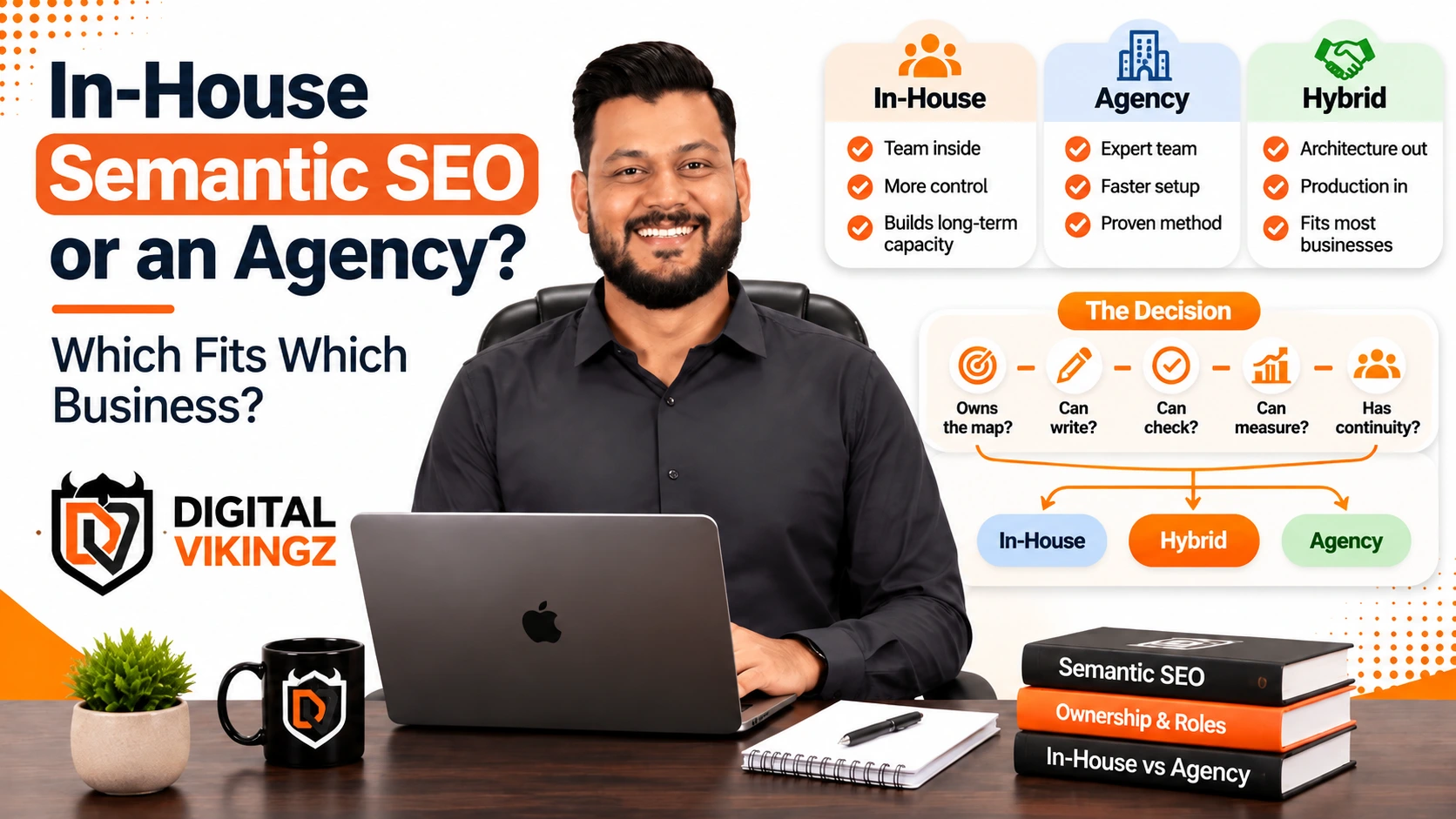
A hybrid, where an agency produces the architecture and the business produces the pages from that architecture, fits most businesses between those two states. Five questions decide the model: who owns the map, who writes, who checks, who measures, and what happens when that person leaves. The documents are the same in every model, and the business owns them in every model.
Entity card
Field | Value |
Term | In-house semantic SEO versus an agency |
Also called | In-house vs agency SEO, build or buy SEO, SEO team or agency |
Part of | Engagement decisions |
Depends on | A map owner, writing capacity, a checking owner, a measurement owner and continuity |
Produces | A model: in-house, agency or hybrid, with the owner of each layer named |
Measured by | Pages published to brief per month and query count per cluster, in any model |
Not the same as | Choosing which agency, or choosing a tool |
What does semantic SEO require, whoever does the work?
Semantic SEO requires five owned roles in any model: a map owner, writers who work to a brief, a checker who reads each page against the brief, a measurement owner, and continuity when any of those people change.
The five roles and what each one owns are listed below:
Role | What the role owns | What fails without the role |
Map owner | The central entity, the topical map, the page decisions, the vocabulary | Pages are written from keyword lists and compete with each other |
Writers | Pages produced to the brief in the fixed vocabulary, on rhythm | Momentum breaks, or pages drift from the brief |
Checker | Every page read against its brief before publication | Drift reaches the live site and the vocabulary splits |
Measurement owner | Search Console per cluster, the prompt set, the CRM landing page field | No one knows which cluster moved or why |
Continuity | The documents, the log and the handover when a person leaves | The map leaves with the person who held the map in their head |
The choice is never in-house or agency in the abstract. The choice is which of the five roles the business can fill from inside, this year, with people who will still be there next year.
When does in-house semantic SEO fit?
In-house semantic SEO fits when the business already has a person who can own the map, at least one writer who can work to a brief, and a marketing or revenue owner who reads Search Console and the CRM.
The map owner is the test. A map owner has done the work before: defined a central entity, built a processed map with page decisions, written a vocabulary and held writers to that vocabulary. A marketing manager who has run keyword campaigns is not yet a map owner, and the gap is learned on the business's own site at the business's own cost.
In-house fits best in three situations: a business with a subject-matter author on staff whose expertise is the content, a business large enough to employ a strategist full time on one site, and a business already publishing to a rhythm that needs method rather than hands.
The in-house advantage is depth of subject knowledge and speed of approval. The in-house risk is continuity: a map held by one employee is a map that leaves with that employee.
When does an agency fit?
An agency fits when the business has none of the five roles filled, needs the architecture built once and run correctly, and prefers to buy the documents rather than to grow the people.
An agency that does the work every week has the map owner, the writers, the checker and the measurement owner already, and brings the method tested on other sites. The business supplies the subject-matter facts, the approvals and the access.
An agency fits best in three situations: a business with no marketing team, a business whose team is occupied with channels other than search, and a business whose site needs a rebuild of its architecture before any in-house production would pay off.
The agency advantage is that the five roles arrive filled and the method arrives tested. The agency risk is dependence: a business that never learns the documents is a business unable to read its own map when the contract ends. The fix for that risk is in the contract: the business owns every document, and the handover is a deliverable.
Choosing which agency is a separate decision, covered in how to choose a semantic SEO agency.
When does a hybrid fit?
A hybrid fits when the business can fill the writing or the measurement role from inside and is unable to fill the map owner role, so an agency builds the architecture and the business produces from that architecture.
Most businesses sit here. The common hybrid shapes are listed below:
Architecture out, production in. The agency defines the central entity, builds the map, writes the vocabulary and the brief template, and hands over. In-house writers produce the pages; the agency checks the first batches and then reads the ranking state quarterly.
Architecture and first cluster out, then in. The agency builds the architecture and publishes the first authority cluster, so the in-house team inherits a site with historical data and a worked example of every document.
Production out, ownership in. The business has a map owner and no writers. The agency produces pages to the business's briefs and vocabulary, and the business's owner checks them.
Measurement out. The business runs everything and the agency reads Search Console per cluster after each core update and returns the configuration decisions.
Each shape names the owner of each of the five roles. A hybrid that leaves a role unnamed is two teams each assuming the other holds that role.
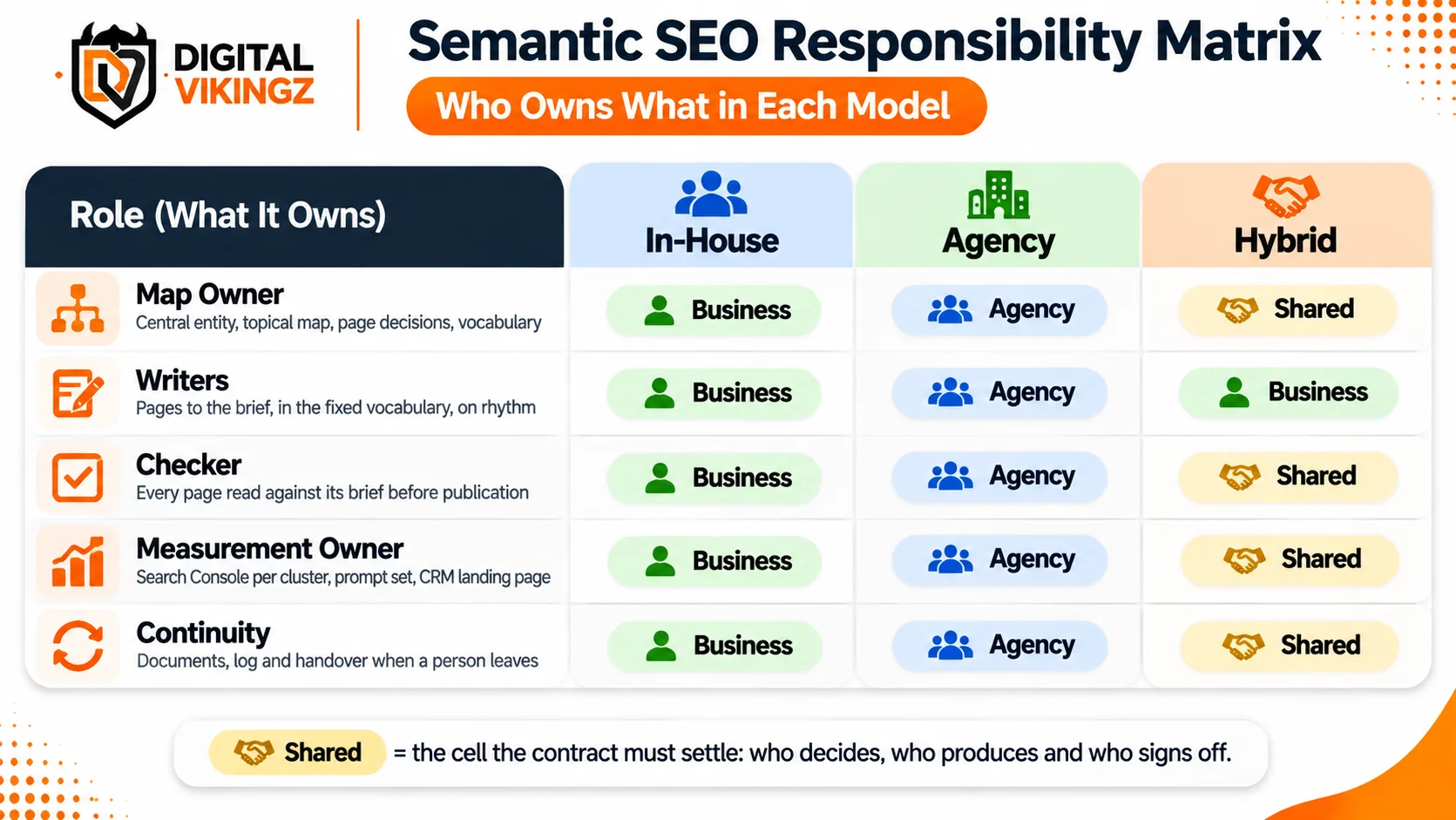
The image above shows the matrix. Each row is a role. Each column is a model. A cell marked shared is the cell where the contract must say who decides.
How do you decide between in-house and agency semantic SEO?
The decision between in-house and agency semantic SEO is made by answering five questions in order and reading the first answer that is no.
The five questions and what each answer means are listed below:
Is there a person inside the business who has built a processed topical map before and can own the map for the site in question? No means the map owner comes from outside, as an agency or a hire.
Can the business publish pages to a brief, in a fixed vocabulary, on a steady rhythm for twelve months? No means production comes from outside, or the rhythm is set lower than the business wants.
Is there a person who will read every page against its brief before publication and send back the ones that fail? No means the check comes from outside, because a check nobody owns is skipped under deadline.
Is there a person who reads Search Console per cluster and the CRM landing page field, and who owns the configuration pass after each core update? No means measurement comes from outside, or the work runs blind.
When the person in question 1 leaves, do the documents and the log allow the next person to continue within a month? No means continuity is a contract term, whichever model is chosen.
Five yes answers mean in-house. Five no answers mean agency. Any mix means hybrid, with the no answers naming the roles the agency fills.
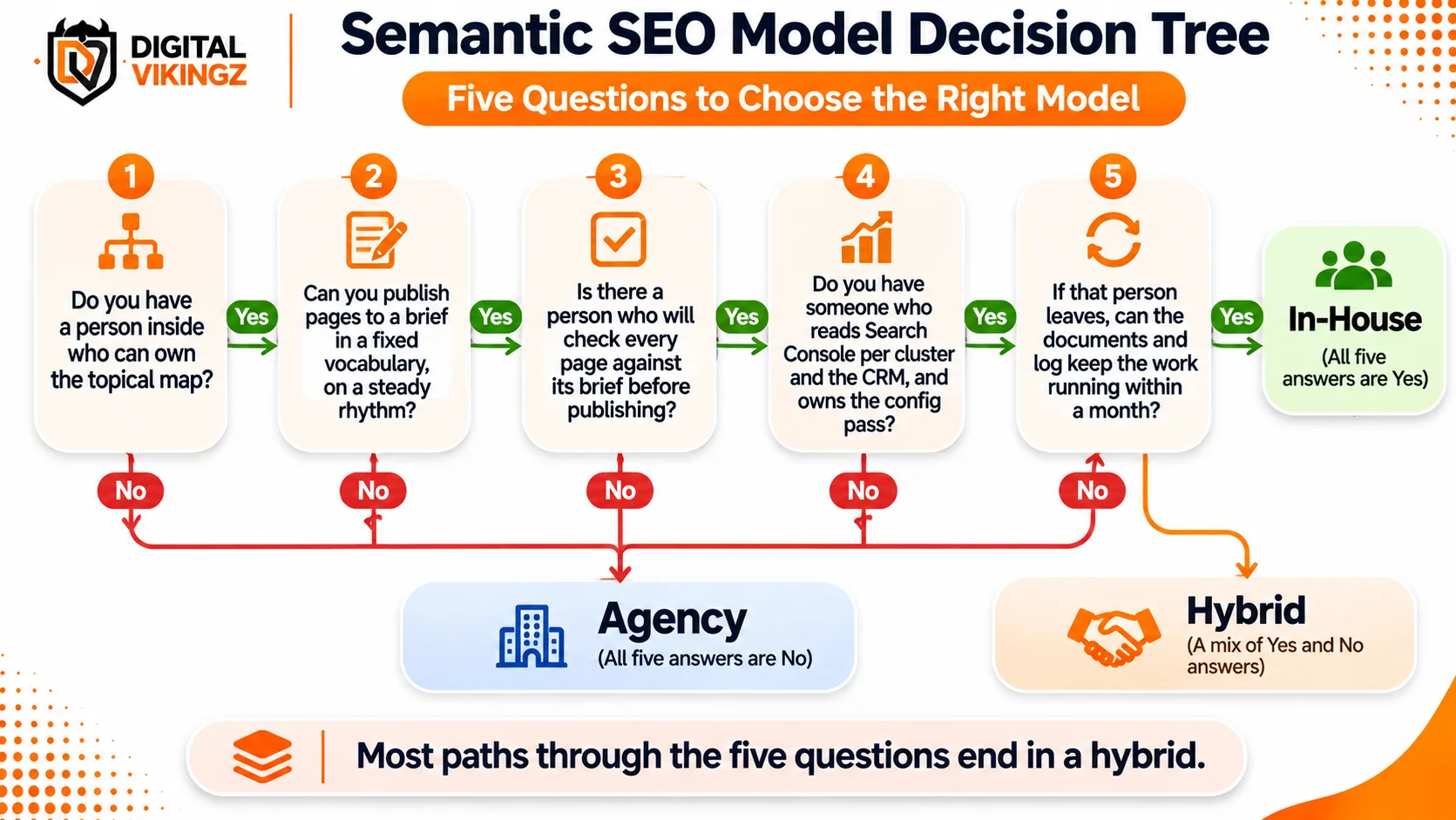
The image above shows the five questions as a tree. The leaves are the three models. Most paths end in the middle.
What does the decision cost in each model?
The cost shape differs by model: in-house is salaries and time to competence, an agency is a project fee for the architecture and a monthly fee for production, and a hybrid is one of each.
The figures depend on market, seniority and scope, and no general number holds across businesses. The comparison that does hold is shape. In-house cost is fixed and continues whether pages ship or not. Agency cost for architecture is fixed scope with a written output, and agency cost for production follows the pages. How semantic SEO is priced sets out the factors on the agency side.
Time to competence is the hidden cost in-house. Google's own guidance for businesses considering an SEO states that four months to a year is usual before improvements are implemented and benefits appear; an in-house team learning the method adds its learning period in front of that.
Can a founder run semantic SEO alone?
A founder can run semantic SEO alone when the founder is the subject-matter expert, owns the map, and publishes at a rhythm the business can sustain, which in practice means a small map and a slow rhythm.
The founder fills all five roles for a while and then stops filling one. The usual first casualty is the check, because the founder is both writer and checker. The second is measurement. A founder who starts alone plans the point at which one role moves out.
How are results measured in each model?
Results are measured the same way in every model: pages published to brief per month, query count and clicks per cluster in Search Console, mention and citation rate on the prompt set, and leads per cluster in the CRM.
The model changes who produces the reading, not the reading. An in-house team that reports keyword positions and an agency that reports keyword positions have the same measurement problem. The KPIs are set before the work starts, in the statement of work for an agency and in the role description for a hire. How to attribute SEO to pipeline sets out the lead side of the reading.
How does an agency work with an in-house team?
An agency works with an in-house team by producing the architecture documents, training the team on them, checking the first batches of pages, and then reading the ranking state per cluster on a fixed schedule.
The architecture arrives as documents the team can use without the agency in the room: the central entity definition, the topical map with page decisions, the vocabulary, the brief template, the internal linking rules, the page templates and the publishing roadmap. Semantic SEO Architecture lists the seven and the handover that goes with them.
The check on early pages is where the vocabulary either holds or splits. The agency reads the first batches sentence by sentence against the briefs, and the team's own checker takes over once the pass rate is high. The quarterly read then returns configuration decisions the team applies.
Businesses that are themselves agencies and resell the work have a separate route through white-label semantic SEO, where the roles sit differently.
What goes wrong in each model?
In-house fails on continuity and method, an agency fails on dependence and subject knowledge, and a hybrid fails on unnamed ownership.
The common failures by model are listed below:
In-house, method. Pages are written from keyword tools because no one has built a map before. The site grows and cannibalises itself.
In-house, continuity. The strategist leaves, the map was in a personal folder, and the next hire starts again.
Agency, dependence. The business receives reports and never sees the map. The contract ends and the business holds pages nobody inside can read.
Agency, subject knowledge. The agency writes from research alone and the pages state the obvious. Fix: the subject-matter contact inside the business answers the brief's fact questions before writing.
Hybrid, unnamed owner. Both sides assume the other checks the pages. Drift reaches the live site within a month.
Each failure is prevented by one line in a document: who owns which role, and where the documents live.
Name the owner of each role on your site
On a 30-minute call we go through the five questions for your business, mark each role as inside, outside or unfilled, and show you which model that produces. You leave with the matrix filled in, with or without an engagement.
Book a strategy call · See the services
Questions about in-house semantic SEO or an agency
Is a freelancer a third model?
A freelancer is an agency of one for the roles the freelancer fills. The same five questions apply, and continuity is the question to press hardest, because one person is the whole supply.
Can an in-house team learn the method from courses?
Yes, and the learning shows on the site. A course teaches the concepts; the map owner role is learned by building a map and reading what happens to the ranking state afterwards. A hybrid with the first architecture done outside shortens that.
Should the subject-matter expert write the pages?
The expert supplies the facts and reviews the drafts. Writing to a brief in a fixed vocabulary is a separate skill, and experts who also write well are rare and expensive to take off their main work.
How big does a business need to be for in-house?
Large enough that one person can spend most of their time on one site's map and the writers can publish without competing priorities. Below that, the strategist role is part time, and part-time map ownership is where continuity fails.
Does the model change for a multi-location or multi-language business?
The roles stay the same and the production role grows. Multi-location adds a template and a location owner; multi-language adds a vocabulary per language and a native editor. Both push the production role outward more often.
What should an in-house team ask an agency for first?
The architecture, not the pages. A team that receives the map, the vocabulary and the brief template can produce for years. A team that receives pages has nothing to produce from.
How do you move from agency to in-house without losing rankings?
The documents are already owned, the log is current, and the new owner shadows the last configuration pass before the contract ends. The vocabulary registry is the document that keeps the site reading as one source through the handover.
How do you move from in-house to agency?
The existing map and log are handed over first. An agency that starts by throwing out the map discards the historical data the pages earned. The existing map is audited and extended, not replaced.
Who owns the Search Console and CRM access in each model?
The business, in every model. Access is granted to the agency and revoked at the end. Property ownership never transfers.
Is a hybrid more expensive than either pure model?
A hybrid pays for the architecture once and for production at the in-house rate. The pure agency model pays for both from outside. The pure in-house model pays for the learning period. Over a year the hybrid is usually the lowest total, and the figure depends on the business.
What is the one question that decides most cases?
Question 1. A business with a real map owner inside can fill the other roles over time. A business without one needs the map built outside before anything else is decided.