 Digital Vikingz
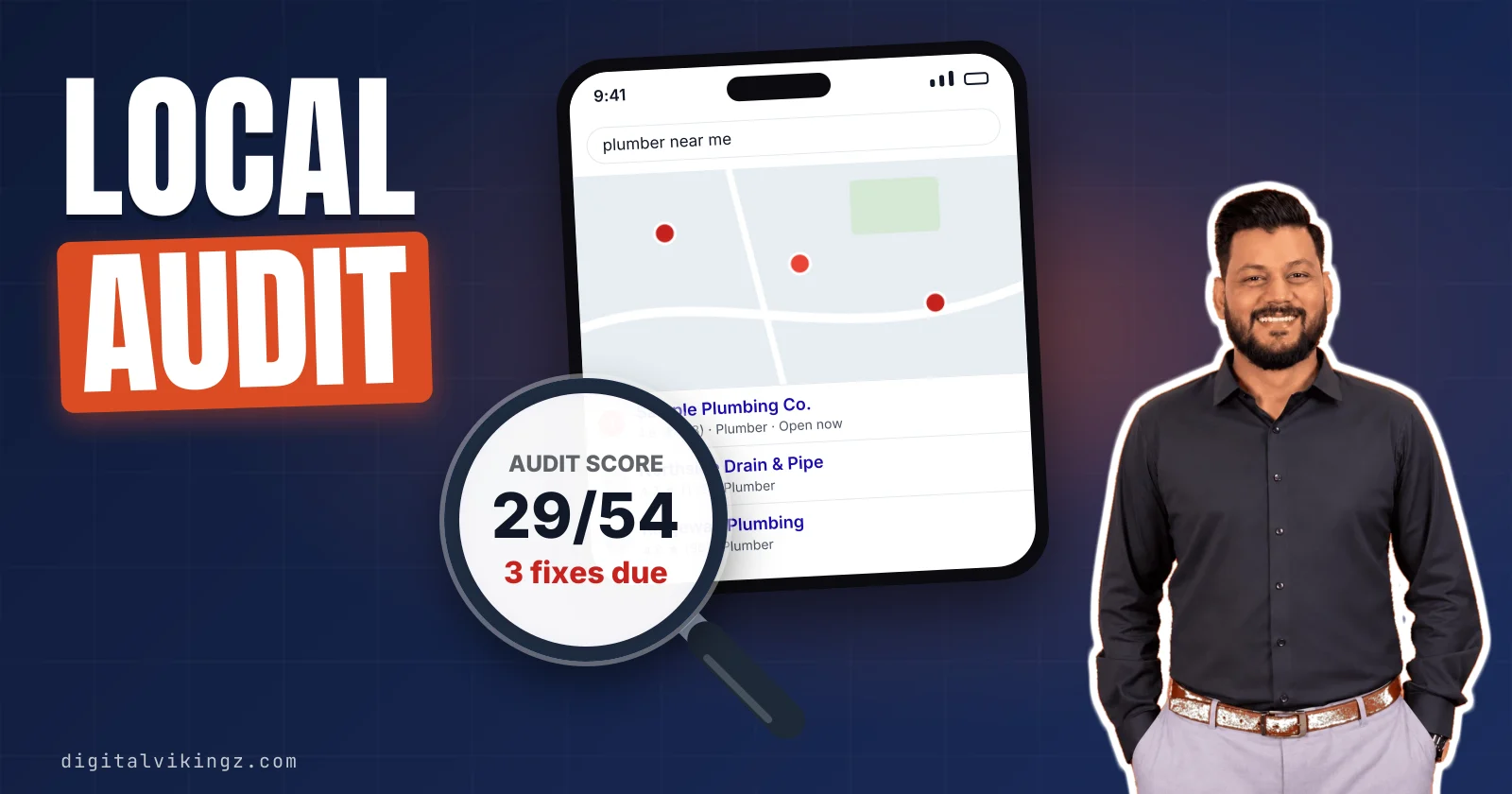
A local SEO audit is an inspection of a business's existing local presence that ends in a scored, ranked list of fixes.
The audit runs in seven steps: baseline, Google Business Profile, reviews, name, address and phone, website, map pack competitors and AI answers. The baseline records rank across the service area and the calls, direction requests and website clicks the profile already gets.
Each check is marked pass, partial or fail, and the failed checks are ranked by their effect on calls. Fixes that lose calls today come first, missing pages and reviews follow, and competitor gaps close by day 90. One location can be audited in-house with free tools, and a full audit is worth repeating every quarter to every year.
What is a local SEO audit?
A local SEO audit is an inspection of a business's existing local presence that ends in a scored, ranked list of fixes. The audit checks the Google Business Profile, reviews, directory listings, website and map pack competitors, and now the answers AI assistants give.
Google states that "Local results are mainly based on relevance, distance, and popularity." Each step of the audit tests one of those three factors, so every finding points at a cause Google names. Agencies also call the work a local SEO check or a local SEO analysis.
An audit differs from a checklist in the starting point.
How is a local SEO audit different from a local SEO checklist?
A local SEO audit inspects the local presence a business already has, while a local SEO checklist lists what a local presence should have. A checklist gives the same items to every business. An audit records what fails for one business, against named competitors, in one service area.
A checklist ends with ticked boxes, and an audit ends with a score and a fix order. A general SEO audit of the website is a third thing, because a site crawl never opens the Business Profile or the map pack.
A local SEO checklist for service businesses is the list of profile, website and listing items to set up once. The audit itself follows seven steps in a fixed order.
How do you do a local SEO audit?
A local SEO audit runs in seven steps, from a baseline of rankings and calls to a test of AI answers. The baseline comes first because fixes can only be ranked against a before picture. The Business Profile comes straight after.
The audit needs owner or manager access to the Business Profile and access to Google Search Console for the website. The list of services and towns and the names of the top three map pack competitors complete the inputs.
The seven audit steps are listed below:
- Measure rank and calls across your service area.
- Audit the Google Business Profile.
- Compare reviews with the top three competitors.
- Check name, address and phone across every listing.
- Audit the website's service and location pages.
- Benchmark the map pack competitors.
- Test whether AI assistants name the business.
Steps 2 to 7 hold 27 checks, and each check gets a pass, partial or fail mark. Step 1 sets the numbers every later fix is measured against.
Step 1: Measure rank and calls across your service area
The first audit step records map pack rank across the service area plus Business Profile calls, direction requests and website clicks. Owners who check the map pack from the office see one position, but customers search from every street in the service area.
A rank grid is a map of search positions for one keyword, checked from evenly spaced points across the service area. The local pack, the block of three map results, can change from one grid point to the next.
The three baseline numbers are listed below:
- Rank by grid point: the map pack position for the main service at each point of the rank grid, for two or three main keywords.
- Calls: clicks on the call button of the Business Profile over the last three months. Google counts the click, not the connected call.
- Direction requests and website clicks: the other two customer actions in the Business Profile performance report, over the same three months.
Business names, towns and numbers in the figures of the article are samples, not client data.
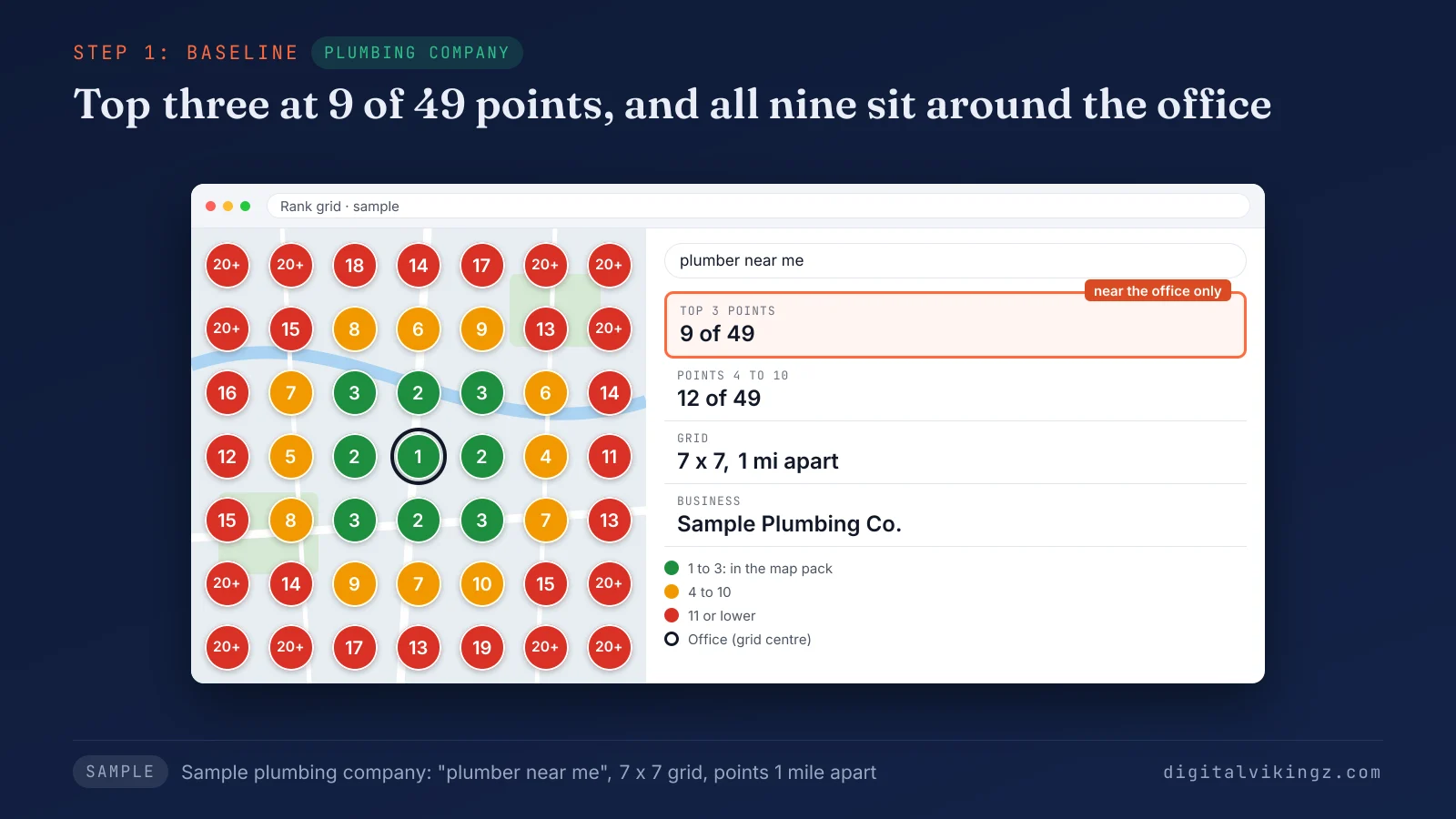
Figure 1 shows a sample plumbing company in the top three at 9 of 49 grid points. All nine points sit close to the office, so a single rank check from the office would hide the gap.
The Google Business Profile performance report shows views, searches, calls, direction requests and website clicks by month. The audit opens the Business Profile once the baseline is saved.
Step 2: Audit the Google Business Profile
The Business Profile step checks the name, categories, services, hours, photos, posts and description against the business customers know. Google states that "Businesses with complete and accurate info are more likely to show up in local search results."
The profile was called Google My Business until November 2021, so older guides use that name. Newer guides call this step a GBP audit. Our guide on how to optimize a Google Business Profile covers the setup behind each check.
The seven Business Profile checks are listed below:
- Ownership and duplicates: the business controls the profile, and only one profile exists. Fail: an old agency holds owner access, or a second profile shows the same business.
- Name: the profile name matches the signage, website and stationery. Fail: a service or city word added to the name.
- Primary category: the most specific category for the main service. Fail: a broad category, such as a roofer listed as a construction company.
- Secondary categories and services: up to 9 more categories, the limit in Google's help page, and a services list that matches the work. Fail: categories used as keywords, or services missing.
- Hours: regular and holiday hours are current. Fail: no holiday hours, or hours that differ from the website.
- Photos and posts: recent photos and posts compared with the top three competitors. Fail: the newest photo or post is months older than theirs.
- Description and attributes: the description names the main services and areas, and the attributes are filled. Fail: an empty or keyword-stuffed description.
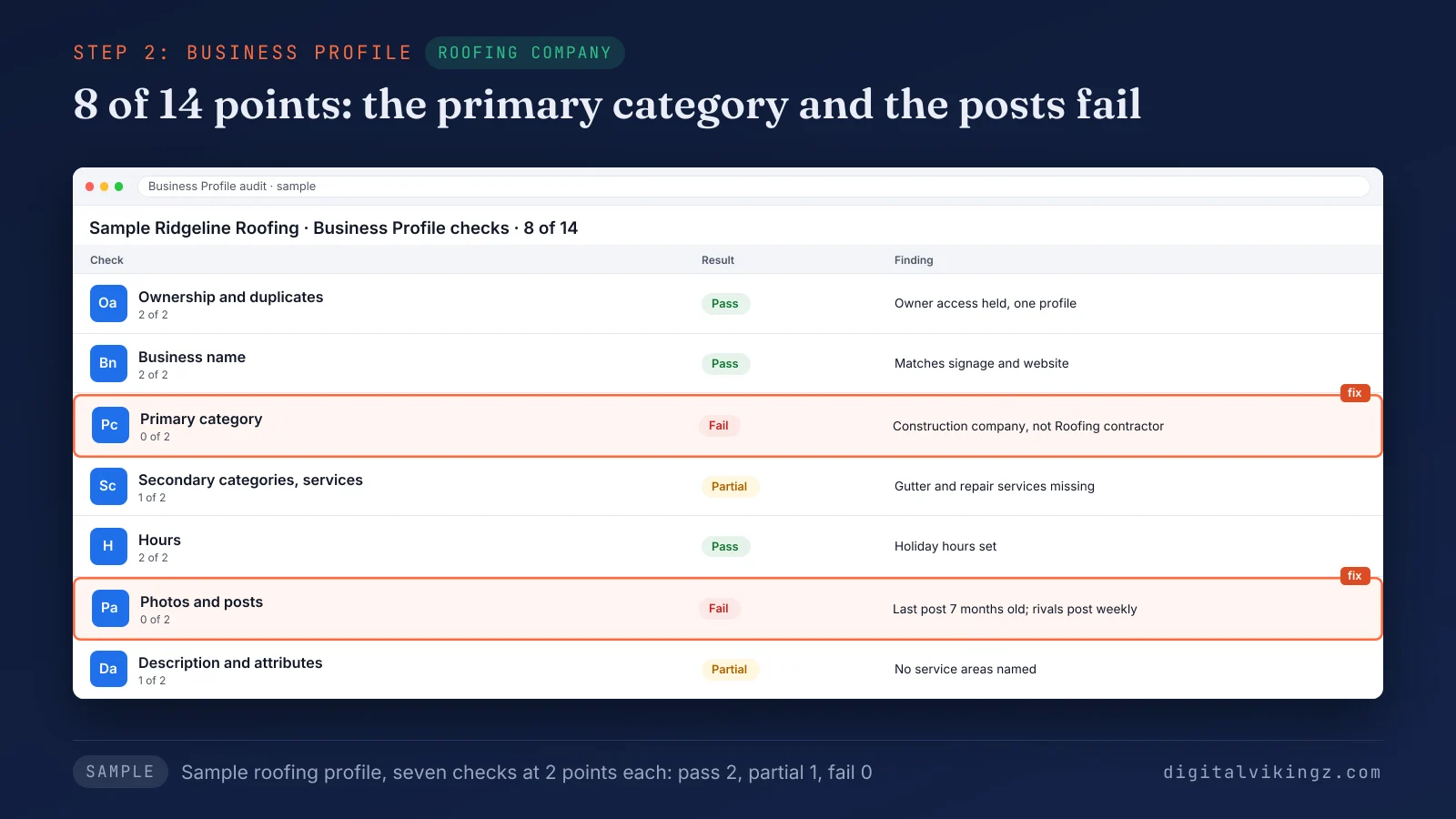
Figure 2 shows a sample roofing profile scoring 8 of 14, with the primary category and the posts marked as fixes. Owners who fail the category check can follow our guide on how to choose the Google Business Profile primary category.
One name check carries more risk than the rest.
Can a keyword in the business name get the profile suspended?
Yes, a keyword added to the business name can get a Google Business Profile suspended, because Google does not permit extra words in the name. Google's guidelines say "Including unnecessary information in your business name isn't permitted, and could result in the suspension of your Business Profile."
The audit scores any added service, city or slogan word in the name as a high-risk fix, never as an opportunity. Service and city words belong in the categories, services, description, posts and website instead.
Profiles that are already suspended need Google's reinstatement request before any audit fix can help.
Step 3: Compare reviews with the top three competitors
The review step compares review count, average rating, recency and reply rate with the top three map pack competitors for the main service. Google says "More reviews and positive ratings can help your business's local ranking."
The four review checks and their fail states are shown below:
| Check | What to compare | Fail looks like |
|---|---|---|
| Review count | Your total against the top three | Below the lowest of the three |
| Average rating | Your star rating against the top three | Lower than all three |
| Recency | Reviews in the last 90 days against the top three | No review in 90 days while they gain several |
| Reply rate | Share of reviews with an owner reply | Unanswered reviews, above all negative ones |
The audit also flags any review incentive or filtered request, because Google bars merchants who "selectively solicit positive reviews from customers." A review gap closes with a request after every finished job. Our guide shows how to get more Google reviews in 7 steps inside Google's rules.
Reviews describe the business, and the next step checks that every listing describes the same business.
Step 4: Check name, address and phone across every listing
The citation step checks that the business name, address and phone number match, token for token, on the website, the schema, the Business Profile and the main directories. Each listing of the name, address and phone number is a citation.
Matching details across all citations are called NAP consistency, so agencies call step 4 a citation audit.
The four citation checks are listed below:
- Master record: one agreed spelling of the name, address and phone, written down before any comparison.
- Own sources: the website footer, the contact page and the LocalBusiness schema match the master record and the Business Profile.
- Main directories: Apple Business Connect, Bing Places, Yelp, Facebook, BBB and one trade directory match the master record. AI assistants cite trade directories such as Healthgrades or Zocdoc for dentists and Angi, HomeAdvisor or Thumbtack for trades, according to a BrightLocal sources study.
- Old and duplicate listings: no directory still shows an old address, an old phone or a second listing.
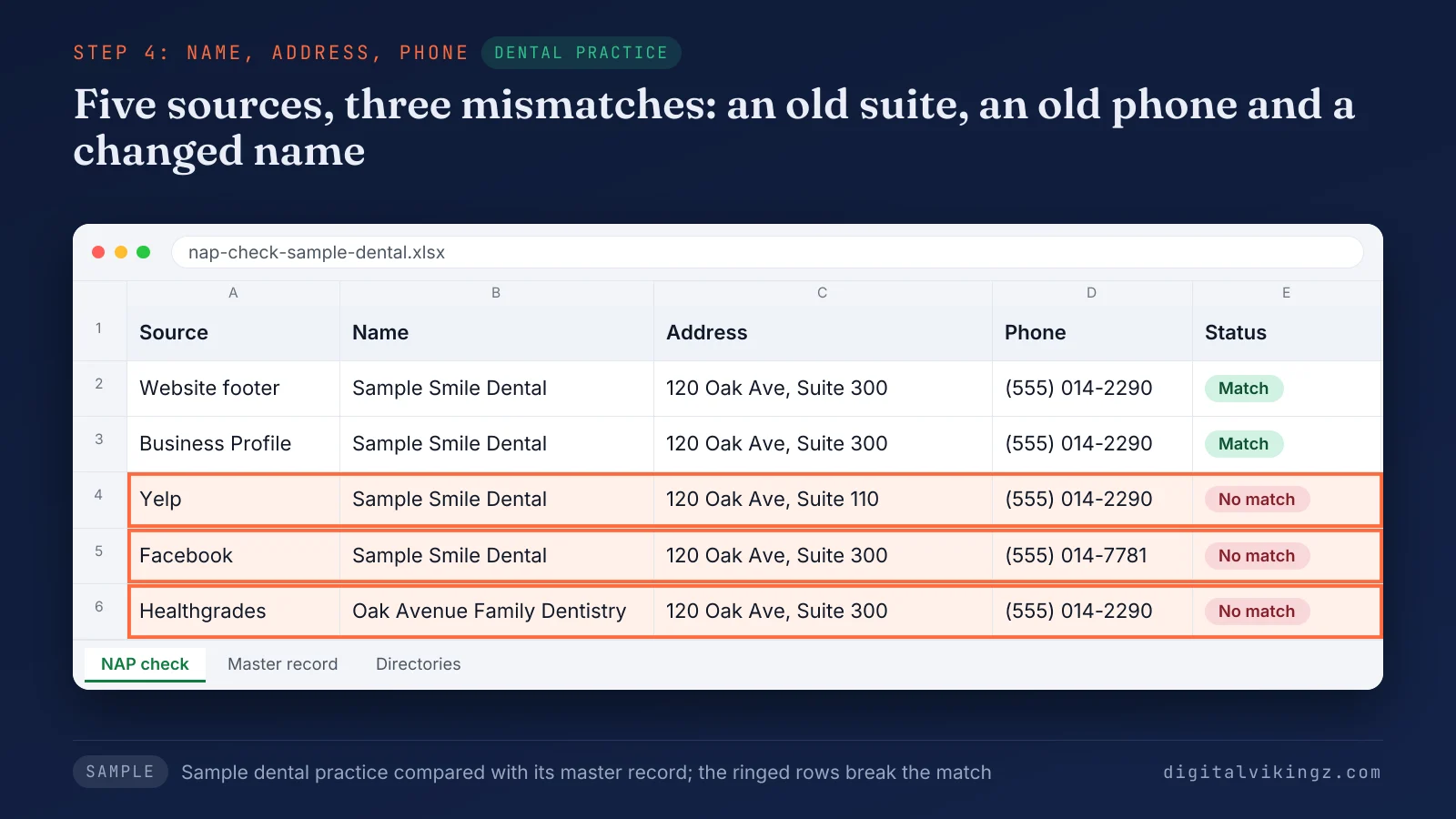
Figure 3 lines up five sources for a sample dental practice. The old suite number, the old phone number and the changed practice name are highlighted where they differ.
We treat citations as a consistency check: fix the mismatches, then spend the time on pages and reviews. The website is the source every listing should copy.
Step 5: Audit the website's service and location pages
The website step checks service and location pages, LocalBusiness schema against the visible name, address and phone, page titles and mobile speed. Google's LocalBusiness structured data requires two properties, the business name and the address, and recommends the telephone number.
The five website checks are listed below:
- Service pages: one page per main service. Fail: every service on one page.
- Location and service area pages: one page per staffed location, and pages only for towns with their own demand. Fail: copied city pages that change only the town name.
- LocalBusiness schema: the name, address and phone in the schema match the visible text token for token. Fail: an old address in the schema.
- Titles and headings: each page title and H1 names the service and the area served. Fail: "Home" or a slogan as the title.
- Profile link and mobile: the Business Profile links to the matching page, and the page loads well on a phone. Fail: the profile links to the homepage for every service, or the page fails Core Web Vitals.
Our free AI Visibility Checker tests part of step 5. The checker confirms that the name, address and phone are shown and matched in the schema, and that the site links to the Business Profile. Run the AI Visibility Checker for local business pages to test checks 3 and 5 for free.
Pages that pass still have to beat the pages of the three businesses above you.
Step 6: Benchmark the map pack competitors
The competitor step lists what the top three map pack businesses have that the audited business lacks: categories, service pages, recent activity and local links. Google's help page still names the third ranking factor Prominence, which Google bases partly on links and reviews.
The four competitor checks compare the business with the top three as shown below:
| Check | What to compare | Fail looks like |
|---|---|---|
| Categories | Primary and secondary categories of each competitor | They hold a more specific primary category |
| Service pages | Pages each competitor has for the main services | They have a page for a service you only mention |
| Recent activity | Newest photo and newest post on each profile | Their activity is weeks newer than yours |
| Local links and mentions | Local news, associations, suppliers and sponsors that mention each competitor | They are mentioned locally and you are not |
Distance is the one factor no fix changes, so a competitor next to the searcher can outrank a stronger profile. Each gap maps to a ranking lever, and our guide explains how to rank higher on Google Maps with the three ranking factors.
The last step checks a surface the map pack does not show.
Step 7: Test whether AI assistants name the business
The AI answer step asks ChatGPT, Gemini and Perplexity for the main service in the main city and records whether each assistant names the business correctly.
The three AI answer checks are listed below:
- Named: the business appears in the answer to "best [service] in [city]".
- Correct details: the answer gives the current name, address, phone and services, with no closed location.
- Sources: the answer cites the website, the Business Profile or a directory the business controls.
Answers can change between runs: a 2026 BrightLocal study found that repeat searches named overlapping businesses only 20 to 33 percent of the time. We run each prompt three times on each assistant and count the business as named only when the business appears in at least two runs.
AI assistants read business profiles, directory and review sites, websites and third-party mentions, so a fail here usually traces back to steps 2, 4 and 5. The sources behind a fail are set out in our guide on how AI assistants decide which local business to name.
A full AI visibility audit of off-site mentions is a separate job, and step 7 only tests the local answer. The checks turn into a score once all seven steps are done.
How do you score a local SEO audit?
A local SEO audit is scored by marking each check pass, partial or fail and ranking the failed checks by their effect on calls. Our scoring gives 2 points for a pass, 1 for a partial and 0 for a fail, across 27 checks and 54 points.
The baseline in step 1 is measured, not scored, because the baseline is the before picture the fixes are judged against.
The checks and points of the audit score are shown below:
| Step | Checks | Points available |
|---|---|---|
| Step 2 Business Profile | 7 | 14 |
| Step 3 Reviews | 4 | 8 |
| Step 4 Name, address and phone | 4 | 8 |
| Step 5 Website | 5 | 10 |
| Step 6 Map pack competitors | 4 | 8 |
| Step 7 AI answers | 3 | 6 |
| Total | 27 | 54 |
A low total matters less than which checks fail, so the fix list is sorted by effect on calls first and effort second. A fail that stops customers calling, such as wrong hours or a wrong phone number, ranks above a fail that only slows growth.
Calls also explain the most common puzzle an audit meets.
Why do rankings look fine while calls stay low?
Rankings that look fine next to low calls often mean the rank holds only near the office, or competitors win the click with stronger profiles.
The four common causes of good rankings with low calls are listed below:
- Narrow rank: the top three positions cover only the grid points near the office (step 1).
- Weaker profile: competitors show more reviews, newer photos or clearer services (steps 2, 3 and 6).
- Wrong details: an old phone number or wrong hours on the profile or a directory (step 4).
- Lower demand: a seasonal dip, or calls that start from the website, which the Calls metric does not count.
The audit tells the four causes apart, because each cause fails a different step. A sudden fall in calls has its own first checks, listed in our guide on what to check first when Google Business Profile calls drop.
The score and the causes decide the order of the fixes.
What should you fix first after a local SEO audit?
The first fixes after a local SEO audit are lost-call fixes within 30 days, then missing pages and reviews by day 60 and competitor gaps by day 90.
The three phases of the fix order are listed below:
- Days 1 to 30, stop the losses: correct the primary category, remove extra words from the name and set holiday hours. Match name, address and phone on the site, schema and profile, merge or remove duplicates and reply to every open review.
- Days 31 to 60, build what is missing: add service and location pages and LocalBusiness schema, request a review after every finished job and restart photos and posts.
- Days 61 to 90, close the competitor gaps: fix trade directory listings, earn local mentions and links, and make the facts AI assistants read agree everywhere.
Day 90 repeats step 1, so the new rank grid and calls are compared with the baseline. Profile edits go through Google review before they show. The notice on our own profile in November 2026 read "Your edit is pending review. It may take up to 1 day to be published."
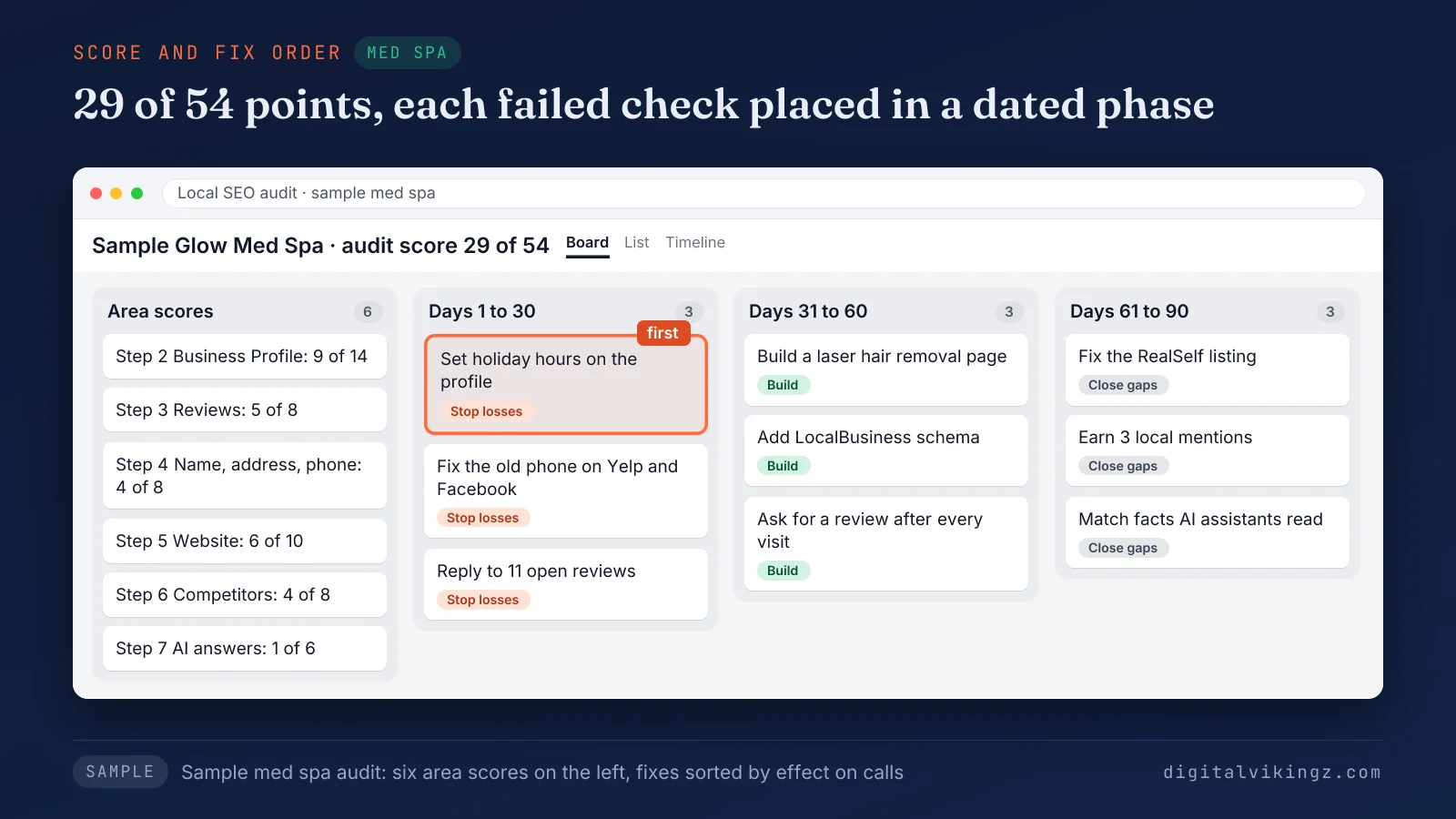
Figure 4 shows a sample med spa scoring 29 of 54, with each fail placed in its phase. The Business Profile scores 9 of 14, reviews 5 of 8 and name, address and phone 4 of 8. The website scores 6 of 10, competitors 4 of 8 and AI answers 1 of 6.
Home-service businesses whose posts stalled can hand the posting to Daily Google Posts, where our AI agent posts from the business's own website. A complete Google Business Profile optimization guide covers field-by-field setup, which an audit only inspects.
The next question is who does the work.
Should you do a local SEO audit yourself or hire someone?
You can do a local SEO audit yourself with free tools and a few hours, and hiring someone makes sense when fixes need pages, schema or weekly work. One location takes hours, not days. The harder part is the 30, 60 and 90-day work after the score.
The three ways to run the audit compare on cost, owner time and limits as shown below:
| Route | Money cost | Owner time | Best fit | Weak point |
|---|---|---|---|---|
| Yourself with free tools | None | Several hours, plus the fixes | One location, an owner who keeps the routine | No outside eye on competitors or schema |
| A free automated audit | None | Minutes | A first look at one profile | Usually scores the profile only, with no fix order |
| Our Local SEO and Google Business Profile Optimization | A written quote after the strategy call | A strategy call and approvals | Owners who want the audit and the fixes handled, including clinics and multi-location brands | Costs more than doing the audit yourself and starts with a call |
Our service starts with the same audit: every category, detail and page is checked against what your customers search, then categories, details, schema and pages are fixed. We work with manager access, so the owner keeps the profile. We do not promise rankings or a number of calls.
Owners who would rather hand over the audit and the fixes can book a strategy call for Local SEO and Google Business Profile Optimization with a full audit.
How much does a local SEO audit cost?
A local SEO audit done yourself costs time rather than money, while a paid audit is priced by scope, so no single market price exists. Scope means the number of locations, services, directories and competitors checked, plus any fixes included in the price.
The website part of the audit can start free with the AI Visibility Checker. Our Local SEO and Google Business Profile Optimization service quotes the audit and the fixes in writing after the strategy call.
Local SEO pricing by monthly budget is a separate decision from the audit price, because a retainer pays for the fixes month after month. Price matters less than what the audit hands back.
How do you judge a local SEO audit someone else hands you?
A useful local SEO audit shows a baseline, evidence for every finding and a dated fix order, and never promises a ranking.
The five tests of an audit report are listed below:
- Baseline: rank by grid point and three months of calls, direction requests and website clicks.
- Evidence: a screenshot, a listing URL or a value for every finding.
- Competitors: the top three named and compared on the same checks.
- Fix order: each fix placed in a phase with an owner and a date.
- Local scope: the Business Profile, reviews and listings covered, not only a website crawl.
A report that promises a top position fails at once, because Google states "There's no way to request or pay for a better local ranking on Google." Some businesses need the steps adjusted before the five tests apply.
How does a local SEO audit change for service-area and multi-location businesses?
A service-area business audits its service areas and hidden address instead of a storefront, and a multi-location business repeats every step for each location.
Google's guidelines say "If you're a service-area business, you should hide your business address from customers." Google allows "up to 20 service areas" and one profile for the whole area a service-area business serves.
A business with several staffed locations needs one profile per location, and Google says "Do not create more than one page for each location of your business." A multi-location audit scores each location separately and compares the locations, because one weak branch hides inside a group average.
Towns without a staffed location get service area pages only where local demand exists. Every business type repeats the audit on a schedule.
How often should you run a local SEO audit?
A full local SEO audit should run once a quarter to once a year, with the Business Profile and reviews checked every month. Search Engine Journal suggests a full audit every 6 to 12 months, and several agency guides suggest every quarter.
The five events that call for a new audit are listed below:
- A move to a new address.
- A new business name or phone number.
- A change of primary category.
- A website redesign.
- A sudden fall in rank or calls.
Each new audit starts again at step 1, so the next score is compared with the last one.
Local SEO audit questions
How long does a local SEO audit take?
An audit of one location takes about 90 minutes to 8 hours, according to published agency guides. More services, directories and locations add time to each step.
Can ChatGPT do a local SEO audit?
ChatGPT can review details you paste in, but a full audit needs data no assistant sees, such as the rank grid and profile performance. Step 7 still uses ChatGPT as one of the assistants tested in the audit.
Do backlinks matter in a local SEO audit?
Backlinks matter in the audit as part of prominence, which Google bases partly on how many websites link to a business. Local mentions and links sit in step 6, after the profile and the pages.
Does page speed matter in a local SEO audit?
Page speed matters in the audit as a pass mark: a mobile page that passes Core Web Vitals needs no further speed work to compete locally. Our experience is that speed rarely closes a map pack gap once the page passes.
Do you need paid tools for a local SEO audit?
An audit of one location needs no paid tool, although a rank grid tool saves hours in step 1. Google Maps, the Business Profile performance report, Search Console and a phone cover the other steps.
Does a local SEO audit still check Business Profile Q&A?
The audit checks Business Profile Q&A only where the profile still shows a Q&A section to customers. Google's help page still describes Q&A while vendors report a narrower feature, so the answers belong in services, the description and the website too.
Is a general SEO audit enough for a local business?
A general SEO audit is not enough for a local business, because a site crawl misses the Business Profile, reviews, listings, map pack competitors and AI answers. The site crawl covers only step 5 of the seven audit steps.
Where should you start a local SEO audit?
Start a local SEO audit with step 1: save the rank grid and three months of calls before changing anything. Digital Vikingz runs the full audit and the fixes for owners who would rather hand the work over.
Owners whose audit shows a quiet profile can hand the posting to our AI agent. Daily Google Posts starts at $99 per listing per month, with the first post free. See today's post for your business with the free Daily Google Posts preview.