Digital Vikingz
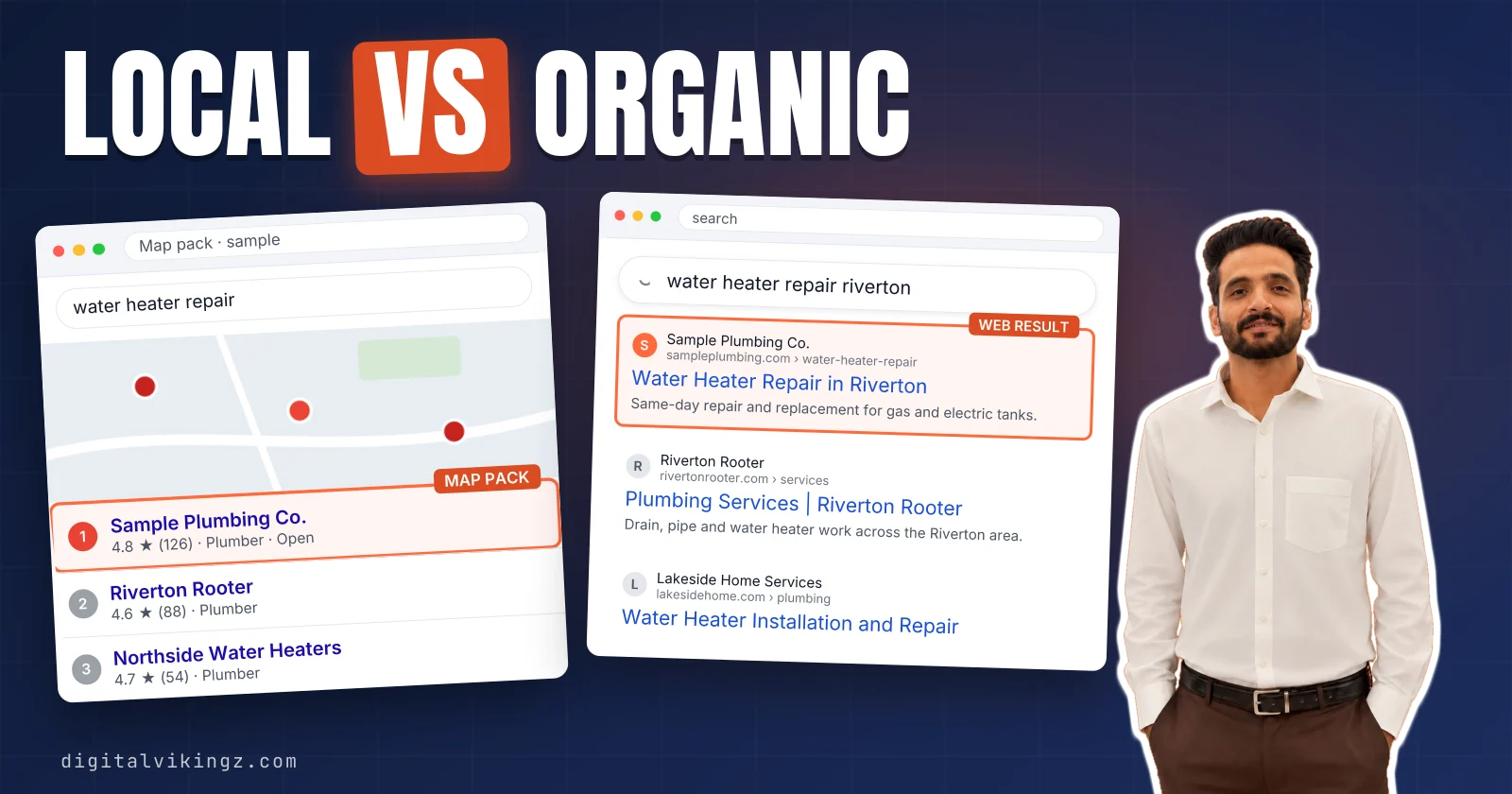
Local SEO is the part of SEO that wins a business unpaid visibility in the map pack, Google Maps and nearby results.
Organic SEO wins a website's pages unpaid rankings in Google's standard results, for searches near the business and far away. Both scopes share the website, and local SEO adds the Google Business Profile (GBP), distance from the searcher and reviews.
Local SEO targets the map pack, while organic SEO targets the web results above or below the map pack. Google ranks local results on relevance, distance and prominence, and links and reviews feed prominence. The GBP performance report measures local SEO, and the Google Search Console Performance report measures organic SEO.
A service business whose buyers search near the business should start with local SEO and add an organic page for every service. A business that sells beyond its area, or has no location to visit and no travel to customers, should lead with organic SEO. Most service businesses then run both scopes from one website.
What is the difference between local SEO and organic SEO?
Local SEO and organic SEO differ by target: local SEO wins the map pack and nearby results, and organic SEO wins standard web rankings.
Both scopes belong to search engine optimization, and both earn unpaid results. Organic SEO goes by other names, including traditional SEO, national SEO and regular SEO.
Local SEO adds three inputs that a website does not control: the GBP, distance from the searcher and the profile's reviews. Business names and towns in the examples below are samples.
The table below compares local SEO and organic SEO on six attributes:
| Attribute | Local SEO | Organic SEO |
|---|---|---|
| Target result | Map pack, Google Maps and local results | Standard web results, local and national |
| Asset that ranks | Google Business Profile | Website pages |
| Main ranking inputs | Relevance, distance, prominence | Meaning, relevance, quality, usability, context |
| Geography | Searchers near the business or in its service area | Any searcher, with location applied to local-intent searches |
| Measured in | GBP performance report | Search Console Performance report |
| Best first fit | Businesses customers visit, or that travel to customers | Businesses that sell beyond one area |
A common first question is whether local SEO counts as SEO at all.
Is local SEO the same as SEO?
Local SEO is not the same as SEO, because local SEO is one branch of SEO with a geographic scope.
Agency and vendor guides agree that local SEO is a subset of SEO, not a separate discipline. Every local SEO plan still needs the website work that organic SEO does: service pages, links and a site Google can crawl.
The GBP ranks in the map pack, and the website ranks in web results, so neither one replaces the other. The word organic causes a second mix-up about payment.
Is local SEO organic?
Local SEO is organic, because map pack and local results are unpaid, like the standard web results below them.
Google's local ranking help states: "There's no way to request or pay for a better local ranking on Google."
Google labels paid placements with "Sponsored" or "Ad" and shows them apart from the unpaid results. Local Services Ads and Google Ads are paid channels, so both sit outside local SEO and organic SEO.
The axis between local SEO and organic SEO is the result type and the searcher's location, not payment. Both result types often share one page for a service search.
Which search results do local SEO and organic SEO target?
Local SEO targets the map pack, Google Maps and local results, and organic SEO targets the standard web results on the same page.
Google's help page says a customer who searches "for a business or place near their location" finds "local results on Google Maps and Search." Google Search also recognizes that "many queries have a local intent", even when the searcher types no town name or "near me".
The three search results a service business can target are listed below:
- Map pack: the short list of GBP listings shown on a map for a local search, with more listings in Google Maps.
- Local organic results: website pages ranked for a local-intent search, which change with the searcher's location.
- National organic results: website pages ranked for searches without local intent, such as how-to and cost questions.
Local SEO wins the first result type, and organic SEO wins the second and the third.
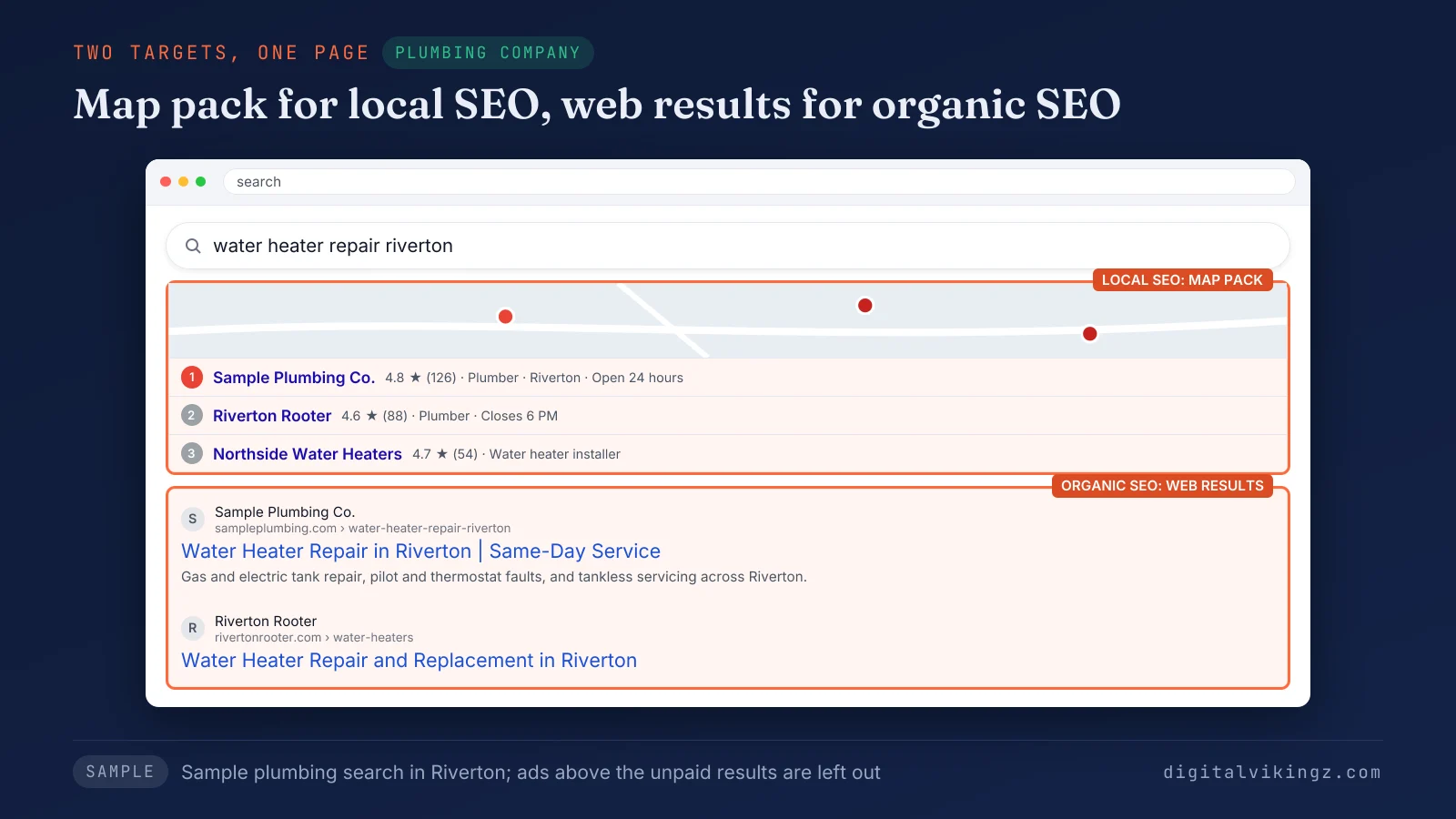
Figure 1 shows a search for water heater repair in Riverton, with the map pack above the local organic results for Sample Plumbing Co. Paid ads and Local Services Ads can sit above both result types, which pushes the unpaid results down the page.
The local organic results are the target a profile-only plan misses.
Do organic results change with the searcher's location?
Organic results change with the searcher's location for local-intent searches, so organic SEO for a service business is mostly local.
Google's Search Console help notes that search results are "specific to the time, place, device, and recent history of the person searching." Google uses the searcher's location, search history and settings to decide which results are most relevant in the moment.
Our day spa client saw the query "couples massage [city]" grow from 2 to 257 clicks in Search Console between two 89-day windows. The clicks landed on the spa's website pages, for a query that names a city.
The day spa SEO case study covers a brand with three locations in three states. Our day spa SEO case study sets out the windows and the pages behind the growth.
A service business should give each service a page of its own, so the page can win local organic results through organic SEO. Profiles rank on local SEO inputs, and pages rank on organic SEO inputs.
What decides rankings in local SEO and organic SEO?
Local SEO rankings rest on relevance, distance and prominence, and organic SEO rankings rest on meaning, relevance, quality, usability and context.
Google states that "Local results are mainly based on relevance, distance, and popularity", and heads the third factor Prominence.
The three local ranking factors Google names for a GBP are listed below:
- Relevance: how well a GBP matches what someone is searching for.
- Distance: how far each business is from the customer who is searching.
- Prominence: how well-known a business is, based partly on links to the business and its reviews.
Google's page on ranking web results lists "the words of your query, relevance and usability of pages, expertise of sources, and your location and settings."
Distance is the one input no profile or page edit changes. A GBP usually ranks best close to the business and less well across town.
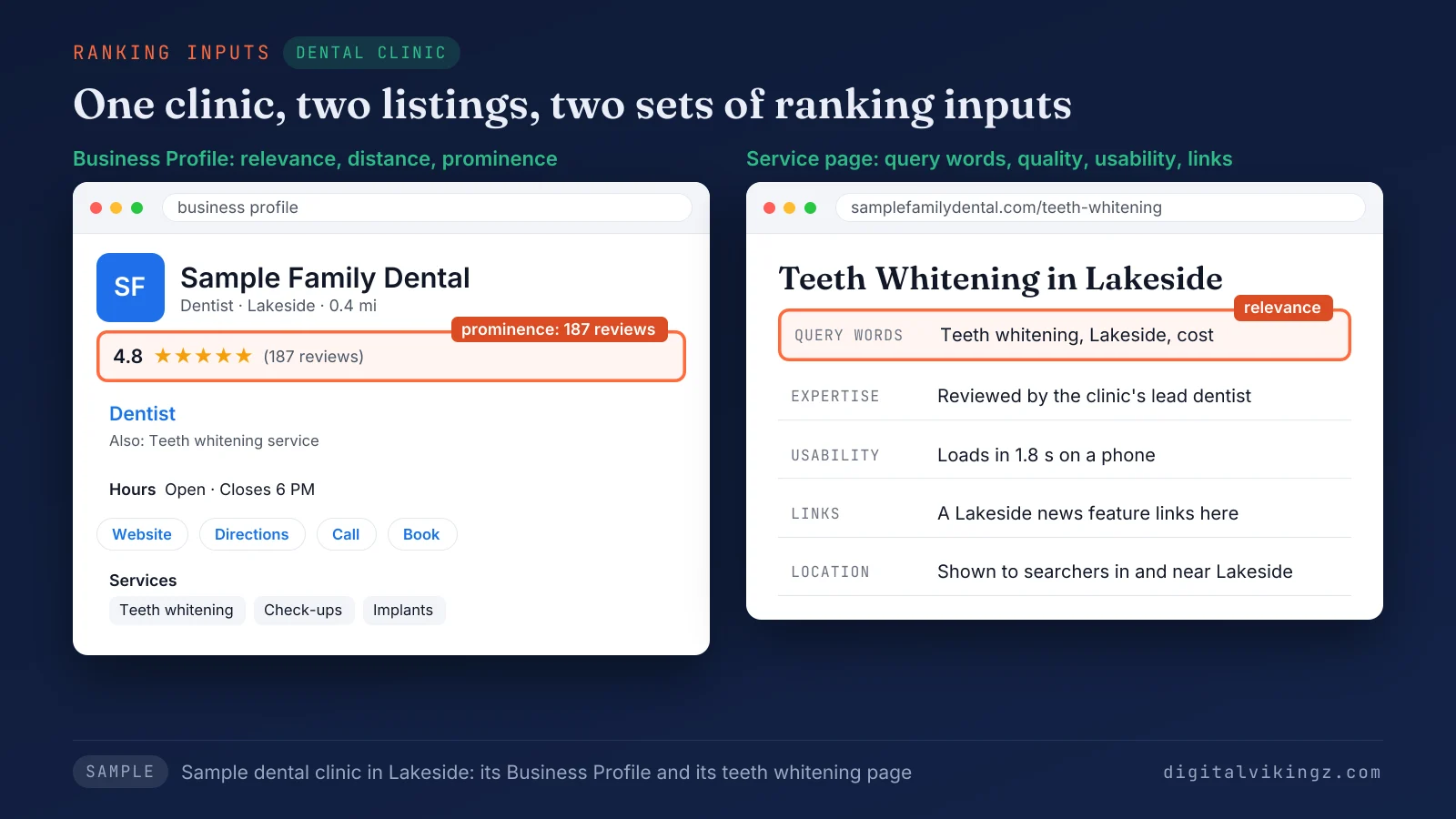
Figure 2 shows the GBP of Sample Family Dental in Lakeside beside its teeth whitening page, with the inputs each one carries.
Ranking higher on Google Maps comes down to local SEO work on relevance and prominence. Our guide to how to rank higher on Google Maps sets out that work in order. Two inputs count on both sides of the comparison.
Do links and reviews help both local SEO and organic SEO?
Links help both local SEO and organic SEO, and reviews help local SEO directly, according to Google's own help pages.
Google bases prominence partly on "how many websites link to your business and how many reviews you have."
Google's ranking page names links for web results too: one quality factor is whether "other prominent websites link or refer to the content."
Google adds that "More reviews and positive ratings can help your business's local ranking."
Google has not said that GBP reviews rank website pages, so review work counts on the local side. A link earned for a service page can work twice, for the page in web results and for the business's prominence in local results.
The profile itself belongs to the local side only.
Does local SEO need a Google Business Profile?
Local SEO needs a Google Business Profile, because the profile is the listing that appears in the map pack and Google Maps.
Google Business Profile is the name Google gave Google My Business in November 2021. Google's help page states that "Businesses with complete and accurate info are more likely to show up in local search results."
A business qualifies for a profile when the business "either has a physical location that customers can visit, or travels to customers where they are."
The profile is one component of local SEO, beside the website pages, reviews and listings that support the profile.
Google Business Profile optimization covers the categories, services, hours, photos and posts of the listing. Each field filled in brings the profile closer to the complete and accurate info that Google's help page asks for. Local SEO and organic SEO then each need a scorecard of their own.
How do you measure local SEO and organic SEO?
Local SEO is measured in the GBP performance report, and organic SEO is measured in the Search Console Performance report.
The GBP report counts views, searches, calls, direction requests, website clicks, messages and bookings. Google notes that the profile's performance data "includes views, searches, and actions from both organic search results and Google Ads."
The Search Console report counts clicks, impressions, click-through rate and average position for each query and page.
The table below matches each local SEO and organic SEO question to its report and metric:
| Question | Report | Metric to read |
|---|---|---|
| Do people call from Google Maps? | GBP performance | Calls |
| Do people come to the location? | GBP performance | Directions |
| Which services do web searches find? | Search Console Performance | Queries and pages |
| Does the website win the visit? | Search Console Performance | Clicks |
Google shows performance data only for verified GBP listings. Neither report shows the map pack position, so local SEO rank needs a separate check across the service area.
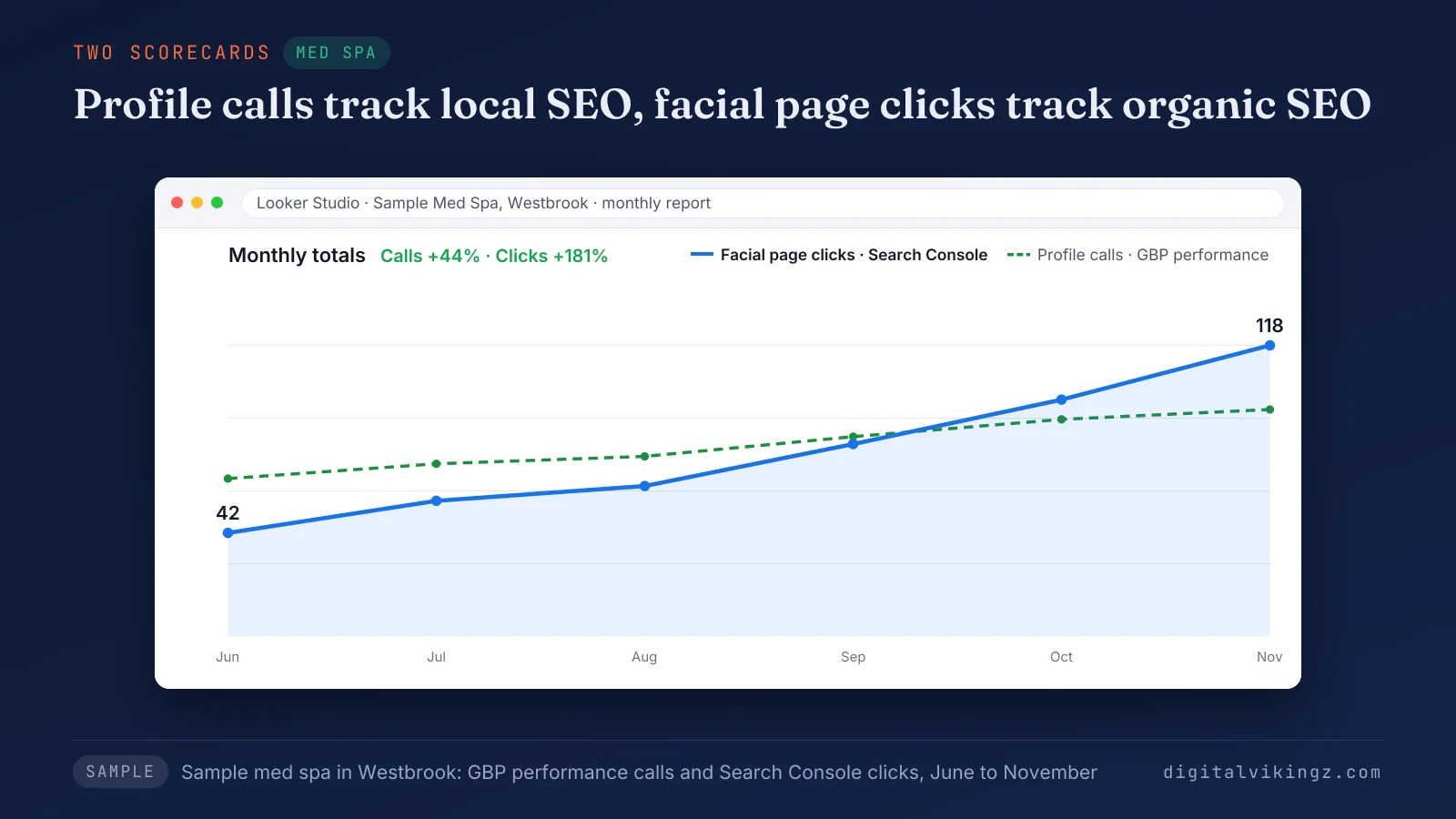
Figure 3 shows Sample Med Spa in Westbrook, with calls in the GBP report beside clicks on its facial page in Search Console.
The two reports also move at different speeds.
Which shows results sooner, local SEO or organic SEO?
Local SEO often shows results sooner than organic SEO, because a map pack has fewer competitors than a national set of web results.
Agency guides measure both scopes in months, and no study gives a fixed number for either. Speed depends on the competitors near the business, the state of the profile and the pages already live.
How long local SEO takes depends on the profile's starting point and the competition around the business. A complete profile with steady reviews usually starts closer to the map pack than a new, empty profile.
The faster start is one reason most service businesses begin with local SEO.
Which does a service business need first, local SEO or organic SEO?
A service business whose buyers search near the business needs local SEO first, then an organic page for every service on offer.
The order follows where buyers search and whether the business qualifies for a GBP.
The table below gives the starting scope for four types of service business:
| Business type | Example | Start with | Add next |
|---|---|---|---|
| Single-location trade or clinic | Plumber, dental practice | GBP and map pack | One page per service |
| Service-area business | HVAC company, roofer | Profile with a service area and a hidden address | Service pages, then town pages where demand exists |
| Practice with several locations | Med spa or dental group | One profile per staffed location | One page per location and per service |
| Business selling beyond its area | Supplier shipping nationwide | Organic pages for each service | A profile only for a location customers visit |
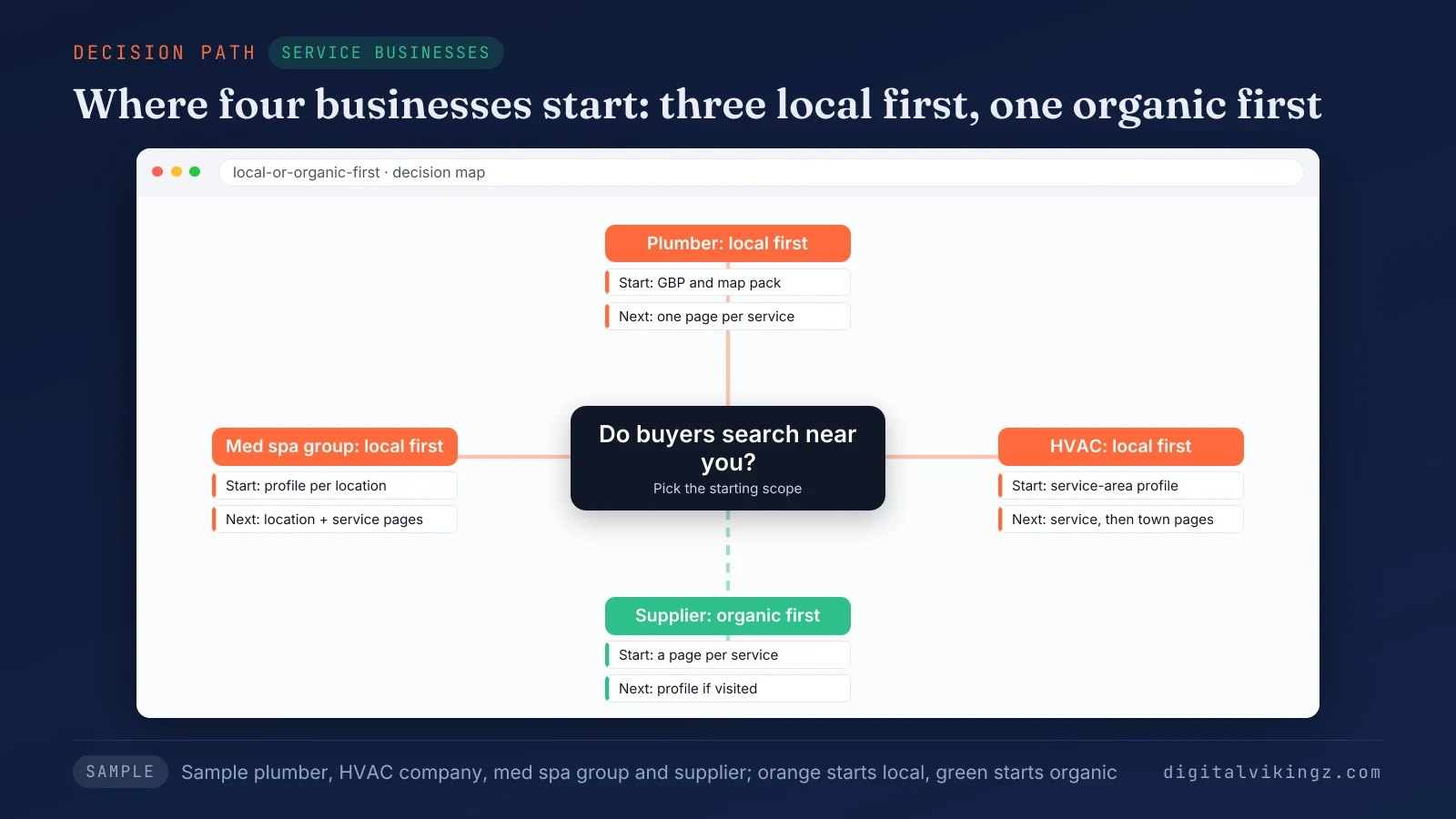
Figure 4 turns the table into a decision path, with a plumber, an HVAC company, a med spa group and a supplier.
A quote that lists local SEO and SEO as separate lines should show which tasks overlap, such as the service pages.
Local SEO for plumbers is a worked example of the first row. Our guide to local SEO for plumbers covers the map pack, service areas and emergency searches for one trade. A service business without a storefront follows the second row.
What should a service-area business do first?
A service-area business should first set up one GBP with a service area and a hidden address.
Google's guidelines say service-area businesses "should have one profile for the central office or location with a designated service area." Google also asks service-area businesses to hide the business address from customers.
The service area "shouldn't extend farther than about 2 hours of driving time" from the base, though Google allows larger areas for some businesses.
Organic SEO pages then carry the towns the profile does not reach, one page per town with its own demand.
Service area pages need details unique to each town to avoid becoming doorway pages. Our guide to service area pages for each town without doorway pages shows the test for each town. A business with several staffed sites follows different local SEO rules.
What should a practice with several locations do first?
A practice with several locations should first give each staffed location its own GBP and its own location page.
Google allows a service business one profile for each location that has "separate service areas and separate staff."
Each location page should match its profile's address, hours and services. Organic SEO pages for each service then serve every location at once.
Some businesses should reverse the order and put organic SEO before local SEO.
When should organic SEO come first?
Organic SEO should come first for a business that sells beyond its area or has no location to visit and no travel to customers.
A business with neither a location customers visit nor travel to customers does not qualify for a GBP, so no map pack listing exists. Google's guidelines also exclude rented virtual offices from GBP listings, which removes local SEO from the plan.
National SEO is the name for organic SEO aimed at searchers across a whole country. A business with a local showroom and national buyers runs local SEO for the showroom and organic SEO for everything else.
Most service businesses end up running both scopes.
How do local SEO and organic SEO work together?
Local SEO and organic SEO work together through the website, which the profile links to and which ranks in web results on its own.
A GBP sends visitors to the website through the website clicks Google counts in the performance report. Each service listed on the profile should have a matching service page on the website.
Website work does not cover the profile fields, the reviews or distance, which stay local SEO tasks. The website clicks in the profile report and the page clicks in Search Console together show how much one scope feeds the other.
Service and location pages carry both scopes, AI answers read both, and most mistakes come from funding one side only.
Both scopes run as one plan in our Local SEO and Google Business Profile Optimization service. The Local SEO and Google Business Profile Optimization plan covers the profile, the service and location pages and a monthly report of calls and clicks. Book a 30-minute call to see which scope your business should fund first.
Which website pages serve both local SEO and organic SEO?
Service pages and location pages serve both local SEO and organic SEO, because each page ranks in web results and can take the profile link.
The website pages that serve both local SEO and organic SEO are listed below:
- Service pages: one page per service, named the way customers search for the service.
- Location pages: one page per staffed location, with the address, hours and services of that location's GBP.
- Town pages: one page per town with its own demand, written with details unique to that town.
- Contact page: the business name, address and phone written the same way as on the GBP.
Local SEO guides commonly add LocalBusiness structured data to location pages. A business with several locations can point each profile's website link to that location's page.
Each service page should link to the location pages that offer the service. AI answers read the same pages and profiles.
Do AI answers use local SEO or organic SEO signals?
AI answers use both local SEO and organic SEO signals, reading business profiles, directory listings, reviews and business websites.
A top Google Maps position supports a local business without guaranteeing an AI recommendation. Website pages that answer service questions give an assistant facts that a GBP does not hold.
AI assistants recommending a local business compare several sources before naming one. Our guide on AI assistants recommending a local business shows what each assistant reads.
Distance from the person asking still shapes which local business an assistant names. Treating the two scopes as one leads to predictable mistakes.
What mistakes come from mixing up local SEO and organic SEO?
Mixing up local SEO and organic SEO leads to four common mistakes, and each one leaves a scope without work.
The four common mistakes when local SEO and organic SEO are mixed up are listed below:
- Profile only: a business that stops at the GBP has no page to win local organic results or cost questions.
- Website only: a business that skips the profile has no listing in the map pack, however well its pages rank.
- Copied town pages: pages that repeat one text with a new town name risk being treated as doorway pages.
- Keywords in the business name: adding service words to the profile name breaks Google's guidelines.
Google's guidelines say the name "should reflect your business's real-world name".
Each mistake is fixed by giving the missing scope a task list of its own. Shorter questions about the two scopes follow.
Questions about local SEO and organic SEO
Six shorter questions cover local SEO effort, cost, staying power, websites, examples and calls.
Can you do local SEO yourself?
A business owner can do local SEO alone, starting with the GBP fields, review requests and one page per service. Organic SEO for a competitive service usually takes longer, because pages and links build up over months.
Is local SEO cheaper than organic SEO?
Local SEO often costs less than organic SEO, because local SEO competes in one area instead of a whole country. Local SEO pricing still depends on the number of locations, services and competitors.
Does local SEO still work?
Local SEO still works, because Google still shows local results on Google Maps and Search for nearby searches. Customers still compare profiles, reviews and photos on Google Maps before they call, and organic SEO still wins the web results beside the map pack.
Does local SEO need a separate website?
Local SEO does not need a separate website, because the same site serves the profile link and the organic SEO pages. One site with a page per service and per staffed location covers both scopes.
What is an example of local SEO?
An example of local SEO is a plumber adding water heater repair to the GBP and asking each customer for a review. The matching organic SEO step is a water heater repair page on the plumber's website.
Why does a business rank in the map pack but get few calls?
A business in the map pack can get few calls when ads sit above the listing, searches are few, or the listing looks inactive. Calls in the GBP performance report show the local SEO effect apart from the rank, as clicks in Search Console do for organic SEO.
Where should a service business start with local SEO and organic SEO?
A service business should start with a complete GBP, then add a website page per service for local SEO and organic SEO.
Check calls in the GBP report and clicks in Search Console once a month. Digital Vikingz builds both scopes into one semantic SEO plan, so Google Maps, web results and AI answers all find the business.
Home-service owners short on time can keep the profile active with daily Google posts. Our daily Google posts written by an AI agent come from the business's own website, for plumbers, HVAC companies, roofers, electricians and cleaners.