Digital Vikingz
A service area page is a page for one area a business travels to, stating the services and facts true only in that area. Google's spam policies treat near-identical pages built for city searches as doorway abuse, so a page that only swaps the town name fails. Digital Vikingz decides which areas earn a page with the Query Deserves a Page test and names every other town in a service-area block. Each earned page carries facts that change by area, such as travel time, permits, prices, completed jobs and local reviews.
One query template for service area pages keeps the shared blocks short and the area blocks long. Each page links up to the service page and to an areas we serve page, forming the browseable hierarchy Google describes. Our Local SEO and Google Business Profile service keeps the pages inside the profile service areas and merges failing pages. Location pages stay reserved for staffed addresses, the model behind semantic SEO for a multi-location business. The Google Business Profile primary category, set beside the service areas, states what the business is. Service area pages are one part of the website pages for local service businesses.
How does a service area page rank without becoming a doorway page?
A service area page can rank without becoming a doorway page when four conditions hold, from an earned area to a matching profile.
The four conditions for a service area page that is not a doorway page are listed below:
- Earn the page with the Query Deserves a Page test before any copy is written.
- State facts that change by area, such as travel time, permits, prices and completed jobs.
- Link each page up to the service page and to an areas we serve page.
- Keep the page set inside the service areas listed on the Google Business Profile.
Conditions 1 and 2 shape the content of a service area page, built on area facts from an earned area. Conditions 3 and 4 place the page inside the site and inside the profile. Google's 2015 doorway guidance asks whether pages are "an integral part of your site's user experience" or a route to another page. We apply the four conditions in order, because a page that fails the first condition gains nothing from the other three. Each condition answers one part of Google's description of a doorway page.
What does Google treat as a doorway page?
Google treats a page as a doorway page when the page targets similar searches and leads users to a less useful intermediate page.
Google's spam policies state: "Doorway abuse is when sites or pages are created to rank for specific, similar search queries." The two doorway examples in Google's spam policies that touch service area pages are given below:
- "Having multiple domain names or pages targeted at specific regions or cities that funnel users to one page"
- "Creating substantially similar pages that are closer to search results than a clearly defined, browseable hierarchy"
The second example is the one city page sets meet, because pages that differ only by town name are substantially similar pages. Google's Search Central blog added five test questions about doorway pages on 16 March 2015. One question asks whether pages exist as an "island" that is hard to reach from other parts of the site. A doorway page in Google's current wording needs no redirect and no hidden text, so a visible and linked city page can still qualify. The next question is whether every service area page counts as a doorway page.
Are service area pages doorway pages?
Service area pages are not doorway pages when each page answers an area need that no other page on the site answers.
Google's two city-related examples name pages that funnel users to one page and pages that are substantially similar, not city pages as such. Local SEO guides from BrightLocal and Local Map Dominance read the policy alike: each page has to earn the URL. A service area page with area facts answers an area need, and a copy with a new town name answers none. The risk rises with each added page that repeats the others, because the set moves closer to Google's second example. Which areas earn a page is the decision that keeps the set clear of that example.
How does Query Deserves a Page decide which areas get a service area page?
Query Deserves a Page decides which areas get a service area page through five checks: demand, entity, similarity, predicate and pattern.
Four or five passes give an area a page. Three passes give a page when entity or predicate is among the three, and a section otherwise. Two passes make a section on the nearest earned page, and one or none make a sentence naming the town in the service-area block. The five checks read an area as given below:
- Demand: Searches name the area together with the service, in Google Search Console queries or call records.
- Entity: The area is a distinct place, such as a separate city, county or permit authority.
- Similarity: The top results for the service in the area differ from the results for the base area.
- Predicate: The needs attached to the area differ, such as emergency work or a different property type.
- Pattern: The area fills the "service in area" template and produces attribute searches that name the area.
A page per suburb fails demand and similarity almost every time. The page belongs to the area with its own search demand and something different to say. The other suburbs are listed in a service-area block on that page. Our knowledge hub works through each check of the Query Deserves a Page test with scored cases. The sample below scores five towns for a real estate agency.
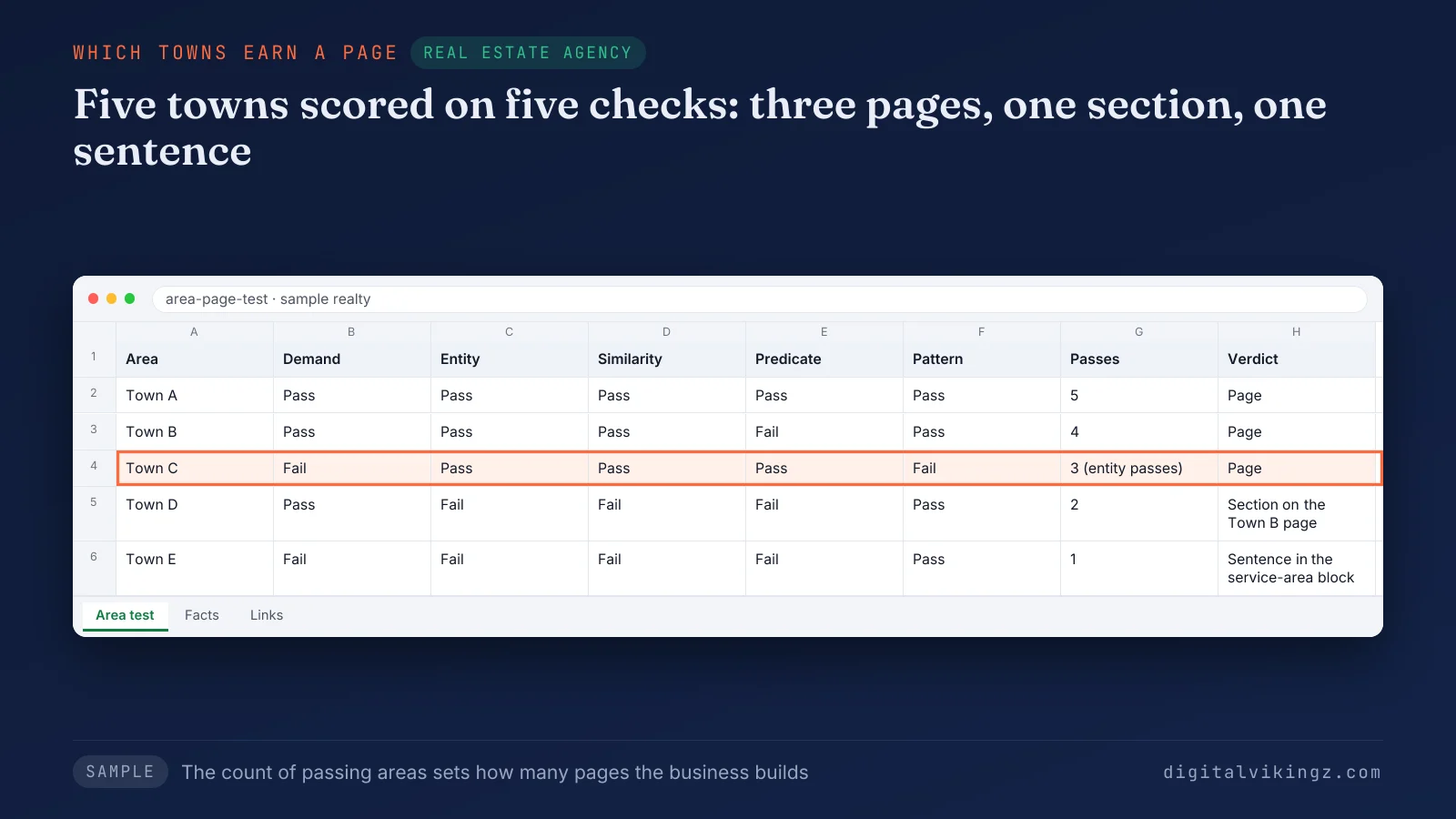
The sample agency earns pages for three towns, a section for one town and a single sentence for the last. The count of passing areas, not a target number, sets how many pages the business builds.
How many service area pages should a business build?
A business should build one service area page per area that passes the Query Deserves a Page test, and Google documents no safe number.
Google's spam policies state no page count and no word count for pages that target places. The Google Business Profile help page on service areas states no page count either. Published guides offer page counts and unique-copy percentages, and none of the guides we read on 13 November 2026 sources the numbers. The service areas on the Google Business Profile set the outer edge of the page set. We build no service area page for an area outside the profile service areas. The facts that make one page differ from the next matter more than the count.
What makes one service area page different from the next?
One service area page differs from the next through facts that change by area, not through a different town name or reworded copy.
The facts that change from one service area to the next are listed below:
- Travel and response time: The page states the response time to the area and any travel fee that applies there.
- Permits and rules: The page names the permit authority, inspection or local code that applies in the area.
- Property type: The page describes the housing stock, building age or property mix the work meets in the area.
- Prices: The page gives price ranges that differ in the area, with the reason and the date.
- Completed jobs: The page lists jobs done in the area, with the service, the month and a photo.
- Local reviews: The page quotes reviews from customers in the area that name the service.
- Area questions: The page answers questions customers in the area ask, taken from calls and Search Console queries.
Landmarks, local history and tourist facts add words without adding a reason to hire, so the list leaves them out. The swap test checks the result: change the town name, and a page built on area facts now contains false statements. A page that stays true after the swap holds no area facts and fails the test.
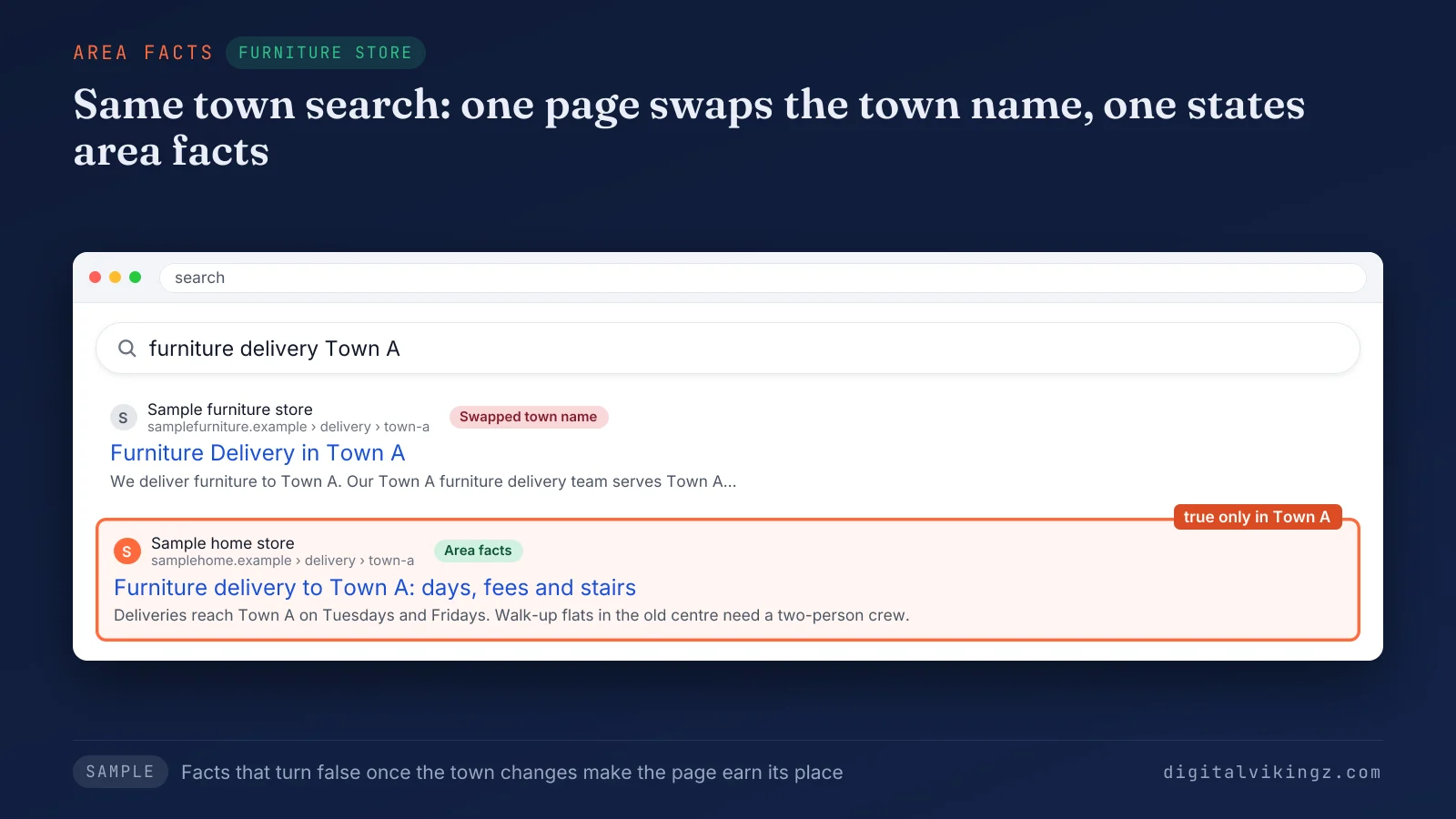
The second sample result names delivery on Tuesdays and Fridays and a two-person crew, two facts that turn false once the town changes. One template keeps the area facts in the same place on every page.
How does a query template keep service area pages distinct?
A query template keeps service area pages distinct by fixing the "service in area" pattern and filling the area slot with area facts.
A query template is a recurring query pattern with fixed wording and one variable entity slot. The area slot takes one earned area at a time, and every filled slot produces one service area page. Shared blocks, such as the service summary and the booking steps, stay to a sentence or two each and link to the service page. Variable blocks carry the area facts and the larger share of the words on each service area page. Area questions and completed jobs fill the variable blocks first, because both come from the area itself. A query template for service area pages works like every variable-slot template: the slot changes, the wording around the slot stays. Our knowledge page on the query template for service area pages and other variable-slot pages sets out each part of the template. Area facts, not page length, decide how far one page sits from the next.
Does each service area page need a minimum word count?
Service area pages need no minimum word count, because Google's spam policies state no word count for a page.
Word-count floors in published guides carry no source in the guides we read. Length added through rewording leaves the facts the same, and the same facts on two pages make the pages substantially similar. A short page with three area facts is more useful, from our audit point of view, than a long page with none. Links then decide whether the earned pages read as one hierarchy.
How are service area pages linked into a browseable hierarchy?
Service area pages are linked into a browseable hierarchy when each page links up to the service page and an areas we serve page.
The link rules for a set of service area pages are listed below:
- Link each service area page up to the parent service page.
- List every earned area page on one areas we serve page with one line of area context.
- Name the remaining towns in the service-area block of the nearest earned page.
- Link each service page down to the area pages through one block.
- Keep area pages from linking to each other in body text.
A city-to-city link ring adds no relevance and reads as a template artefact. The areas we serve page gives visitors and crawlers one route to every earned service area page. The structure also answers Google's island question, because every area page is reachable from the service page and the areas we serve page.
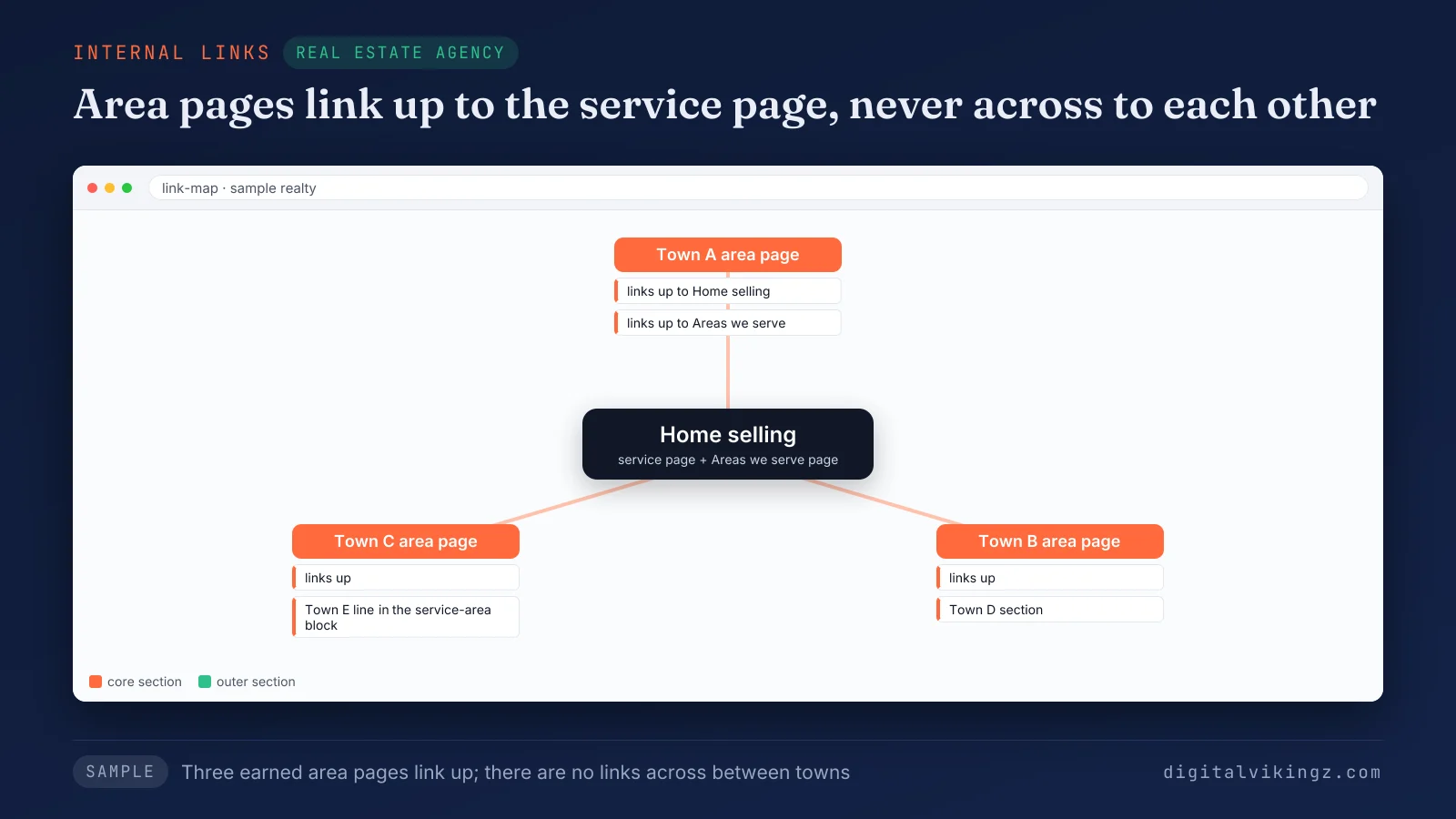
The sample link map shows the three earned area pages of the real estate agency linking up and never across. Town names in the footer are the one link pattern left to settle.
Should the footer list every town served?
The footer should not list every town served, because Google names blocks of city names as a keyword stuffing example.
Google's spam policies list "Blocks of text that list cities and regions that a web page is trying to rank for" as keyword stuffing. A footer repeats the same town list on every service area page, so the list adds no area fact to any page. The service-area block differs from a stuffed list, because each town named there is served from that page and appears once. The same towns belong in the service areas of the Google Business Profile.
How do service area pages fit with the Google Business Profile?
Service area pages fit with the Google Business Profile when every page covers an area that the profile also lists as a service area.
Google's help page defines a service-area business as one that visits or delivers to customers and does not serve customers at the business address. Google accepts up to 20 service areas, set by city, postal code or another type of area, and no longer accepts a radius. Google's help page, read in November 2026, also keeps the overall area within about 2 hours of driving time from the base. Setting the profile and the pages from one area list is part of the Local SEO and Google Business Profile service we run. The scope of our Local SEO and Google Business Profile service covers profile setup, service areas and the location and service pages. The service areas say where the business works, and the Google Business Profile primary category states what the business is. Our guide to the Google Business Profile primary category sets out how a business chooses the category. The profile type also decides whether a site needs service area pages or location pages.
How does a service area page differ from a location page?
A service area page covers an area the business travels to, while a location page represents a staffed address that customers visit.
BrightLocal draws the same line: location pages are tied to physical locations, and area pages are not. A sample dental clinic that patients visit needs one location page with a service-area block, not pages for each suburb. Google's help page states: "Service-area businesses can only have one profile for the whole area that they serve." Several staffed bases change the model to semantic SEO for a multi-location business. Our guide to semantic SEO for a multi-location business sets out one location page for each staffed address. Pages that mix the two models are the first to fix.
How do you fix service area pages that already read as doorway pages?
Service area pages that already read as doorway pages are fixed by scoring each page, keeping the pages that pass and merging the rest.
The steps that fix a set of doorway-like service area pages are listed below:
- Export the Search Console queries and impressions of every area page for the last 3 months.
- Score every area with the Query Deserves a Page test.
- Rewrite passing pages with area facts from jobs, reviews and calls.
- Merge failing pages into the nearest earned page with a 301 redirect and updated internal links.
- Check that the profile service areas name the same areas as the remaining pages.
We read 3 months of Search Console data for every audit of area pages. A 301 redirect with the internal links updated is the cleanest merge for a failing area page. A robots.txt block is the wrong fix, because Google stops crawling the page and never sees the redirect.
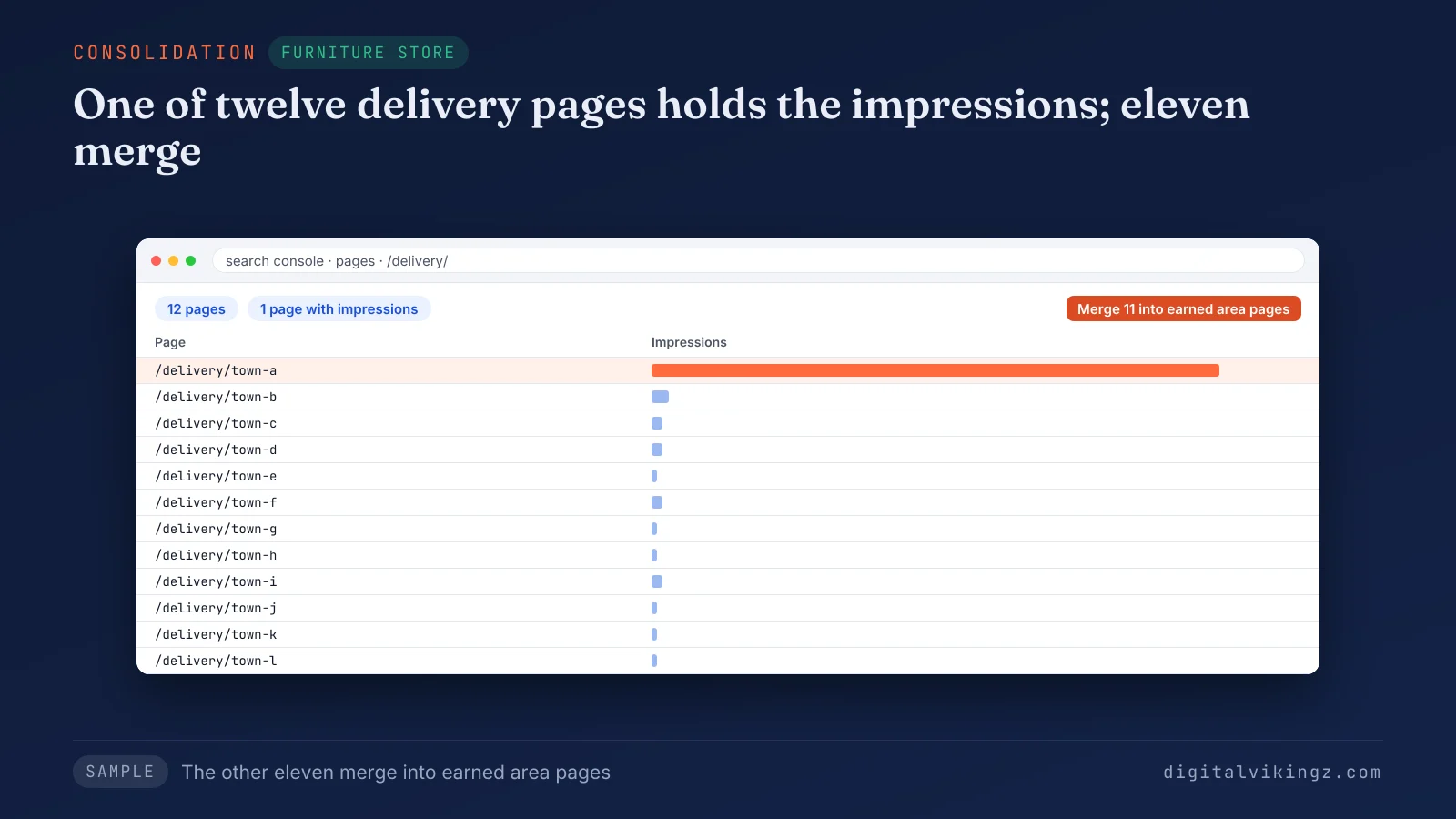
The sample shows one of twelve delivery pages holding the impressions, so the other eleven merge into earned area pages. Pages that rank today can still belong on the merge list.
Are copied service area pages safe while they rank?
Copied service area pages are not safe while they rank, because Google detects spam policy violations through automated systems and human review.
Google's spam policies state: "Sites that violate our policies may rank lower in results or not appear in results at all." Google's 2015 doorway update warned: "Sites with large and well-established doorway campaigns might see a broad impact from this change." A competitor ranking with copied pages shows today's results, not the results after the next review. The same reading covers service area pages written with AI tools.
Do AI-written service area pages count as scaled content abuse?
AI-written service area pages count as scaled content abuse when the pages add no value, because Google judges the pages, not the tool.
Google's spam policies list "Using generative AI tools or other similar tools to generate many pages without adding value for users" as scaled content abuse. AI tools can draft service area pages that pass, once a person supplies the area facts from jobs, reviews and calls. The swap test from the area facts section applies to drafted pages in the same way.
Questions about service area pages
Owners building service area pages raise five further questions: other page names, service pages per area, URL order, schema and manual actions.
Are city pages and service area pages the same thing?
City pages, geo pages and local landing pages are other names for service area pages when the business travels to the city. The same names describe location pages when the business has a staffed address in the city.
Should each service get its own page in each area?
Each service gets its own page in an area only when the service and the area pass the Query Deserves a Page test together. The service area page otherwise lists the services offered in the area and links to each service page.
Should the URL put the service or the area first?
Service area pages that cover every service sit in one areas folder, and a single-service area page sits under the service. A word shared by the parent path and the child path signals the link between the two pages.
Which schema fits a service area page?
A service area page fits Service schema with an areaServed list of the towns the page covers and a provider link to the business. Every areaServed value matches a town named in the page text, and no page claims an address the business lacks.
Can doorway pages lead to a manual action?
Doorway pages can lead to a manual action, because Google says human review of spam policy violations can result in one. Google notifies site owners of a manual action through the Manual actions report in Search Console.
What does a service area page set without doorway pages give a business?
A service area page set without doorway pages gives a business one page per earned area, each answering searches no other page answers.
The page set aims to rank in each earned area once the area facts, the profile and the links name the same areas. Service area pages are one part of the website pages for local service businesses. The full set of website pages for local service businesses, from service pages to problem guides, follows the same page test. Digital Vikingz scores a service area page set against the five checks on a strategy call.